The Wahl Pen

IMGP9249

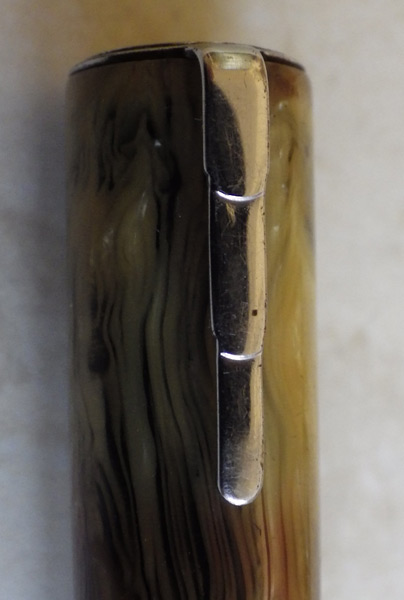
I confess I’m not well up on my Wahl Eversharps.  I was unable to find this exact pen depicted anywhere but its style suggests late 20s or early 30s.  After 1929, to be more precise because it celluloid and that’s when Wahl Eversharp change from black hard rubber to celluloid, or Pyrolin, as they called it.  It’s simply called the “Wahl pen”.  That’s hardly enough and it would be good to know more about it, if there are any people knowledgeable on the Wahl brand reading this.
IMGP9252
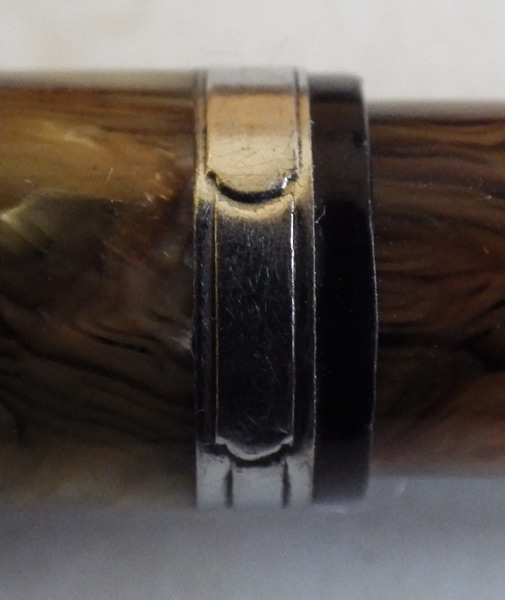
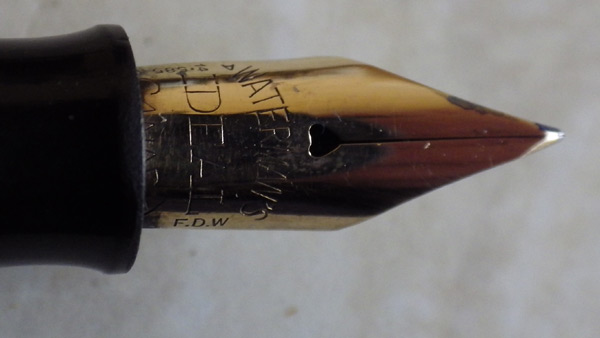
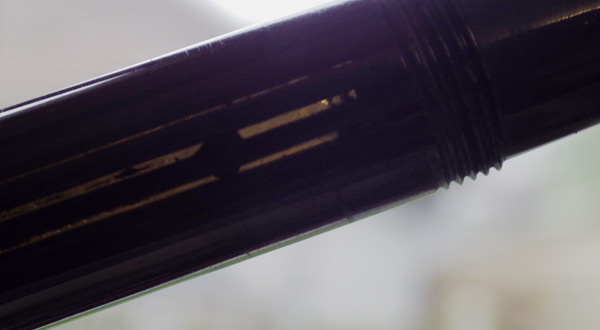
The pen measures 13.3 cm capped.  Though it isn’t a Gold Seal, the quality is very high and the gold plating remains impeccable.  The barrel and cap have a subtle interrupted line pattern.  The quite broad single cap band is unusual for the period, as Wahl Eversharps seem mostly to have had three or two rings.  The nib is simply marked “Eversharp Made in USA”.  It’s an elegant pen, especially when posted.

I think Wahl Eversharp’s pens in this style (and there are many) are at the peak of their production.  Though it’s only my own opinion, evidently not shared by many others, I feel the company lost their way in later years, particularly with the ugly and inconvenient Henry Dreyfuss-designed Skyline which doesn’t post well and has an unnecessarily bulbous cap.  This is explained (or excused) by the fact that he also designed streamlined steam engines, but pens are pens and trains are trains and never the twain shall meet.
IMGP9250
I think that the quiet, understated elegance of this pen is far superior.  It feels good and well-balanced in the hand and it is pleasant to write with.
Not Much Assistance From My Assistant

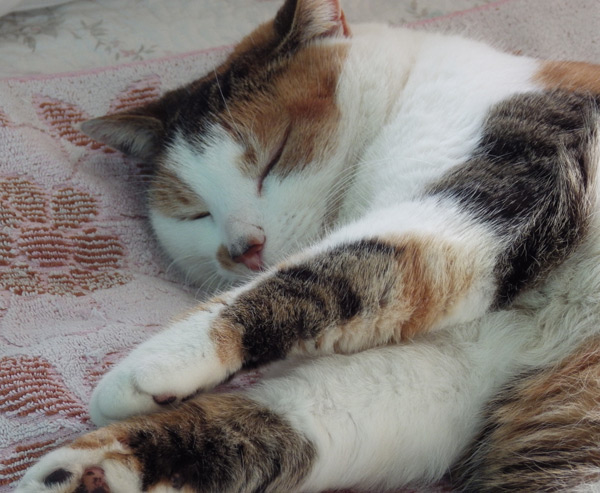
We had a lovely couple visiting us today and they would have liked to meet my assistant but being the obnoxious character that she is, she preferred to indulge in her Saturday dog-baiting session with the other hooligan cats from around here.  No sign of her all day but the moment that they left she strolled up demanding food, praise and attention and a soft bed.  Our bed.

Anyway, here she is, hard at work as usual.

IMGP5443

Waterman 52 Red Ripple Pen and Pencil Set

I don’t often get my hands on a Red Ripple and to get hold of a Waterman 52 pen and pencil set is an exceptional pleasure.
IMGP9237
These went into production in this pattern in 1923 and I’m told that the material is stainless and non-inflammable.  It’s beautiful and it’s probably the most famous pen pattern of all time.
IMGP9240
I’ve written about Waterman 52 pens on several previous occasions and I don’t have anything to add here.  This is the first time I’ve had a Red Ripple pencil, though.  It has lead and works well.
IMGP9244IMGP9238
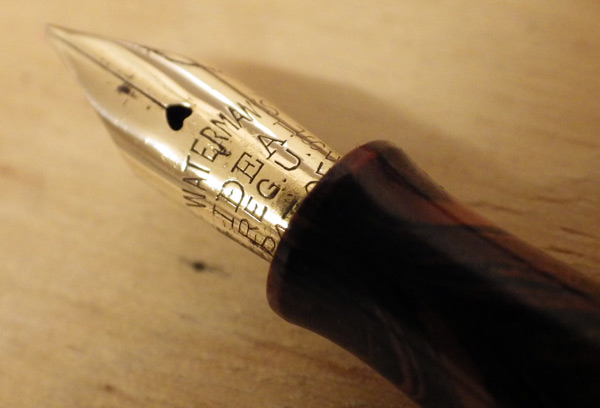
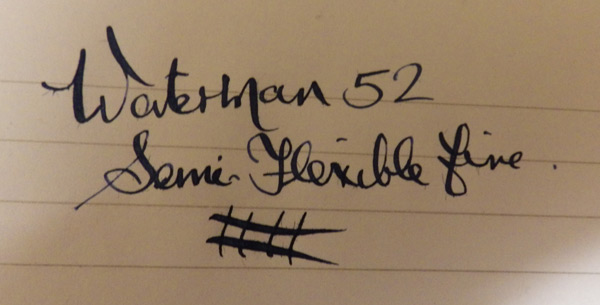
Stunning though they are to look at, the best thing about Watermans of this period is the nib.  This one is a very pleasant fine semi-flex.  I could write with this all day and it holds enough ink to allow me to do so.

IMGP9247

Latest Uploads

“Will you walk a little faster?” said a Parker to a Swan
“There’s a Blackbird close behind us and he’s treading on my flight
See how eagerly the Blackbirds and the Jackdaws will alight!
They are waiting on the web page – will you come and browse the site?
Will you, won’t you, will you, won’t you, will you come and browse the site?
Will you, won’t you, will you, won’t you, won’t you log onto the site?”
*With apologies to Lewis Carroll

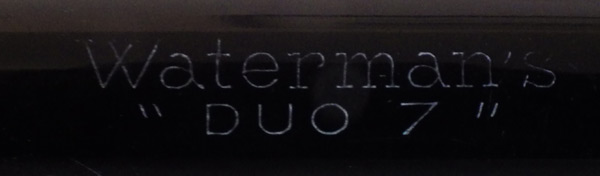
The Jif-Waterman Duo 7

$_57

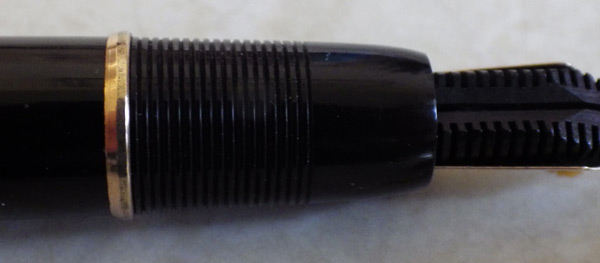
The first to introduce glass cartridges to the public was the Eagle company way back in 1890.  The idea was not a resounding commercial success and it was not until 1936 that it was revived by Waterman, France.  The first glass cartridge Watermans were converted American-made pens but later Jif-Waterman went on to produce designs of their own.  World War II halted production of these pens but it was resumed after the war, one example of the new models being the Duo 7.

IMGP9093 IMGP9091

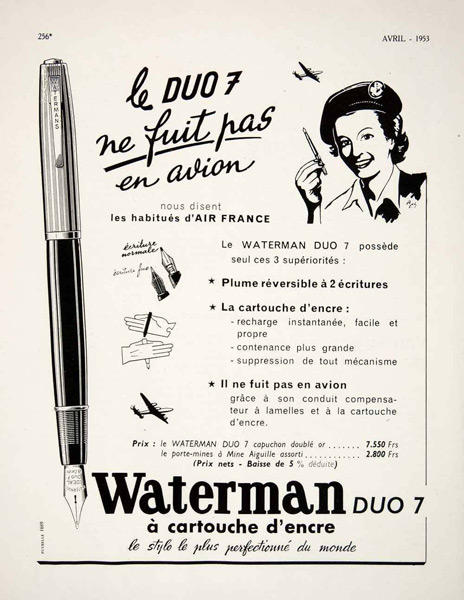
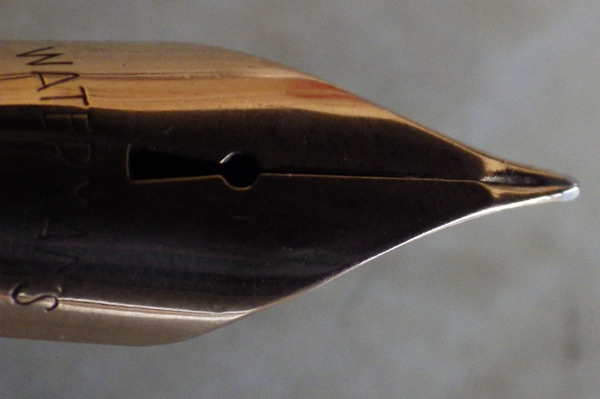
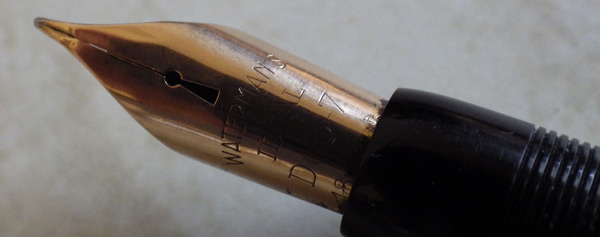
It was advertised as being “the most perfect pen in the world”, but goodness knows, that’s been said often enough about almost every pen that ever came on the market.  It was also said that it was safe to fly with it and that it was reversible, one side of the nib giving a thinner line than the other.  In France it cost Fr.7.550 and in Britain 84 shillings, which is £4.4 shillings or four guineas, just to confuse those of you who are used to decimal currencies.  For that you got a barrel with an exceptionally long blind cap, a nice large 18 carat number eight Waterman Ideal nib and a double rolled gold cap.
IMGP9095IMGP9094
It’s a superb pen by any standard.  The build quality is very high and in the case of this example, the original cartridge seal is still in good condition.  When they perish, the seals are quite easy to replace.  The glass cartridge can be refilled an infinite number of times.  Not that you’ll have to do it all that often.  By modern standards, it’s a huge cartridge.
IMGP9102 IMGP9103
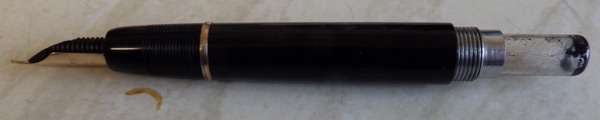
The pen has a push-on cap which catches on the gold-plated ring between the section and the barrel.  It works very well.  I assume that one would normally remove the blind cap to fit a new replenished cartridge though the section unscrews as well.  There is a spring mechanism in the butt of the blind cap which forces the cartridge into place.  If you’re one of those people who is devoted to soaking pens, remember that that’s there and it will rust and break in no time at all if it’s soaked.  This section is ribbed, giving a secure grip and the feed is one of the patent Waterman complex multi-finned type.
IMGP9101 IMGP9096
In use, the nib, like most 18 carat nibs I have come across, is no more than semi-flex.  The nib is truly reversible and writes perfectly well on either side.  I don’t know if it really is “the most perfect pen in the world” but if not it’s a pretty good runner-up.

Persian Pattern Lady Patricia Pen And Pencil Set

There hasn’t been much activity here in the past few days because I was hardly at home last week.  Almost every day I had appointments which involved travelling.
IMGP9079
I love these little Lady Patricia Watermans for their design, for their patterns and for their nibs.  The name hints at a relationship with the famous Patrician but the design is quite different.  The clip flows like lava and the cap band continues this flowing theme.  We always talk about Art Deco with regard to 1930s pens but we rarely have as good an example as the Lady Patricia.
IMGP9084

IMGP9083
This set is in the Persian pattern.  The pen, of course, has discoloured as they almost always do due to the decomposition of the sac.  Without the sac, the pencil shows how the pen would once have looked, though I must say it isn’t as badly discoloured as many I have seen.  Received wisdom would have it that you should put a silicone sac in pens that are likely to discolour, but there is more to consider here.  This pen uses the Waterman lever box and swing pressure bar.  These lever boxes can and do crack in the middle due to the pressure of constant refilling.  The latest silicone sacs and the PVC sacs that we once thought were silicone are both quite inflexible in comparison with a latex sac.  That causes greater pressure to be brought on the lever box, so I have stuck with the latex sac.  My view is if that you wish such a pen to retain its colour you’d be better taking the sac out and just treating it as a collectable object rather than writing instrument.  Me, I would much rather write with a Lady Patricia than keep it in a box.
IMGP9080
The reason for that is that these pens have some of the best Waterman nibs there are, and that’s saying something!  Not only are they flexible but they snap shut instantly after being flexed to their fullest extent.  That makes them a total pleasure to write with.  Though the Patricia is a small pen, when it is posted it is a surprisingly adequate length.

IMGP9085
These, then, are a precious pair.  It’s just a pity that they don’t have a box but that seems to have disappeared.

IMGP9086

Mordan Centennial Pencil

IMGP8933

Here’s another Mordan pencil.  It looks and behaves like silver but I suspect that it’s just silver-plated.  It’s a natty little thing of about 9.8 cm.  I’ve checked such information as I have but I find it quite hard to date these things.  I’m guessing that it’s about 1930.  It works well and has a piece of lead loaded.  It also has several spare pieces of lead in the reservoir at the butt end, which is useful because Mordan pencils use 1 mm lead which isn’t always easy to find.
IMGP8934
It’s the simplest of pens.  There is nothing there to be seen that doesn’t add to the way it works.  The function dictates what the form will be.

Osmia 883

IMGP8919 IMGP8920

Many pen companies have passed through several hands and as a result have quite a complicated history.  Few if any, however, are as complex as Osmia.  The company was started by George Bowhler in 1919.  Though the company did well initially declining sales left it open to the Parker pen company’s acquisition.  In 1929 Parker sold the company back to Bohler.  He sold the nib manufacturing factory to Degussa.  A W Faber-Castell invested heavily in the company from 1935 on and finally the company over in 1951.
IMGP8927 IMGP8924
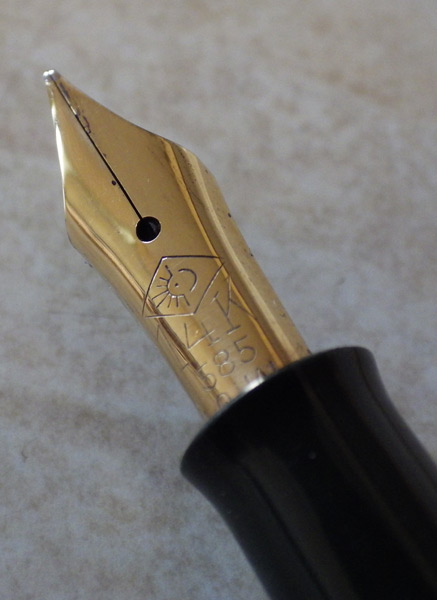
There is more to it than that but enough’s enough.  It’s enough to make your head spin.  This beauty is an Osmia 883.  It measures 13 cm capped.  The cap and barrel are in a subtle wind green colour and both are semi-transparent.  The gold-plated clip is a little reminiscent of those used by Pelikan and it has a medium gold cap band.  It doesn’t actually say “Osmia” anywhere on the pen, which suggests to me that it’s quite late, after the Faber Castell takeover.  The name Osmia continued to be used for a few years but afterwards these pens were turned out under the Faber Castell name though they are identical to the earlier ones imprinted Osmia.  The large nib has a sun inside a diamond which was Osmia’s trademark from the outset.
IMGP8930IMGP8929
It’s a piston filler, working well and holding a considerable amount of ink which can be seen through the semi-transparent barrel.  The nib is medium and very flexible.  This is a splendid pen both aesthetically and in use.

IMGP8928