Thank you all for your kind messages. The operation went well and we got home last night. Glad to be back in our own surroundings and the pen stuff can begin again.
I’ll be back.
My husband has an operation this week and I will be spending all my time at the hospital which is more than 100 miles away. We’ll be home later in the week and I’ll pick up the reins then. Enjoy your pens.
National Security Button Filler
I’ve written about National Security and the mysterious British Carbon Papers several times before. The search box above will find them if you’re interested.

One of the pens I wrote about was almost identical to this one: russet and black marble, a clip devoid of gold plating if it ever was there, button filler with black hard rubber blind cap and clip screw. It only differed in having one cap ring whereas this one has two.

This pen had not been well looked after and was very dirty outside and in. The clip had some corrosion and the button was totally black. The pressure bar, though it still had plenty of spring, was rusty. I have a deoxidiser which works in the ultrasonic cleaner and it took care of these problems. Despite these difficulties the pen is clearly well-made. I am as certain as I can be that it is a product of Langs of Liverpool.
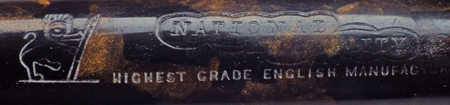
Measuring 11.6 cm this is a shorter than average pen. It has a Phillips of Oxford 14 carat gold nib, most likely a historic replacement. I love the subtlety of the dark pattern and the smiling lion with his pen.
Parker Duofold Streamline

The world – or our world, at least – is full of wonderful pens and this is one of the most wonderful. The Duofolds made Parker and were so hugely influential that for many years most pens bore some resemblance to them.

This one is the Duofold Streamline Short. It’s longer than the Junior but shorter than the Standard Duofold. When I think of Duofolds of the 20s and 30s, though they came in many colours it’s this bright orange and black that I see in my mind’s eye.

This size of Duofold fits my hand very well, where the Standard model might just be a little on the large side. This one was made in Canada.
The Hightime Standard
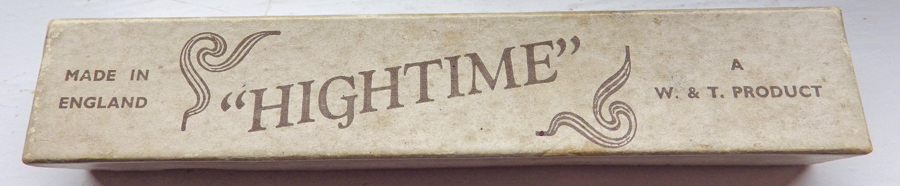

This one’s a real rarity. I don’t remember ever coming across one before. As is the way with several post-war British pens the Hightime copies the Parker 51 in a very superficial way while actually being a traditional button filler.
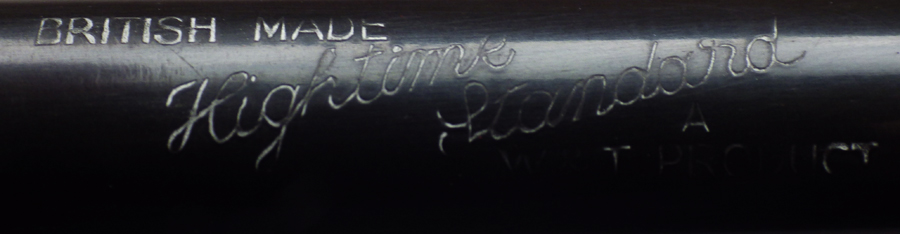
It’s not entirely clear to me who made the pen. Amalgamated Pen Repair Service Ltd are recorded as the sole distributors for the Hightime in January 1945*. Written on the box is “a W & T Product” which just adds to the mystery.

It’s a substantial pen at 13.3 cm capped and it has an unusual scimitar-like clip. The hooded nib is actually quite normal, not tubular like the Parker 51. It is probably plated. The blind cap fits so well that the join is almost imperceptible. The appearance of the pen is spoiled by the missing clutch ring but I should be able to find a replacement.
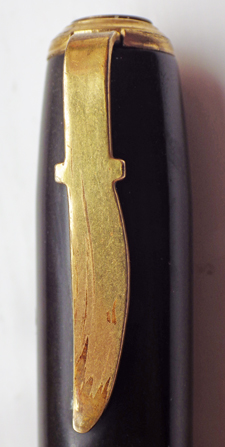
It is possible that this is a product of one of those start-up companies that appeared after the war. However, the designer knew what he was doing. The pen is not crude and the parts fit together well. The cowled clip and screw in plated gold are a good design. The Hightime appears to have hung on for a few years, perhaps until 1950 but judging by the few around today, was not a big seller.
*Stephen Hull: The English Fountain Pen Industry 1875 – 1975
Ink
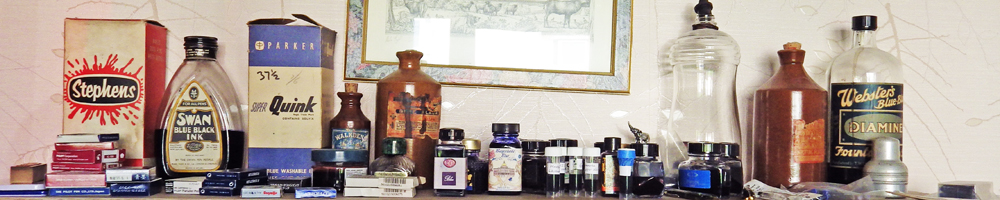
I have a shelf full of vintage inks which I sometimes use but are really there for the bottles. Otherwise I am quite unadventurous about ink. Until recently it’s been blue, blue/black and black. Then someone gave me Baystate Blue and I confess to being impressed by that astonishing electric blue. More recently another kind person gave me tester bottles of various inks and I have been trying some of those.
Really, though, I’m not about bright ink colours. Yes, I like them but they are a distraction. For me, it isn’t about presenting a pretty page, it’s about getting information down. Also it’s about write-testing restored pens. Both of these uses require ink that stands out well on the paper and that ink has to be safe for any pen I put it in. I don’t want to experiment to discover which inks are safe. I already know that Watermans and Quink are.
I read somewhere that newspaper editors discard letters written in green ink. This is because the seriously obsessed, the conspiracy theorists and other types of loony tunes favour green ink. Pity, because I quite like it. I wonder what that says about me?
Which Pen?
Back when fountain pens were what everyone used, people only ever had one pen, not a boxful as most of us have today. I suppose for many people any pen would do so long as it worked but we are more selective than that, aren’t we? What would be your everyday pen, the only pen you would have? I think we should leave boring modern pens out of it. Select any vintage era where vintage = whatever you think it does.
There are so many pens with different wonderful qualities to offer. If I was especially concerned about the quantity of ink my pen would hold it would have to be an Onoto or even a Ford Patent Pen, but actually I don’t mind filling my pen occasionally. Most sac fillers hold more than the average cartridge, so that’s enough for me.
Colour and pattern might distract me. I do appreciate the wonderful patterns that Waterman produced in the 30s and especially the subtle 1920s and 30s Swan patterns. Post-war Conway Stewarts have a colourful glow to them as well.
But colour won’t decide which pen I choose. The nib is what the pen is about. I would want something firm and fine – at least as fine as a Japanese EF. Not many of the major manufacturers produced nibs as fine as that in the vintage years (my vintage ends at 1960). In the late 30s Waterman (or actually Altura) produced an accountant pen with a near needlepoint nib. A plain-looking pen, invariably in black so far as I’m aware. That would be my one and only pen
Swan Safety Cap

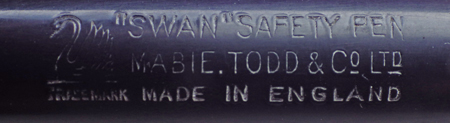
According to the box this is the Swan Standard Fountpen, a name that harks back to an earlier era. The paperwork describes it as the Safety Screw Cap type – that’s a blast from the past! The barrel imprint calls it the Swan Safety Pen. Despite all the historic references I believe it’s a late pen, made sometime in the 50s.
It’s an eyedropper filler, most likely for the export market. Like Macniven & Cameron, who had Burnham produce an eyedropper filler for them around the same period, Mabie Todd (or rather Biro) were perhaps trying to break into the Indian market as home sales declined.

It’s a nice enough pen, only brought down by the gold-alike cap. The rest of the pen is in a very dark blue and the nib is up to the usual Swan standard – very good in other words.
What Waterman is This?
I’m usually quite good on English Watermans but I don’t know this one


Any ideas?
A Different Selsdon Ballpoint
Selsdon, if nothing else, were inventive. They turned out fountain pens which varied from the passable to the very good. I’ve written before about their ballpoints.

This thing, which could also be called a ballpoint for want of a better word, is a lever filler with a ball point of sorts. The amount of wear on the pen, particularly on the clip, suggests that it once worked well enough to be in use for some time.

I can’t make it draw ink. There is a blockage inside the hood. It doesn’t remove for servicing but some time in the ultrasonic cleaner might yet clear it.

I don’t quite suggest that Selsdon are underappreciated because much of their output was unashamedly aimed at the lower end of the market. However, they were not afraid to take a risk with something new. It would be good to know more about them.
 Goodwriterspens's Blog