Colours

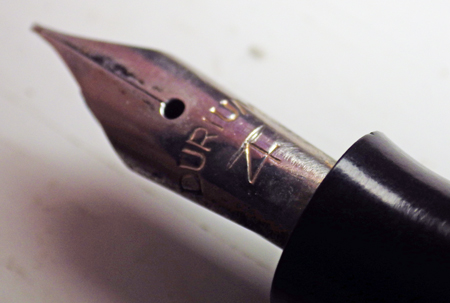
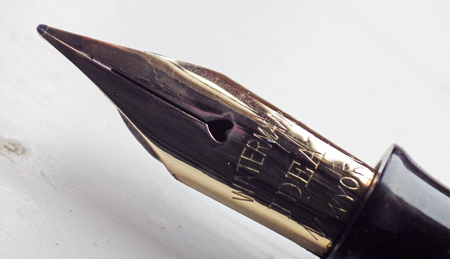
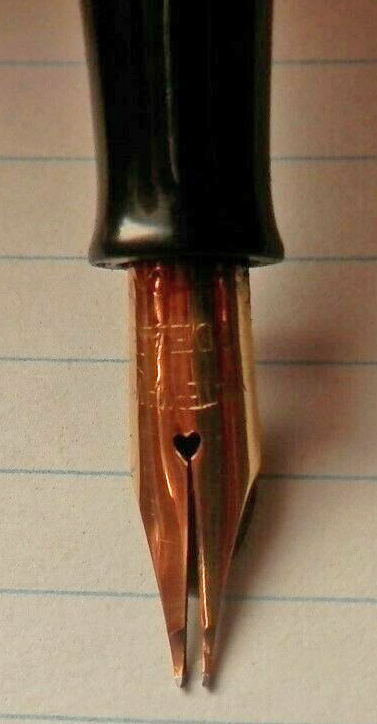
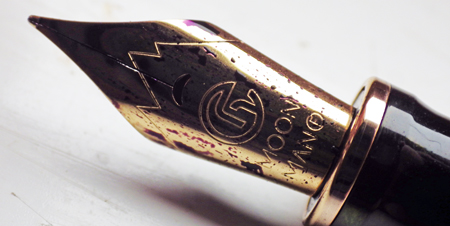
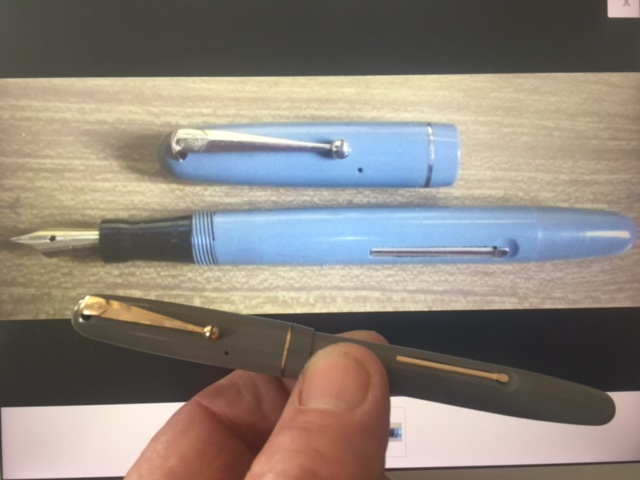
Rob P kindly provided me with these photographs of the same pen. The bottom one is accurate. These extreme variations often cause problems for buyers who discover that the rare colour they thought they were buying turns out to be something duller and more common.

It’s hard to imagine that such a difference from the real colour can be entirely innocent. Differences in uncalibrated monitors can account for a certain amount of colour change but not this much. It looks like very bright light with a blue cast is responsible.

It happens mostly with the paler pens. It’s easier to decide what colour patterns should be. I would think that such an unreal picture would be the basis for returning a pen – after all, you’re not getting what you have every reason to think you should.

Of course PhotoShop and similar programs can be used to make a pen appear any colour but they can also easily restore accurate colour to an image with a colour cast or overexposure. The one exception I have found is in some of Parker’s English Duofold range of the mid-20th century. Greens in those materials that Parker used can be impossible to photograph accurately, usually appearing blue.

If a photograph leaps off the screen at you and is clearly a previously undiscovered colour in a Swan, think twice. It most likely isn’t.

The Guinea Pen

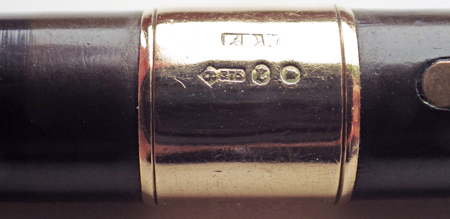
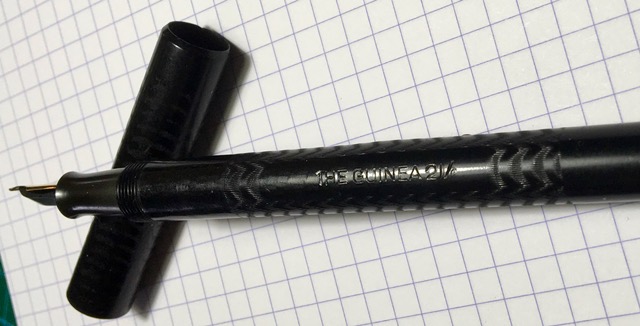
I’ve posted about several examples of the Golden Guinea. This may or may not be another. It’s in black chased hard rubber, the lever is chrome plated and the barrel is threaded for posting. There is no clip. The only imprint is on the cartouche, “The Guinea 21/-” the nib is warranted 14 carat gold so that doesn’t help with identification.

I would have thought that if the pen was a Golden Guinea that’s what would have been imprinted. On balance I think this is something else. Many of these black hard rubber pens with threaded barrel ends were turned out in the 20s, most unbranded. The threaded barrel was almost an indicator of an inexpensive pen, but at 21/-this pen was comparatively expensive.

The only other pen I’m aware of with a Guinea model name is The Guinea Whytwarth but I see no indication that this is it.

Thanks to Rob P. for pictures and information.

Smartie’s Latest Uploads

Assistant Smartie says, “Hello,
There are new pens for sale, you know.
My human says she did it all
Which is unmitigated gall!

I work until my paws are sore,
And yet she constantly wants more!
She never gives me ANY treats;
No crunchies, mice or any sweets.

Ungrateful human, oh the shame!
The way she constantly lays blame
On poor old me, as if I’d ever
Chase pens under the chairs – no, never!

It’s not MY fault she has to crawl
When pens – all on their own – do fall
Onto the floor, landing just there…
It was some OTHER cat, I swear!

I am offended, greatly so;
In fact, I think it’s time to go.
I need some sleep, can’t take the strain,
My human is just such a pain!

If you go look at her website
And buy some pens this very night,
Perhaps I’ll get some peace and rest;
You’ll like my pens – they are the best.

That’s right – MY pens – ’cause I’m the one
Who works so hard and has no fun
While she takes credit for each sale.
It really is beyond the pale.

I’m never petted, stroked or spoiled
No matter how much I have toiled.
I’m starved! She only feeds me twice
An hour, sometimes more – not nice!

She only lets me in and out,
Three dozen times a day, that lout!
I’m telling you, my life is fraught,
It’s so unfair, I’m overwrought.

I’m feeling faint, I need my bed
So I can rest my tired head.
Perhaps she’ll feed me some small scrap
Before I take a little nap.

That Deb says I’m a drama queen
But I say that she’s very mean.
Oh, woe! The life of one wee cat
Who wears a Pen Assistant’s hat!”

http://www.goodwriterssales.com/

The Blog

I’ve come to a point in this blog where I have to consider where to go with it. I’ve done a lot of repetitive posts recently – seven or eight about the Kingswood for instance. I don’t mind writing more than once about the same pen if there’s something new to say but otherwise it becomes tedious.

It’s been almost 9 years of pen blogging and a lot of pens have passed over my bench – just over 3100 since I started keeping a record, and several hundreds before that. There are other pens out there that I have yet to write about but I don’t always find those rarities. Because they’re rare (tautology).

I’m not going to continue to repeat myself because it spoils the blog so I won’t be writing so often. If that leaves you feeling a little deprived, I’m the same because I love to write. I will still make discursive posts when a subject comes to mind and if you come across something unusual and would like to send me photos I’ll be delighted to write about that. Whenever something different or unusual comes along, I will write about that, of course.

So that’s where we are.

A Different Geha Schulfuller

I recently picked up this Geha Schulfuller. At first glance it appears the same as the one I have had for many years. Setting them side-by-side, however, the new one is obviously larger. When measured my own one is 12.4 cm and the other 13.3 cm and proportionately thicker. The difference is too great for them both to be the same model but there is nothing on either to indicate a model name or number. Both are just Schulfullers.

Reading about these pens I discovered that most, supposedly, have a serial number on the cap or barrel. This was so that each child knew his or her pen, Gehas being so common in the classrooms in Germany. Neither of mine has such a number.

As I have said elsewhere in the blog, Geha was a serious competitor in the German market until finally taken over by Pelikan in 1990, when the brand was discontinued.

Pearl and Black Wearever

I don’t usually have Wearevers. They are not common in Britain and most of those I see I don’t want. There are exceptions though.

Wearever was part of David Kahn Inc. Their business model seems to have been to make pens as cheaply as possible and sell in great quantity. This worked, in the sense that Wearever made more pens than any other manufacturer and doubtless David Kahn Inc made a lot of money. Quality suffered, of course, and many bad Wearevers were made. The company was making pens from injection moulded plastic as early as the 1920s and those pens were especially subject to shrinkage and discolouring.

The exceptions were several ranges of pens made in the 1940s. I cannot assign a model name to this pen but it is acceptably well-made. The parts fit together well, the design is attractive and the pearl and black celluloid is beautiful. As expected the gold wash on the metal parts has mostly vanished but I don’t think that detracts from the appearance too much.

The original steel Wearever nib was worn to the point where it could not be used. It was surprisingly difficult to find a replacement that fitted well. I have several gold nibs that would have fitted but they would have been inappropriate. In the end I found a steel nib of a similar age to the pen and that fitted the feed as if it had been made for it.

This is an example, like several others I have written about, of a cheap pen that has worked well and given good service. The beauty is a bonus!

Waterman 52 BCHR

The Waterman 52, in all its varied forms, is one of the stalwarts of fountain pen collecting. In both its hard rubber and celluloid forms it’s a sturdy, reliable pen, often with a great nib. At its best, a Waterman nib is unsurpassed even by Wahl Eversharp or Swan.

This black hard rubber model has a 9 carat gold barrel band. I can’t find my hallmark book; perhaps someone will kindly do the honours. I am more than satisfied with this pen. It is semiflexible and medium. It writes splendidly.

However, the seller provided a photo that to me suggested that it is very much more flexible. The pen is strongly pressed against a surface causing the tines to spread wider than they would ever do in writing. This is a pernicious practice. As well as misrepresenting the nib’s flexibility it risks cracking the nib at the breather hole. It’s stupid and a way of increasing the price with a false promise.

The shape of this nib gives rise to another point.  It is usually taken, in the pen boards, that a nib like this with a slender profile and long tines, is sure to be highly flexible.  It is not so.  I have had nibs exactly like this that are nails and others short-tined and high-shouldered that have flex you would not believe.  The shape of the nib is no guide to its flexibility.

Mabie Todd Swan SF230


This is an SF230, one of Mabie Todd’s glorious 1920s pens. I’ve written about them several times before; there’s nothing technical or aesthetic to add.

These pens and others of similar quality are fully modern. An SF230 would be at least as useful and comfortable in the hand as any modern pen. We may feel a kinship with the first owner of this pen, using it daily in his business and leisure.

It was a very different world though. There was no smart phone, PC, laptop or tablet. For most there was neither electricity nor landline telephone. Communication was either face-to-face or written. If the local shops could not provide a required item there was no Amazon to send it. A handwritten letter to some distant supplier was the answer.

In business, though some correspondence would be typewritten, most was handwritten. Permanent records were done in ink. The Armed Forces depended upon the handwritten word. So did the law courts and government.

It appears that our SF230 was an essential instrument, without which the world of the 20s and 30s would have rapidly come to a halt. The power of the pen – any kind of pen – is much diminished today. Nearly all of its functions have been taken over by ever faster and more capable machines.

Has the pen any role in which it is essential today? Christmas cards and note-taking, writing lists and dashing off a quick note – these and similarly trivial tasks are of the last islands of pen use for most people, and a vanishingly small proportion of them will ever use a fountain pen. Is it, like the spinning wheel and the horse-drawn carriage, to be laid aside in the museums, marveled at for its primitiveness and used only by hobbyists and those who refuse to let modernity rule them?

I love my fountain pens and I use them every day. I use a mixture of old and new technology in my life and I enjoy the ongoing online conversation with like-minded friends. Wherever possible I encourage younger people to consider using a fountain pen. But I do wonder how many will use them in subsequent generations…

Moonman 600S

Here we are again with another modern Chinese pen. I’m sure I said some time ago that I wouldn’t buy any more. I relented for several reasons and I expect I’ll do so again. The reasons: I’d heard good things about PenBBS and Moonman nibs. I already have one or two decent Chinese nibs and I wanted to try another. Secondly it wasn’t going to break the bank or be a huge concern if it proved defective. Also I have readers who are interested in these things and should not always be deprived. The penultimate reason is that despite its garishness I like the acrylic. Almost all acrylics appear garish when compared with the subtlety of marbled pattern celluloid or casein.

But here’s the big reason, the elephant in the room! Is it possible for a Chinese company to make a pen more like a current Duofold? I have regularly defended Chinese pen manufacturers against the accusation of plagiarism. After all there are so many pen shapes around that it is nearly impossible to come up with a pen that doesn’t resemble one of them, and it isn’t only the Chinese who fall foul of that difficulty. This, however, is of a different order. Even the dimensions, though not quite close enough to allow swapping components, are very close indeed. It isn’t a fake. Moonman put their name to it. But there can be no question that they are maximising their sales by offering a Duofold for people who can’t, or don’t want to, afford a Duofold!

That said, assessing the pen as a pen, it’s very good value for money. These recent Chinese pens are much better and provide real competition to Western and Japanese pens, for those who are buying pens to write with. The pen comes with a converter. All the parts seem to fit together well. The nib is splendid – absolutely fault-free. My only complaint about it is that it is a Western fine rather than an Oriental one. Something that might prove a little annoying is that it takes 2 3/4 turns of the cap to close the pen – not a note-taker, then.

In all, a very good pen. Not the first example of plagiarism and I’m sure it won’t be the last. Quite shocking in its cheek. And not unamusing.