Taxes and Shellac

I did my taxes today.  I dread it every year but when I finally get to it it doesn’t take long and it’s not so bad.  It gives you a great feeling when it’s done and no longer hanging over you.  This was not my best year.  Both my husband and I were ill or in hospital at different times and that’s a really big distraction from work.  However, I have a lot of stock to work on and post on the sales site.

I noticed that it’s quite hard to find little bottles of shellac these days, and where you do find it it’s quite expensive.  So I thought I would make a batch, buy some bottles and offer it on the sales website.  I found, though, that it was very difficult – if not impossible – to do this on my sales site as it’s set up now.  There are complications about postage and to rejig the site to accommodate the bottles of shellac would cost me a lot of money which I would probably never get back.  Anyway, I have a whole lot of little bottles of shellac and if you want one just drop me an email at goodwriters@btinternet.com.  It’s £3.50 per bottle and postage is included in that price.  N.B. I can only send shellac to UK addresses.

Because last year was the least successful for a while, we were talking over the future of the business today.  We did consider dropping it and doing something else to make a living, but I realised that a life without fountain pen restoration would be completely unthinkable.  Pens are my life.  They fascinate and obsess me and are as much a part of my life as eating or breathing, and you can’t stop doing those things either.  So it looks like I’ll be around for a bit longer.

Platinum 3776 Century

I had heard many good things about the Platinum 3776 Century and, as it isn’t very expensive, I bought one to see if I agreed.
IMGP1221
It’s the standard cigar-shaped pen.  Where it differs from others is in the plastic (you’re supposed to say resin) which is a deep, rich burgundy and it’s translucent.  Very pretty.  Much prettier, in fact, than most transparent pens, usually sold as “demonstrators”.  It’s a matter of taste I suppose but I find them quite ugly.  The innards of this pen are visible if you hold it up to the light but otherwise it’s just a very shiny red pen.  The gold plated trim is nice, especially the cap band which bears the legend “Platinum 3776 made in Japan”.

It has the “Slip and Seal” closure mechanism which closes the pen so well that the nib does not dry out even during extended periods when it is not in use.  I haven’t had the pen long enough yet to be able to determine whether this innovation works or not, but it’s reasonable to assume that it does.  When the cap is screwed on, there is a slight tightening of the action in the last quarter turn which, I assume, is the additional piece of inner cap plastic closing the pen.
IMGP1223
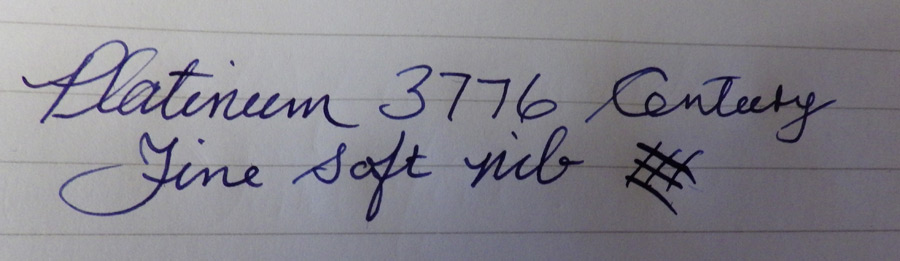
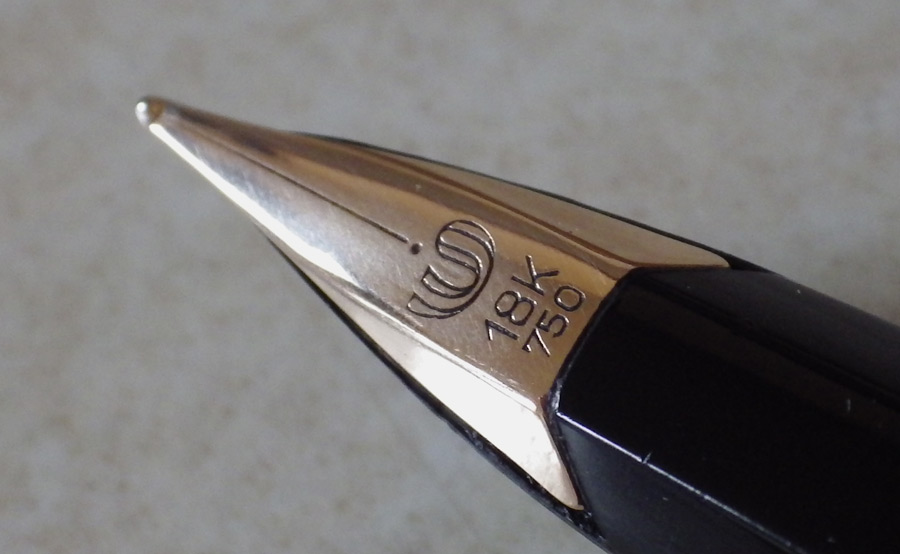
The 14 carat nib is pretty much standard fare, except that it is less curved than most modern nibs.  Quite flat in fact.  I chose the “soft fine” option.  Surprisingly, for an oriental pen, it’s quite a generous fine.  The nib is pleasantly springy and it is possible to force a little line variation, but it isn’t enough to be significant and that isn’t what you would buy this pen for.

The pen is a cartridge/converter filler and the one that I bought (courtesy of Amazon) came without the converter.  The cartridges are, of course, proprietary which possibly explains why a pen of this quality is as inexpensive as it is.  Platinum can make up any losses on the pen in sales of their cartridges, I’m sure.

It’s a light pen at around 20 g, something which meets with my approval.  It isn’t a large pen but I would say that it is more than adequate at 15.5 cm posted.  It posts securely and feels well-balanced.  The nib is smooth and the ink flow is perfect, neither dry nor too wet.
IMGP1226
My only complaint about this pen – and it’s a small one – is the step from the widest part of the barrel to the threads.  It doesn’t interfere with gripping the pen to write so it’s a purely aesthetic consideration.  I would prefer an unbroken smooth curve.
IMGP1222
This, then, is a modern pen of which I thoroughly approve.  I would approve of it even more if it had a proper filling system but you can’t have everything, I suppose, or at least not at the very economical price at which the Platinum 3776 Century is sold.

Waterman Concorde

IMGP1215

The Waterman Concorde was in production from, so far as I can establish, 1971 to 1978.  It’s a faceted pen with six sides to the barrel and a more complicated arrangement of two curves joined by two facets on the cap.  The angled cap top with the inset clip is very much of its time, and is a feature that is seen in some other pens.  The snap-on cap is removed to reveal a very handsome wraparound 18 carat nib.  It is filled with a squeeze converter.
IMGP1219
It’s an elegant pen with its complex geometry, good quality gold plating and beautifully designed angular nib.  The details are nice: a goldplated ring at the barrel end and thin and medium rings on the cap.
IMGP1217
I’ve seen it variously spelled as Concorde and Concord.  As it appears in Waterman advertising with the “e” and as it was made in France and that’s how they would spell it, I’m assuming that’s the correct spelling.  It isn’t a pen that you hear much about but it is obviously a quality product and very pleasant to write with too.  Perhaps it falls into that dead zone between vintage and modern.  It looks very modern to me.  Unlike most modern pens, however, it’s very light in the hand.  They didn’t use brass piping to make pens back then.

Mabie Todd Jackdaw

In Britain, Mabie Todd had a quite straightforward hierarchy of pens: Swan, Blackbird and Jackdaw.  There might be subsets like Swan Leverless and Swan Visofil within that and even off-the-wall bizarre individual models like the splendid Jackdaw Toledo but, in general, the order held true.  There wasn’t a huge qualitative difference between them, though a generation of pen-fanciers has been misled into thinking that the Jackdaw was worse than it is by Steinberg’s* assertion that it is a “tin or gold-plated nib pen”.  I’ve seen a lot of Jackdaws and they’ve all been gold nib pens.

I suppose the major difference between the Swan and the Blackbird is that the latter more often has chrome plating than gold on the trim.  The nibs have a shorter tail and the material from which they are made is a fraction thinner.  Other than that, in terms of quality, there are no other significant differences that I can think of.

When you come down to Jackdaws, the difference becomes a little more pronounced.  I think the gold used in the nibs is thinner still with the result that many of those that we see today have bent nibs.  Of course, there is another possible explanation for that, which is that they were school pens and therefore probably handled a little more roughly than the Blackbirds and Swans owned by adults.  Strangely, the clips on Jackdaws are very often corroded and pitted whereas the levers are usually in good order and have retained their chrome plating.
IMGP1210
One respect in which the Jackdaws are often more attractive than their more expensive stablemates is in the celluloid.  Several of those I have owned have been very colourful, as is this present example.
IMGP1211
I’m not sure what this pattern is.  The pen has no identification number and the descriptions of several of these 1930s patterns are somewhat similar.  I can read through about 15 of them before my eyes glaze over.  In any case, I assume that these very bright and attractive patterns were assigned to Jackdaws because they would be attractive to younger people.  I’m not sure they’re correct, mind you.  That may just be another example of the condescending nonsense that adults come up with when they design for the young.
IMGP1213
There aren’t very many Jackdaws around today.  That may be because they had a tough classroom life.  It may also be because they were not priced at the correct level to encourage the mass of parents to buy them when there were probably many cheaper yet serviceable pens around.  Be that as it may, I think we can be grateful that at least some of these bright and cheerful pens are still around.

*Steinberg, Jonathan: Fountain Pens, Eagle Editions, 2002

Mabie Todd Swan L205/62

IMGP1203

In all the years and many hundreds of Swans that have passed through my hands this is undoubtedly the best one so far!  It is a Leverless L205/62 which is Wine And Silver, further described as red, greenish silver and gold.  It truly is an outstanding pattern, a wine-dark sea (to quote Homer) of red with islands of silver floating therein and the odd unexpected splash of gold.
IMGP1204
There’s not a lot more to say about it.  The pen was made in about 1927.  It has a number 2 Eternal nib.  Other than that, I’ll let the pictures speak for themselves.

IMGP1208

The Swan Plug Filler.

1

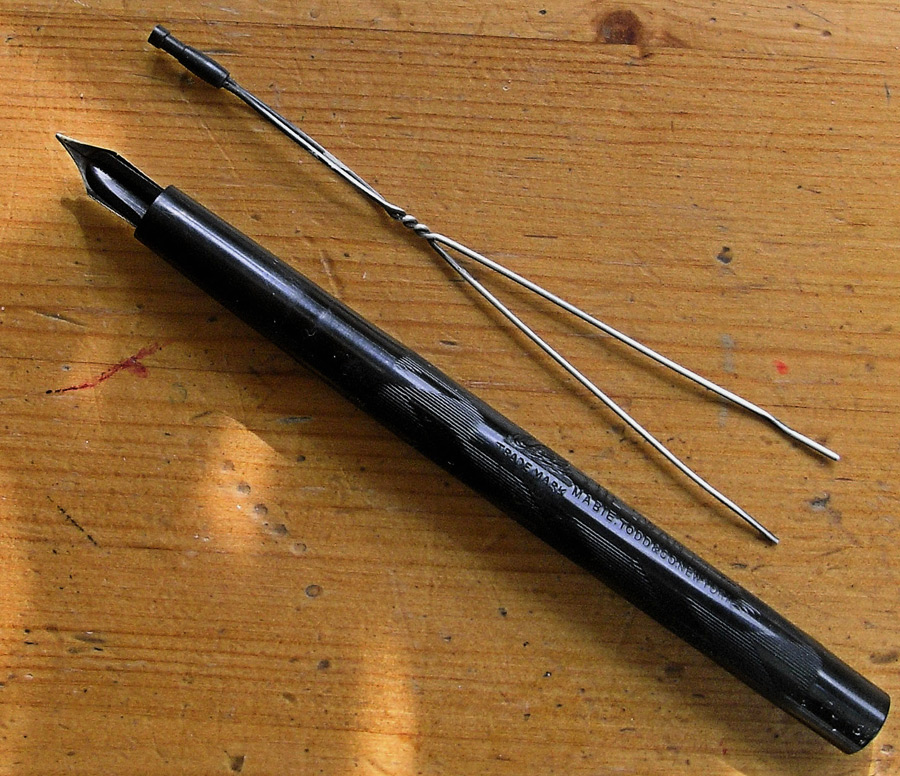
Here’s one you don’t see often – a plug filler Swan!  This was originally a Mabie Todd and Bard design and it was continued on after the company became Mabie Todd in 1907.  This pen is stamped “Mabie Todd & Co” on the barrel.  As the feed is stamped MTB that suggests that it was made very soon after the change in the company name, when earlier parts were still being used up.  Well more than 100 years old, anyway, and looking like new.
3
This is an eyedropper filler but instead of unscrewing the section to fill the pen, the plug is withdrawn to allow filling with a very slender eyedropper.  This method does not seem to have caught on as there aren’t many pens of this type around.  Perhaps it became unreliable as the plug wore with much use or it may be that it was less expensive to revert to the screw-in section.
4
This must be the longest twisted silver wire that I have ever seen!  I have no doubt that it did the job of improving ink flow just as well but these became much shorter as time went on.
2
It is remarkable that the black hard rubber has retained its original darkness and shine so well for over a hundred years.  Is this the earliest appearance of the gold overfeed in Swans?

Many thanks to Paul Leclercq for sight of this splendid pen and permission to write about it.

Platignum Regal

I recently had reason to agree with Paul Stempel that not all Platignums are bad.  Some are particularly nice.
IMGP1096
This is a Platignum Regal dating to about 1965.  It’s a very traditional pen – screw cap, lever fill,  “jewels” on each end.  Inside it has Platignum’s equivalent of Parkers pliglass sac – in other words, one that goes on forever.
IMGP1097
This is a school pen, built to a low price and yet it has survived all these years in very good condition.  The plastic takes a good shine when rubbed with a cloth.  The metalwork has retained all of its chrome plating.
IMGP1100
The steel nib looks at first glance like Platignum’s usual offering but it’s a bit better than that.  It doesn’t have the folded tips; this one has good tipping material.
IMGP1105
The result is that it writes very nicely, on the fine side of the medium, a size of nib I particularly like.

If what you appreciate about the pen is its writing ability, then this is as good a pen as any Swan or Onoto.  If, on the other hand, you expect your pen to look and feel like quality, perhaps the Platignum Regal falls a little below their standard.

I think I’ll be hanging onto this one for a while to write with myself.

Three Everyday Old Pens

Some inexpensive old pens are featured today.  Two of these pens are quite uncommon, not because they sold in small quantity but probably because people disposed of them rather than carefully putting them away, as they would have done with Swans, Onotos and Conway Stewarts.  Though they don’t appear so often they are probably a better representation of what people used than the more expensive pens.
IMGP1071 IMGP1072
It’s not always the most expensive pens that are the prettiest.  This Platignum looks quite modern but probably dates back to the 1930s.  Though some of the later ones appear with gold nibs, originally Mentmore designed the Platignum to be the least expensive pen on the market with a good steel nib.  This is a good solid button filler.  Strangely enough, it has been fitted with a Burnham nib at some point.  I’ll hang on to it until I get a proper Platignum nib of the right date.
IMGP1082 IMGP1081
This Penplas is a very basic pen.  It’s a lever filler with a folded-tip nib.  There is very little more that one can say about it.  Penplas only existed for a few years in the late 40s.

The Duragold was made by Perry’s of Birmingham, a company with a long history of making dip pen nibs.  I don’t think they made many fountain pens but a later scion of the family went on to make the very successful Osmiroids.
IMGP1088 IMGP1091
These pens have little value but they should not be forgotten.  Hundreds of thousands of people wrote with simple, inexpensive pens like these.

Conway Stewart 226

I have always found the middle period of Conway Stewart’s production to be the most interesting.  Admittedly, the early eyedropper fillers and Duros are exciting but they are unlikely ever to be seen in the flesh by the average buyer.  The period from 1930, on the other hand, to about 1948 sees the production of a huge number of models in some of the most delightful plastics that Conway Stewart – or any other company – put on offer.
IMGP1061
A good example is the 226, which Jonathan Donahaye records as being produced between 1933 and 1946.  At 10 shillings and sixpence it was two shillings cheaper than the more common 286.  The what makes the 226 stand out is the patterns that it came in – marbled sky blue/slate blue/gold, blue rock-face and this one which Jonathan calls marbled burnished copper/gold.
IMGP1059
As a slightly cheaper version it has no cap bands which allows for an uninterrupted stretch of this glorious pattern.  These highly colourful pens are not especially common and are quite sought after by collectors.