Late Swan Lever Filler

IMGP2142

I’ve been puzzling over the date of this pen today. I believe that it’s not the first metal-capped pen that Mabie Todd issued under the Swan name. There was one of 1948 to 1952 that had the clip inserted through the cap. That seems to me to be an earlier design than this one. My guess is that it’s somewhere in the period 1954 to 1958. It’s a better pen than the Warwicks and Oxfords that were made right at the end. This pen is capable of repair which is more than can be said for those others.

IMGP2144
I have a great many Mabie Todd adverts but unfortunately none of them is later than the nineteen forties. My various reference books are helpful to a degree but they don’t go quite far enough back either. Best guess is all I can do.

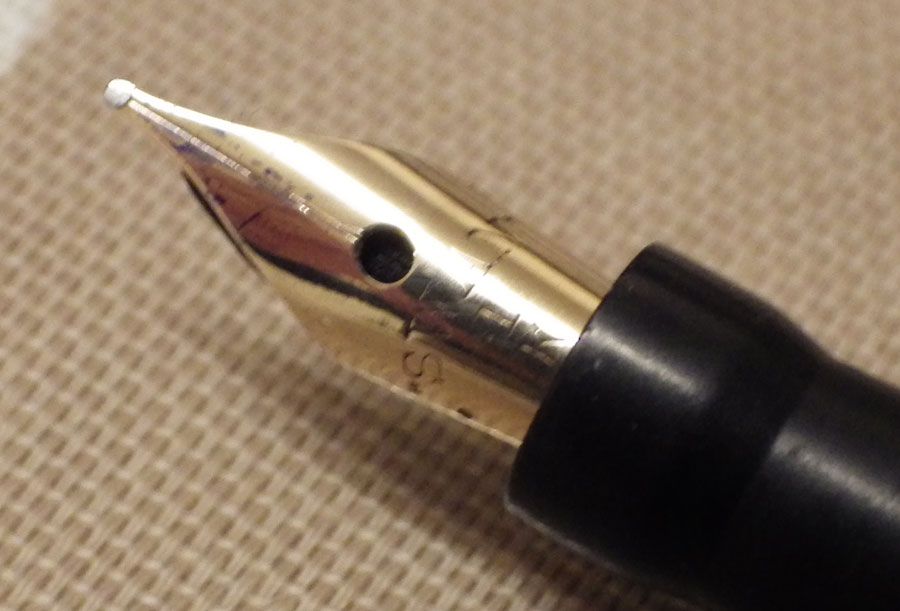
It’s a handsome pen, perhaps a little on the smaller side at 12.8 cm capped. The cap is gold plated and nicely patterned. The clip is held in place by what appears to have been a screw which has been later buffed down. The black plastic barrel takes a moderate shine. The cap is screw-on and still fits quite well. Even at this late date, the section is made from black hard rubber. The nib is a number one and by comparison it is smaller than the traditional number ones. The section screws in. I did a quick writing sample and I wasn’t too pleased with the result.  The nib will need some work before I pass the pen on.  It’s quite flexible but doesn’t lay a line reliably unflexed.
IMGP2146
The metal cap really took off in the late forties and fifties, perhaps because of the popularity of the Parker 51. This is a nice example with its subtle pattern. It’s an excellent pen by any standards and writes very well but in handling and using it there is a suspicion in the back of the mind that this isn’t quite up to the mark that Mabie Todd had established for the Swan pen. If it were in the output of almost any other manufacturer one would say it was a very good pen indeed. As a Swan, however, it’s not as good as earlier pens and, sad to say, there was very much worse to come.
IMGP2147
This, to my mind, is a pen made by a company marking time while they decide how to go forward. Some pen makers, like Montblanc for instance, went upmarket which was a good decision as they are still around today, producing far fewer pens for a vastly higher selling price. Others, like Conway Stewart, tried to continue by reducing the unit cost and hence the quality. They bit the dust fairly rapidly. Still others, like the Mentmore company, aimed for a specific sector of the market which gave them a few more profitable years.

In the end, of course, production of Mabie Todd pens ceased in 1958. The decision to do so was made by the Bic company who probably did not have any great commitment to the long and admirable history of the Swan fountain pen. They had a good product – probably the best of its kind – in their ballpoint pen. That was where profitability lay and it would be foolish to expect a company with responsibility to their shareholders to do anything other than pursue their most profitable line. It is sad, though, that such a splendid writing instrument as the Swan pen ceased to be made.
IMGP2150
A few years ago, someone turned out a series of cheap Chinese pens and called them Swans. It was a disgrace to traduce such an eminent name in this way. Thankfully, nobody liked the pens and they appear to be no longer to be sold. Trying for commercial success on the back of an earlier company’s fine name is very poor practice. Personally, I would rather have the cheapest Conway Stewart Scribe than even the most expensive so-called “Conway Stewart” that was made by a company with no connection to the original output which tried to claim continuity with the old company. I suppose it’s too much to expect ethics in business these days.

A Little About Little Me

Debbday

Ten years ago I lived a few miles outside Philadelphia and worked as a legal admin. My hobby was old fountain pens, especially British fountain pens. Not in my wildest dreams would I have imagined that one day I would live in Scotland and earn my living restoring and selling them.

My husband-to-be lived in the remote north of Scotland and was then a registrar of births, deaths and marriages. His hobby, too, was old fountain pens. We “met” on a site that was about creative writing and it had nothing to do with fountain pens. That was a kind of freaky coincidence.

One thing led to another and we were married in Pennsylvania seven years ago and here we are now 2698 restored pens later (as of today).  So much of what I have learned in detail about British fountain pens has come from shamelessly mining my husband’s brain, and much of our fountain pen business has been a happy collaboration.  On days when I’m feeling lazy and not much like researching a question someone has, all I often need to do is holler out from the den, “Sweetheart, what can you tell me about a Conway Stewart 55?” and faster than a speeding Windows 10 download, I have my answer along with side-notes, personal stories of Pens He Has Known, and generally even which reference book I should be looking in.

So if someone had said “You’ll be living the Pen Life with someone who is as geeky about them as you are,” I would have laughed.  But oh how glad I am that life’s funny turns have led me here.

Eversharp Viscount

IMGP2128

No writing sample with this one – it’s New Old Stock and I won’t be putting any ink in it. It still has its original factory chalk marks. It’s an Eversharp Viscount and it’s quite an interesting pen in its way.
IMGP2134
Wahl-Eversharp had a presence in the British market from the nineteen twenties onward. For some reason the Wahl part was never mentioned and the pens were called Eversharps. From around 1940 they produced the popular Kingswood which was their main seller until the mid-fifties, when they withdrew from the fountain pen market. In 1961 they advertised, “Eversharp are making fountain pens again,” and one of the new pens was the Viscount.
IMGP2129
It’s an average sized pen at 13.5 cm. The cap is of the press-on type and it closes against a raised ridge on the barrel. It works well. The gold plated clip which contrasts with the stainless steel cap is a nice touch. The long, slender section and the quite narrow nib are very much in the fashion of the time. To fill the pen, one unscrews the barrel to expose a black plastic squeeze filler – a unique component in my experience.
IMGP2135
These pens, along with the Viking and Vanguard, remained in production until 1964 but they were not a success. That, I suppose, partly accounts for their rarity today but I suspect that the plastic filler didn’t help either as it doesn’t appear to me to be particularly robust.
IMGP2137
This is one of those pens that is interesting – and to a degree valuable – because it doesn’t appear very often and is a milestone in pen development, or rather, in this case, the end of development because there were no Eversharp fountain pens after this one. That’s not to say that the quality isn’t good – it seems to me to be at least adequate though as I’ve said I have my doubts about the filler.

For anyone who has an interest in Eversharp’s involvement in the British pen market this one is a must.


With thanks to Stephen Hull: The English Fountain Pen Industry 1875 – 1975

Mabie Todd Swan 142/50

IMGP2101 IMGP2103

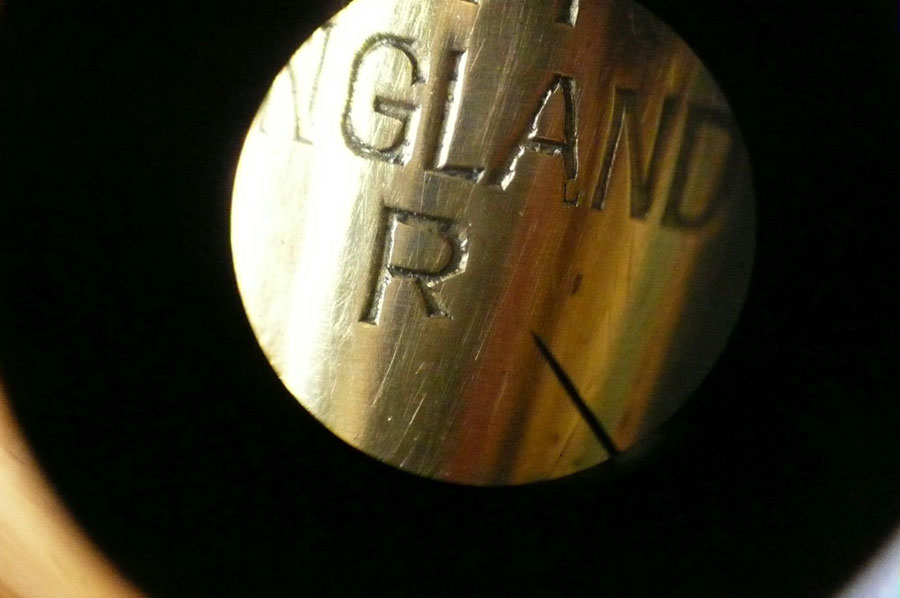
No pen, to my mind, is as beautiful as the large nineteen twenties Swan. That’s the shape a pen should be, that’s the size it should be and this is how the clip should look. Black cap rings surrounding the gold ones are just a huge bonus. The pen is 13.6 cm capped and posted it’s 16.7 cm which sounds very long but it balances nicely like that.
IMGP2108
As you can see this one was once jade but it has discoloured as these pens often do. I think it’s still a very beautiful and elegant pen. For those who like the detail this is a 142/50. I’m not sure how you work that one out. Normally, for pens of this date, the first digit is the nib size but this pen has a number two size nib which it was clearly meant to have. The four refers to a complication of banding on the cap. The two might be a transferred nib size. Maybe. Perhaps. We are on more certain ground with the 50 which is simply the code for jade.
IMGP2104
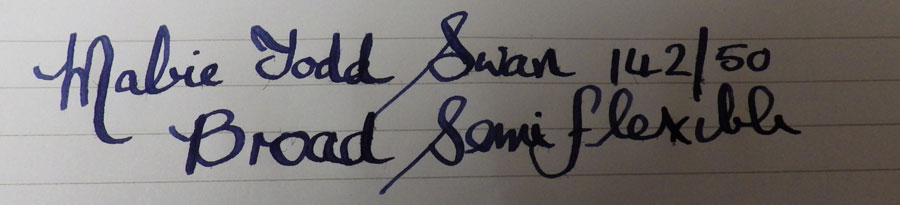
The nib is splendid: broad and semiflexible and the ink delivery has no trouble keeping up. As you would expect with that amount of ink being laid on the paper it’s as smooth as smooth can be. It’s a perfect pleasure to use.
IMGP2110
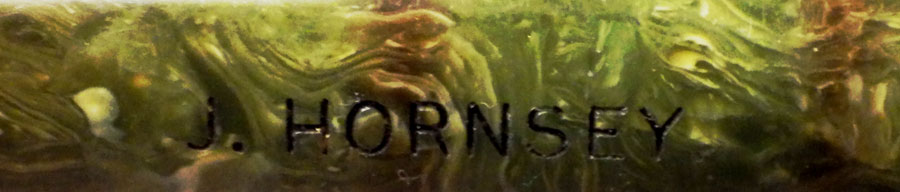
There is a discreet personalisation, “J Hornsey”. A Google search threw up several by that name, mostly in Yorkshire. Perhaps Hornsey is a Yorkshire name but the pen came from away down in Hastings, just to confuse things. None of the ones I found really fitted the profile for someone buying a quite expensive fountain pen back in the nineteen twenties.
IMGP2111
All in all, it’s an exceptionally nice pen and if it had been a fine it would have been a keeper for me but with my writing a line written with a broad would take up half a page, so this one will turn up on the sales site in due course.

Hero 329

I bought a lot of pens for spares just after Christmas and they arrived yesterday. There were some Platignums and other disposable pens among them and that was what I wanted. I pull the pressure bars out of those pens and throw the rest away. Cruel, I know – spare parts surgery, but necessary. Things have come to a strange pass when it is cheaper to buy whole pens than new pressure bars!
IMGP2091
There were several Chinese pens in the lot as well. I’ll be trying some of them. Today it’s a Hero 329. Someone had filled it with black ink of incredible density. I flushed it and flushed it and flushed it until my thumb dropped off and I had to go over to the surgery to have them stitch it back on but that ink was still there. After some more flushing I managed to get it down to a pale grey. I had to settle for that because the muscles in my arm were bulging like Popeye’s. I filled the pen with some less brutal ink and write-tested. I was delighted to find that it was a European fine and it wrote superbly – no skipping or inconsistency. It’s light, which I like and nicely balanced when it’s posted.
IMGP2094
It has an arrow on the hood – can you say Parker 61? Actually, in size and behaviour it’s more like a Parker 21. The arrow is of course shocking plagiarism but at least the clip is plain and not in the least Parker-arrow-like. As you will see, the barrel is a pleasant green and the cap makes no attempt to disguise the fact that it is stainless steel. It’s not a huge pen at 13.7 cm long capped. The cap slips on and clicks against the barrel ring. It works well and closes the pen properly. The nib, I’m sure, is steel. It has a squeeze-type filler. Some people refer to these as aerometric fillers but take it from me that they are not and the very suggestion is a dreadful insult to Parker. These are squeeze-fillers that manage at best a half fill. Proper aerometrics have a breather tube and fill the sac completely.
IMGP2097
Though the pen is in very good condition it seems to me likely that it was bought some time ago. I haven’t seen these 329s with the arrow on the hood for quite some time. Interesting, because now it’s quite hard to buy a Chinese pen with a fine nib. If you look for them in eBay you’ll find nothing but mediums. It’s like the sellers have come to the conclusion that all Westerners dislike fine and extra fine nibs. But no, Chinese friends! Take note that there is at least one here who likes her pens fine or even finer than fine.
IMGP2093
I’ll continue to use this pen over the next few days to see if there are drying-out problems. Of course it will take a little longer to find out about durability. I’ve had Chinese pens (and some other rather more expensive ones) that fell apart in a few months.

IMGP2098

Sheaffer Triumph Sovereign II

IMGP2083

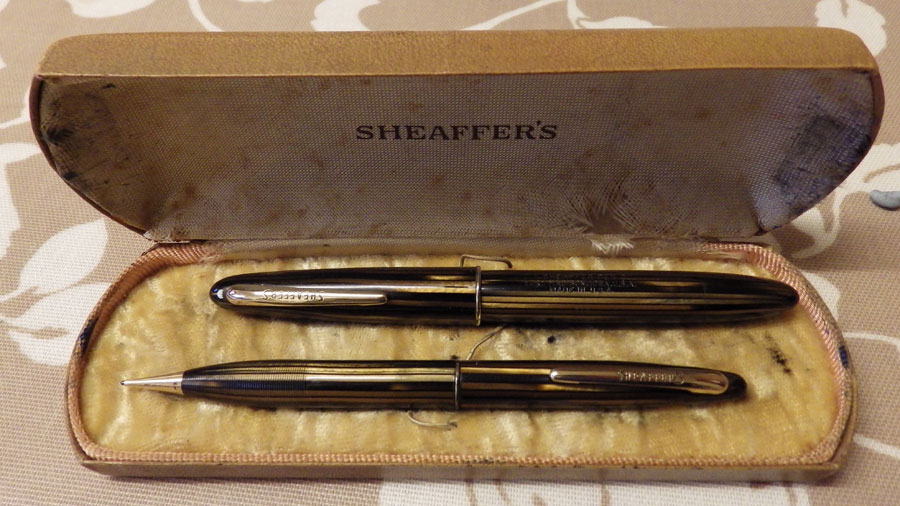
Isn’t this a beautiful thing? It’s a Sheaffer Triumph Sovereign II from the nineteen forties, and there’s a matching pencil. I love the Triumph nib – it’s splendidly elegant. I’ve had quite a few over the years but somehow I’ve never kept one. This one is medium but if I should come across one that’s a fine I’ll hang onto it. The honey and black striated celluloid is very beautiful too.
IMGP2085
Sadly the box is not quite so smart, despite my best efforts at cleaning it up. It’s strange to find a box that has had a harder life than the pens it contains! Perhaps it was kicking around in a drawer while the pen and pencil were safe on the desk.
IMGP2087
Walter Sheaffer was a jeweller before he got into pens and it shows in the quality of the Sheaffer output. This Sovereign II is rather an oddity in one sense: it has the Sheaffer name on the clip and the white dot above it, something that doesn’t occur in any of the other pens, I believe.
IMGP2089
Given that I regard the lever filler as a simpler and hence better filling system than either the vacuum fill or the Touchdown, when combined with the Triumph nib it makes for the best pre-1950 Sheaffer, in my none-too-humble opinion, anyway.

A Shabby Wyvern 60C

IMGP2074 IMGP2075

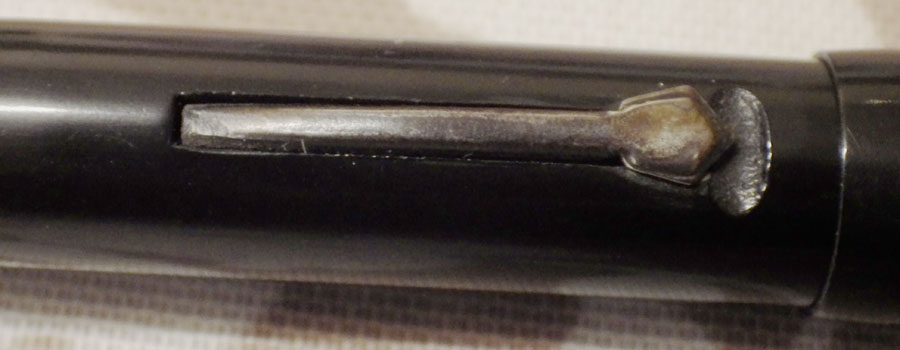
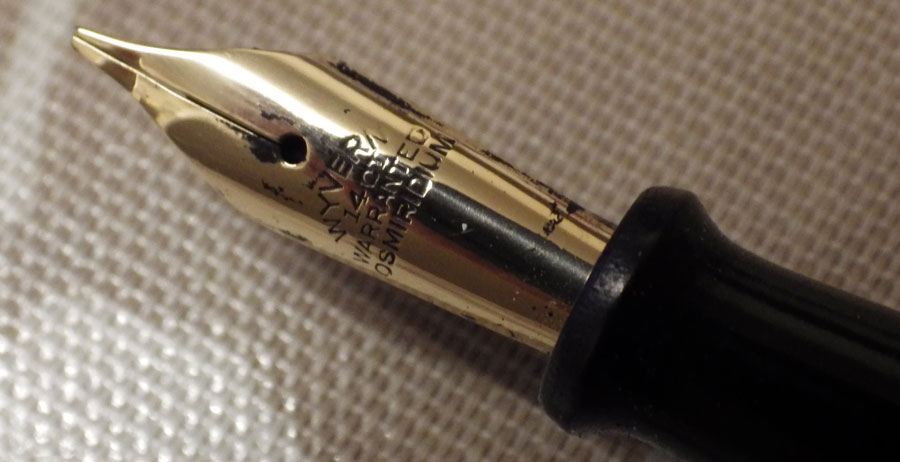
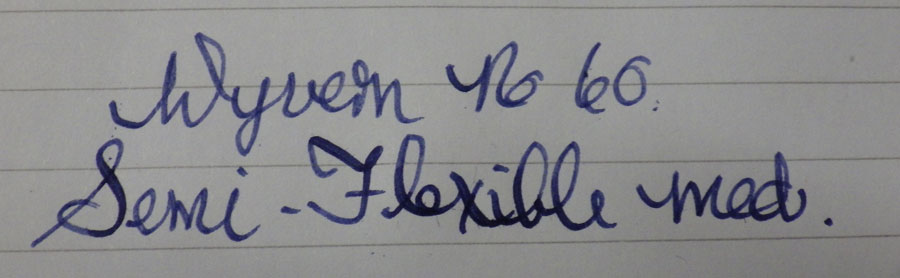
This Wyvern No 60C came in a bunch of pens that I bought for spares. It was in a very dirty condition and the engraving on the nib was impossible to read because it was deeply coated in black ink that didn’t want to come off – iron gall black or some calligraphy ink perhaps. In other respects the pen showed that it had been heavily used: the imprint on the barrel is worn to the point where it is just legible and no more. The pen has been dropped at some time and the nib has been “straightened”. As the tines are quite well aligned and the pen writes well I’ve left well alone. Though the clip isn’t too bad the plating has worn entirely off the lever which, being steel, has rusted.
IMGP2079
I’ve tried to date this pen and I suspect that it’s from the 1930s. The 60C was introduced in 1921 but I think that this is a later model. I would think that the spatulate end to the lever and the short, narrow section would help in dating. If Wardok were to read this, I’m sure he could pin it down.
IMGP2076
A pen like this that is in very shabby condition but writes very well goes into my “bargains” section on the sales site. It’s not the kind of pen that you can wave around to make your colleagues admire your taste. It’s more of an everyday user that you can leave lying around the desk in the certain knowledge that no one will steal it. I like pens like this and often have one in use.

IMGP2080

Happy New Year!

A guid New Year to yin and a’, as Scots are supposed to say. They don’t speak like that up here but I think they probably do a few hundred miles further south. I hope 2016 will be a good and interesting pen year and I also hope that you will all get the pens that you want and enjoy them.

For myself, I hope I will be more consistent both with the blog and the sales site than I was last year when there were unavoidably a couple of lengthy gaps. Anyway, here we are with a whole new year to play with and make the most of!

Hero 616 Jumbo

IMGP2065 IMGP2067

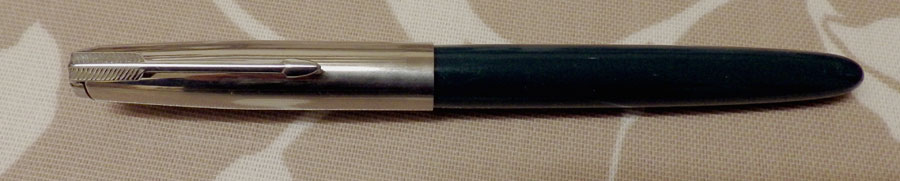
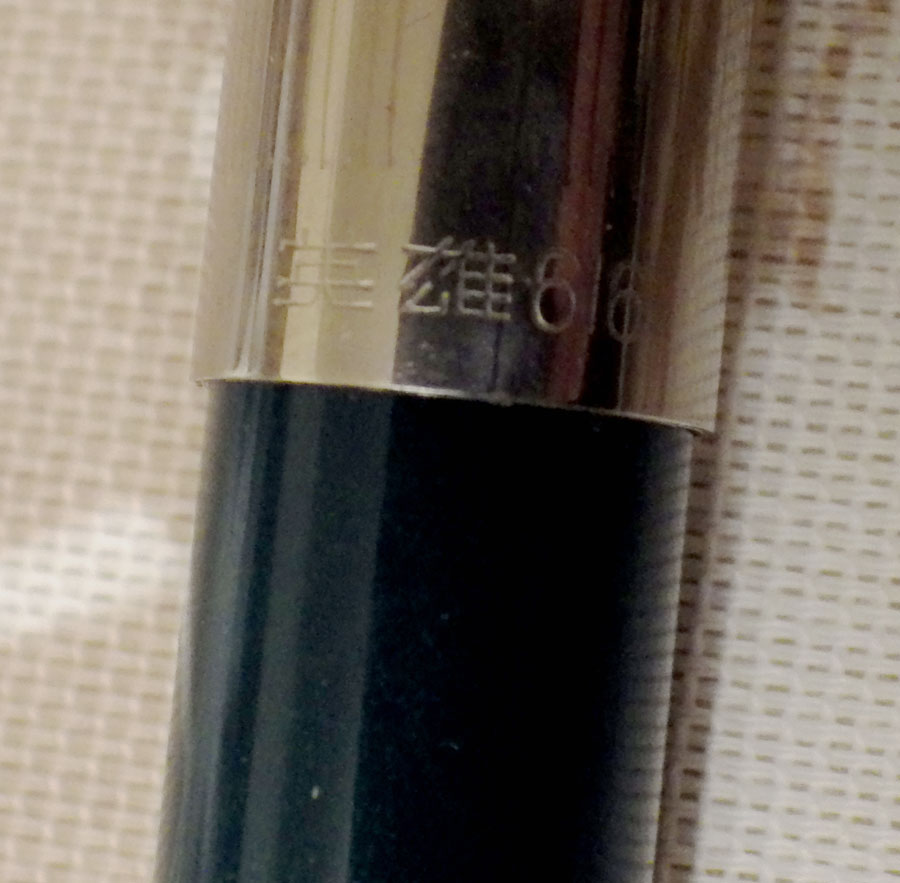
Whenever I’ve been scouting around for cheap but good Chinese pens recently, it has been Jinhao that has come most readily to mind. Recently, though, someone suggested the Hero 616 Jumbo. I picked one up for a very reasonable price and here it is: yet another Parker 51 clone – or so it seems. Actually it’s more of a pen than it appears, at 13.9 cm capped. I don’t have a Parker 51 at the moment to compare it with but I suspect that both cap and barrel are longer.  It has the usual “Parker Arrow” and the cap has a faint lined pattern. The green barrel and section are made of what seems to be a reasonably durable plastic. Two rings protrude sufficiently to grip the cap giving firm closure but I wonder how long this will last.
IMGP2068
It has a squeeze type converter which draws a decent supply of ink. This pen has one problem that recurs: on pulling off the cap there is often ink on the section. This is the old problem of a tight, unventilated cap drawing ink from the reservoir when opened. It’s a problem that was solved by the early nineteen hundreds but it seems that Hero need to reinvent the wheel.
IMGP2071
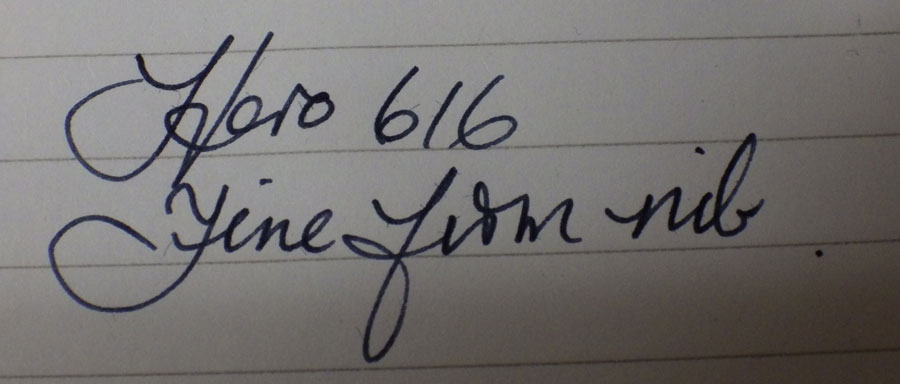
I don’t suppose it would matter with such an inexpensive pen. I could just chalk it up to experience and consign the pen to the bucket. Problem is, it’s an absolutely splendid writer – a real delight to use! I certainly don’t want to throw it away but nor do I want to have ink on my fingers everytime I use it.

I think the answer will be to drill a small hole in the cap to release the vacuum.