Latest Uploads

For months I’ve added, here and there,
Some pens for sale, without fanfare.

I have not written clever verse
(Which always goes from bad to worse).

But these fresh pens are so delightful
Keeping silent would be frightful!

So here’s a mangled bit of rhyme
To say, come and take a little time.

Peruse my site and find some gems
On sale here, far north of the Thames!

(I warned you it might be the case
That my words here would lose me face.)

All this nonsense is to say
I’ve got some glorious pens today!

Be quick, my friends, or they’ll be sold,
Red Ripple and more, with nibs of gold.

Peruse my site and find a winner –
I’m off to have my well-earned dinner!

Platinum Long-Short Pocket Pen

In the 60s the main Japanese pen manufacturers – and some smaller ones – developed a new kind of pocket pen with a long cap and a barrel just long enough to contain a cartridge. These “long-shorts” came in at all price points. Some were dignified and opulent with black barrels and sterling silver caps. Others were more colourful.

Of course the long-short was a configuration that had been tried before. Diamond Point, among others, had tried this form of pocket pen as a bulb filler in the 1920s. None of the earlier attempts achieved the success that the Japanese made of the style.

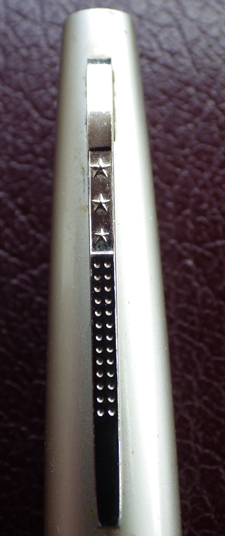
This example is by Platinum. It has an 18 carat EF nib. In every respect it is a typical long-short. I have seen this model identified as a Platinum 200 and PKA-500 is also applied to it. So far as I can tell it’s a 70s pen. Though it is quite pretty with a metal cap and turquoise barrel/section, the selling point for these pens is, as is always the case with Japanese pens, the nib. Hair’s-breadth fine yet completely smooth, it delivers ink consistently with no pressure at all. There is no hard starting or skipping. It may be a small pen but it doesn’t really feel like one in the hand.

All three major Japanese manufacturers produced long-shorts in all sorts of colours and patterns, which makes them very collectable today. Not for me, though. I wanted to try one, the nicest one I could find, to see if it is a pen I can write with. It is.

(My apologies for the photographs. The metallic finish is intensely light reflective and very annoying to try to capture. I tried various setups and this was the best I could do!)

Are Fountain Pens Really Better?

When I worked for an employer, the stationery cupboard contained one kind of writing instrument: the ubiquitous Bic. Though I always had my Sheaffer Targa at the ready I often had to grab a Bic when answering the phone or taking notes at impromptu meetings. At more formal ones I used my Sheaffer. I don’t like ballpoints for all the reasons we usually share – painful writing angle, characterless writing point, pressure required etc, etc. However, there is no doubt that they won the war.

When I buy batches of pens in auctions there are often ballpoints among them. The cheap or unbranded ones go in the trash but I pass the better ones: Parker, Sheaffer, Cross and Papermate to my husband. He installs refills and gives them out at the hospital. Nurses do a lot of form filling and, busy as they are, grab the first ballpoint that comes to hand. To them, it’s an irrelevance whether it’s a Bic or a Parker. Just the tool they need for the job.

Ballpoints gave rise to several descendants – fibre tipped pens, roller balls and gel pens. I use the Pilot G2 gel pens for those jobs that the demand something other than a fountain pen: the forms of officialdom and addressing envelopes. I used to address envelopes with a fountain pen then rub over the address with a candle to waterproof it. I gave that up – too pernickety. The gel pen has proved its worth.

When it comes to real writing – blogging and corresponding, however, I would never dream of using anything other than a fountain pen. I barely touch the paper. In fact with the best pens like this little no-model-name 1960s Pilot, it’s as if I wave the pen over the paper and the words magically appear. I could write my autobiography at a sitting without fatigue. The act of writing with a very good fountain pen is not work; it’s a pleasure, happily anticipated.

I am no calligrapher. I cannot produce the artistic script that was the norm one hundred and fifty years ago but my handwriting is much better than it ever could have been if I had not escaped the trap of the ballpoint. The way that a good fountain pen lays ink on paper is so much more pleasant and aesthetically pleasing that better handwriting is automatically encouraged.

So are fountain pens really better? Of course they are and we knew that anyway, but there’s no harm in restating the obvious. Emphatically!
Unbranded MHR Lever Filler

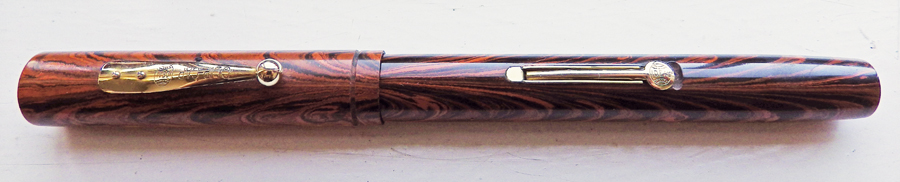
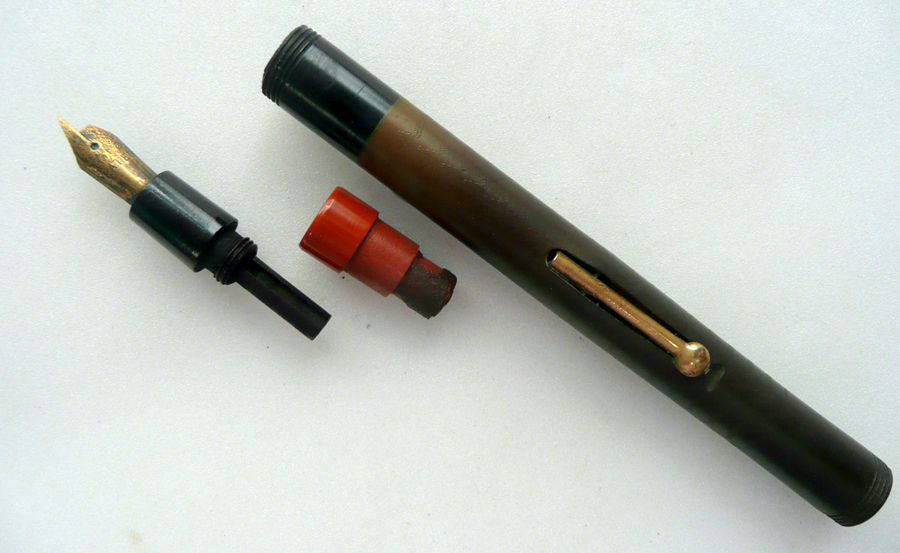
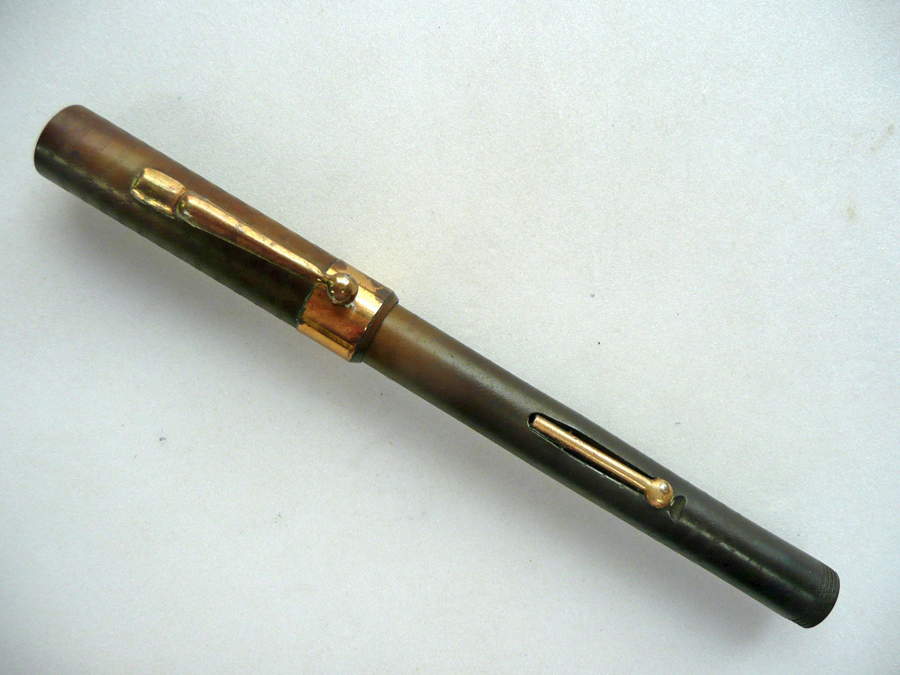
Anonymous pens can be beautiful too! This mottled hard rubber lever filler is well-designed and well made, doubtless the product of one of the well-known factories. The black and red of the mottled hard rubber remains colourful and with sharp contrast. People tend to use names like woodgrain or red ripple (which this is asssuredly not!) But it’s all mottled hard rubber, a very beautiful, quite robust material.


The pen has a warranted 14 carat gold nib, very fine with a modicum of flexibility. The clip remains nice and shiny but the lever appears to have lost some of its chrome plating. The milling on the clip screw is a nice touch.

I usually look back through my blog to see if I’ve covered a subject before, and I wrote about MHR back in 2011. Boy, did I get it wrong back then! I recommended the use of museum wax rather than strongly abrasive polishes. While I would still be careful about the polishes – read the label and used sparingly, if at all – I would never, ever, use any form of wax on a fountain pen. Many of the wax products that were highly recommended a decade or more ago are no longer used because of harmful ingredients they contain. Also, there is no coming back from wax. It’s very difficult if not impossible to remove completely.

It’s fine for furniture but not for pens.

The Conflict

I can’t keep all the pens I buy. I can’t, indeed, keep one tenth or even one hundredth of all the pens I buy. I buy them to write about, to restore and to sell. I already have thirty-five or forty pens that I keep. I really neither need nor can use more.

And yet… Though my criteria for pen purchase is often very different from what I would buy for myself, it is inevitable that some of the pens will appeal to me aesthetically and will suit my hand. The present pen is a case in point. If I was starting out and didn’t already have a boxful of pens, this one would be a keeper!

This is not a new problem for me. I’ve always had to deal with this conflict. I adjusted my thinking a long time ago. Now, I am grateful that I can enjoy these exceptional pens for a little while before they move on.

Still, it is a wrench to part with such exceptional pens…

Cap

We discuss our pens in whole or in parts. One day I’m writing about Conway Stewarts and Mabie Todds, the next it’s levers and J-bars. In the whole group of words that surround and describe fountain pens the one that annoys me most is “cap.”

Allow me to explicate. I use Dragon Naturally Speaking to transcribe my blog articles because I have a deep-seated hatred of keyboards. I’m not fond of mice either but that’s by the by. Dragon Naturally Speaking always interprets “cap” to mean capital letter, so instead of, “to replace the cap on the barrel,” I get “to replace the On the barrel,” if I am unwary, as I often am. If I was writing about cars or coins it wouldn’t matter, but any poor soul that writes about head wear and uses Dragon Naturally Speaking must suffer spasms of anxiety.

Just to be more annoying it isn’t entirely consistent. I can get away with cap ring and cap band but not cap on its own.

I imagine that it’s perfectly possible to go into the inner workings of Dragon Naturally Speaking and change the command to “capital” but I’ve never had the time. In eight years I’ve never had the time.

Gold Nibs For Scrap

My husband, who is a member of FPN, showed me a horrible photo he saw there: more than $1000 of gold fountain pen nibs, sold for scrap. I studied it carefully and most of those nibs were not damaged. I saw a few that were bent – all bent nibs can be saved. There may have been some in the pile with cracks or missing iridium but I didn’t see any.

What’s the scrap value of a gold nib? Can’t be all that much. Most gold-nib pens in unrestored condition are fetching £30 and upwards – often far upwards these days. Those scrap merchants are throwing money away! How can we get across to these people? A lump of lead behind the ear would do, but we could appeal to their greed if there was a way of contacting them.

It’s so infuriating. Hundreds of restorable pens are going in the trash. I’m sure many of us would love to have those pens, or even those nibs. All restorers, I am sure, have otherwise excellent pens set aside awaiting an appropriate nib.

We could, of course, buy the nibs that appear in quantity on eBay and I have tried to do that once or twice, without success. I’ve also had gold scrap merchants going door-to-door, collecting any gold they can get. I’ve tried to educate those guys but it’s an uphill job. How many fountain pens do they destroy every month?

Waterman 52 Red Ripple

Everybody knows the Waterman 52. It was produced in huge numbers over a long period and remains one of the most common vintage pens. Because many 52s have flexible nibs – some exceptionally so – they are in demand whether black hard rubber, mottled hard rubber or ripple like this one.

For many years they were were workhorse pens, a job they did very well. The nibs come in a variety of forms – this one is a stubbish semi-flexible medium oblique, a very stylish line!

To my mind, the Waterman 52 is up there with the all-time greats – the Onoto, 1920s Swans, the Duofold and the Wahl Eversharp Doric. Red Ripple pens, especially those in condition like this one, are much demanded. The gold plating on this pen has survived unblemished. That doesn’t happen often!

Like those other pens I mentioned above, the 52 is an ergonomically superb pen, whether by design or accident. It remains comfortable in the hand after many pages of writing. How many modern pens are as good in this respect? Their popularity has driven prices up over the last decade but compared with many modern pens Waterman 52s remain a bargain

The Mentmore Bonzo

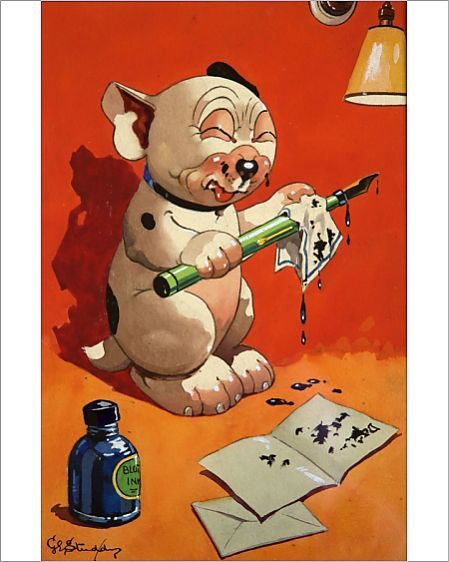
Every now and again something takes the public attention and it appears everywhere: Minions now or Pokémon a few years ago. In the 1920s it was Bonzo, a cartoon dog drawn by G E Studdy, a commercial artist. The little dog was an ideal marketing choice, appearing as mechanical and soft toys, car mascots, jigsaw puzzles, postcards and many other things. And one pen! Mentmore caught onto the public fondness for Bonzo and doubtless paid Studdy a fee.

The Bonzo pen was not just a gimmick, however. Mentmore were paying another licence fee, to Wahl, and it may be that it related to the red collar, which is in fact a double section. This enabled changing nibs without completely dismantling the pen as the other section held the sac. In this respect the Bonzo was the forerunner of the Esterbrook, Osmiroid and Platignum pens with their interchangeable nibs.

The Bonzo was a popular pen but not all that many have survived today. They fetch a good price on their own, and much more with the very attractive, colourful box (which I sadly don’t have!)

Thanks to Paul S for photographs.