Some Interesting Old Pens

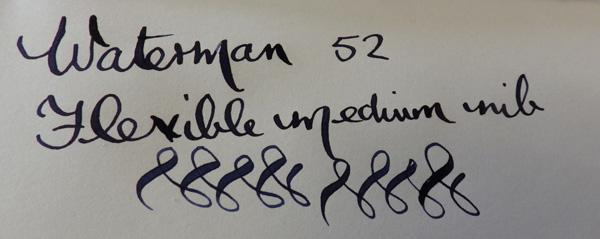
I’m having a very busy day, pen-testing and making writing samples.

DSCF3114

Thankfully my assistant is helping, as you can see.

There are a few interesting pens for sale in ebay today.  There’s an eyedropper filler called “The Efficient” which the seller suggests might have been made by De La Rue but my guess would be Burge, Warren and Ridgley.  There’s also a solidly well made pen called “The Golden Cockerel” which might be by the same maker.  Finally there’s a pen described by the seller as a “Rare BHR Travelling Eyedropper”.  He suggest that it might have been made by Mabie Todd but I don’t see anything to support that.  Another Burge, Warren and Ridgley?

So a good day for rare old pens.  I’d be after these myself but this week’s purchasing budget has been committed.  So it goes.

Feathers And Pens

Etymologically, a pen is just a feather, neither more nor less.  That’s not altogether surprising when you consider that for thirteen centuries the feather or quill was the main writing instrument.  Goose, swan, turkey and even eagle feathers were used.  The large wing feathers; the pinion and two or three big feathers adjacent were the only ones suitable.  Thus began an association between writing instruments and birds that persists to this day.

Mabie Todd, of course, were the manufacturers who made most use of this association, with their Swans, Blackbirds, Jackdaws and Swallows.  Other pen-makers like Parker, Stephens and Croxley came at it from another angle, using an arrow with its flight feathers as a pocket clip.
IMGP0116
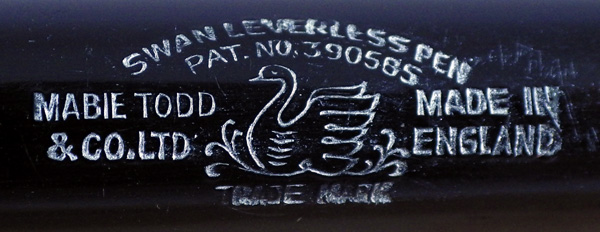
Mabie Todd’s Swan, especially, features large in their advertising, from detailed painted swans to drawings made with an evocative line or two.  In truth, though, the various swans impressed onto the barrels of their pens aren’t very swan-like.  They’re a bit chunky and short in the neck.  A long-established ebay seller whose first language is probably not English consistently refers to the barrel imprint swan as “The Swan Duck”.  Not an elegant description, perhaps, but an accurate one!
IMGP0523
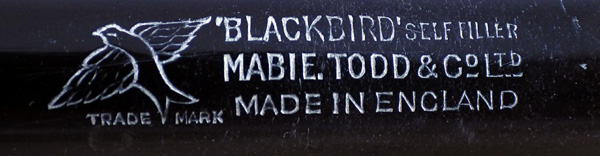
By contrast the blackbird logo is very well observed.  The blackbird is in upward flight, that moment of startled evasion when the blackbird hurtles noisily from the lawn to the safety of the hedge.  Looking at the blackbird on the barrel you can almost hear it.

Even forgetting the association with the quill which was in the distant past even at the time the first Swans were produced, the notion of flight well suits the subject, where a well-made pen glides over the paper and the concepts fly from the mind to the words on the page.  Flights of fancy, whether poesy or prose, figure in the metaphor that the Swan pen evokes.

It pleases me that a company like Mabie Todd, so go-ahead in its day, carried a historical reference throughout its own long history.

A Celluloid Waterman 52

IMGP0959

Waterman updated its long-running 52 in 1934.  It was shortened slightly and the ends of the cap and barrel became a little tapered.  Most importantly, it was now made from celluloid and the trim was redesigned.

These pens were not lathed from rod stock but made from wrapped celluloid sheet and some show signs of delaminating.  Most are stocky, sturdy pens like their hard rubber predecessor and of course they retain the wonderful Ideal nib.

Care should be taken in disassembling these pens as some of them have a two-part feed which can be damaged by injudicious use of the knock-out block.  Not all celluloid 52s have these redesigned feeds.  Perhaps they were tried and withdrawn.
IMGP0965
This example was made in Canada.  Back in the bad old protectionist days (considering how well globalisation has worked out they might not have been as bad as all that!) the larger US companies found ways to overcome the tariffs imposed on imports of their pens in Britain.  Parker and Waterman established factories in Canada and Sheaffer did the same in Australia, as these Commonwealth countries had free trade with Britain.  Interestingly for us, some of these factories developed a degree of independence and made models unique to them.

This red and grey marbled celluloid was popular and was used in several other Waterman models of the time.  Despite its face-lift and new material, the 52 began to look dated when compared with pens designed in the thirties.  As demand for it dropped, the pen disappeared from the Waterman catalogues.  Celluloid 52s are far less common than the hard rubber ones.  The 52 appeared in so many different forms that it makes an ideal subject for collecting and it is, of course, the writer’s pen par excellence.

IMGP0966

Casein And A Conway Stewart Conway 15 Set

IMGP0955

Casein is peculiar stuff.  While there’s no denying that there are some problems associated with it, the depth and luminosity of colour that it offers can’t be matched by any other material.  It positively glows.

The problem that concerns most people is that they will not recognise it as casein, immerse it in water and destroy the pen.  This one is easily dismissed –  regardless of the material from which they’re made – keep your pens out of water!  There’s no benefit to be gained from exposing the externals of a pen to liquid of any kind.

What is more worrying is the insidious effect of exposure to varying humidity over many years.  The casein absorbs a little moisture when the humidity rises and expands slightly.  When the humidity falls, it releases the moisture and shrinks again.  Over time, this leads to cracking.  Craquelure is all very well on Old Master paintings but it isn’t so welcome in pens.  I’ve seen Burnhams disintegrate from this effect.  Perhaps because they treated the casein differently in some way, Conway Stewarts never get quite so bad.  Usually it’s more of a disfiguring surface haze.

I think it was Jonathan Donahaye who suggested that those casein pens that are perfect today after the passage of fifty or more years were probably undisturbed in a box in a drawer for all that time.  That seems a very likely explanation to me.
IMGP0958
This Conway 15 pen/Conway 25 pencil set is in that fortunate condition, showing the high gloss that these pens all had when they were new.  It is an amazing material.  It can’t really be mistaken for any of the other pen materials.  The pen had been inked but it appears that it was not used.  It had the original Conway Stewart sac.  The pencil still has lead in it.

My husband delights in making me envious by describing British newsagents’ shops of old, with brightly-coloured Conway Stewarts hanging on a card awaiting sale.  This Conway 15 is so fresh, glossy and new that it might have been removed from the card moments ago.

Monday Mailing

IMGP0952

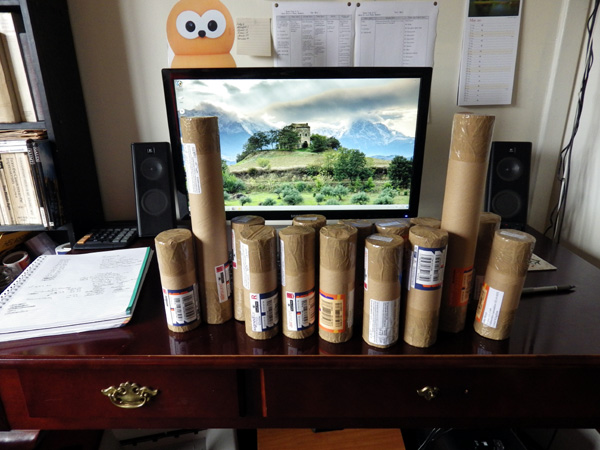
I send pens out almost every day but the orders accumulate over the weekend.  Checking which form of overseas postage to use, writing cover letters, getting the packets together – it all takes quite a bit of time and effort and then I have to haul them all to the Post Office.

I’m not a cruel person, as you know.  In fact I’m rather nice, but it does brighten my day when I go into the Post Office with fifteen packets, as today, and I see the Postmistress flinch.

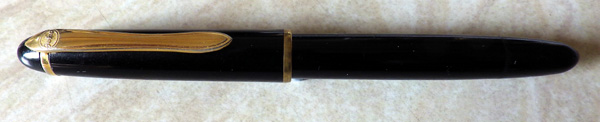
Geha Schulfüller

IMGP0943

This Geha Schulfüller is a well-travelled pen.  It crossed the Atlantic from Germany to the USA with my mother’s friend in the sixties.  Many years later, when she found that I had an interest in fountain pens she gave to me.  When I married my husband and came to Scotland, it crossed the Atlantic again.  So it’s been around.
IMGP0945
Geha is Gebrüder Hartmann, a Hanover office supplies company which went into pen production 1955.  Their big seller was this school pen with a reserve tank which was in fierce competition with Pelikan’s pens for school students.  In 1991 Pelikan bought Geha.  As the pens stopped being made, one can only assume that the purchase was purely to remove a competitor from the market.  Good for Pelikan but not for us!
IMGP0946
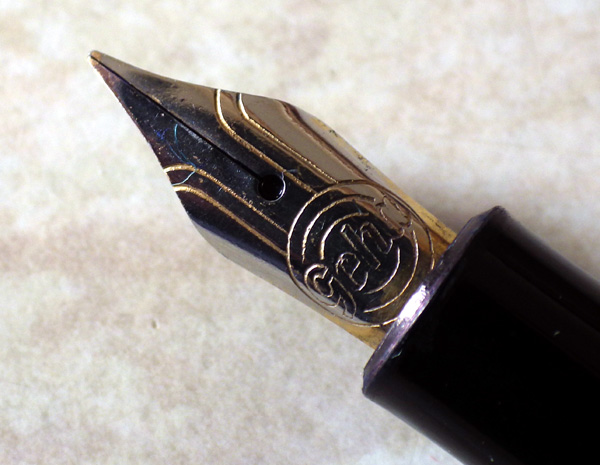
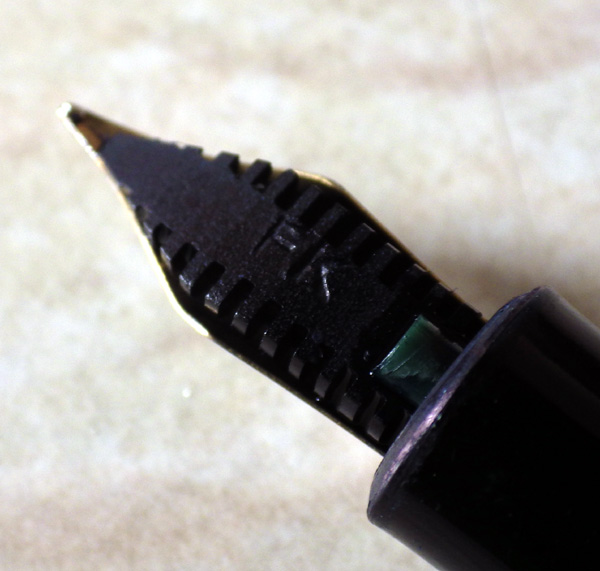
The Geha Schulfüller is a good quality no-nonsense piston filler.  The nib was plated originally but that has gone.  It’s a nice smooth fine.  There’s a green lever in the section that activates the reserve tank which will give another couple of pages.  As there’s a blue transparent area in the barrel that lets you see how much ink is left, I’m not sure why you would let the ink level drop to the point where you needed to call on a reserve, but it was a good selling point for the pen.  The nib is threaded and easily removed for cleaning.  It may be possible to exchange nibs with some of the other German school pens but I haven’t tried it.  The Geha nib is good enough for me.
IMGP0948
I am assured that some of these plated nibs are flexible, but mine is not.  There’s also the Geha Goldfeder 585, virtually the same pen but with a gold nib.  Gehas are not especially common now but they do appear in ebay quite often and the prices remain good for what is an eminently practical and reliable user pen.

An Unbranded Chinese Pen

The other day I spotted a small lot in ebay that looked like it was worth a bid.  There were two Swans, a boxed Parker 45 and this… thing.
IMGP0939
The lot arrived this morning.  I’m very pleased with the other pens and the thing has its curiosity value.  It’s an iridium-point Chinese pen.  I’ve seen them online before – once seen never forgotten!  What seeing it online doesn’t tell you is that this thing is solid lacquered brass, which means it’s monstrously heavy.  I defy anyone to tell me they could write two pages of A4 with this “pen”(I use the term advisedly) without requiring protracted physiotherapy thereafter.
IMGP0940
That’s not to say it isn’t useful.  It would make a passable doorstop.  Or I could keep it by the bed in case of home invasion.  Oh, and there’s one other thing about it – it’s the ugliest pen I have ever seen.  It’s so ugly that you could use it to discipline naughty children.

“You children stop that or I’ll SHOW YOU THE PEN!

“No, Mummy, please don’t!  We’ll be very, very good!”

Conway Stewart 84 Rose Marbled With Gold Veins

CSW84

I like the Conway Stewart 84.  It’s quite a short pen but no thinner than most other Conway Stewarts of the time, so it’s quite comfortable to write with for most people.  Its time was the early fifties to the early sixties and it must have sold extremely well during those years, as it remains one of the most commonly found Conway Stewarts today.
IMGP0933
The “rose marble with gold veins” pattern was one that was introduced with the 84, and it makes a beautiful, jewel-like pen.  All the signs indicate that this was a pen for the ladies but, so far as I’m aware, Conway Stewart don’t come right out and say that.  The medium cap band indicates that though the pen is comparatively small, it’s not intended to be an economy model.
IMGP0935
The CS4 nib fitted to the 84 is a larger nib than that in some of the bigger models.  This one is semi-flexible.

An Unbranded Pen

IMGP0880

I don’t usually write about unbranded pens but this one is exceptional.  It’s quite a large and chunky pen at 13.3cm capped.  It’s very well made and the gold plating has lasted well. The green and black celluloid has large blocks of colour like some of the Parker Thrift Pens.  Not that I think it’s a Parker, I don’t, but I do think it’s American.  That cap and fixed clip look American and the section is plastic rather than BHR, though I think the feed is BHR.  The diameter of the feed is greater than is usually found in British pens.
IMGP0877
There’s no hint or indication who might have made this pen.  The nib, though it’s a decent size, is warranted.  The tipping material is quite worn from long use and I’ll have to replace the nib.  The barrel and cap are free of any imprint.  The feed is quite sculpted and might be a clue to the pen’s origin.
IMGP0884
If any of my US readers can throw any light on this pen’s origin, I would be most grateful.

A Late Stephens 106

I somehow managed to catch the reflection of my strip-light in these photos.  Please forgive.
IMGP0865
Stephens had a 106 in their line-up from 1935 on, but this pen is clearly not of that date.  There’s no black art about Stephens’ numbers, unlike Conway Stewart or De La Rue.  A 106 cost ten shillings and sixpence.  It’s as simple as that.
IMGP0866
The pen is sturdily made with quite thick material in the barrel and cap.  This makes it feel a little more solid than some pens of the time.  The metal trim is generally good, though there’s a little bit of plating loss on the high points of the clip.  The nib, though a warranted one, is clearly good quality.  The streamlined shape of the pen suggests that it’s later than the more angular Stephens pens we usually see.
IMGP0873
From 1950 Stephens withdrew almost entirely from the production of gold-nibbed pens and concentrated on their inks and ballpoint pens.  In the late fifties, when there were talks between Stephens and Waterman with the possibility of a merger, Jif Waterman produced some colourful pens for Stephens, and I suspect that is what this is.
IMGP0870
It’s a beautiful pen with glowing patterned plastic.  It’s a pity that so few of these pens were made with the result that they’re not often seen now.