A Special Swan SF2

As I’m sure I’ve mentioned before, I’ve been doing this for a long time. Sometimes I wonder why I do it. The hours are long; being your own boss means you serve a hard task master. It’s not the money – if I got a job flipping burgers that would be a major wage rise. The close-work is ruining my eyesight; there’s a ridge on my brow where the OptiVisor sits and I have x20 loupes all over the house. I get a bit of a buzz from the shellac but that’s about it.

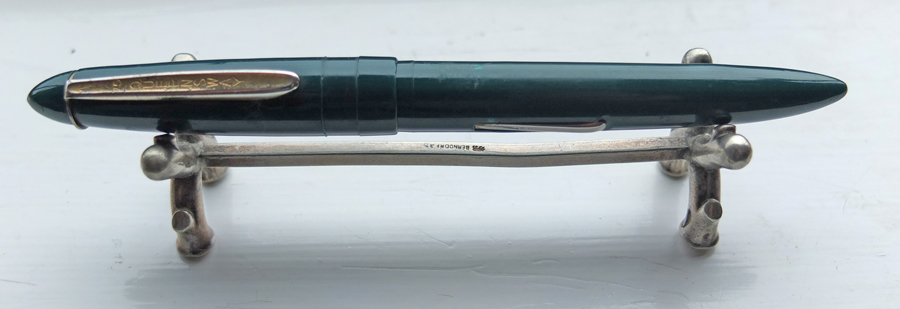
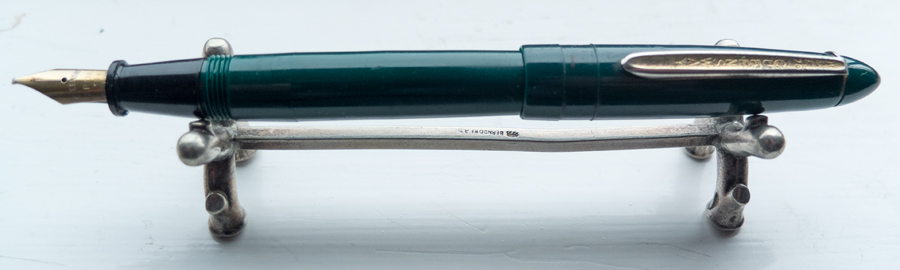
And then I remember why. When a pen as glorious as this Swan SF2 turns up I remember why I wouldn’t dream of doing anything else. To be given the opportunity to resuscitate a fine instrument like this is a great privilege indeed.

Because it’s such a fine pen I’ve written about the SF2 on several previous occasions. The little search box at the top right will take you to what I’ve said before. I won’t have any more to say about the model, just about this individual pen.

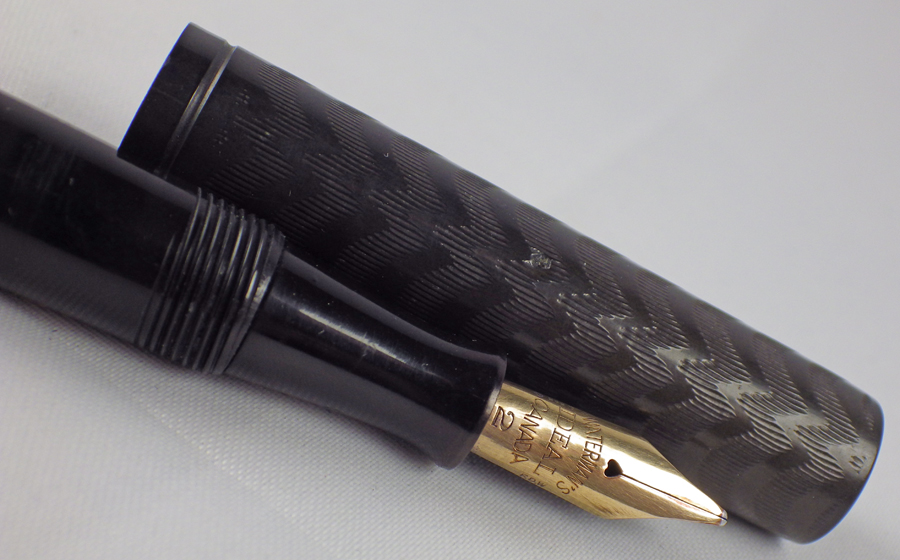
It was awarded to F V Stephen at HM Dockyard, Rosyth in 1924. Sadly, I can’t track down FV Stephen. I can’t even tell whether he was a civilian or a naval officer or rating. In that no rank is given it seems likely that he was one of the many civilians working there in all capacities. HM Dockyard Rosyth was built during the arms race preceding the First World War and serviced surface ships and submarines up to the present day.

It’s likely that this was a retirement present if for no other reason than because it has seen little use. This is a very old pen and yet the engine-cut patterning is still crisp and the colour is good. It’s an expensive gift, so F V Stephen was a highly appreciated employee, probably in a quite senior position.

Of course, a pen is designed not only to look good but to write well. This one with its fine New York nib writes splendidly.

Truth be told, I could win the lottery tomorrow (or I could if I bought the tickets) and it would make no difference. I would still fix old pens.
Ugly Pens

I’m sure I could produce an “Ugly Pen of the Month” every month without any difficulty. However, the ugliest pens I see around these days tend to be modern. Some of those pen manufacturers employ aggressive and vicious ninjalawyers who would sue me back to the Stone Age if I were to criticise their expensively designed horrors. So I won’t.

Ugly Pen Of The Month


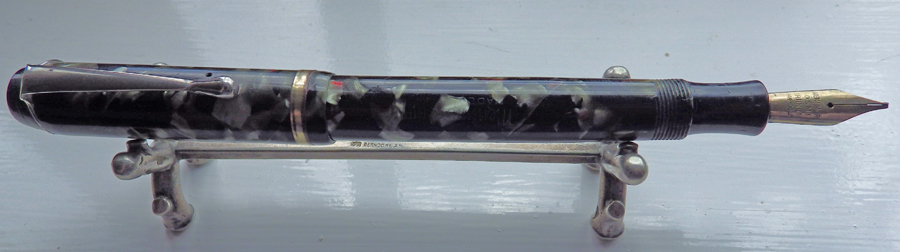
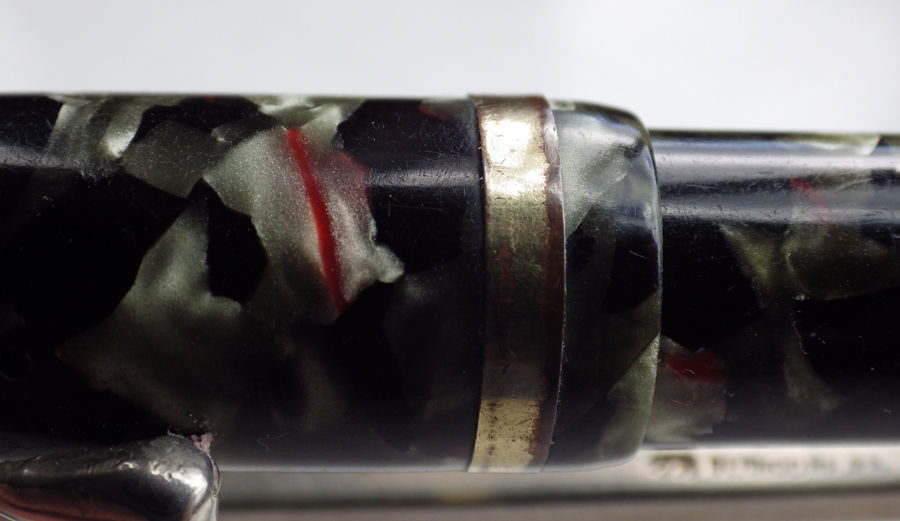
That, I must confess, is not the prettiest fountain pen I have ever seen. It’s clearly missing a large cap ring and it’s made from some sort of early injection moulded plastic which isn’t terribly attractive.  The cap screws on and is quite secure but it’s tight and you know there’s been some shrinkage going on there.

When you take the cap off, there’s this nice gold nib and then you see that it’s 18K gold-plated! It hardly seems worth the bother of going from 14K to 18K when it’s only a gold wash anyway.

It seems hardly even fit for the spares box until you try writing with it, and then suddenly it becomes an altogether better pen!

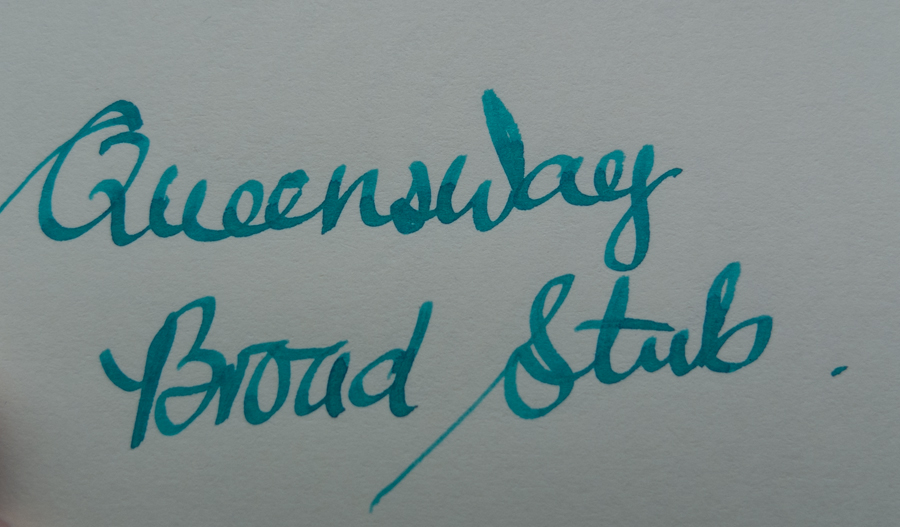
I’ve tried researching Queensway, the company that made this pen, but I’ve drawn a blank. It’s surprising that there’s nothing about them on the Internet because in the postwar decades Queensway pens were everywhere. I asked my husband about them, as he benefits from having grown up in Britain and also being a little bit older than me (just a bit). He recognised the style of this pen but the ones that he used were later and were cartridge fillers rather than lever fillers. He said that after having lost and broken the better quality pens his parents bought him, he was condemned to a life of Platignums and Queensways. Whereas the Platignums were just bad the Queensways were truly awful. They existed to leak. It was something to do with the cartridge, which if he remembers correctly, had a strange neck which didn’t fit right and ensured that the ink went everywhere except on the paper.

That’s a pretty bad rep! Surprisingly, this one doesn’t leak at all and it writes beautifully. It’s still not an attractive pen but at least it’s a good writer.

The Jock Pen

For years my main supplier of pens was eBay but recently my other sources have been producing better pens.  By better pens I mean pens I can write about here and that will be interesting to my readers and customers.

Today I found the Jock Pen, a real rarity from times gone by.  I’ll add photos when it arrives but it’s a black hard rubber pen with engine chasing, made in the 1920s, I would estimate.

As you might guess, this is a pen with a Scottish connection.  I can’t tell who made it, but it was made for William Ritchie & Sons, a wholesale stationer with outlets in Edinburgh and Glasgow.  They also sold a range of stylos:  the Elderslie, the Bantam and the Accipol, as well as the Floeesie Valveless fountain pen*.

William Ritchie & Sons was a well established company, going back to 1892.  Like many other stationers, they added photography to their products, bringing out postcards of Scottish scenes and eventually getting into publishing, producing ‘Picturesque and Romantic Edinburgh’, a book I wouldn’t mind getting my hands on.

They’re no longer around.  Though I can’t find an exact date I think they closed down soon after World War II.  The Jock Pen is a fine memento of this company and I would love to find a Floeesie Valveless pen.  It sounds very interesting.

*Stephen Hull:  The English Fountain Pen Industry 1875-1975

The First Repair

The first pen I ever worked on was a little Swan eyedropper. Looking back on it now, it might have been a 1500. I found it in a junk shop, one of those places that was piled high with other people’s worn-out dreams, stacks of furniture and old trunks, ornaments and knick-knacks that had served whatever purpose those things serve.

The pen was seized solid with ancient ink. You’ll have to bear in mind that I was as innocent as a newborn where pens were concerned. I would have a pen like that disassembled in two minutes flat now, but then I had no appropriate tools or knowledge.

A few minutes examination showed how it went together. Getting it apart was another matter. Despite being a girly I have strong hands from years of operating motor bike clutch and brake levers, but I couldn’t unscrew the section. I was savvy enough to know that ordinary pliers would cause irreparable damage so that was out.

It occurred to me that ink is a water-soluble substance, so I suspended the pen nib down in a jar with a couple of inches of water in it. It worked in a way. By the next morning the water was deep blue and when I applied some force I was finally able to unscrew the section. The downside was that the front part of the pen which had been a dark greyish green was now a nasty dull yellow. That was disappointing but I refused to be discouraged about it. After all, I wanted the pen to write with, not to impress anyone.

I couldn’t get any ink to reach the tip of the nib. It seemed that the section was still blocked with dried-out ink. I couldn’t really see how to get the feed out. The rear of the feed was pointed so it wouldn’t be a good idea to hit it. It looked like it would have to come out from the front. I spent the day alternately soaking the nib/feed/section unit and pulling on it. I wasn’t getting anywhere. It wouldn’t budge.

Then I had a brilliant idea! I took a set of pliers, ground the ridges off and wrapped the jaws in many layers of insulating tape. I seized the nib and feed with it and give a mighty pull. And the feed broke off. That was a bad, bad moment.

There were no Internet discussion boards where I could go for advice in those days, and everyone I knew was perfectly satisfied with their Bic ballpoints and regarded fountain pens as being as outdated as a horse and cart. All I could do was ponder on my experience and try to find a way forward. No blinding light of revelation came to me but I had learned that force is never the answer, pens (I didn’t even know what the material was that the pen was made from) didn’t like water and I had made my first pen restoration tool, imperfect though it was.

That might have been the end of that and I would have had to be satisfied with a Bic ballpoint like everyone else or laid out the huge sum that new fountain pens cost in those days. Fate intervened, though, as it so often does, and I went to a stationery store one day to buy that accordion-fold paper that printers used back then. The man who sold it to me was making notes with a truly ancient fountain pen. I admired it and we fell into fountain pen conversation. In the past, as part of his stationery business, he had serviced and repaired fountain pens. That work had dried up several years before. Not only was he happy to sell me some tools and spares (including sacs) but he gave me a brief tutorial on types of fountain pen and the methods of their repair.

From that moment on there was no looking back. I would like to say that I still have that first Swan, all these years later, but barrels, caps and nibs are too precious for sentimentality. It was used for spares long ago.

A Mentmore Diploma

We all know what Mentmores are like, don’t we? The Diplomas are rather staid and old-fashioned, well-made but with nail-like nibs. They’re the Morris Miners of the British pen world.

Except that’s not always true. Take this beauty. The only other pen I can remember wearing this livery is the Watermans of the 1930s and it was known as Steel Quartz. Beautiful as it is, that’s not the best thing about this pen. It has a delightfully flexible nib. It needs no pressure at all to induce considerable line variation. It’s an unexpected treasure.

More generally, I think it’s fair to say that Mentmores are both underestimated and undervalued. They have the odd problem. Several models have poor gold plating. Others can have a tendency to slight shrinkage in the caps. It’s usually not enough to affect how the cap screws on but it can leave the cap ring loose. Not the worst fault in the world, but annoying.

That aside, Mentmore has much to be admired. If you like inflexible nibs – and many do – then the Mentmore is up there with Parker in nib quality. Given the large amount of tipping material that Mentmore applied to its nibs, it may be even better, in the sense that it is even more durable. Mentmore was not parsimonious with the gold and made big, sturdy nibs. As is the case with Parker, it’s rare to find a cracked Mentmore nib. Especially in the pre-war years Mentmore experimented with filling systems and in this regard they were the most adventurous British pen manufacturer.

After World War II, when fountain pen sales were beginning to fail in the face of the increasing reliability and popularity of the ballpoint, Mentmore didn’t lose their nerve. They brought out several new models that reflected the changing shape of fountain pens. They produced ballpoints of their own and innovated there as well.

I think that the better quality Mentmores are of the sleepers of the British fountain pen market. Their day will come.

Re-blacking Again (and again and again and again…)

There is discussion of restoration materials, namely re-blacking and waxes, in Fountain Pen Geeks. I would continue posting there, but what I have to say on the subject is (as you might expect) a little long-winded for a board comment.

As a restorer, I believe that one should do the minimum necessary to a pen to bring it to good working condition and an acceptable appearance. If you want old pens that look like they came from the factory yesterday, try another restorer. I don’t do that kind of work.

Re-blacking is irreversible, no matter which method you use. Even Syd Saperstein’s Potion No 9, which does not remove any material, cannot be fully reversed. It will wash off smooth surfaces, but removing it from chasing and the marks a pen acquires over decades is very difficult or actually impossible. Methods that depend on removing the oxidised layer will also remove detail of chasing and imprints. Then, of course, it will oxidise again. So what do you do? Remove more surface layers?

If you have a common and inexpensive old hard rubber pen that has turned absolutely yellow with oxidisation, and you have no intention of selling it, then it seems to me that there is no great harm in using the latest product to come on the market to re-black it. It apparently removes very little material and it may make your pen more appealing to you for a time. It may fade again. After all, some black hard rubbers are more prone to fading than others. It may, for all we know, dissolve into a puddle of goo some way down the road. We don’t know the long-term effects of any of the current products. By time we do it may be too late.

My strongest word of caution is: don’t re-black uncommon and/or expensive pens. We have a duty of custodianship to our pens and to the hobby. Old pens are important historical artefacts and should be treated as such. That’s not to say don’t write with them, or keep them in a glass case but it seems sensible not to coat them with chemicals whose ultimate effect we don’t know. Black hard rubber is very durable and, left alone or conserved with the minimum of intervention, these pens will last a very long time. Using inappropriate substances on them may, in the long term, destroy them.

Most oxidisation is not unattractive. Careful hand polishing will make most hard rubber pens look good. That’s all that I do with the pens that pass through my hands.

I don’t have much to say about the use of waxes. I don’t believe they have a place in pen restoration. All, so far as I am aware, have been shown to contain chemicals that are, at the very least, dubious. Some attack metals. All seal the surface of the pen which doesn’t seem all that clever a thing to do. They are very, very hard to remove. They produce a wholly unnecessary gloss. Why do it?

Over the last decade I have seen the supply of old pens begin to reduce. Nobody is making any more old pens! We must look after those we have and that includes using a minimum of chemicals and only those we know to be trustworthy.

Waterman 52 (Again)

I’m sure I’ve written about the Waterman 52 before but as it’s a superb pen it’ll do no harm to eulogise it again.

Its immediate ancestor was the Waterman 12, and when the company brought out their lever filler it became the 52, the five denoting the lever filling system and the two for the size of the nib.

When you find a black one these days it’s usually quite faded and if it’s chased the pattern is well-worn.  This one has retained its original blackness and the chasing is sharp.  Perhaps it wasn’t used very much because it had a damaged nib.  The pen is US-made but it now has a Canadian flexible stub nib, a real beauty.

52s as you may be aware, came in a variety of guises.  There was the plain black hard rubber, then the chased version, like this one.  Rather rarer and more desirable are red hard rubber versions and the lovely ripple hard rubber in different colours.  If you wanted to spend a bit more you could have various cap and barrel bands and the most expensive models were encased in gold or silver overlays.

I like hard rubber.  It’s a great material and I’m grateful to Waterman for sticking with it as long as they did and making so many pens from it.  It didn’t do the company any good though, as the public wanted patterened celluloid by the 30s, and Waterman sales went into decline.  By the time they changed they had lost market share and they never quite recovered from it.  They made a celluloid 52 – same shape and size and same nib but for me it lacks the character of the hard rubber version.

The Waterman 52 was not an expensive pen when it was new.  Rather, it was a good quality pen for everyman.  Now as David Isaacson noted in his excellent blog* a couple of years ago, it has become an expensive pen.  This is due to the mistaken belief that all Waterman 52s have flexible nibs.  Some do, most don’t, but even a faded and battered example will cost you considerably more than a good one would have done a few years ago.

Pen prices are rising across the board, but the present high demand for pens with flexible nibs has distorted the market.  Various modern manufacturers are offering what they describe as flexible nibs but so far none of them approach vintage pens in that quality.  I really hope that someone comes up with a very good flexible nib soon, so that we can get back to a situation where the only people chasing vintage pens are those who really want vintage pens, not just a flexible nib.  I even hear of people putting vintage flexible nibs in modern pens.  For me that’s just desecration.

http://vacumaniablog.blogspot.co.uk/