An Unbranded Lever Filler


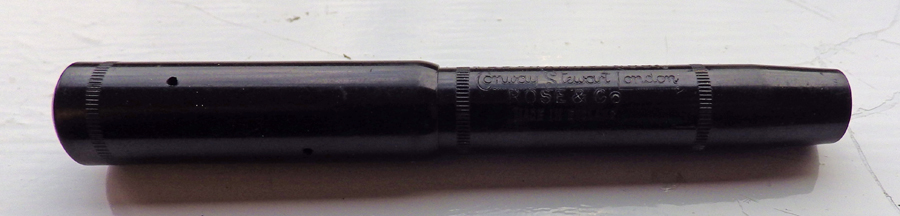
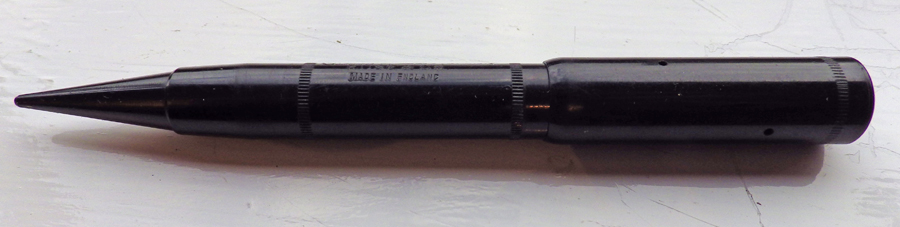
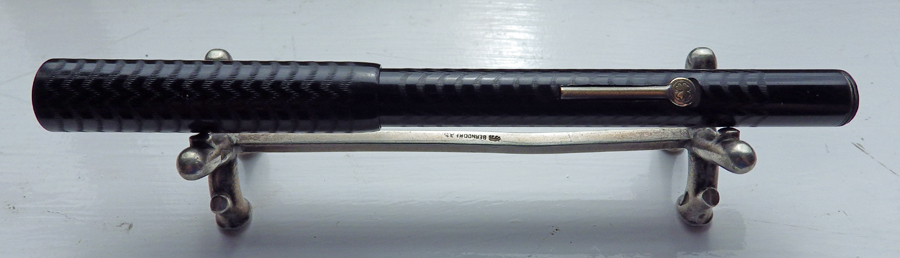
IMGP4042There is a language to the design of pens and with experience you can read it. Straight sided barrel and cap, bought-in lever, threading at the end of the barrel to take a posted cap: all this adds up to a recognisable type of pen. Nobody knows who made them. It might have been Mentmore, Wyvern, Langs or just about anyone else. It might even have been a pen manufacturing company whose name never occurs in any context. These pens were cheaply mass produced as giveaways or inducements to buy for commercial companies that had nothing else to do with fountain pens. Often they were given away by newspapers in return for postage and the mastheads of a week’s worth of daily papers.

IMGP4050

This one is a bit strange, though. It was made for FW Parris and Sons, which is a large hardware store in Nagambie, Victoria, Australia. So the story is that this pen was made in Britain for an Australian company and somehow found its way back to the UK again. That’s a lot of travelling. People didn’t fly to Australia when this pen was made in the 1920s, so there probably were two ocean liner voyages.
IMGP4043

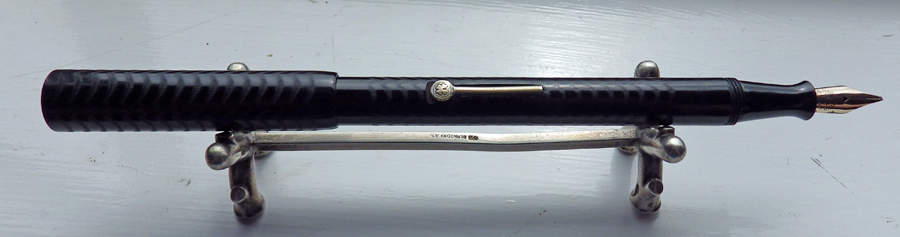
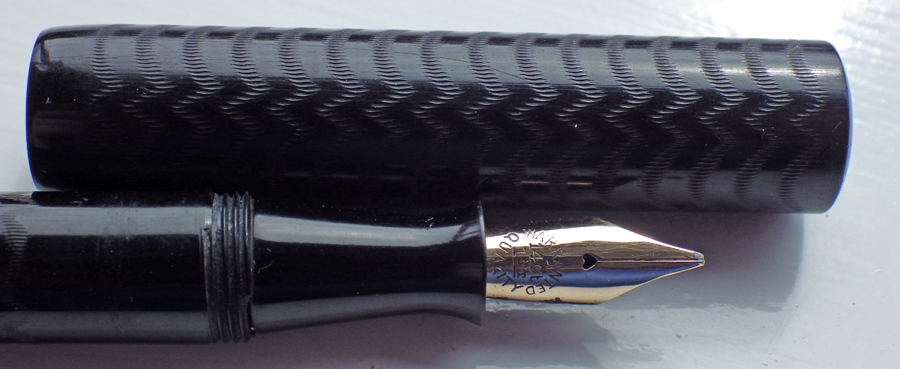
As I said, these pens were produced to a low price, in large quantity. The quality is good nonetheless. The cap and barrel fit together well and the black hard rubber is as fresh, and the chasing as sharp, as the day it was made. Perhaps that’s an indication that the pen wasn’t used much but it has survived the intervening near-century in better condition than many much more expensive and prestigious pens.
IMGP4046

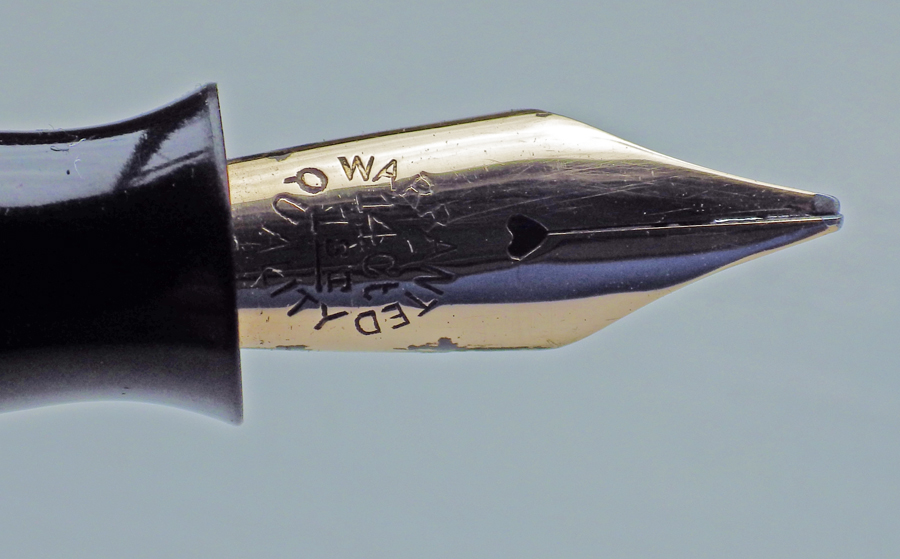
The nib is warranted but it’s a reasonable size, comparable with a Swan No2.
IMGP4045

I suppose this pen is roughly the equivalent of some of today’s law-cost Asian pens, some of which are rebadged for commercial companies in a similar way. I doubt that the modern equivalent will look as good 90-odd years from now.
A Mechanical Pencil

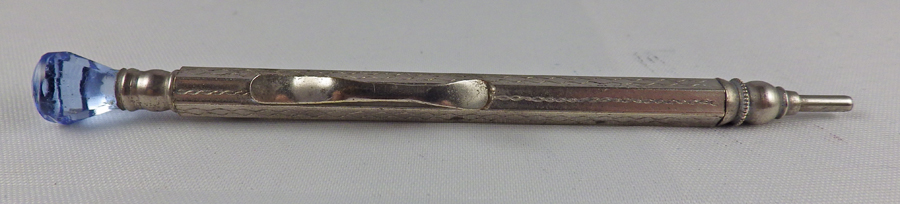
It amazes me that pencils like this one are so little valued. This one arrived as part of a large lot of pens and the seller didn’t even bother to mention it in the list. It’s not silver. It’s steel or an alloy, what we call white metal for convenience. It’s six-sided and two engraved patterns alternate around it. The rather decorative nozzle suggests that it has some age – Victorian or early 20th century – I can’t say with any certainty not being very well informed on pencils.

It has two attributes that one would think would make it collectable: it’s useful and it’s attractive. The blue glass jewel really sets it off.

These little pencils must have been very convenient and much used in the days before the ballpoint changed everything. You didn’t have to fill it with ink or sharpen it. It was just there, ready for whenever you had to take a note.

At present, mechanical pencils are only really appreciated if they are silver or made by one of the most valued manufacturers, like Sampson Mordan or Yard O Led. Though these ones do sell, they don’t make high prices compared with fountain pens. It seems to me that mechanical pencils could be an area of collection that wouldn’t be too expensive.

Stylos, Newsletters, Sections and Things


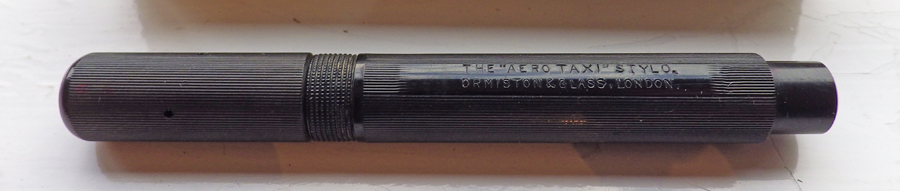
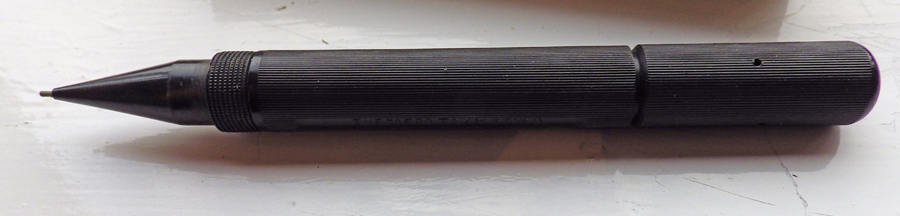
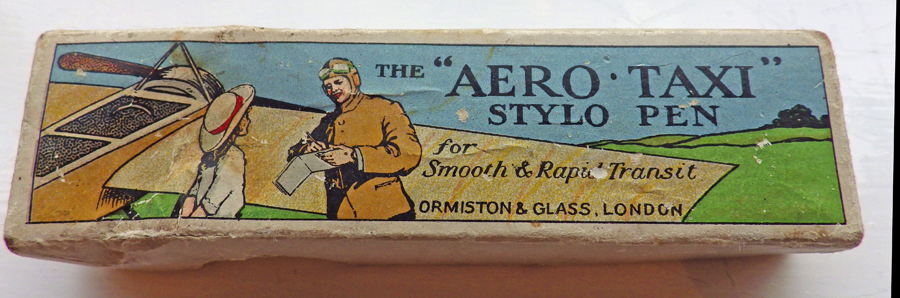
That Ormiston & glass stylo and its box are very interesting. Old pens are historical artefacts but sometimes they don’t give much away. Through experience I can often establish a rough date for a fountain pen just on its appearance but I’m less familiar with stylos. I don’t know what style changes they went through. I know that they remained popular at least until World War II and Churchill’s everyday writer was a stylo.

When you get a box, though, and especially a wonderfully illustrated box like this, there is more information to be had. I’m not sufficiently well up on aeronautical history or the history of dress to be precisely accurate, but it says to me that it’s before 1920.

On another note, I had been thinking about issuing a newsletter to customers through a facility on the sales website. However, it isn’t straightforward and there would be a number of hurdles to overcome including learning quite a bit of HTML. To be honest, I’d just as soon have root canal treatment. Also, it has no capability of showing images which is quite limiting.

Apparently there is another program I could use which would access my customer list and use templates to avoid the necessity of learning HTML but it seems the cost rather a lot for what could only be an occasional newsletter.

Another restorer and I were discussing the phenomenon of extremely tight sections/feeds. Once you’ve drifted out the feed and nib and cleaned everything up and you go to put it all back together, what was there before just won’t go back! This problem never seems to afflict Swans but isn’t uncommon in Conway Stewarts and Mentmores. Some Langs pens can be affected in that way too. Almost invariably the offending sections and feeds are hard rubber, which isn’t subject to either shrinkage or expansion. Perhaps the feeds and nibs were fitted with a mighty hydraulic press!

Of course these difficulties are always resolved. My friend Mr Heat encourages these recalcitrant parts to cooperate.

Odds & Ends

Two large lots of pens I’d ordered arrived this morning. It was like Christmas! Some good pens of which more to follow. There were also some interesting items among them.

This is a gorgeous Conway Stewart Dandy No 81 Ink Pen, as crisp and black as if it had been made yesterday instead of sometime in the 30s.

An equally pristine Ormiston & Glass Aero Taxi Stylo was there as well.

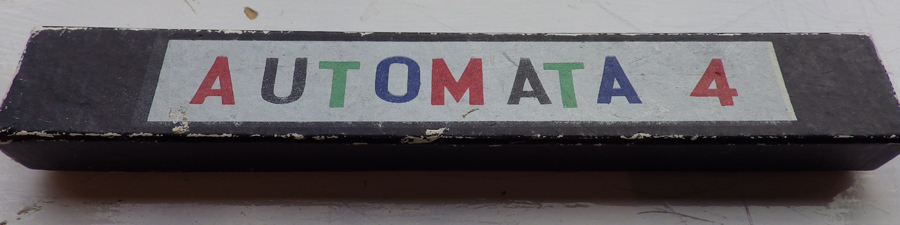
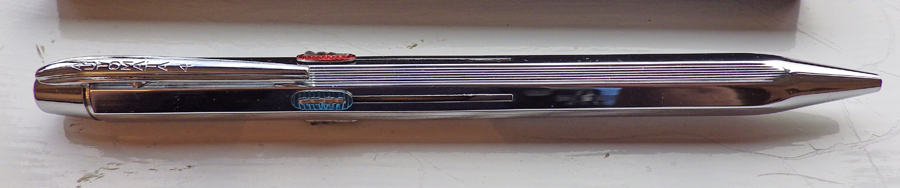
Rather more modern, but quite interesting too in its way, is an Automaton 4-colour ballpoint pen. These things have always been popular with children of all ages and I have a modern version in the cup on my desk.

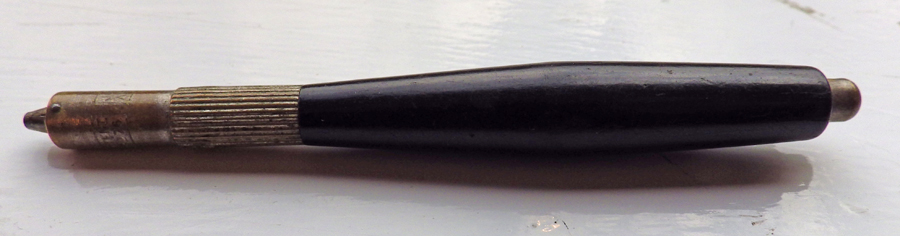
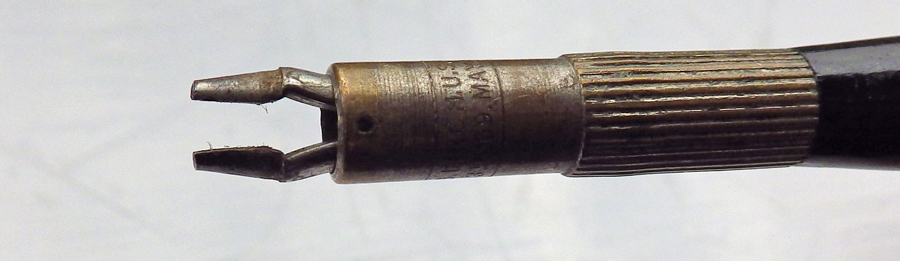
Lastly is this rather odd-looking ebony and plated brass item that I at first took to be some sort of mechanical pencil. Closer study revealed the name John S Birch and a patent number. A quick spell of online research revealed that it is a 19th-century pocket watch winder.  Many older watches required keys for winding and they could easily be lost. This was a universal solution to that problem.

Conway Stewart 800 Ink Visible

Once they got past the eyedropper filler stage and lever fillers came along, that’s what Conway Stewart did, with huge success. I’m talking about the original company, of course, not the various later efforts that borrowed the name but little of the enterprise.

When something works there is no point in messing with it, and Conway Stewart’s lever fillers worked well with the same – rather good – design for decades. Like Waterman they used a slide pressure bar which depresses the sac much more efficiently than the J-bar that some other manufacturers used.

Despite that great success, Conway Stewart did try other filling methods. The Speedy Phil was a complicated twist filler. There are a few around today but it seems clear that they didn’t sell all that well. Conway Stewart also made a first-class button filler, but again, the numbers surviving suggest that sales were poor. It looked like the public was telling Conway Stewart to stick with what they did best: lever fillers.

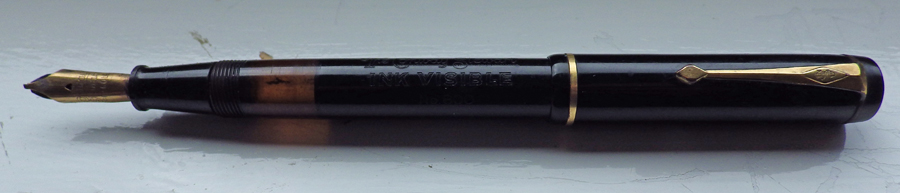
They tried one other innovation, the Ink Visible, a type of piston filler. I’ve wanted to get my hands on one of these for a long time but they don’t turn up very often. Again it may be that sales were low, but in addition they are quite fragile, and any attempt to disassemble one has to be done in the right way and with appropriate caution.

I managed to snag one in eBay recently. It had been in good order before someone started fiddling with it, pulling the nib and feed partially out and leaving tool marks. Checking visually, it doesn’t seem that the tamperer has managed to break it.

I plan to leave restoration for a time when I have nothing to distract me. I would really like to have this pen back in working condition again but I know it won’t be easy. I’m not going to be too strictly original about it and I can see the cork seal being replaced with an ‘o’-ring. The pen has a nice oblique stub and I’m looking forward to using it. More will follow!

Ranga/Sheaffer

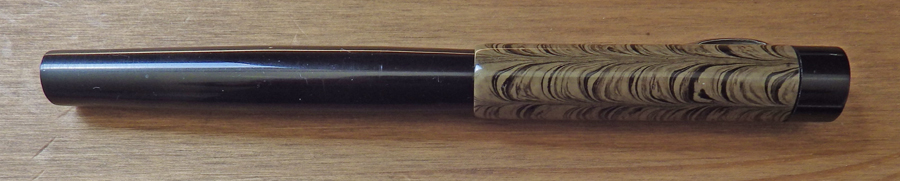
I’m writing this with a Ranga pen which I bought from Peyton Street Pens some time ago. It’s a big pen at 15 cm capped and 18.6 cm posted and it’s one of the few that I don’t post. Barrel and cap are hard rubber, the barrel black and the cap in that delightful wave pattern that Waterman called ripple. Though it’s big it’s very light due to the material.

India seems to be the only place that routinely works in hard rubber. I’m grateful that they do because it’s a material that I really appreciate.

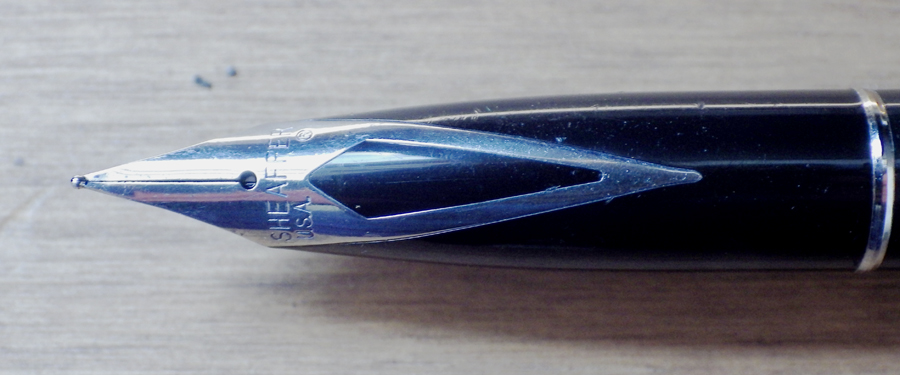
The other outstanding aspect about this pen is the nib. It’s a 60s – 70s Sheaffer Imperial nib, excess components from the time which are being very creatively used now. I love Sheaffer inlaid nibs and I love hard rubber, so this is a dream pen in many ways.

There are a couple of slight drawbacks. I couldn’t get a fine nib at the time I bought this pen so I had to settle for a medium. I suppose I could grind to a fine but it’s so smooth and reliable that I think I’ll leave it as it is. The other thing is the fitting of the cap which is a little imprecise. I sometimes have to try a couple of times but once I catch the thread it closes firmly. There is never any skipping or hard starting with this pen and it isn’t excessively wet either. Just right.

Looking at the Peyton Street Pens website I don’t think you can get this flat-topped version now. The latest pens using the Sheaffer nib, the Ranga Ebonite 4CS, is round topped, also a very attractive pen in a variety of patterns. I think there are more nib size choices too.

I would heartily recommend this pen to you all but there is one word of caution. Customs and Excise apply tax to anything from America these days and Royal Mail add on an £8 handling charge. This makes the pen a lot more expensive than it should be. I don’t understand how this charge works. I’ve had many pens delivered from Japan and China and they never seem to attract the attention of Customs. At one time I used to bid on pens in eBay USA and for years it was a good way of adding variety to my stock. Then, some years ago, customs began applying charges and put an end to buying American pens. Such a pity.

Collecting

There was an interesting discussion in Fountain Pen Geeks on the subject of collection. One respondent suggested that there are less collectors now than there were a few years ago. Knowing him, I assume he meant collectors of vintage pens rather than modern ones.

There may well be something in what he says. One pen discussion board which dealt exclusively and knowledgeably with old pens closed some years ago. The Fountain Pen Board, also covering vintage pens, has become very quiet in recent months, though the reason for that is not entirely clear. Pentrace and Fountain Pen Geeks both do discuss old pens but on balance they seem more concerned with current pens. I don’t know about Fountain Pen Network. I haven’t been there since it became Mordor.

Against that, old pens continue to sell and prices continue to rise. Some of these pens undoubtedly do go to collectors but, in my experience, most sell to people who appreciate writing qualities they cannot find in modern pens.

There is another branch of collection, though, and that is collection of modern pens. It’s rather different, in that it doesn’t involve the search for that one elusive pen from a century ago that is needed to complete the set. In fact, I have no idea how collection of modern pens works. I know that people pursue limited editions at huge cost. To be frank, limited editions seem like a scam to me. The pretence of exclusivity is a fiction. A limited edition of 500 pens is probably as many or more than many ordinary, everyday models will sell these days. Also, it seems to me in my ever so humble opinion, that any pen selling over £300 has a huge margin of profit unless it is made of precious metal.

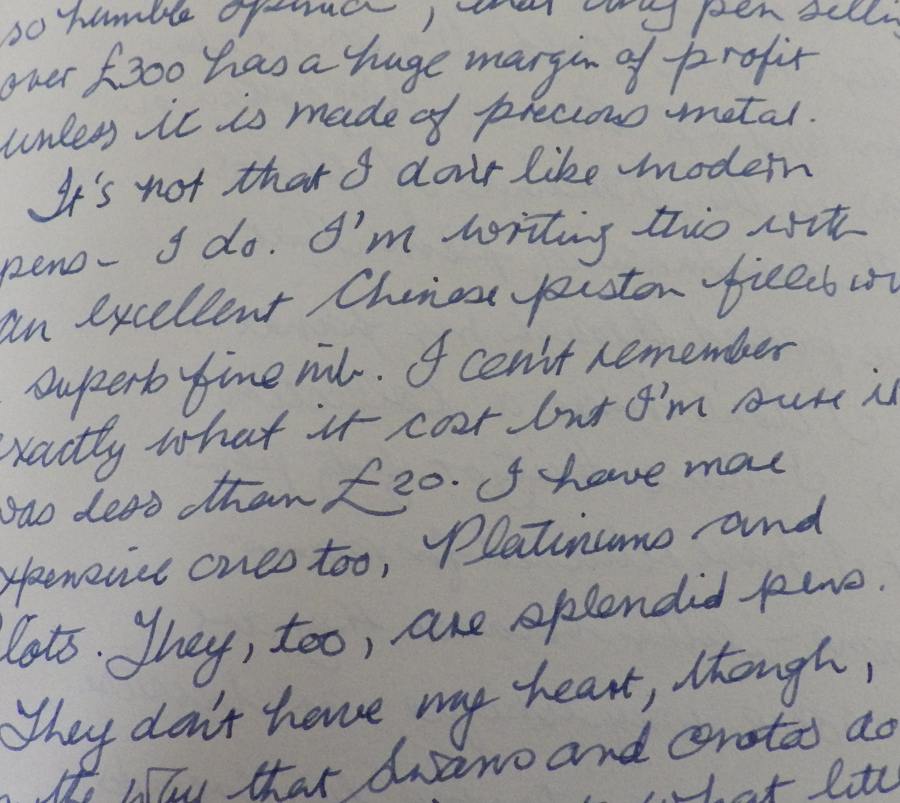
It’s not that I don’t like modern pens – I do. I’m writing this with an excellent Chinese piston filler with a superb fine nib. I can’t remember exactly what it cost but I’m sure it was less than £20. I have more expensive ones too, Platinums and Sailors. They too are splendid pens. They don’t have my heart, though, in the way that Swans and Onotos do. Pens like those bring out what little creativity there is in me, and with one of them in my hand I’ll write for the sake of writing.

I’m not a collector. I was for a while and I amassed a small collection of Conway Stewarts. In the end, I realised that I would never be able to afford the kind of complete, comprehensive collection that I was aiming for. I could do a better thing. I could buy and restore pens and sell them on. My collection now is the thousands of photos of the hundreds of pens that have passed through my hands.

I don’t have a collection of pens now. I have 30 or 40 pens that I have retained for various reasons, either because they are in some way unique, or because they were given to me by friends or because I love the way they write.

I’m afraid I’ve rambled on here without coming to any conclusion but that’s because I don’t know what conclusion to come to. Is vintage pen collection dying? I don’t think so but I don’t have much evidence either way. Perhaps you do.

A Parker Duofold Junior

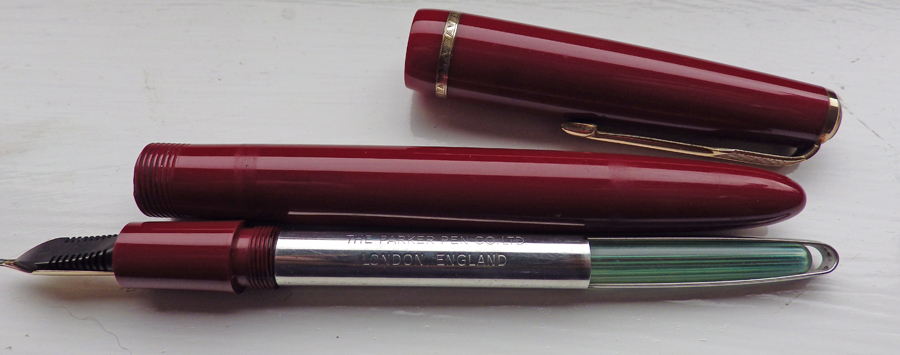
We had a discussion some time ago about UK Parker Duofolds and came to the conclusion that they are reliable but dull. It’s strange that quite a few modern pen makers, especially Japanese ones, use that same cigar shape but they are not regarded as dull. Or maybe they are. I’m not well up on modern Japanese pens.

Be that as it may, not all Duofolds are equally uninteresting. Take this red Duofold Junior, for instance. It’s the same length as the standard Duofold but slimmer.

The other difference is that it doesn’t have the full sac protector, as you can see in the photograph. Otherwise it’s pretty much your average British Duofold.

So what’s so special about this one? Well for a start it’s red. Red pens are always exciting, aren’t they?

Maybe not, but have a look at this nib. It’s broad, stubbish and unlike most Duofolds – flexible!

Between the stub and the spreading tines, it gives a lot of line variation, so here’s one Duofold at least that isn’t dull.