The Rubinette (Part Two)


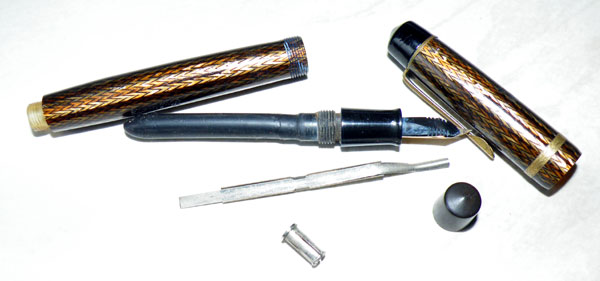
I finally got around to disassembling the Rubinette for repair. It turns out to be a perfectly straightforward button filler, and there were no internal clues to its origin.


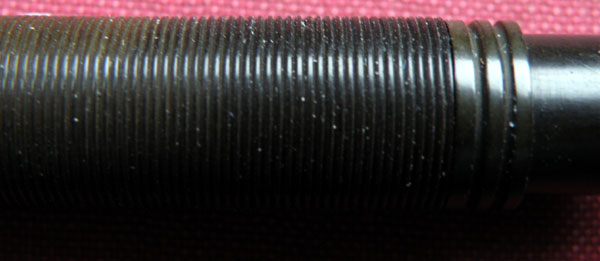
It scrubbed up pretty well, apart from some ink traces on the barrel threads which I’ll remove later – I have my methods! Further extensive searching online and in my reference materials found no reference to this pen nor any tie-up with the 1950s Rubidor ball-point.

The Rubinette Button-Filler


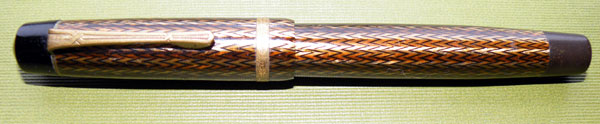
It’s always been my aim to get a set of all the herringbone pattern colours that Conway Stewart used for their late fifties/early sixties pens. I’ll probably never achieve that but I found a herringbone celluloid that they didn’t use: this beautiful gold-coloured Rubinette button filler.


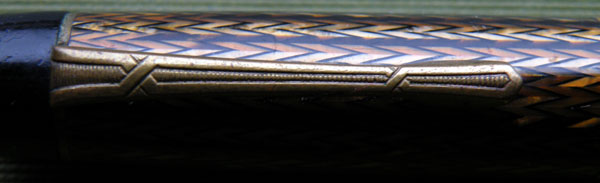
I have yet to restore this pen, but it’s a lovely piece as it is. The clip and cap ring are patterned and the mount for the button is made of clear plastic. Searching for Rubinette didn’t help me much. It’s a variety of apple and there’s a Rubinette Way in Winchester. Oh, and it’s a seldom-used synonym for “ruby”. Nothing about pens.


So if you know anything about the Rubinette, please share the wisdom!

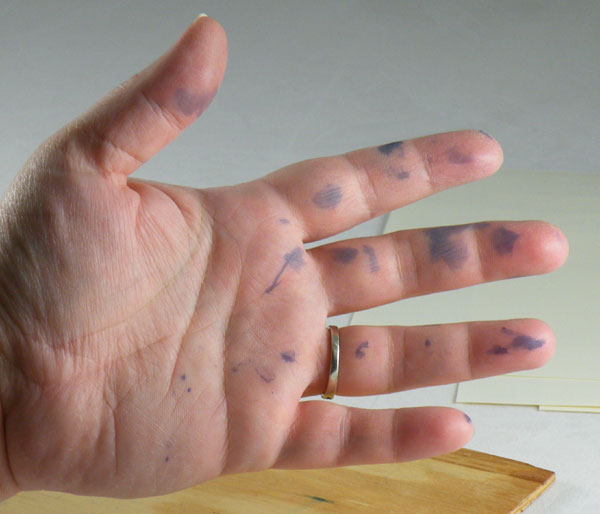
On another topic, ink’s a useful substance in the bottle or the pen or on paper but anywhere else it’s a messy nuisance. Handling pens all day as I do, there are plenty of opportunities to get inked, so I glove up to work on pens and even to do writing samples. Now, it seems, I need to put on gloves to open the mail:


Please, please drain and flush pens before sending them out…

Summit S100 Cadet

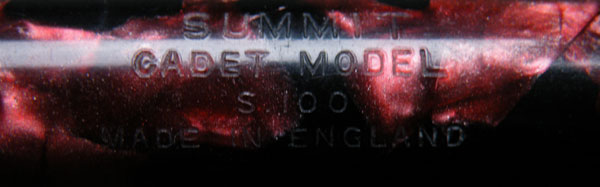
This rose marbled pattern plastic is, I think, unique to Summit. I’ve seen somewhat similar patterns on Stephens pens and on some Parkettes, but they don’t have the intensity of this colour. It almost glows in the dark like the slumbering embers of a rested fire.


After World War II the S100 became the S100 Cadet Model and I think it’s reasonable to assume that this pen was aimed at the school pupil market. That doesn’t imply a decline in quality; this is still a well-made pen, crafted with attention to detail.


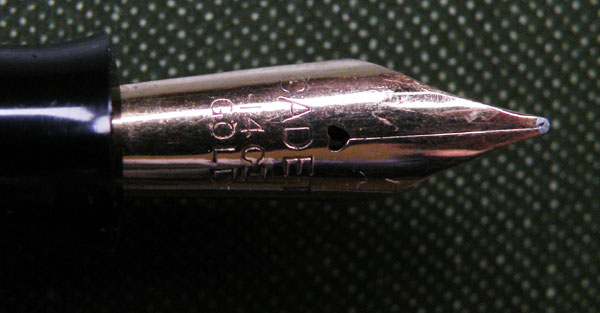
The 14ct gold nib is marked “Cadet” now to match the pen. Compared with the more streamlined pens being produced by Conway Stewart at this date, or the hooded-nib Mentmores, the Cadet may be regarded as conservative – and justly so. A case can be made for conservatism in pen design. Streamlining is purely aesthetic; it confers no practical benefit on the writer. Mentmore’s hooded nib was just an ordinary small nib enclosed in plastic, unlike the Parker 51 it emulated which at least had a redesigned ink delivery system to justify its shape. It might be said that sticking with the tried and tested traditional pen shape gave the owner a better writing instrument.

Certainly, enough of them sold for Cadets to be quite plentiful still, though not all are in this glorious colour. This example has survived in near-perfect condition and it’s a comfortable and well-balanced pen in the hand. It writes well with a consistent medium line.

The Fattorini President

Back in the beginning of April, I saw a small job lot in Ebay that took my interest. There was a virtually worthless Platignum Silverline, a black chased hard rubber Blackbird and a strange pen with no nib that was evidently quite old. At first glance, because it had a prominent barrel ring, I took it to be a crescent filler that had lost its crescent. When it arrived and I was able to examine it properly it clearly was not a damaged crescent filler. I toyed with the idea that it might be a coin filler, but after sliding the barrel ring back and forth a few times I concluded that it was a primitive form of piston filler.

 

Apart from the missing nib the pen was in remarkably good condition and the clear barrel imprint told me that this pen was The President, made (or sold) by Thos. Fattorini Skipton Ltd. A quick search online showed that the Fattorini company still existed, and there’s a wonderful PDF file of the history of this entrepreneurial family here:

http://www.buttoncrs.com/pdffiles/FattoriniCompaniesHistory.pdf

I found an email for the company’s Birmingham sales team and wrote including a couple of photos to enquire whether they knew anything about this long-ago product. I had little hope of a reply so it was a pleasant surprise when an email arrived from Greg Fattorini, Managing Director. He informed me that though they had no record of this pen, they had outsourced manufacture of pens that they sold in the their jewellery shops, some from De La Rue, the makers of the Onoto pen, and others from Switzerland and the USA. If I was pushed into a corner I think I might opt for the USA as the most likely source of this pen, given its resemblance to other American pens of the period. Given that Thos.Fattorini (Skipton) Ltd. was incorporated in 1919, I’m forced to put the pen’s date at that year or very soon after, though the style of the pen would suggest a few years earlier.


The use of the barrel ring to operate what is, essentially, a syringe filler is quite ingenious. I’ve never seen anything quite like it elsewhere.
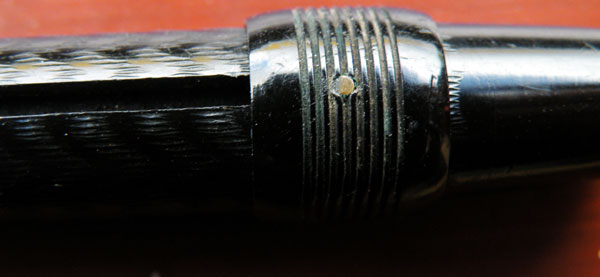
The whole filling assembly is held together by a tiny brass pin which would have to be drifted out for the pen to be serviced. I was fairly certain that if I tried to remove the pin I’d break the whole thing, so I sent the pen to the estimable Eric Wilson, who fitted a cork seal and returned the pen to working condition. He notes, “I would imagine there was quite a risk when putting the pen in your pocket of catching the barrel ring, pulling it up and squirting ink on yourself!”
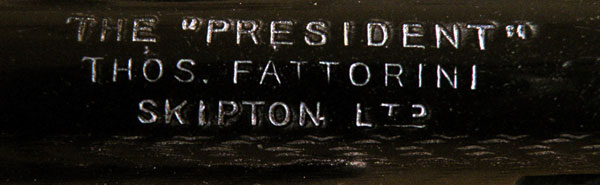
 

That risk aside, the pen is a very handsome rarity. It’s in remarkably good condition for its years. The black hard rubber has not faded at all and the chasing is crisp and sharp. It’s an innovative and high quality instrument and a credit to the house of Fattorini.
A Brace of Wahls

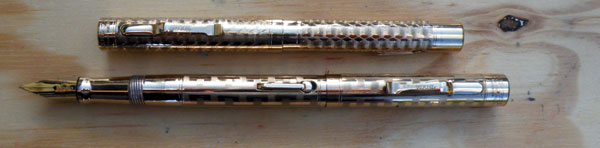
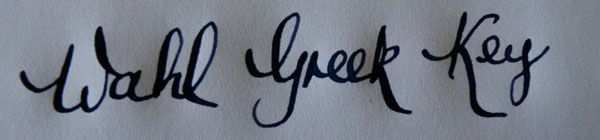
Recently somebody was selling off their collection of overlay and metal bodied pens and I bought a few of them. These are the shorter Wahl Gold-Filled pens, measuring 10.8cm (41/2 inches). They were made between 1920 and 1929, the height of the Art Deco period, and these are often called Wahl Art Deco Pens. That’s odd, in a way, because there’s no individual feature of these pens that relates to the Art Deco Style. They’re restrained and symmetrical. The machined decoration on one – the Greek Key Pattern – is entirely classical in origin and the other, the Diamond Wave Pattern, is without any obvious influence. The overall effect, though, with the shapely clips and the tiny, decorative levers, is, perhaps, slightly Art Deco Mild, as it were, and the fact that the patterning is machined rather than hand-engraved as it would have been in an earlier era, adds to this.


These are quite practical pens. Capped, they’re no longer short at 14.8cm, which is an average size for a pen. Both have the excellent Wahl 3 nib. The Diamond Wave patterned one is semi-flexible, but the Greek Key pattern is fully flexible. Both are a delight to write with. There’s a little loss of plating where the pens have been posted, but at 80 – 90 years old they’re as pretty and useful as when they were made.

The Bayard 2000

I don’t often buy French pens* but I couldn’t resist this boxed Bayard 2000. It’s a beautiful pen and it’s in wonderful condition for its sixty years. With its torpedo shape, narrow/medium/narrow cap rings and inserted clip, it bears more than a passing resemblance to the Swans of the same date. I don’t think there was any particular reason for that. So far as I’m aware there was no relationship between the companies – that’s just where design was at the time, and in fact Bayard had been making this shape of pen for some time by 1950.


Though its origins lie deeper, Bayard actually began production in 1922. Their logo was a knight with a fountain pen for a lance and a nib for a shield. Their motto was sans reproche which I’ll translate as “beyond reproach” or “irreproachable” until someone with better idiomatic French than me (most people) comes along and puts me right. They made consistently high-quality pens until the mid-fifties, when competition from the increasingly successful ballpoint pen began to seriously erode sales and, like so many other manufacturers they tried various cost-saving exercises that affected the quality of their pens. The company closed in 1965.


Among the last few high-quality pens Bayard made, then, the 2000 is an excellent pen by any standard. The gold plating remains very good on this example and a rub with a soft cloth soon restored the plastic’s original shine. It’s nicely balanced and sits well in the hand. Like many 18ct nibs this one has noticeable “give”. It’s not particularly flexible – though there is a little understated line variation – but it’s soft, making writing with it a very pleasant experience.


*This is not to cast aspersions on French pens. There are many superb French pens and I wish I could pursue them all, but the truth is that you can spread yourself too thin. There are so many British pens I have yet to write about, and many I’ll want to say more about. Also, unlike American and Canadian pens which have always been common here, European pens’ penetration of the British market was very slight.

Ormiston & Glass “The Secretary”

Ormiston & Glass began making fountain pens in 1902 and continued until, perhaps, 1920. They made some excellent pens and stylos.


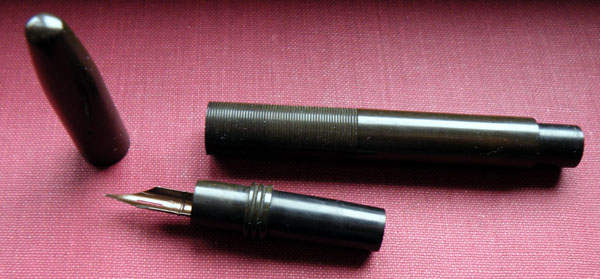
This rather strange pen doesn’t fit either of those categories. After studying it for a while I’ve concluded that it isn’t an eyedropper filler that uses dip nibs, but simply – or perhaps not so simply – a dip pen.


No ink flows from the “reservoir” to the nib. Also, as the two parts of the barrel simply slide together, it isn’t ink-tight. So it’s a dip pen. Why the accessible hollow barrel, then? And the slip cap, not usually a feature of dip pens?


I can only speculate but perhaps it is an attempt at a comprehensive solution for the secretary of the day. The hollow barrel could be used to contain extra nibs, and the slip cap would enable the pen to be carried in a pocket.


The pen is wonderfully well made. All the parts slide together firmly and the machining is of a very high quality. Though I’m not quite sure how it fits into the grand scheme of things, it’s a delightful small part of pen history.

An Oversize Salz Jade

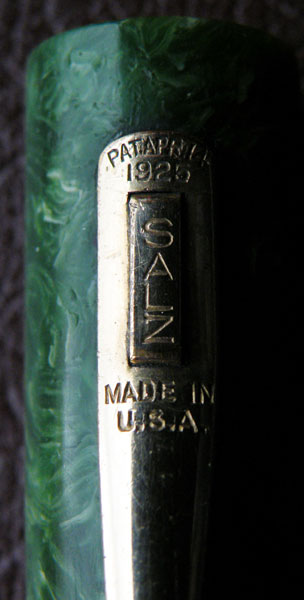
It’s an American pen today, and one that isn’t often seen in Britain: a Salz. We’re not talking about those little Dinkie-sized Salz Peter Pan pens either. This is a Great Big Salz – 13.8cm capped and 16.6cm posted.


I would guess that this pen dates from the mid to late twenties. Salz is usually thought of as one of the lesser brands but this is a high quality pen.

The gold plating has lasted well on the cap rings, lever and the unusual two-part clip. The nib is a warranted 14k gold No 8, which is a sizeable lump of bullion. Sadly, there’s no tipping material left on this nib, so the long search for a warranted replacement of the right size begins, before I can restore this big beast to working condition.


Perhaps the best thing about this pen is the colour. It’s that all-too-uncommon thing, a perfect jade with no discolouration. Quite the dream pen, or it will be when I finally get it fixed up.

The Bulow X450

I do stupid things sometimes. So do you, I expect, but you don’t then sit down and write about them in your blog.


A few weeks back I read somewhere about these good deals that were to be had at Xfountainpens. I went and had a look. Sure enough, the pens cost half nothing and for very little more you could have a supposedly improved nib fitted. Even broad and double-broad obliques were available. I selected a couple of X450s, paid the paltry sum and forgot about it.

A week later the postman delivered a package. By the weight I thought it must be at least a part for the car or maybe somebody had bought me a new bench vice. But no, it was the two cheap pens I bought. Each weighs an astounding 39.7g! A proper pen like, for instance, a Waterman 52, weighs about a third of that at 13g. Now I understand that some people – for whatever foolish reason – equate weight with quality, but brass pipe ain’t quality.

Once I got over the shock of the weight I tried filling one. A messy business. The converters the pens came with don’t exactly fit securely. However, once I got some ink into the things, they wrote. Quite adequately well, too, though their manufacturers’ idea of an oblique and mine don’t quite match. What this is is the normal round bead of tipping material with one side ground down a bit and rounded off!

I have bought the odd cheap Chinese pen before (recurring fits of madness) and it has been my experience that they write quite well for a fortnight and then bits fall off. These, I believe are made by Jinhao and re-badged as Bulow. The “improved” nibs are marked “Knox, Germany” but which bits of that are true – if any – I know not, though I have my suspicions.

The pens are solid if uninspired. The castings of the clips are somewhat vague, quite unlike the precision castings we’re used to in the west. The clutch on one pen is fine, on the other it takes such a grip that a mighty effort is required to pull the cap off, which is only accomplished to accompaniment of a fine spray of ink being jetted from the nib.

They make good paperweights, though.

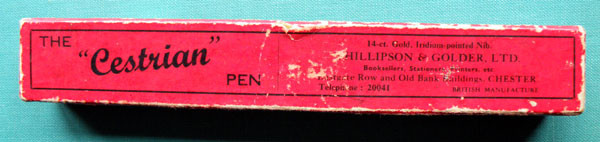
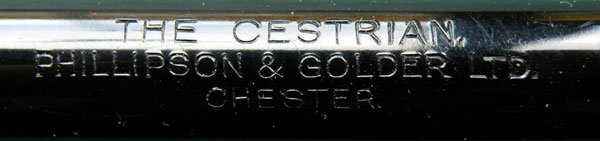
The Phillpson & Golder Cestrian

A Cestrian, in case you didn’t know (I didn’t) is an occupant of the city of Chester. Phillipson & Golder were (and may still be, for all I know) a large and successful printing and publishing business in Chester, turning out books, many related to the area, directories, maps, prints and an almost endless list of other things.


They also sold – or maybe gave away as a promotion – the Cestrian pen.


We don’t have to hunt for clues as to who actually made it; Thomas De La Rue’s logo is on the clip.


It’s a well-made pen in a plain way. Its only notable features are the quite short filling lever and the peaked clip screw.


I have nothing to date it by, but going on the style alone I would suggest that it’s a post-war pen.