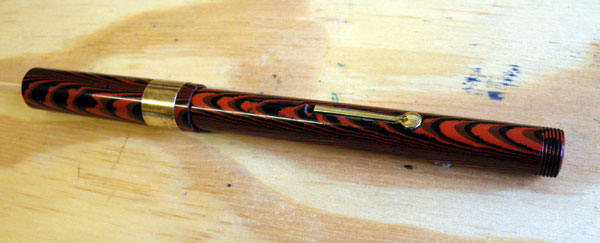
The Wyvern No 33 Clip Filler

Like the matchstick filler which it so closely resembles, the clip filler was temporarily accepted as a solution to the problem of getting ink into the pen, not because it was so technically elegant, but because the better methods were covered by patents that hadn’t been hacked yet.

I wrote about a clip filler before, back here: http://wp.me/p17T6K-kn and I had assumed that like this Aiken Lambert, all clip fillers were American. It turns out not to be so. Wyvern had their own clip filler.

By the late teens of the twentieth century, Wyvern was experimenting with self-filling pens. There was a matchstick filler of 1918 and it seems likely that this pen followed very soon after. It’s a slight improvement in convenience; you might not have a match handy but you’ll always have the cap at hand.

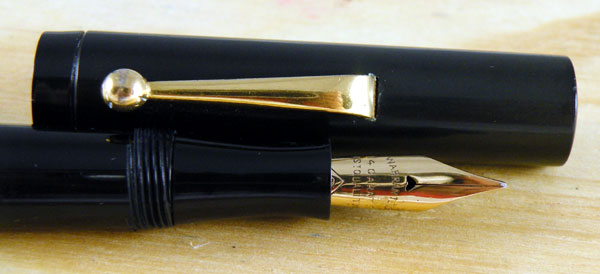
It’s a well-made pen of a very traditional appearance, straight-sided except for a gentle taper at the barrel end. This example looks like it has never been used. The black of the black hard rubber isn’t at all faded and the chasing is sharp, as is the barrel imprint.
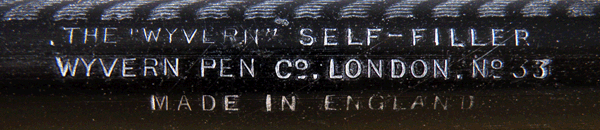
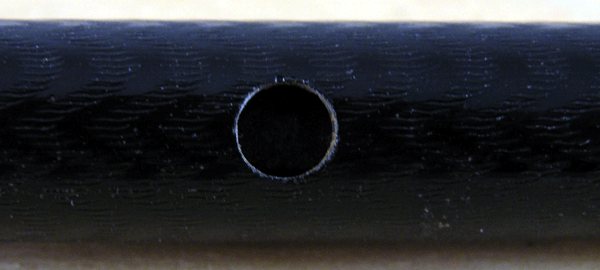
Actually, though I suggest above that the filling system isn’t elegant, there’s something to be said for minimalist simplicity. When it comes down to it, there’s no real need for a lever, crescent or hump if you can apply pressure directly to the pressure bar! It works unfailingly because there’s so little that can go wrong.
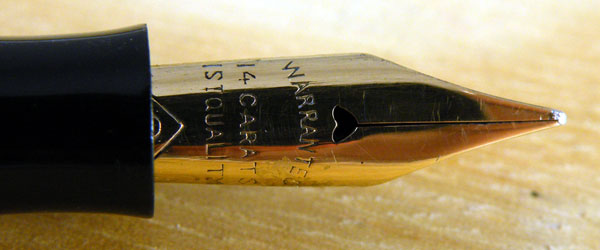
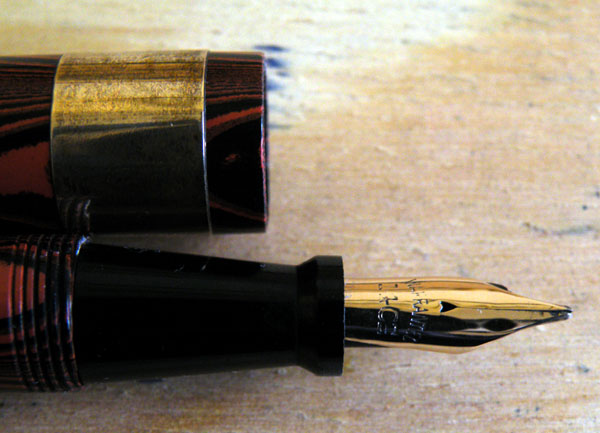
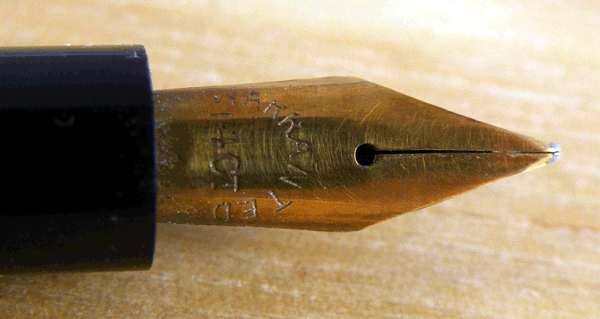
The nib is warranted and is likely to be original. Wyvern bought in nibs until the mid-twenties when they established their own nib plant. The nib has a modicum of flexibility.
All in all, this is an interesting, historical and practical pen. It’s an intriguing stage along the trail to the modern fountain pen.


My thanks to Shrikaanth Krishnamurthy for allowing me to see and photograph his beautiful pen.

The Mentmore Spot

When Mentmore started out one of their earliest pens was the Spot. The first version was a handsome flat-top mottled hard rubber pen and it was issued in 1923. It caught on quite well – it was a lot of pen for comparatively little money – and Spot became established almost as a separate brand in its own right. It was strongly marketed with the slogan “None genuine without the spot.” Spot pencils and ink were produced also.

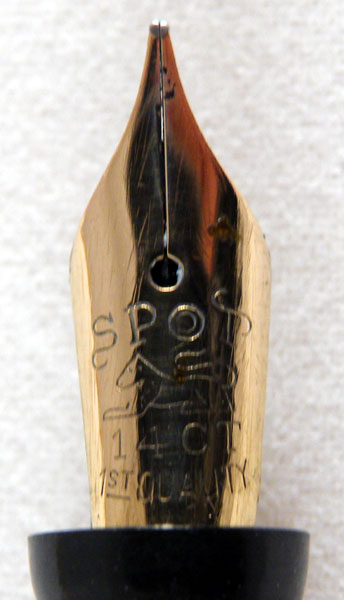
This one’s a later version, still hard rubber (quite faded in this case) but now streamlined and quite modern-looking. I can’t accurately date this pen but I’d guess at the late thirties. It has the leopard logo on both the nib and the barrel, and the cap band has the “stack of coins” form. It’s a solid, well-made pen, though this example has seen a lot of use.

Spot has a collector following and early examples are snapped up pretty quickly. It has been said – and appears to be true – that Spot used the white dot before Sheaffer used the same thing to indicate a lifetime warranty.

The Desbeau Advertising Pens

I frequently buy lots of pens in eBay. Quite often, it isn’t all that apparent what’s in the lot, but if it doesn’t go too high I’ll always take a chance. Apart from anything else, poor pictures and bad descriptions scare other bidders off, so if there’s anything decent in the lot, you score.

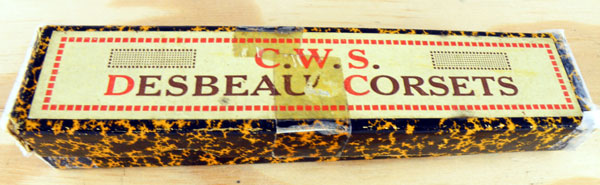
Among the other pens in this lot was this strange box.

And in it were two glorious pens, a mottled hard rubber lever filler from the twenties, which looks like it has never been used, and a later, maybe forties, button filler in striking green/black marbled celluloid. Score? Well, maybe…

Now I may be wrong, but I don’t think my customers will be beating a path to my door to lay claim to pens that bear the legend “Desbeau Corsets”. If I’m proved to be wrong I’ll happily sell them, but if not I’ll equally happily keep them as users. They’re gorgeous pens.

Of course my curiosity was piqued and I went a-googlin’ to see what I could find. CWS, as the Brits among us will recognise, is the Cooperative Workers Society. DesBeau Corsets were popular support garments made at the factory in Desborough from about 1920 to 1970. They were well marketed; as well as the pens, there were advertising pocket mirrors, fruit knives and thimbles.

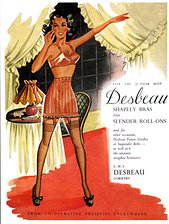
And there were adverts, like this one:

Does this imply that sex existed back in the nineteen-thirties?

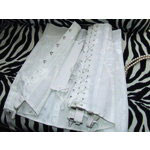
And finally, here’s the dread garment itself:

The famous Desbeau Corset!

The Paragon

This one’s a total mystery to me and if anyone knows anything about it, I’d be delighted if you would chime in. It’s the Paragon and that’s all I know with certainty. Stylistically, I’d say it was made in the nineteen-twenties. It’s the typical flat-top of that period though at 13.8cm capped it’s larger than most.

It has a large and elegant warranted 14ct nib and the lever bears a four-leaf-clover symbol. I believe these were parts that could be bought in. The clip is inserted through the celluloid of the cap and retained by an inner cap. The barrel imprint is the single word “Paragon”. Not another hint as to who made it or where, though there’s every reason to believe that it’s English.

This isn’t one of those cheap pens that were turned out in their hundreds as advertising give-aways or sold for a few shillings. This is a pen with a solid feel, well made, robust and quite impressive in its size.

Info, anyone?

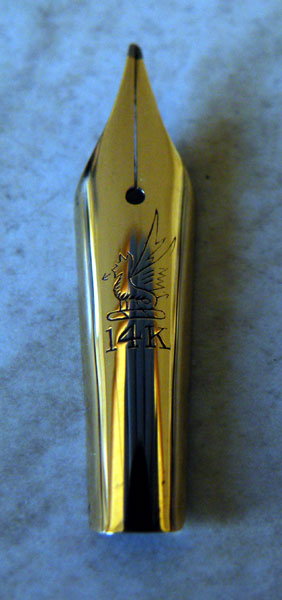
A Wyvern Nib

Just because it’s such a beautiful nib.

This nib belongs to a fairly shabby blue marbled Wyvern 60C. I haven’t tested it yet but it seems to me I detect some flex there, and a flexible Wyvern nib is one of the best you’ll get.

Whether this nib will stay with the shabby blue 60C or be grafted onto a better pen, we’ll just have to wait and see.

A Feast Of Kingswoods

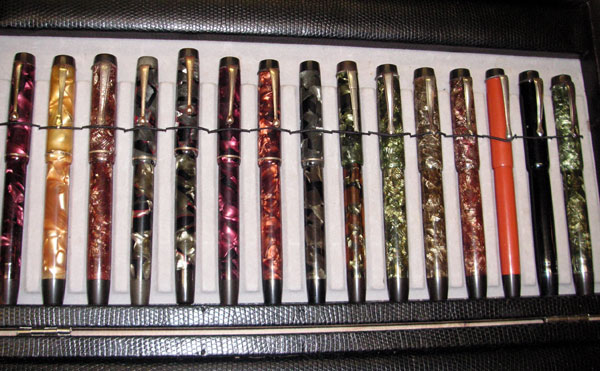
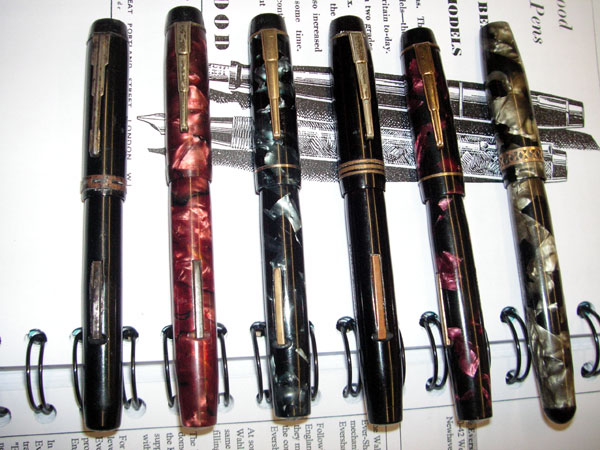
Some time ago Simon (Waudok) and I had a discussion about Kingswoods and I asked to see some of the examples he has collected. Good as his word, he sent me these pictures the other day and has kindly allowed me to reproduce them here.

These button-fillers are, I think, quite uncommon. Looking at the patterns of celluloid used, I would have little difficulty in believing that these were made by Valentine, sharing the same material they used for their own pens. I think there can be little doubt that Valentine is the source of most, if not all of these pens. That said, there are Kingswoods that are very Summit-like and share that company’s materials too. I have no doubt that the sleuthing of our dedicated researchers will, one day soon, solve the puzzle of the origins of the various Kingswoods.

These zig-zag patterned pens are outstandingly beautiful. They’re very reminiscent of Conway Stewart’s herring-bone patterns, though they employ a different celluloid.

Among the lever-fillers there are some that I haven’t seen before, notably the burgundy marble with no cap ring and the black three-ring example. It would be useful to establish a time-line for all of these pens but it’s a bit beyond me. I’d hazard a guess that the pen on the extreme right, missing its clip and with a pierced cap band, is later than the rest. It’s quite a common pen and I’ve had a few examples in different colours. Simon believes this pen was made by Unique.

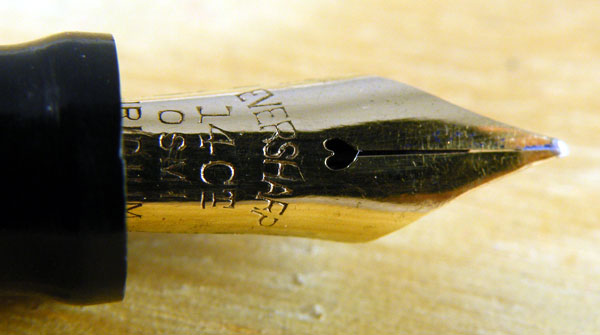
There was a time, not so long ago either, it seems to me, when you could pick up Kingswoods for very little. Though they’re still by no means expensive, they have a stronger market now. Appreciation of the excellent Eversharp nib contributes to that, I have no doubt, together with the realisation that these are sound pens with a fascinating history.

My thanks to Simon for his generosity in allowing me to share these beautiful pens with you.

A Late Ormiston & Glass Camel

Among the pioneers of fountain pen making in Britain is the firm of Ormiston & Glass. The company was established in 1868, probably as a manufacturer of steel nibs, among other stationery products. In 1902 the company was incorporated as a limited company and began the production of fountain and stylographic pens in that period. They were an innovative company and provided a wide range of fountain pens and stylos. In later years, probably after 1915, the company stopped making fountain pens and continued with a varied range of other products.

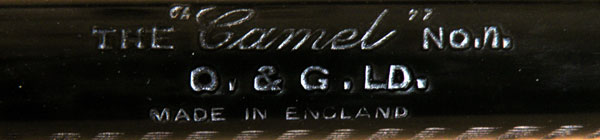
One of their most famous pens was the Camel, and I’ve tried to get my hands on one of these pens for several years without success until now. This is a late version – possibly a No 7, though it’s hard to tell as the barrel stamp is indistinct.

As a lever-filler it cannot, I would think, be earlier than 1912 when Sheaffer brought out the first of this type of filling system, and indeed even 1915 would show the company as being quick off the mark, though it is possible. Waterman brought out their box lever in that year and this pen copies it very closely.

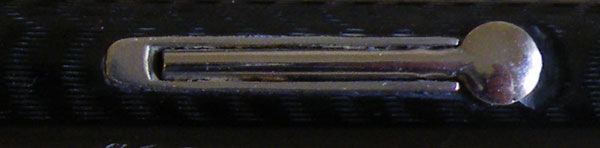
In style – straight-sided with a very slight taper at the end of the barrel, chased black hard rubber, flat-topped with a gently concave section – it would not be out of place in 1915, but I think we might consider a slightly later date as at least a possibility. The riveted clip might be original or an after-market addition as it bears no imprint.

The name “Camel”, one would imagine, implies a pen that contained an exceptional amount of ink but this one doesn’t. Indeed, it’s a quite ordinary pen, though well-executed. I’ve seen a hint somewhere that the Camel range of pens had something special about the feed but I’m denied the opportunity to see that here as someone has been at the repairing before me, and employed a wholly inappropriate Swan feed and an even more inappropriate (if that were possible) Waterman Skywriter nib! I have no idea what a Camel feed looked like or whether Ormiston & Glass produced their own branded nibs or used warranted ones. Perhaps someone can tell me.

The black of this pen is unfaded and the chasing and imprint remain razor-sharp. Though not in any way outstanding, this is a high-quality pen and one that was well worth the wait.

A Mottled Hard Rubber Fleet Pen

I wrote about the Fleet pen back here http://wp.me/p17T6K-iC. Much of the interest in this pen comes from its cultural context, but not all, as I discovered recently. I had thought that the two models I have often seen – a BCHR eyedropper and a BHR lever filler – were all there was in the way of Fleet pens.

Then this example appeared in eBay a few weeks ago. Sadly, it’s missing its original clip, which would have been interesting to see, but the medium cap band and lever show very little wear. The construction is still essentially two straight-sided tubes, with the same concave section as the BHR model, but the colourful Mottled Hard Rubber improves the pen’s appearance no end. What a difference a change of material can make! The nib, as before, is a medium-sized warranted one, roughly equivalent in size to a Swan No 2. It has a useful degree of flexibility.

Though doubtless still aimed at the school pupil market, this is a better pen with its gold trim and medium cap band, and it must have cost a bit more. The adverts I have seen make no mention of gold trim or a cap band. Perhaps this one is a little later and I may come upon advertising for it yet, or maybe this slightly more prestigious pen was sold in a more conventional way, though I’ve seen no trade press adverts yet either.

The Golden Guinea Pen

It’s not often you see a true red ripple pattern (as opposed to the other versions of mottled hard rubber) in a pen that isn’t a Waterman, but here’s one. It’s a 1920s or possibly 1930s Golden Guinea, and in case you were in any doubt, yes, the name does refer to the price.

Was it worth the money? It’s the simplest type of pen, two tubes that fit one inside the other.


The steeply tapered BHR section makes me think this pen is from the twenties rather than later. The feed is about as simple as they come.

The barrel end is threaded to take the posted cap – in itself an indication of a low-priced pen usually. The nib is very small (and exceptionally flexible) and the broad cap band has thin plating that shows considerable wear. If you consider that in 1926 a Conway Stewart 200M in Mottled Hard Rubber (an altogether better quality pen) cost 10/6d, exactly half the price of the Golden Guinea, you might be forgiven for having doubts. Be that as it may, this model and later ones, some of them very beautiful, kept Golden Guinea in business for quite a few years. There were both lever and button fillers in hard rubber and later in celluloid.

Who made them? I confess to remaining clueless about this one. There’s very little documentation. I’ve seen it suggested somewhere that they were made by Conway Stewart but I’ve seen no evidence to that effect and, frankly, given the quality of these pens, it would surprise me. Wyvern or Mentmore would seem more likely, but in truth it could be any one of half-a-dozen known pen makers, or, for all I know, there might have been a Golden Guinea company that made them in-house.

Another mystery pen, then, and a rather beautiful one!

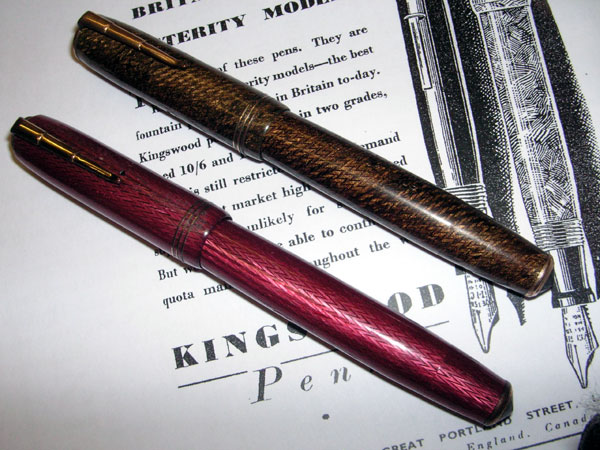
Who Made The Eversharp Kingswoods?

I’ve restored quite a few Kingswoods over the years. I’ve had my own ideas about them, and who made them – some maybe half right and others probably completely wrong. I think the question remains unanswered, though, or not conclusively answered at any rate. – who made the Kingwoods?

Eversharp had a British presence from as far back as the 1920s, though initially I suspect that they were only importers from the American parent company. By the 1930s, trade advertisements asserted that Eversharp pens were made in London, as well as in Toronto and Chicago.* These pens were the same as the USA range. If it is true that they were also made in London, there’s no indication who manufactured them.

The Kingswood range was introduced in 1940, with the models 146, 260 and 376*. I’ve never seen any of these earliest pens.

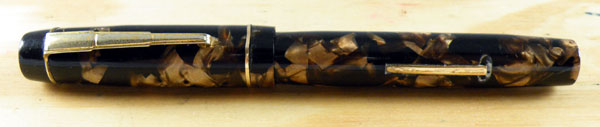
This, I believe, is one of the 1946 models, priced then at 10/6d. “Waudok” has stated in a comment to this blog that he believes that these lever-filler pens were made by Unique and the button-filler pens of the same period were made by Valentine. Stephen Hull* believes that both these types of pen were probably made by Valentine.

To muddy the water further, “Northlodge”, in a recent post to FPN, showed a button-filler Kingswood that he believes was made by Langs, and, frankly, I’m convinced that he’s right.

So did all those companies make Kingswoods under contract at different times? Who made the Eversharp nibs that they are usually fitted with? Were they imported from America? Enquiring minds wish to know.

Though it won’t help in answering these questions, I’d like to build up an image library of the various Kingswood models for reference. All I have is the type illustrated here and the later, more streamlined version. I expect I’ll come across them all eventually, but it could take years, so if any of you have Kingswoods that you could photograph and allow me to publish here I’d be grateful.


*Stephen Hull: The English Fountain Pen Industry 1875 – 1975.