Burnham 51

Burnhams haven’t appeared here often.  I avoid them because so many, especially the post-war ones, have not survived well.  Some models tend to lose clips and many of the casein ones suffer from crazing.  They look fine in a photograph, but when you have the pen in your hand the beauty of the pattern is lost in a spider-web of tiny cracks.  I’ve yet to hear why casein Burnhams are worse than other pens using this material.  Perhaps the material was not aged or cured correctly, or maybe they were unfortunate in their supplier.

Still, I pick up a few in lots of other pens and occasionally I break my own rules (it’s OK for me to do it, but don’t try it at home) and buy an especially attractive one.
IMGP2480
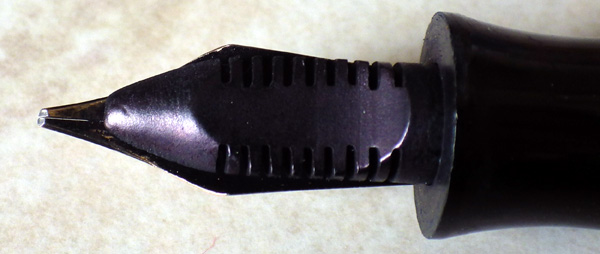
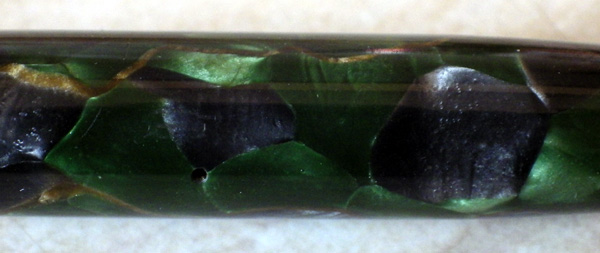
This Burnham No 51 is an example of the latter.  The seller’s photographs were good and it appeared to be free of the pernicious crazing.  The green and grey with amber veins made a wonderful pattern.  To cut a short story even shorter I bought it and I was not disappointed when it arrived.  Though it’s quite a small pen (11.8cm capped) it’s a good quality one.  The cheaper versions have screw-in nibs but this one has a proper 14ct gold nib and ladder feed, held by a robust section. Unlike later Burnhams this example has a low, rounded clip screw which gives the cap a pleasing design.  Burnham’s Achilles’ Heel is poor gold plating and this pen is no exception.  The gold wash clings to the lever and cap ring but is largely gone from the clip.  It doesn’t spoil it, really, because the base metal of the clip cleans up to an impressive shine.

IMGP2483
The Burnham nib is small.  This pen was aimed at those with a limited amount of spare cash in their pockets, and savings that didn’t affect the functionality of the pen were essential to keep prices competitive against Wyvern, Mentmore and the like who were producing for the same slender, highly competitive slice of the market.  When all is said and done, though, the only part of the nib you write with is that rounded spot on the end.  Where nibs are concerned size doesn’t matter, at least not from a purely practical viewpoint (the rest is aesthetics) and it’s a great writer.  Burnham made good nibs.
IMGP2486
The trouble they have with the casein crazing is a real pity because Burnham turned out some of the most delightfully colourful pens ever made.  Just having one on your desk to enjoy must have cheered even the most dreary Monday.
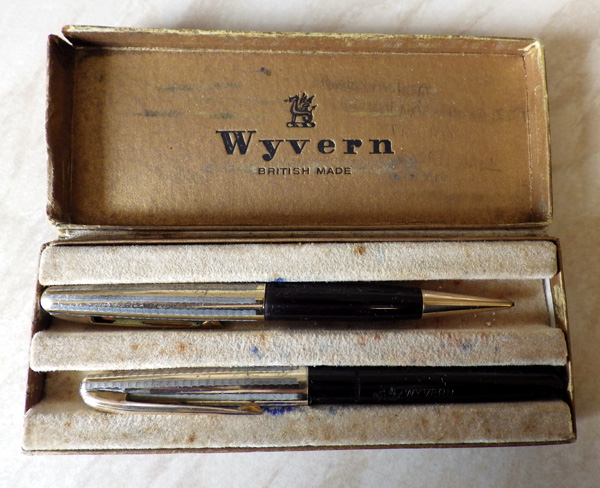
Wyvern Princess Pen & Pencil Set

IMGP1981

I puzzled a little over the date of this Dinkie-sized Wyvern Princess set until I removed the tray from the box and found all the paperwork inside – instructions, guarantee and the original sales receipt, dated September 1951.  With their engraved caps, nestled in their plush box, this set would have made a very acceptable gift.  They don’t look like the output of a company within five years of dissolution, but thankfully for all concerned, nobody in the fountain pen industry saw quite how bad the future was going to be.

IMGP1983

The pen is the simplest form of bulb-filler, though it nods in the direction of modernity with its semi-hooded nib.  The pencil is – forgive my ignorance of the subject – a pencil.  It has lead in it and works well.  There’s an eraser still in place but by the look of it, it won’t work too well.
wyverns
Between the pen and pencil, the box and the included paperwork, there are a number of images of the Leicester Dragon that Wyvern employed as a trade mark.  I don’t know much about the Leicester Dragon or Wyverns either.  It looks a very cheerful beast and it’s hard to imagine it roaming about the countryside torching villages and chomping on the occasional maiden.

I note that I’m not the only one who will be selling a Wyvern Princess Set.  Antiquesboutiqueuk has one here, and he’s asking a mere £236.00 for it, having generously reduced it from £298.00.  That’s pretty stiff competition but I think I’ll be able to undercut him.  Not by much, of course.  I’ll be selling mine for around £38.00

Montblanc Noblesse Slimline

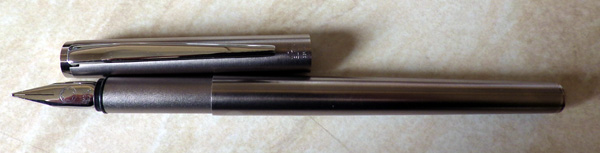
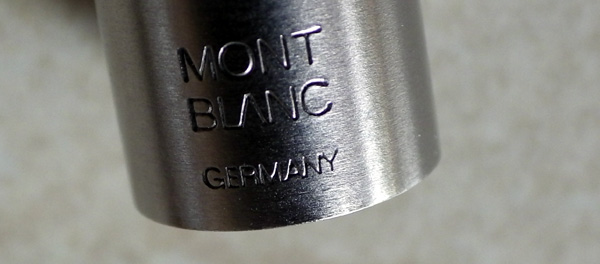
IMGP1547 IMGP1548

I didn’t expect that I would ever be featuring a Montblanc here but this one came my way and here it is.  It’s not a Meisterstück, to be sure, but it’s a solid pen and I bet it didn’t come cheap.  They never do.  It dates to the seventies, I think, when these very slim pens were popular.  It’s a cartridge/converter and it suffers from the same problem that afflicts all c/c pens: there are no interesting gubbins inside to tell you about.  Once you’ve said it’s a cartridge/converter you’re left struggling in vain for something new and original to say that doesn’t apply to all the other cartridge/converters.  It snaps shut with a positive and rather impressive click.  It has a bird-splat on each end so that your work colleague will know that you have a Montblanc.

IMGP1552

And it writes well with a consistent medium line.  That’s about it.  Oh, and it doesn’t post.  I expect that’s a feature.

IMGP1555

By the way, she said proudly, this is not my only Montblanc.  I have a shiny black piston filler in my parts box with a cracked cap and no nib.

Another Golden Guinea Pen

IMGP1538

I don’t think anyone has made a breakthrough since I last wrote about Golden Guinea (http://wp.me/p17T6K-u2).  It’s still not known with certainty who made them.
IMGP1539
Looking at this 1930s example, I strongly suspect that they were made by Mentmore.  The whole impression of the pen reminds me strongly of  Platignum at this time, especially the beautifully boxed colourful pen and pencil sets.  Richly-coloured plastic unlike anything anyone else was using at the time, cap bands that are none too secure, tiny 14ct gold nib and button filling system – all are very like the Platignum output of the time.  Was Golden Guinea one of Mentmore’s many sub-brands, or were these pens made for another company?  For the moment we can’t tell, but I have no doubt all will come out one of these days.
IMGP1543
Be that as it may, this is a lovely pen, if only for the exceptional plastic that it’s made from.  The filling system is efficient and the little nib is a smooth semi-flex.

The Bury Pen

IMGP1521

This is a Bury, an English-made pen I’ve never heard of before and about which I can discover precisely nothing.  Was it made in Bury St. Edmunds?  Is the pen so bad that it should be buried?  Actually, no.  It’s clearly a cheap pen.  Going on the plastic feed and section, I’d guess at the early fifties.  Whatever gold-alike substance was once on the trim has suffered quite a bit of wear.

IMGP1525

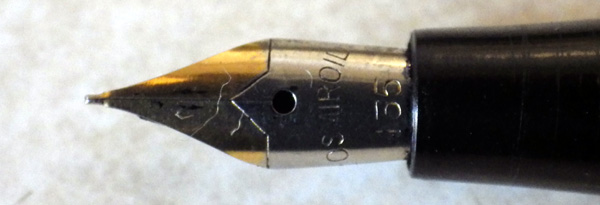
It has an Osmiroid 35 nib, the cheapo nib du jour from the thirties to the fifties.  Having said all that, it’s robust and not without some style.  If all you wanted was a pen to write with, this one would do – and it would serve you rather well for a long time, I expect.
IMGP1524
But what’s it worth?  Nothing.  Zilch.  Not a penny.  This was one of a bunch of pens I bought for the sake of a quite good Parkette that was in it.  I didn’t really want the poor Bury, and I suspect that no-one else does either.  What does one do with these worthless pens that write and are actually rather good writers?  What I’ll do is this: I’ll give them away for the cost of the postage, and I’ll find out what the cheapest method of mailing is to where you live.  PayPal only.  There will doubtless be others.

DSCF3496

Anyway, my assistant is constantly on the look-out for good and interesting pens.  She found one today, a glorious Swan SM 100/63, of which more anon.  To save you looking it up in John’s estimable list, it’s the russet and jade one.  Oh, by the way, there was discussion of John’s list on the Fountain Pen Board today – go and have a look!

Unique No 1 Pen & Pencil Set

As I’ve said often before, I’m not really a collector.  Nonetheless, I have around thirty pens that I’ve hung onto because I found them especially interesting or attractive.  They don’t have any great value and the next pen fancier along might not think much of them.  One of the first pens I bought with the intention of keeping was a black hard rubber Unique No 51, made some time in the 1920s.  The reason it appealed to me so much is the contrast it made with the last Uniques.  Though still adequate pens, the 1950s Uniques were obviously placed low in the market, whereas the 1920s pens were extremely well made.  They failed a little on the trim, but the design and machining of these early pens was very good, they are a pleasure to use and the nibs – at least on those I’ve acquired so far – are a smooth and flexible delight.
IMGP1514
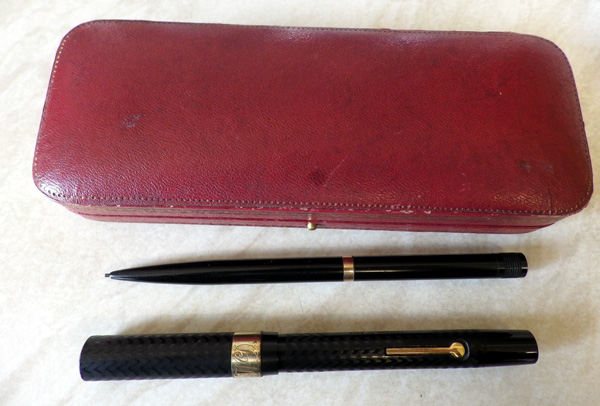
When this very fresh set appeared last week I put in a bid and got it.  It arrived today, and I haven’t had time to restore it yet, so here it is in all its glory.  The pen has been used enough to have acquired the very slightest fading to very dark brown.  The pencil is pristine.
IMGP1515
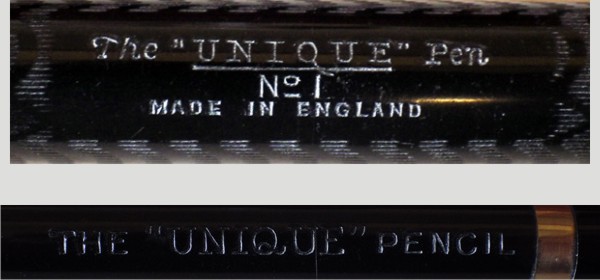
The Guarantee document is dated August 31st 1928, and it is assigned to EF Drury, 16 Chapel Street, Southport.  The slightly tarnished cap band bears the initials WD in a flowing cursive script, so it was bought for a relative, perhaps a son or daughter.  The pen, which is a Unique No 1, bears a strong resemblance to my No 51, with its deeply-cut engine chasing, clipless cap and concave section.  It differs in that the nib is a warranted one rather than the Unique nib in the 51, but it’s a lovely nib with lots of flexibility.
uniqueedit
I’m impressed with the smooth, slender pencil in black hard rubber, bearing a single gold plated band.  I wondered if it was still in working order, and a slight twist of the knurled end produced the lead at the business end.  The plush-lined leather (or imitation leather) box is in good order and still retains its gold trim.  As well as the guarantee, the box contains filling instructions and a price-list for replacement parts.  A nib would cost you two shillings and sixpence and a cap was only a shilling.  You are reminded to send fourpence for the return post.  Today, a nib would cost you around £25 if you could find one to fit, and caps are rarer than hen’s teeth.  Oh, and the postage would be more than £4.00!

Edited to add:  Where are all the 1930s Uniques?

Geha Schulfüller

IMGP0943

This Geha Schulfüller is a well-travelled pen.  It crossed the Atlantic from Germany to the USA with my mother’s friend in the sixties.  Many years later, when she found that I had an interest in fountain pens she gave to me.  When I married my husband and came to Scotland, it crossed the Atlantic again.  So it’s been around.
IMGP0945
Geha is Gebrüder Hartmann, a Hanover office supplies company which went into pen production 1955.  Their big seller was this school pen with a reserve tank which was in fierce competition with Pelikan’s pens for school students.  In 1991 Pelikan bought Geha.  As the pens stopped being made, one can only assume that the purchase was purely to remove a competitor from the market.  Good for Pelikan but not for us!
IMGP0946
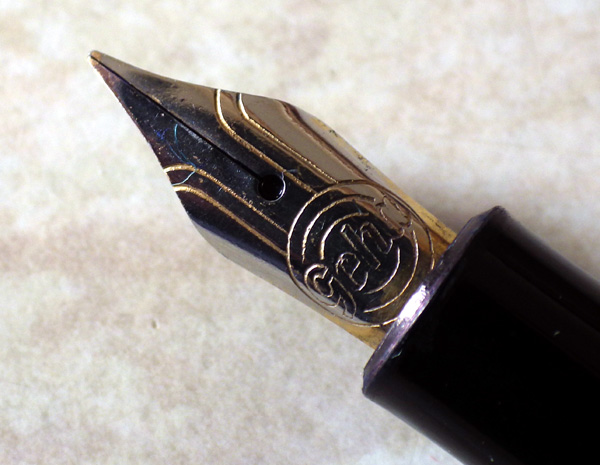
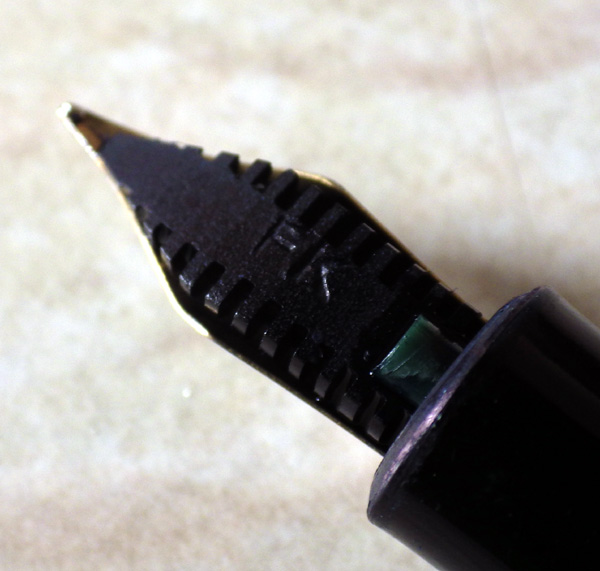
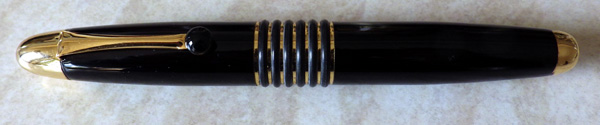
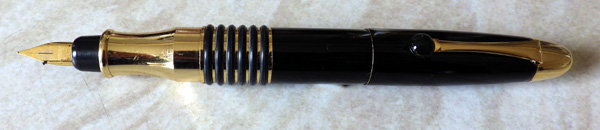
The Geha Schulfüller is a good quality no-nonsense piston filler.  The nib was plated originally but that has gone.  It’s a nice smooth fine.  There’s a green lever in the section that activates the reserve tank which will give another couple of pages.  As there’s a blue transparent area in the barrel that lets you see how much ink is left, I’m not sure why you would let the ink level drop to the point where you needed to call on a reserve, but it was a good selling point for the pen.  The nib is threaded and easily removed for cleaning.  It may be possible to exchange nibs with some of the other German school pens but I haven’t tried it.  The Geha nib is good enough for me.
IMGP0948
I am assured that some of these plated nibs are flexible, but mine is not.  There’s also the Geha Goldfeder 585, virtually the same pen but with a gold nib.  Gehas are not especially common now but they do appear in ebay quite often and the prices remain good for what is an eminently practical and reliable user pen.

An Unbranded Chinese Pen

The other day I spotted a small lot in ebay that looked like it was worth a bid.  There were two Swans, a boxed Parker 45 and this… thing.
IMGP0939
The lot arrived this morning.  I’m very pleased with the other pens and the thing has its curiosity value.  It’s an iridium-point Chinese pen.  I’ve seen them online before – once seen never forgotten!  What seeing it online doesn’t tell you is that this thing is solid lacquered brass, which means it’s monstrously heavy.  I defy anyone to tell me they could write two pages of A4 with this “pen”(I use the term advisedly) without requiring protracted physiotherapy thereafter.
IMGP0940
That’s not to say it isn’t useful.  It would make a passable doorstop.  Or I could keep it by the bed in case of home invasion.  Oh, and there’s one other thing about it – it’s the ugliest pen I have ever seen.  It’s so ugly that you could use it to discipline naughty children.

“You children stop that or I’ll SHOW YOU THE PEN!

“No, Mummy, please don’t!  We’ll be very, very good!”

An Unbranded Pen

IMGP0880

I don’t usually write about unbranded pens but this one is exceptional.  It’s quite a large and chunky pen at 13.3cm capped.  It’s very well made and the gold plating has lasted well. The green and black celluloid has large blocks of colour like some of the Parker Thrift Pens.  Not that I think it’s a Parker, I don’t, but I do think it’s American.  That cap and fixed clip look American and the section is plastic rather than BHR, though I think the feed is BHR.  The diameter of the feed is greater than is usually found in British pens.
IMGP0877
There’s no hint or indication who might have made this pen.  The nib, though it’s a decent size, is warranted.  The tipping material is quite worn from long use and I’ll have to replace the nib.  The barrel and cap are free of any imprint.  The feed is quite sculpted and might be a clue to the pen’s origin.
IMGP0884
If any of my US readers can throw any light on this pen’s origin, I would be most grateful.

Less Common Pens – Roll-Tip

IMGP0443

I don’t suppose there’s anyone out there building a collection of Roll-Tip pens.  Beginning about 1951 this London company turned out rock-bottom basic fountain and ballpoint pens in a variety of styles.  The products were price-driven but they did the job well enough for the company to be consistently profitable.  Over time they acquired or became associated with Penkala Pens and Queensway, both well known for lower end mass market pens.  In 1963 a further acquisition placed them with no less a luminary than Conway Stewart, but this was not the Conway Stewart of forties and fifties fame, but a company intent on swapping quality for price.
IMGP0446
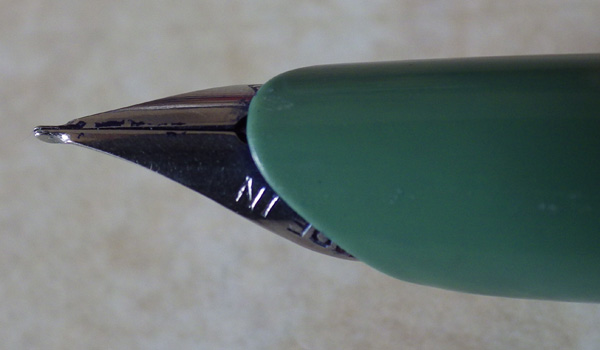
I’m not sure when this cartridge-filling Roll-Tip was produced.  It’s in an attractive pastel green plastic with a brushed steel cap.  The English-made folded-tip nib is probably stainless steel and has a Parker 45 look about it.  The pen will take small international cartridges.  The cap still fits firmly and the pen writes well.
IMGP0447
What does one say about pens like this?  Most of the pens that were in this price range have been scrapped long ago, or like the execrable Queensways continue to exist in a ruinous state.  This pen isn’t like that.  It’s in good condition, it isn’t unattractive and it probably shares a level of quality with many modern pens.  Also, it has to be said that these very inexpensive pens probably reflected the writing experience of most people more closely than a high-quality Swan or Conway Stewart.
IMGP0449
What does one do with them?  Are they worthy of our interest?  Do I chuck this pen away or do I offer it at a nominal price to anyone who might want it?  After all, it writes just as well as a more expensive pen and it has proven durability.  It would probably make an excellent daily writer until the folded nib finally wears out, but even that is a long time away.