A Lizard-Skin Summit

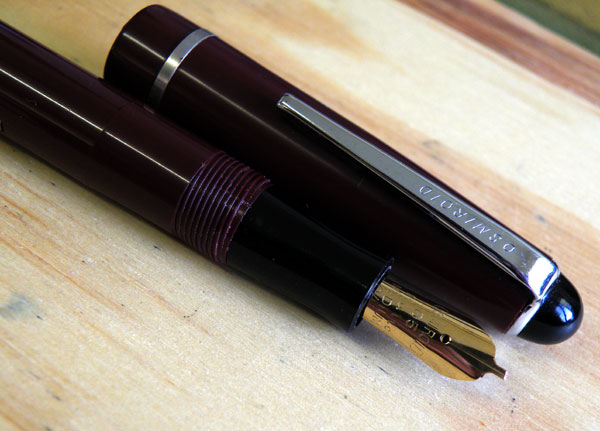
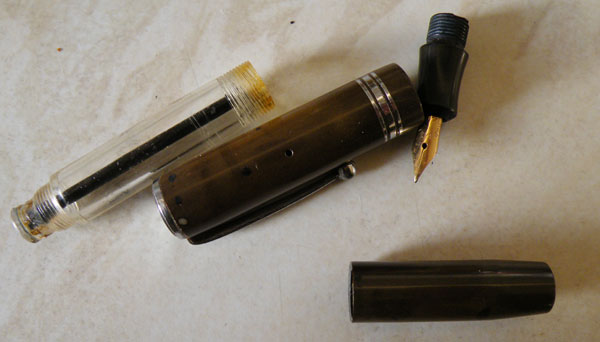
This pen was listed in eBay as an Osmiroid, which it clearly isn’t. It looked like a Summit to me. Though the photos were quite small, the nib could be seen to be white metal and I guessed that the seller had taken the name on the nib to apply to the whole pen. What puzzled me was that there was obviously engraving on the clip which, I imagined, would surely identify what the pen really was. Knowing that I wouldn’t be the only potential buyer to realise that there was more here than met the eye, I bid high. As expected, it didn’t go for peanuts but it sold for a lot less than it would have if it had been properly described.
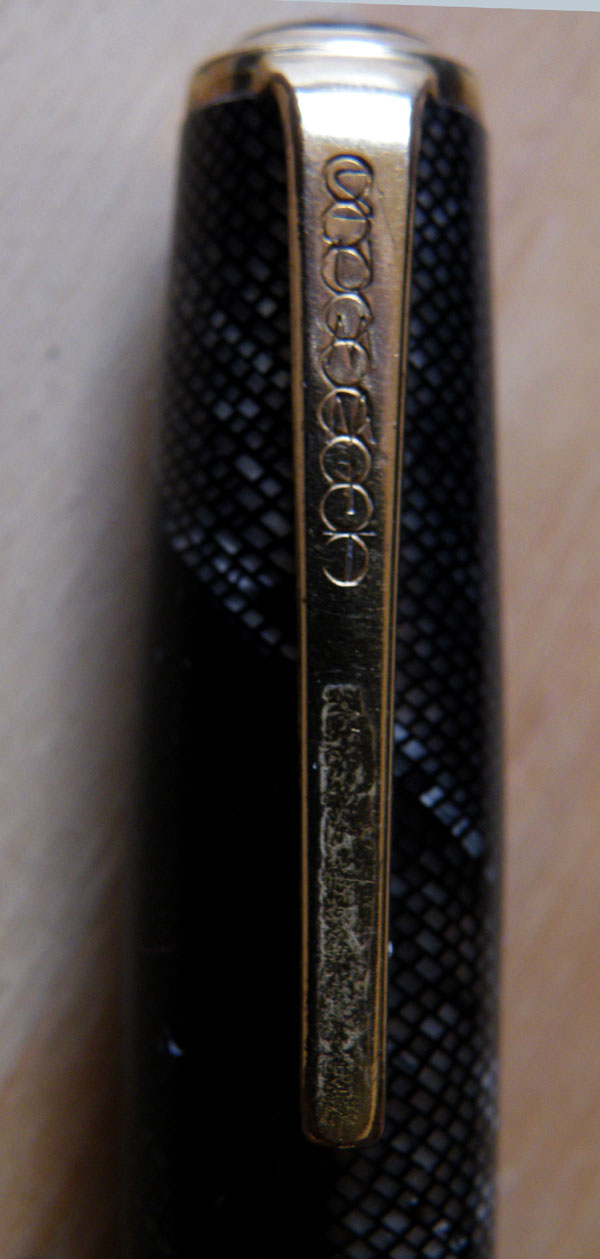
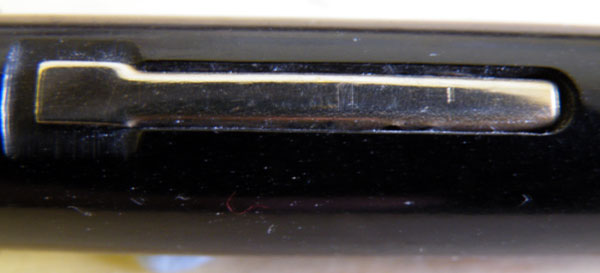
When it arrived, I could see why the seller hadn’t been able to make much of the inscription on the clip. The circles make the name very hard to read. Even knowing what I was likely to see there, I found it hard to distinguish. I’ve seen this shape of Summit with that clip before but not with the circles. My guess would put it at around 1938.
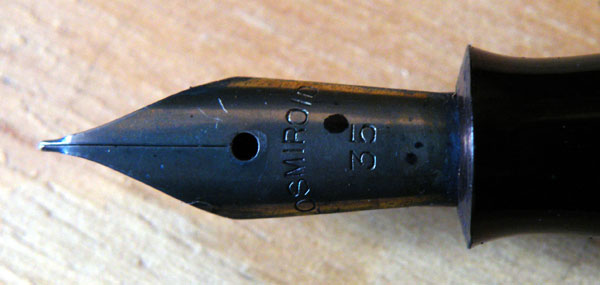
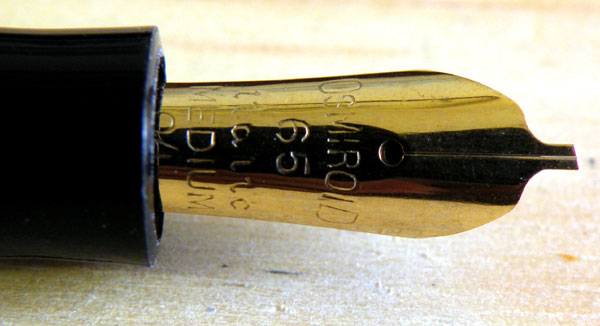
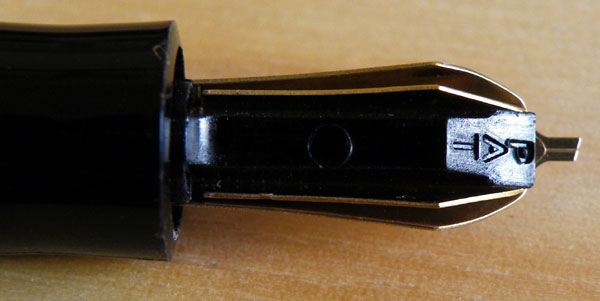
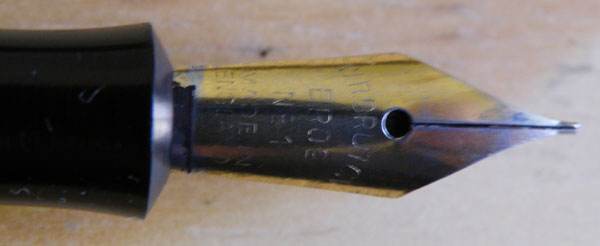
Here’s the cause of the confusion: an Osmiroid 35 nib. If you broke your nib and needed a cheap replacement in a hurry, these were the ones to go for. They turn up in the most unexpected of pens!

Sadly, for once, I don’t have a spare Summit nib lying around so I’ll have to wait until one turns up.

The Primo Dainty

Some time ago I wrote about a red and black hard rubber Primo pen that I’d found. It was an interesting pen and like so many of the smaller, more obscure brands, I couldn’t find out anything about the company or their output. A few days ago, Steve Falkner told me he had another Primo, the Ladies’ Pen, as it is named on the box or The Dainty according to the barrel inscription. Steve very kindly sent me some photos and gave me permission to use them here.

“Dainty” immediately reminds us of “Dinkie” and that’s appropriate. Whoever began the fashion for tiny beautiful pens, Conway Stewart became the best known for it.

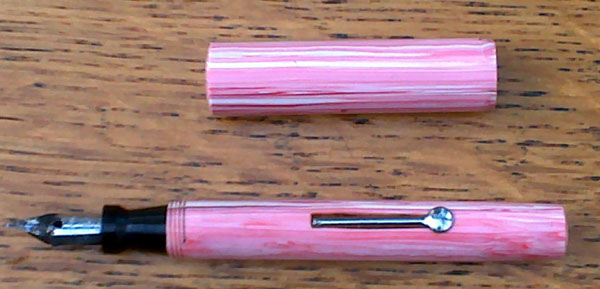
The pen is essentially two tubes, one of greater diameter than the other. That design, also used for the Conway Stewart Dinkies and the small Rosemary pens dates it to around 1930. The box, with its various fonts and its seal is a masterpiece of graphic design and the style coincides with that date. The manufacturers made a virtue of necessity in asserting that their “non-corrosive” nib is “as lasting as gold,” a claim similar to that made for the new Platignum range of pens around the same time. With its simple, clean lines and shocking striated pink, the Primo Dainty holds its own with its Rosemary and Conway Stewart competitors, even though it has a steel nib as against their gold ones.

So we know a little more about the Primo company. A short-lived and minor one, perhaps, as it turned out, but they made some very attractive pens. Thanks very much, Steve, for moving our knowledge forward a bit!

A John Bull Boxed Set

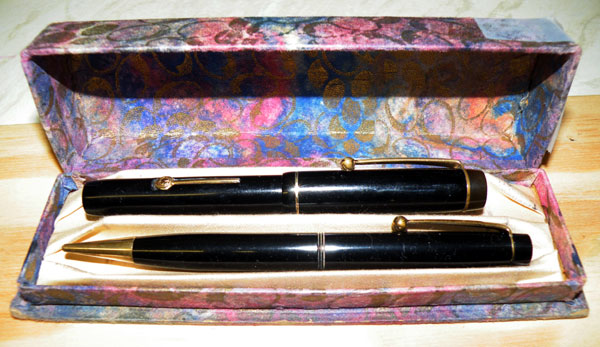
I’ve bought a few John Bull pens over the years and more often than not they’ve been a disappointment. The celluloid ones that I would guess are from the late thirties are good pens but the earlier black chased hard rubber ones seem flimsy to me and often the parts fit together ungraciously. So when I saw this pen and pencil set I debated with myself a little. At length I concluded that as they were clearly later and the price was good anyway, I might as well take a chance.

I’m glad I did. Though they’re not really exceptional in any way, they make a good set. The pencil works, the pen writes with a deal of line variation and the condition of both is good. The box is a smidgen tattered but it’s all there and the colours are quite dramatic!

If you do a web search on “John Bull Fountain Pen” you’ll find several conflicting opinions as to who made the John Bull pens. In every case, so far as I can see, opinion is all they are, without a shred of evidence one way or the other. The late and estimable Jonathan Donahaye, whose opinion I would usually implicitly accept, listed a John Bull pen that he believed may have been made by Conway Stewart. There are some resemblances but resemblance is no proof of provenance. Any of the pen manufacturers of the day could make a pen in any style, and a superficial resemblance to the the popular Conway Stewart would be a good way to sell pens. Wyvern and even Mabie Todd have been suggested – nay, asserted – to be the makers of John Bulls, as have De La Rue, with perhaps a shade more credibility.

This pen has more than a hint of the De La Rue about it. But there I go, falling into the same trap. Resemblance is no proof of provenance.  I could say, in complete accuracy, that there are stylistic resemblances to some some lesser De La Rues, and the quality is comparable with that of the non-Onoto De La Rues.  It’s the same fallacious logic as has misled others, though, and it won’t do.  We need a lot more than that to confidently say who made the John Bulls.   Sight of an old contract would be nice,  or maybe an order…

Another No Name Mottled Hard Rubber Lever Filler

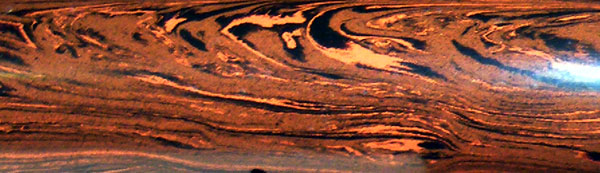
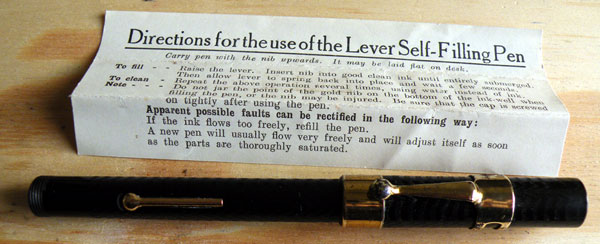
Quite a few No-Name mottled hard rubber nineteen twenties and thirties pens have been coming my way recently. This is a Very Good Thing as despite their variations, these pens usually share the characteristic of being well made. Mottled hard rubber comes in wide variety of patterns from the wholly abstract to quite convincing woodgrain, knots and all. The intensity of the colours varies too, partly through oxidisation over time but also because each MHR mix is a little different.

This beauty has a slightly Duofold-ish look to it, with its straight sides and milled clip screw. The clip once had gold plating but it is no more. The plating has held up better on the cap ring and the lever.

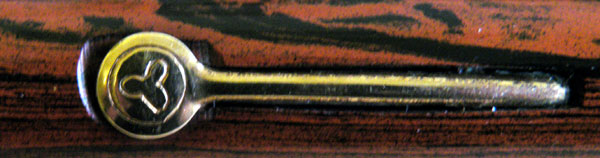
That lever with the little three-lobed dingus appears on a lot of no-name pens from this period. I assume that it’s an off-the-shelf part that manufacturers bought in, often to use on pens that would not bear their own name.

It’s always fun to try to spot resemblances that will enable us to identify the pen’s manufacturer. It’s a pretty fruitless exercise. That handsomely stepped section says “Burnham” to me, but who knows? The small warranted nib is a delight, being both broad and flexible.

We sometimes underrate pens because no manufacturer’s name is on the barrel but this pen, and others like it, compares well with the named output of many pen makers.

A Mottled Hard Rubber Bulb Filler

This beautiful Mottled Hard Rubber Bulb Filler sat in my repair line for quite a while. Restoring this kind of pen is straightforward, but the breather tube had snapped off and it was made from a thinner diameter of tube than any I had. I finally got a length of the right size last week and here the pen is, restored to its former glory.

Excuse the flash photography. I had a long day despatching sold pens and restoring a few more, so I hadn’t the energy to set up lights tonight. The flash exaggerates the difference between the hard rubber in the blind cap and the cap, but the difference is really there. This pen was made from three different pieces of hard rubber, if you count the section too. The mottled rubber in the cap is especially beautiful:

Whoever made the National Security Vis-A-Tank that I wrote about back here: http://wp.me/p17T6K-f0 probably made this pen too. There are many resemblances, particularly the amber ink-view barrel. It may well be that the company made up these no-name pens to use up excess materials. While clearly not expensive pens, quality control has been maintained: these are as well made as pens that doubtless cost several times as much. And, in my opinion at least, the result is an outstandingly attractive pen.

A New Old Stock Osmiroid 65

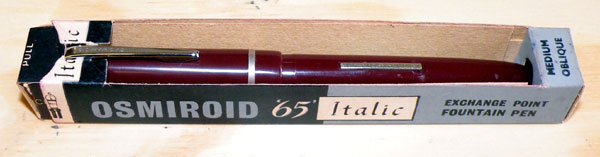
I recently bought a job lot of fountain pens and mechanical pencils. There were a few interesting writing instruments among the lot, some of which will turn up here soon. One unexpected thing was this Osmiroid 65 still in its original packaging. I discussed Osmiroids in general terms back here: http://wp.me/s17T6K-osmiroid and I illustrated that article with a picture of an Osmiroid 75. This pen I have today is the earlier lever-fill No 65.

I don’t have exact dates for the Osmiroid 65 and 75. My husband, who started school in 1955, remembers the 65s being used then or soon after, so it seems that this unused example has been around for fifty years or more.

Normally, new old stock pens will disappear into a collector’s cabinet never to be inked. They fetch a premium as perfect examples of their kind. With an Osmiroid, I suspect the rules will be a little different. While the fact that it is “new” and in pristine condition will still be appreciated, the buyer is likely to be a calligrapher rather than a collector, and the pen will certainly be inked and used.

The left oblique italic nib is a beautiful thing, and one of the less common Osmiroid nibs. I haven’t seen one before.

The Regalia Pen

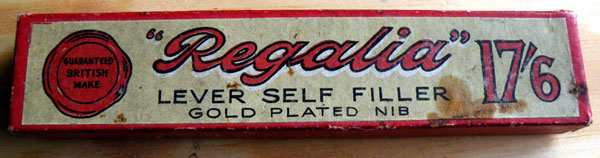
I see these Regalia pens passing through eBay from time to time. They’re not really uncommon, which implies that they must have sold quite well. They’re clearly of a lesser quality than the pens we usually discuss here, but if you’re interested in pens it pays to be interested in all pens. You never know what you might learn.

“Regalia” is quite a strange name for a fountain pen. It’s defined as:

“The emblems or insignia of royalty, esp. the crown, sceptre and other ornaments used at a coronation.

The distinctive clothing worn and ornaments carried at formal occasions as an indication of status.”

Nothing much of a penly nature there, then, but I suppose it’s no worse than Unique, Kingswood or even Onoto. Because the name sounds a bit like it was ill-translated from another language, I initially suspected it might have been foreign made, but no; both box and barrel insist that it’s an English pen.

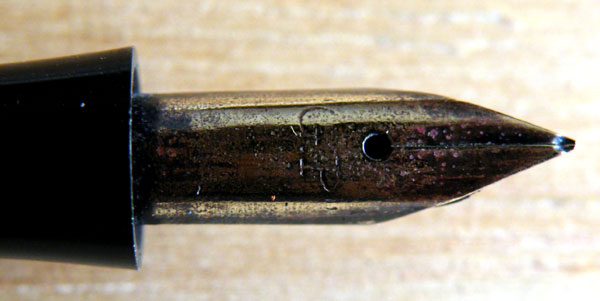
The second thing that’s a little strange is the price. This is, I should think, a nineteen-twenties pen. By a stretch, and allowing for the most backward-looking of conservative design, it might creep into the thirties, but I doubt it. At that time, 17/6d was a lot of money. In 1928 you could buy a high-in-the-range Conway Stewart 212 with two gold-filled barrel bands for 12/6d (Oh, how I want a time machine!). The Regalia isn’t at the top of any range – everything about it says “cheap pen”. The metal trim has at best a gold-wash. The nib is plated, or once was. The design is two tubes, one large enough to screw onto the other, and the barrel end is threaded. That’s pretty crude. Despite being quite a good idea, the barrel end thread is practically diagnostic of cheap pens. Even by the end of the thirties, 17/6d was still the price of a luxury pen, a cracked-ice Duro-nibbed Conway Stewart 1203, for instance. So I can’t really explain the price, unless maybe you got a small car free when you bought it.

So what’s the upside of the Regalia? Actually, it’s a quite competent pen. The spoon-ended nib, though a bit worn, still writes quite well and although it could hardly be described as flexible, I was able to squeeze a little line variation out of it. The black chased hard rubber remains black and the chasing is sharp. The box is gorgeous, very bright and colourful and completely of its time. Both pen and box provide historical documents that fill out the context of the time in which they were made.

Selsdon Again

I wrote about Selsdon Fountain Pens Ltd before, back here: http://wp.me/p17T6K-5K

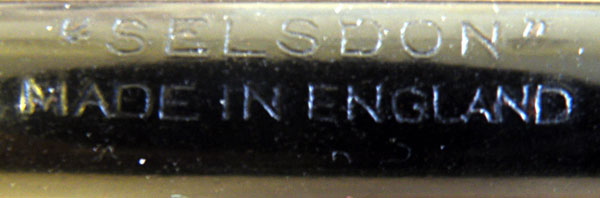
Another one came my way recently, again in the shape made familiar to us by the Eversharp Skyline, with the sharply tapered barrel and rounded cap top. This one’s slightly smaller than my previous example, and lighter too.  Unlike the Skyline, this pen posts well.

Otherwise it’s very much the same, with its very lightly gilded clip and Mystery Metal lever which maintains a shine forever. This one has a W. R. Bruton Bros nib. Bruton Bros Ltd were a West Midlands company which made very fine dip nibs back in the day and went on to make inexpensive fountain pens which are quite uncommon now. They also made plated, folded-tip fountain pen nibs which were installed by some makers of low-cost pens.

I commented before that the plastic in these pens seemed unusual, and I’ve since found out that Selsdon Pens dabbled in the creation of new plastics. After the collapse of the fountain pen company, Lesley Selsdon went on to create Selsdon Filtration and he is interviewed here:
http://www.eurekamagazine.co.uk/article/29312/60-second-interview-Lesley-Selsdon.aspx

These pens will never be prime collector’s pieces (though there are better models), and yet, it seems to me, they have considerable interest as one of the fascinating by-ways of British fountain pen history.

Boxed Crox 2

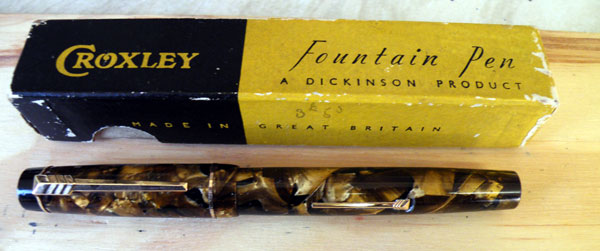
Sometimes it never rains but it pours – but in a good way. A few posts back I was complaining about most Croxleys being black (http://wp.me/p17T6K-dy) and here I find another, colourful, in excellent condition and complete with box.

I love this black/brown/gold/russet marbled mixture. It isn’t quite as bright as the gold/brown marble that Mentmore had around the same time (see here: http://wp.me/p17T6K-dQ) but it has great depth and glorious shades of colour. You could lose yourself in this pen.

According to the graffiti on the box, this pen first belonged to Kenneth Purnell, and judging by the writing, Kenneth was about eleven at the time. That was long ago, though, and if Kenneth is still with us, I would guess that he will be on the high side of sixty now.

The box contains the filling instructions and warranty. It’s advised to use Croxley ink. I didn’t know that there was such a thing, and I’d love to find a bottle of it. You are warned that fitting any parts other than Croxley ones to the pen will void the guarantee. Sadly, it doesn’t answer the question I still have: did Dickinson make those said parts – and indeed the whole pens – themselves, or were they supplied by a contractor? There are many pen mysteries that I feel sure will always remain unresolved, but I think I might find the answer to this one, one of these days.

A Bulb Filler

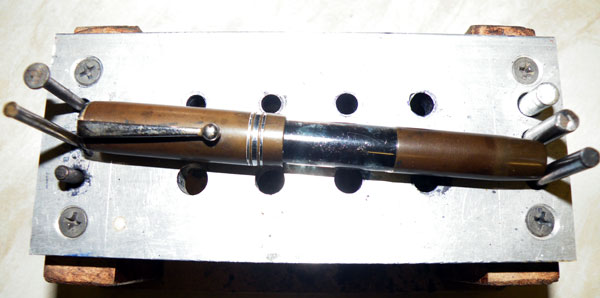
That decidedly ugly thing on my knock-out block is a no-name bulb-filler in hard rubber. It was sold as a Mentmore because it happened to have a tiny Mentmore nib in it. In all respects, it’s identical to National Security bulb-fillers I’ve had before. They were made, I believe, by Henry Stark, Son & Hamilton and that’s the likely source of this pen too. I love bulb-fillers and I haven’t repaired one this year, so I grabbed it despite its sad condition. It cost very little, you’ll be relieved to hear.

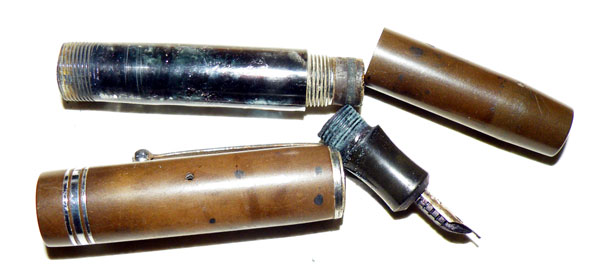
Here it is disassembled. Really, that’s the worst part over. I never know what these ink-view barrels are made of. Might be celluloid or some form of perspex, but they’re often very fragile, just awaiting the slightest pressure to be applied in unscrewing the nib/section unit to crack and break into a thousand pieces and bring the restoration to a sad end. This one was quite sound, though, and disassembly was tense but uneventful. Dry heat and infinite patience is the recipe for success.

Here it is cleaned up a little. As you might expect, the clear barrel was the most difficult to clean and it took repeated applications of the ultrasonic cleaner together with overnight immersion in my Secret Cleaning Compound to get it nice and sparkly.

These pens operate on the vacuum principle, so you don’t want air getting in where it shouldn’t. A liberal application of silicone grease ensures that the section screws back in easily without cracking the barrel, and makes an effective seal too. A chopped-down No20 silicone sac completes the job. I left it to dry and settle for an hour and tested it with water. Success!

Here it is restored and ready to write. Still a little ugly, I fear, though not without character and charm, but it’ll hold a lot of ink and it’s fitted with a little flexible Warranted 14Ct nib.

Bulb-fillers tend to be the poor relations of the pen world, because they’re comparatively cheap to manufacture and this filling method was used to make some truly shoddy pens, and that was the association that built up in people’s minds. Intrinsically, however, there’s absolutely nothing wrong with bulb-fillers, and when you get a well-made one like this, it makes an excellent pen. After all, Parker Vacs are bulb-fillers; they just have a plunger to press instead of a bulb to squeeze, but they fill the barrel with ink in exactly the same way. Like all ink-in-the-barrel pens they have a tendency to blob if the ink is allowed to fall too low, but why would you? You can see exactly how much ink is left in the pen!