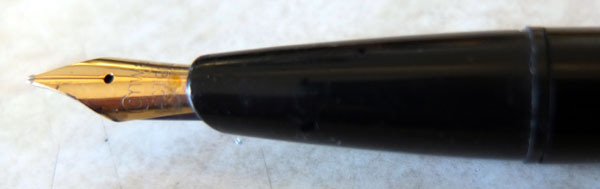
The Conway Stewart 93

IMGP2967

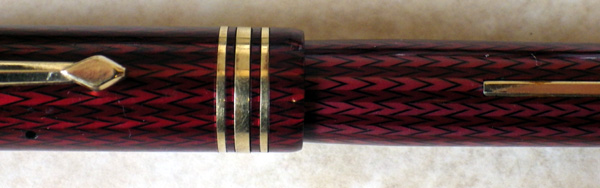
I’ve been trying to get my hands on one of these herringbone Conway Stewarts for years, but I always got outbid.  Until this week, that is.  Not only did I get a herringbone, I got a RED one, and one of the least common models too.

It’s not often I select a pen purely for its looks but I admit that’s what I did this time.  That being the case, there’s not much point in me getting into my usual discussion of the pen’s good and bad points as a writing instrument.  I’ve put a new sac in it; I have no doubt that it writes, probably very well, but when it comes down to it, this is a pen for looking at.  So let’s do that.

IMGP2969

IMGP2972

IMGP2974In conclusion, this was an expensive pen.  If not the most expensive I’ve bought, close to it.  How did it arrive?  In a padded bag with a single turn of re-used bubble-wrap!

Conway Stewart 388 Oblique

IMGP2508

I can’t believe that after all this time I still haven’t written about the Conway Stewart 388, but I just searched the blog and I’ve only mentioned it in the passing where it related to other pens.  Judging by the number of survivals, it must have been one of Conway Stewart’s most popular pens of all time, though its very long period of production, from 1939 to 1955 must help with that.  With its narrow/medium/narrow cap rings and only slightly streamlined shape it looks like a cut-down Conway Stewart 55.   Actually, it’s the other way round.  The 55 is a much later pen inspired by the smaller pen’s popular design.  It worked,  Both pens were big sellers.
IMGP2510
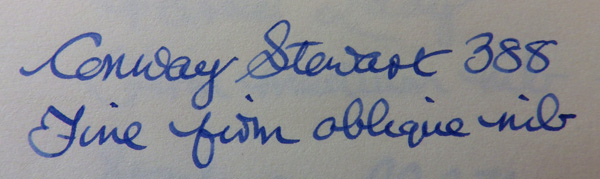
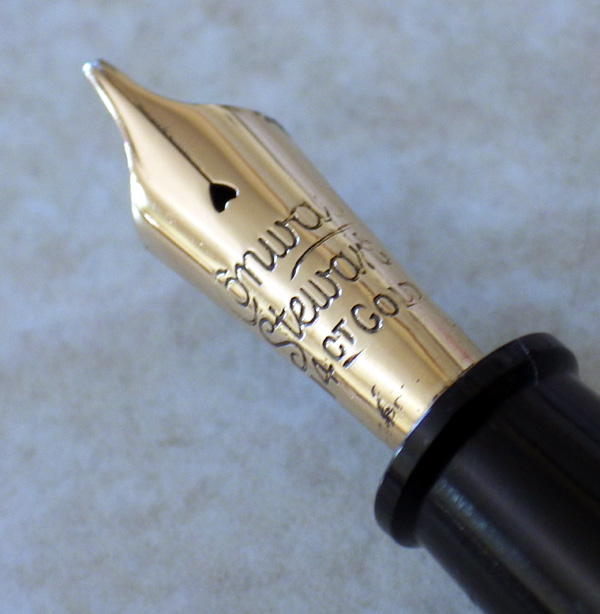
This initially plain looking 388 is, in fact, rather special.  The nib is a firm medium oblique.  Admittedly, such a small nib is unlikely to produce much in the way of dramatic line variation but if you’re one of those people (like me) who hold the pen in a rotated position, this is the pen for you.  It will work with you in producing improved hand-writing.
IMGP2515
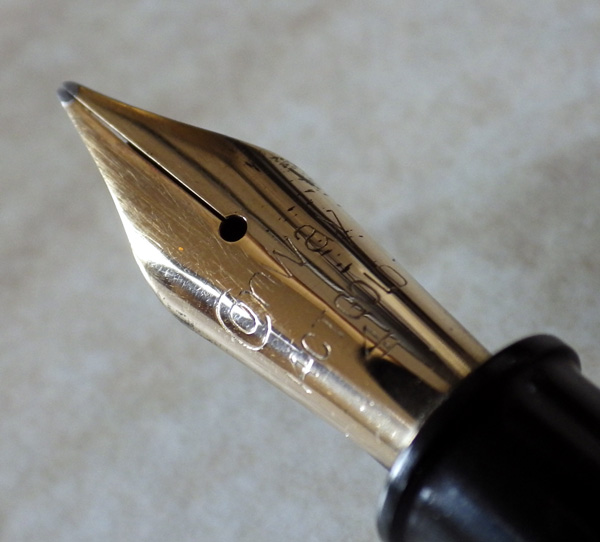
Compared with Swan or De La Rue, Conway Stewart produced few special nibs but when they did produce one they spared no effort.  This high-shouldered nib tapers beautifully to a narrow, slanted stub.  It looks like a piece of jewelry rather than the practical instrument it is.

The 388 remained in the catalogues until 1955, long after its quite straight-sided style had been replaced by the post-war fully streamlined Conway Stewarts.  Perhaps in that year its sales finally began to tail away, because it went out of production and was replaced by the 36, which inherited its cap band arrangement and CS 5N nib.  A pleasant enough pen, the 36 somehow lacked the appeal of its predecessor despite the addition of a unique striped pattern, and judging by the number of survivals, it sold a little less well.

Edit: Andy Russell kindly provided an illuminating comment on this post which changes the chronology and hence the interpretation.  It makes such a significant change that rather than leave it as a comment which many might miss, I post it here as an edit.

“Hi Deb, as you know I’m not one to let a misconception about CS history pass unchallenged…..!

This is one of the areas where Jonathan’s history turns out to be wrong. Surprisingly, the 388 wasn’t actually first produced until after the 58! The 58 was first advertised in the trade press in 1949, the 388 was never mentioned at all until early 1952. This would most likely mean it was first produced in late 1951, probably as a replacement for the 55, and as something more akin to the size of the 58 for those who still preferred a more traditional, straight sided pen.

There is certainly no mention of the 388 in pre-war price lists (up to 1940), the closest model then would have been the 380. CS production was limited throughout the war and for a good few years afterwards, and the 388 doesn’t appear on any of the ‘restricted’ price lists up to 1948. The final date of production of 1955 is about right, though – it still appears on the list for December 1954 but not in December 1956. So, rather than being one of the CS models with a long lifetime, it actually had quite a brief existence! I suspect the low price was the main reason for its appeal – at 22/- in 1952 it compared very favourably with the more modern 58 at 31/6 and the 28 at 25/8.

The lineage of the 55 is rather clearer. The original model of this design was the pre-war 35 (itself a cut down version of the massive Duro 26). This was replaced with the 45 during the war years, a very similar model but with a reduced level of trim (single cap band) because of material shortages. After the war, the 45 was in turn replaced with the 55, with the original cap band configuration being reintroduced, though both models appear to have co-existed for a brief time in 1946. The 55 seems to have disappeared from the listings c. 1950, at about the same time as the introduction of the 58 which was obviously intended to be the clear ‘top of the range’ at that time.

Andy”

Conway Stewart History Corrected

One of several annoying things about the present-day Conway Stewart company is the Soviet-style re-writing of history they present on their website.  Though their only relationship with the original, long-defunct Conway Stewart company is that they purchased the rights to the name and trademarks, they claim the accomplishments of the original company as their own.  In addition to publishing this nonsense on their site, it has been posted in Wikipedia, that magnificent source of dubious information.

To counter this disinformation, Andy Russell  has made available, in .pdf format, a brief and accurate overview of Conway Stewart history.  Go to Fountain Pen Board, seek out the post “Conway Stewart – The True History” and you can download it from there.

Many thanks to Andy for putting the record straight.  The rebirth of dead companies is annoying enough to those of us who are interested only in the older pens, but at least the other re-born companies like Eversharp and Onoto have had the decency to mark a clear line between their output and that of their long-ago predecessors.  Only Conway Stewart have had the brass neck to rewrite history to lay claim to the work of other, and dare I say better men.

Casein And A Conway Stewart Conway 15 Set

IMGP0955

Casein is peculiar stuff.  While there’s no denying that there are some problems associated with it, the depth and luminosity of colour that it offers can’t be matched by any other material.  It positively glows.

The problem that concerns most people is that they will not recognise it as casein, immerse it in water and destroy the pen.  This one is easily dismissed –  regardless of the material from which they’re made – keep your pens out of water!  There’s no benefit to be gained from exposing the externals of a pen to liquid of any kind.

What is more worrying is the insidious effect of exposure to varying humidity over many years.  The casein absorbs a little moisture when the humidity rises and expands slightly.  When the humidity falls, it releases the moisture and shrinks again.  Over time, this leads to cracking.  Craquelure is all very well on Old Master paintings but it isn’t so welcome in pens.  I’ve seen Burnhams disintegrate from this effect.  Perhaps because they treated the casein differently in some way, Conway Stewarts never get quite so bad.  Usually it’s more of a disfiguring surface haze.

I think it was Jonathan Donahaye who suggested that those casein pens that are perfect today after the passage of fifty or more years were probably undisturbed in a box in a drawer for all that time.  That seems a very likely explanation to me.
IMGP0958
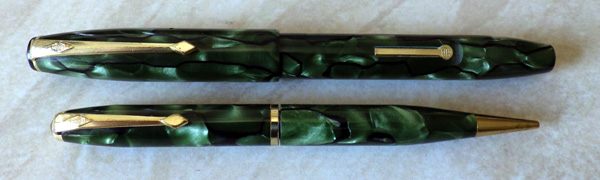
This Conway 15 pen/Conway 25 pencil set is in that fortunate condition, showing the high gloss that these pens all had when they were new.  It is an amazing material.  It can’t really be mistaken for any of the other pen materials.  The pen had been inked but it appears that it was not used.  It had the original Conway Stewart sac.  The pencil still has lead in it.

My husband delights in making me envious by describing British newsagents’ shops of old, with brightly-coloured Conway Stewarts hanging on a card awaiting sale.  This Conway 15 is so fresh, glossy and new that it might have been removed from the card moments ago.

Conway Stewart 84 Rose Marbled With Gold Veins

CSW84

I like the Conway Stewart 84.  It’s quite a short pen but no thinner than most other Conway Stewarts of the time, so it’s quite comfortable to write with for most people.  Its time was the early fifties to the early sixties and it must have sold extremely well during those years, as it remains one of the most commonly found Conway Stewarts today.
IMGP0933
The “rose marble with gold veins” pattern was one that was introduced with the 84, and it makes a beautiful, jewel-like pen.  All the signs indicate that this was a pen for the ladies but, so far as I’m aware, Conway Stewart don’t come right out and say that.  The medium cap band indicates that though the pen is comparatively small, it’s not intended to be an economy model.
IMGP0935
The CS4 nib fitted to the 84 is a larger nib than that in some of the bigger models.  This one is semi-flexible.

A Green Striped Conway Stewart 36

IMGP0730

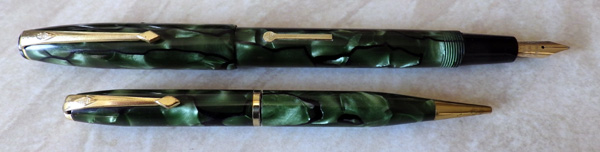
In 1955 Conway Stewart retired the long-running and very popular 388 and replaced it with the more modern-styled 36, using the same CS5N nib and keeping the dimensions roughly the same.

IMGP0729

As well as the hatched pattern the 388 had come in marbled colours and black.  Only the hatched pattern was retained and a lined pattern in several colours was added.

While it may not have reached quite the popularity of its predecessor the 36 seems to have caught on quite well, if the numbers still around today are anything to go by.  Like the 388 it’s quite a slender pen and shorter than some others of this date.  Just the sort of pen to be pushed as a lady’s pen, had it been made by, say, Parker, but Conway Stewart kept that sort of suggestion for the Dinkie range.

IMGP0736

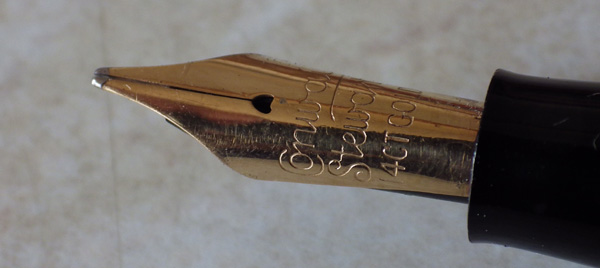
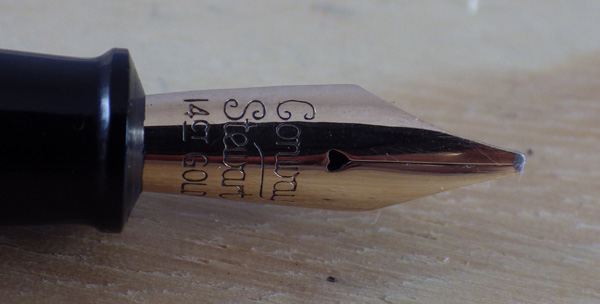
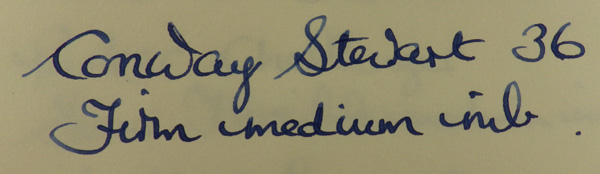
The CS5N is one of Conway Stewart’s better nibs.  As it’s quite curved in profile most examples are firm, as is this one.  It’s a medium with a hint of stubbishness about it, which makes it a pleasant pen to write with.

IMGP0742

The Conway Stewart 57

DSCF1988

I don’t usually buy pens from Conway Stewart’s later output so I must have been dozing off when I bought this 57.  It happens.

I got around to assessing and restoring it today.  Actually, it was in pretty good order and didn’t need a lot done.  I had to put a new sac on, but removing the Pressac sac shield and refitting it was no trouble at all.  Other than that, I flushed the nib/hood unit until the water ran clear, cleaned the pen up a bit and that was that.

DSCF1989

This is by no means the last of Conway Stewart’s pens and while it shows a decline in standards from the high days of the fifties and earlier, it’s not at all a bad pen.  There are the usual slight markings of use but that’s all.  To my surprise, the gold plating has held up well despite clear indications that the pen has been well used.

DSCF1991

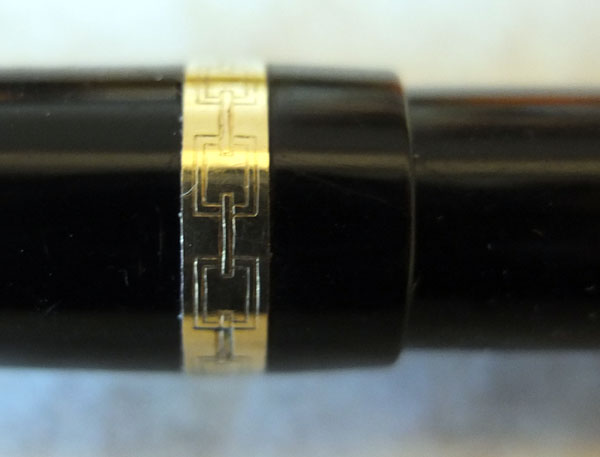
So how does this pen of Conway Stewart’s declining years stack up just as a writing instrument?  I think one might be entitled to knock off a point or two for the filling system.  The Pressac bears a superficial resemblance to Parker’s Aeromentric filler but it isn’t as efficient as it lacks a breather tube.  It’s just a squeeze filler.  The nib’s a nail but that’s OK – plenty of people like nails.  The clutch works well and the pen closes firmly.  The ink flow’s good and the pen sits well in the hand.  I could use this pen quite happily.  It wouldn’t be my first choice but it wouldn’t give me any problems either.  It’s on a par, I think, with the better Chinese pens that are being produced today, with its squeeze filler and nail nib, except that it harks back to a well-respected line of pens and it has a gold nib, which sets it a step or two above.  Also, the chain motif on the cap band might lift it another half a step further.

DSCF1994

One other thing about this pen is that it’s a bit of stylistic grab-bag.  It’s a long, tapering pen like the 85L but it shows pretensions to something more modern.  The nib is fully exposed.  Why then does it have a long hood – which serves no practical purpose – rather than a normal section?  I think it shows two things: that Conway Stewart’s designers knew that the public wanted something new, but also that they didn’t have the money to tool up for a completely new pen, so they made this cheerless compromise.

The 57’s diamond clip is a reminder of past glories but the purposeless hood is an omen of things to come.

The Combridge Pen

DSCF1275

You may remember that I said recently that I’d swapped the little Quail Stylo for a pen I’d long wanted.  This is it, the Combridge, another of those Conway Stewart Associated pens, to use Jonathan Donahaye’s term.  What it is, is a pen made by Conway Stewart for another company, on which Conway Stewart’s own name does not appear.  It’s one of several forms of re-badging.

Combridge was a large stationery business in Birmingham.  Their origins lie in the Victorian period, and they started out with the confidence and ambition of that period.  They expanded into postcard and book publishing, at least a proportion of the latter being devotional material.  As well as having their own branded pens made by Conway Stewart they sold Watermans and Swans. The company was wound up in 1994.

DSCF1279
My Combridge Pen is a later one, I think.  Certainly the chrome clip and lever point to that conclusion.  There are earlier ones that have the Conway Stewart flange lever, and I’ve seen a very up-market version with two gold barrel bands and a cap band.

The nib in mine is a replacement.  Some, at least, have a “Combridge” nib, I believe.  Others may have a warranted nib.  Mine has a warranted nib but it’s graced with rearing unicorn, which I vaguely believe comes from Unique’s nib works.  I have no evidence and if you know better, tell me.

Some sellers describe Combridge pens as rare.  Not so.  Certainly they’re not as common as Conway Stewart 286s, but don’t be talked into paying a high price for their supposed rarity.  They sold well and are moderately common.

I have a particular affection for all of Conway Stewart’s woodgrain pens.

The Conway Stewart Quail Stylo No 3 Again

The Quail Stylo attracted much interest.  A consensus of opinion has it that it’s a rebadged Conway Stewart Pixie 113 though the company for whom it was provided is now unknown.  Late twenties, early thirties, then, one of Conway Stewart’s peaks of high quality production.  For me, their pens never got better than they were in that era.

The Quail is on its way to become part of a very large collection of Conway Stewart pens.  In return I’ll be receiving a very interesting Conway Stewart associated pen which will doubtless appear here shortly.