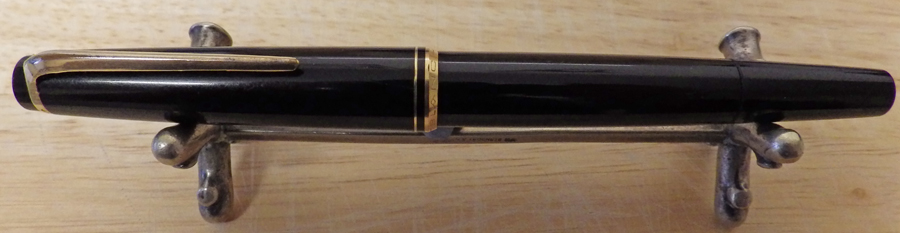
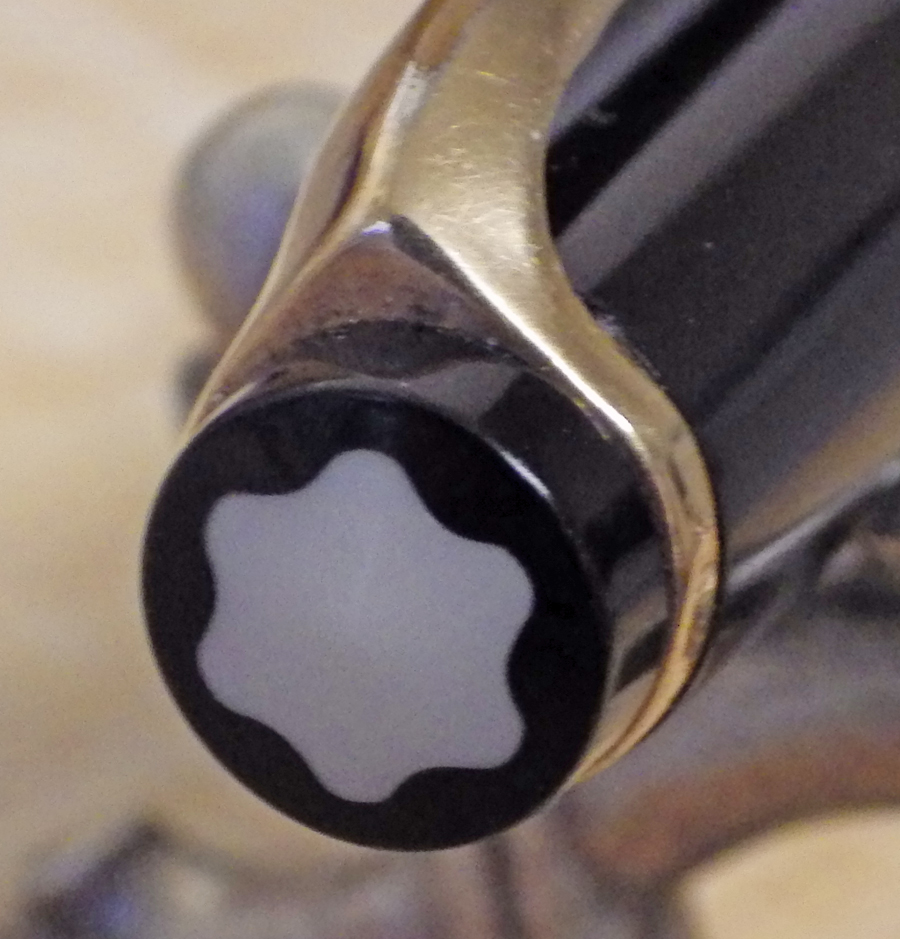
My Frankenblanc

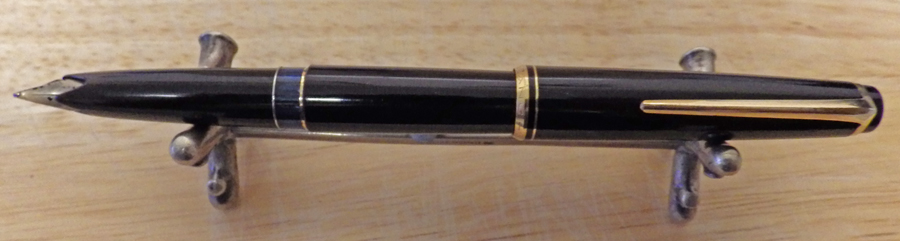
I like this pen. I can use it for swank value. The bird-splat on the cap is very noticeable.

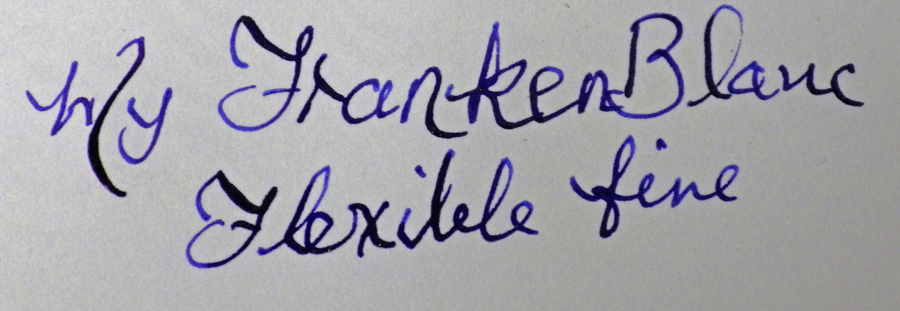
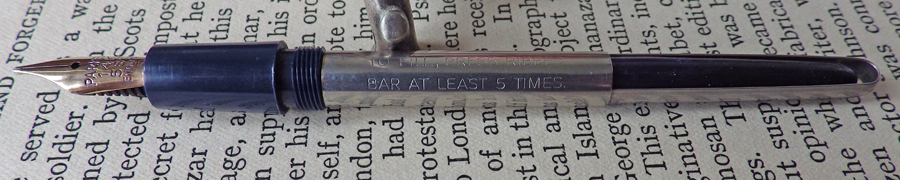
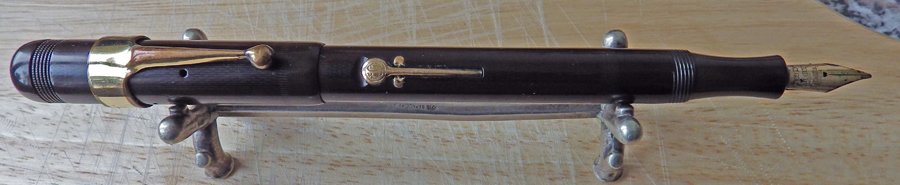
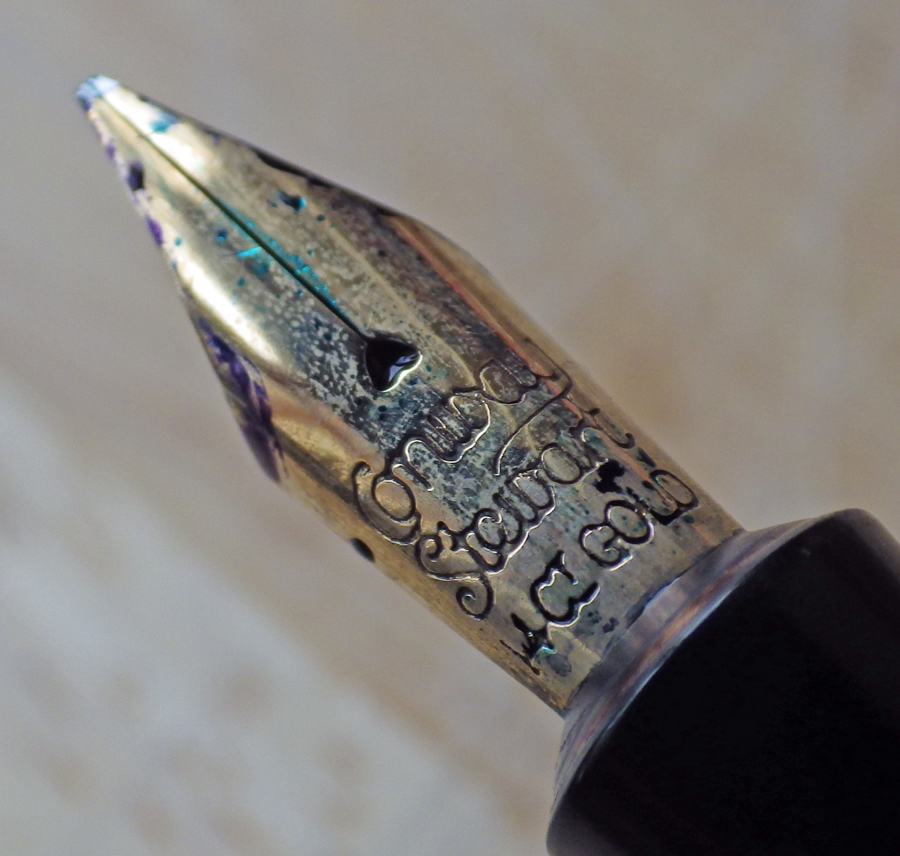
It isn’t really a proper Montblanc. Many years ago, I bought a huge box of spares from a restorer who was retiring. Among the several kilos of pen bits there were parts of several Montblancs. I found a working piston-filler barrel and a cap, section and feed that fit. There was no nib unfortunately but I found a flexible Waterman fine-point nib that slid into place perfectly.

It’s a great writer and I use it a lot. I kind of enjoy using this Frankenpen to counterbalance the snobbery that surrounds Montblancs. Not that I’m criticising older Montblancs, those of the age of this pen. They are superb writers with great nibs. I just think my Waterman nib is even better!

Whither Fountain Pens?

We know what fountain pens were.  What are they now?  Until about, say, 1955, they were an essential tool and had been for the previous half-century.  Most adults had one, and in a society that used the postal system much more than today, fountain pens were heavily used at home as well as at work.  It is true that the wooden pencil was much used then, but when a permanent record was needed, the fountain pen had taken over that role from the dip pen.  They had other roles to play, such as indicating the owner’s wealth by display of an expensive pen, but that was at the margins.  The millions of pens that were out there were, like the Bic ballpoint today, primarily for practical use.

That was what fountain pens were.  What are they now?  Is there any job in the western world today, that demands the use of a fountain pen?  My husband, as a Registrar of Births, Deaths and Marriages, had, by law, to use one with indelible ink, to make entries in ledgers and to create certificates.  That ended about 2003 when the function was computerized.  Was that the last occupation that required a fountain pen?

There are many of us, still, who hand-write by choice.  Though the circumstances in which we do may well obviate the use of a keyboard, we could equally well use one of the other kinds of pens that are available today.  We just prefer to use fountain pens, and the reason for that will vary from person to person.

Calligraphers may use fountain pens.  Many fine dip pens serve their purpose better.  Certainly for those calligraphic styles that require flexibility, even the most flexible fountain pen is a poor competitor to the variety of highly expressive dip pen nibs available.

There will be fountain pen users who don’t care what their pen looks like as long as it does the job well.  I used to be in that category but I must confess that now I like a good-looking pen.  That doesn’t mean that I need to have an expensive pen or a pen that other people would recognise as expensive.  It does mean, though, that I am in that broad category of fountain pen owners who appreciate their pens, at least in part, for their good looks.  What you regard as good looks will likely be different from the next person.  For me, a faded BHR Swan is still a beauty because it retains its great design and the fading is a part of its history.

However we appreciate the beauty of fountain pens, old or new, they fall into the category of “small objects of desire.”  There are many other items in this category, often called “collectables.”  Watches, snuff boxes, some kinds of jewelry, inkwells, even firearms have that attraction to people with the collecting bug.

There are pens, especially Japanese Maki-e, for instance, that are undeniably works of art.  Other highly priced pens may arguably fit that category.  The fashion for limited edition pens, often associated with famous and creative people, may be seen as an attempt to make pens works of art.  How successfully, you may judge for yourself.

How do I wind this up?  Have I come to any conclusion about what the fountain pen is today?  Not really, and I’ll be interested in what you think it is.  I suppose one conclusion is that the fountain pen is a technology that is no longer necessary (at least in the West) but is still produced for a tiny minority that is prepared to assign enough of their income to this hobby to make it profitable for manufacture to continue.
The Transitional Slimfold

With the exception of the Maxima, most English Parkers don’t sell well. The quality is very high and there’s a good range of pens to choose from. The difficulty is a perceived dullness and lack of flair, at least among the 50s and 60s Duofolds in their various sizes.

The Slimfold, of course, suffered from that view too, at least until it was redesigned to look somewhat like a Parker 45. That made it a rather elegant little pen. Some (including me) might regard it as better than the 45 in that it has a fully exposed 14ct nib.

That change in the Slimfold’s design was initiated in 1968. The first version retained the squeeze-filler. In 1971 the design was changed again and the Slimfold became a cartridge/converter filler. Some now call the 1968-71 version with the squeeze-filler a transitional model. That’s this one. A kind friend sent me a photograph of it and asked me if I wanted it. At first sight I took it to be a 45, and I did want one. I’ve always admired the Parker 45. Many have passed through my hands but I’ve never kept one for myself. When the pen arrived I realised that it wasn’t a 45 and it took me a little puzzling over it before I recognised it for what it was. The first clue was the “5” on the nib which declared it to be a Slimfold. That didn’t seem quite right to me. I assumed that a Slimfold with a Parker 45-style cap should be a cartridge/converter. Parkercollector.com , as ever, explained things to me. That’s a wonderful site. This Slimfold is a handsome little pen, in dark blue, measuring 12.4cm capped. I understand that these pens had no barrel imprint. There’s certainly nothing there now and the barrel doesn’t look worn. In fact the pen is in very good condition. It’s a screw-on cap and those threads and the barrel threads that open the pen for filling, are sharp and unworn. The filling system works well and it takes a decent charge of ink. This one needs it because it’s a wet, generous medium, close to being a broad. It lays a lot of ink on the page.

As a small, quite slender pen, it will not appeal to everyone, but I find it quite comfortable to write with. The barrel, section and nib remain the same as its predecessors but the updated cap changes the appearance completely and in a good way. I prefer the squeeze-filler to the later cartridge pen. This, I suppose, is just about the last of the self-filler Parkers. I think it’s a fine addition to my accumulation of pens, a useful writer with an interesting place in Parker history. Many thanks to my kind friend.

Conway Stewart 205

Among my accumulation of pens is a Conway Stewart 205. I can’t date it exactly but it was made some time in the early 1920s. I prefer Conway Stewarts from this period to the even earlier ones which were bought in and re-badged as Conway Stewarts. By time this pen came along, Conway Stewart had their own factory and the designs had begun to take on a style and appearance that made the pens recognisably Conway Stewart.

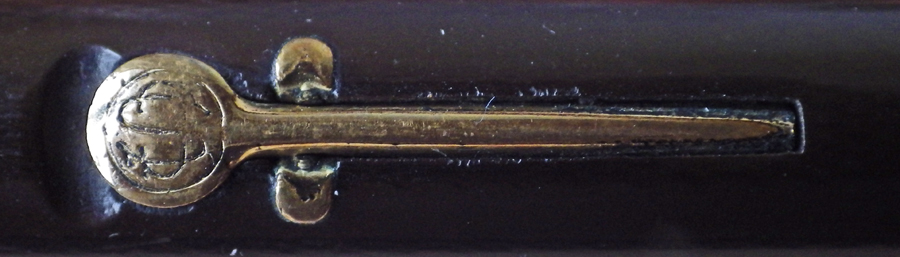
This is a black hard rubber pen measuring 13.6cm capped. Originally clipless, it has had an accommodation clip fitted. The cap has no bands and the only decoration is the knurling on the clip screw. The section is distinctly convex and beautifully sculpted. The barrel tapers subtly at the end. It has Conway Stewart’s instantly recognisable ‘flange lever’, a practical and pleasing design. These pens can appear with either Warranted 14ct nibs or Conway Stewart ones. I don’t believe that the Warranted nibs are necessarily replacements – there are too many of them for that. This one has a Conway Stewart nib. It is medium and very smooth from long years of use.

Indeed, the pen is well-worn. The barrel imprint is so faint from use that it can only be read under strong light and magnification. The gold plating on the lever has held up quite well, but the chrome plating on the clip, which may have been an inexpensive one, shows considerable wear. The black hard rubber has faded slightly to a rich, pleasing chocolate brown.

I bought this pen in eBay many years ago. I’ve kept it ever since as a good writer and an example of one of Conway Stewart’s best periods. The 205 isn’t a common pen by any means but that doesn’t make it especially valuable because there isn’t any great demand for it.

The only fault so far as I’m concerned, is the accommodation clip. I like to post my pens but the weight of this clip unbalances the pen. I have tried to remove the clip though without any great determination. It has been there for a very long time and it isn’t going to part company with the cap easily. I just have to break the habit of a lifetime and set the cap aside while I write.

(Perhaps I should have given the nib a wipe, but it’s an everyday user and this is how one looks!)

Conway Stewart nibs are good but Swan and Onoto nibs are better. Nonetheless, there are Conway Stewarts from several of their periods of production that I like to have. After this one, I like the pre-war 286, in any of the pleasant patterns one can choose from. In the immediately post-war period, the 388 and 55 are great pens and pleasant writers. Among the cigar-shaped pens of the 50s and 60s, the 27 is my choice. After that the pens fell away rapidly and disastrously. When the company rose from the dead like a shambling zombie, it produced pens that were prohibitively expensive and bore little real relationship to the pens of the glory days. I don’t want any of them.

Sailor Sapporo

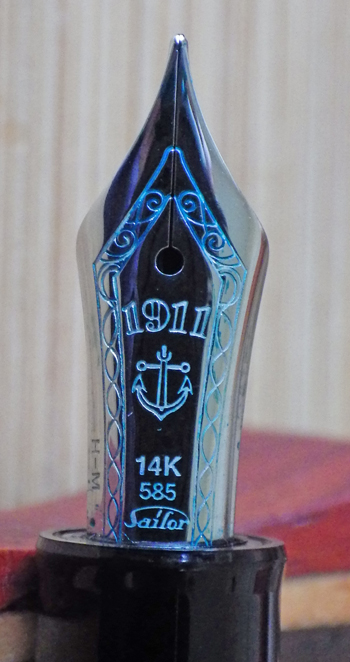
In the lore of modern pens, Sailors are said by many to have the best nibs. I’m not talking about flexibility here, just about the ability to glide across the paper in a pleasing and accurate way. I bought a Sailor Sapporo a year or so ago. It wasn’t an expensive pen by the standards of those who buy limited editions, but it was expensive for me. I don’t remember exactly what I paid for it but it was in the region of what I would normally lay out on a very high quality vintage pen.

In many ways it should be my ideal pen. I love the look of it and it sits well in my hand. It’s a small pen but I have small hands so we are in agreement there. A few days ago I saw it in its box and I wondered why I didn’t use it more. I inked it up and made use of it for a day or two. I know now why I don’t use it much. It drags unpleasantly on the paper. I’m not talking about normal feedback. The cheapo Wing Sung I’m writing this with has plenty of feedback and I love it. The Sapporo isn’t quite a paper-cutter but it’s just not right. I’ve had a look at the tines under magnification and they are perfectly aligned so there is no improvement I can make there. That means that I’m going to have to polish the tipping material, something I avoid like the plague in my everyday restoration of pens. Some highly skilled technician put the right amount of expensive tipping material on the pen, whether it’s now or back in the 1920s, and I don’t believe it’s a good idea to take it off again. Also, if you use an abrasive to polish the nib tip and make it address the paper sweetly, you may be widening the contact area. The pen is a fine which is what I want it to be. I don’t want it to be one whit wider than it is. Of course, if that were to happen, I know how to reshape it to become fine again. That means more removal of iridium.

This isn’t a great tragedy of course. I can fix the pen. I’ll use the most gentle abrasive I have and it may well be that I can improve the nib to an acceptable smoothness without affecting any of its other attributes.

But I am disappointed. I feel that it should be a better pen than it is. I have other modern Japanese pens that have worked splendidly right out of the box. I hear tell that Sailor should be even better than the Pilots and Platinums. Maybe I got a Friday afternoon pen. It encourages me to believe that I need to give up buying modern pens and stick with the Swans, Watermans and Onotos that I know to be great writers and totally reliable.

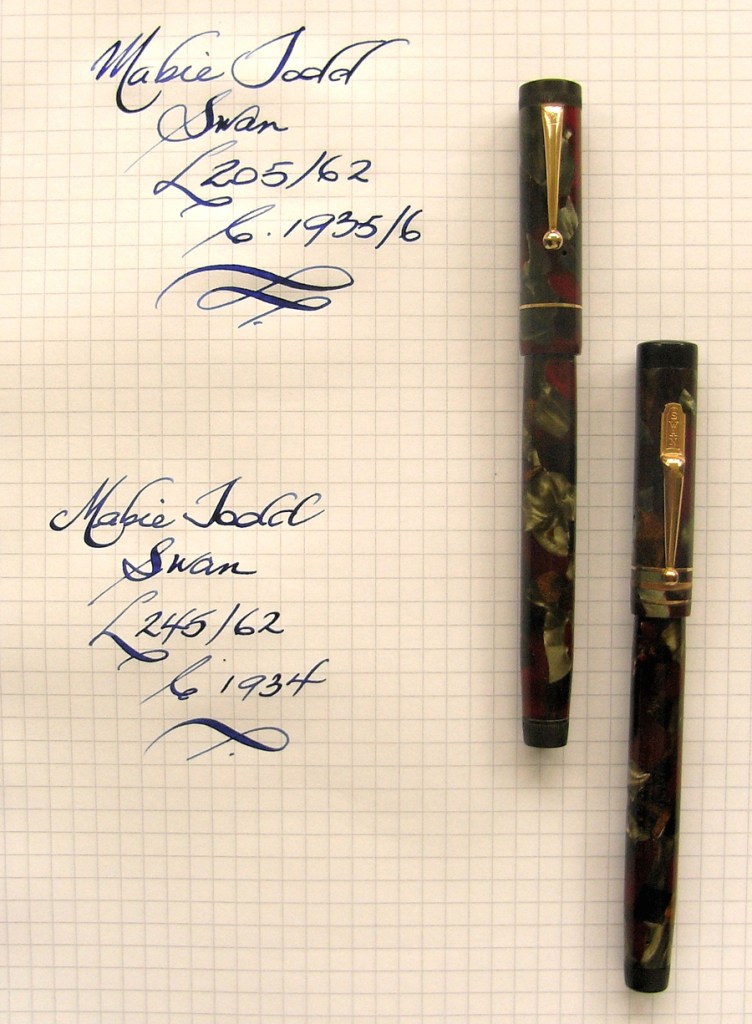
Mabie Todd Swan Leverless L205/62 and L245/62

Though I’ve been writing about quite modern pens recently, my heart lies with the older ones, those from the end of the 19th century up to World War II especially. Those were the years of the development of the fountain pen, and there was a point in there when, I believe, fountain pens became as good as they could be. Which of those pens became the ultimate in design and practicality will vary with your taste. It might be one of the Onotos, the Waterman Patrician, the Wahl Eversharp Doric or some other pen that spells perfection for you.

For me it’s the Swans of the 1930s. I’ve handled many of those pens and everything about them seems just right: the size, the shape, the balance, the wonderful nibs and the sheer grace of the design. Though this may seem like a bold statement it is what I believe: they are the best pens of all. You are entitled to disagree but that remains my belief.

Take that perfection of design and and some of the most beautiful celluloid patterns and you have the fountain pen exemplar.

What beautiful pens!

I wish they were mine but sadly they are not and I have to thank Paul L, collector, restorer and expert on Mabie Todd pens, for these excellent photographs

Wing Sung 235

My “collection” – “accumulation” might be a better term – lives in a pretty lacquered box. They’re all pens that have impressed me in one way or another. They all write well, though in different ways. For me, there’s little sense in having a pen that I can’t write with. There are all sorts of pens in there, many that I’ve written about before, others that I’ll probably write about some day.

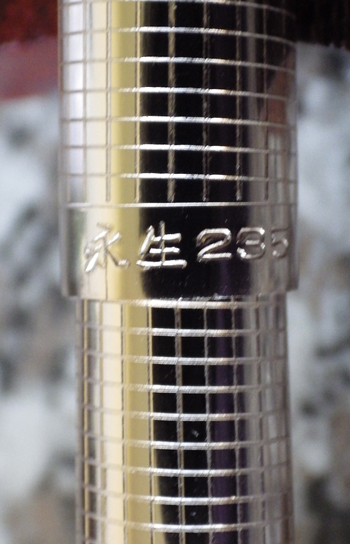
As pens I have been using dry up, I look in the box for the next pen, maybe one I haven’t used for a while. This pen is just such an example. It’s a Wing Sung 235, and I bought it from a Chinese seller who is no longer around. It was in 2004 or 2005 but you can still buy these pens. I’m not sure what you would pay today. I think this one cost about £1.50. I often say that there has been a huge improvement in Chinese pens in recent years and that’s true, but there were some good Chinese pens around years ago. This is a great little pen. It’s nice and shiny and looks like gold but I assure you it isn’t!


The incised pattern is nice to the touch. The pen is metal but it’s very light, something that the manufacturers of those pens made from plumbing materials might take note of. I write a lot in the course of a day and I really appreciate a light pen. If I had a complaint at all about this pen, it might be that the black plastic section is a little slippery. It’s not a big deal though.

The pen is a squeeze-filler with a breather tube, similar to the Parker Aerometric. It takes an adequate fill of ink. I think it’s worth mentioning that the clip is sprung, a piece of high-quality engineering in a very low-cost pen. That means it will grip your shirt pocket very firmly.

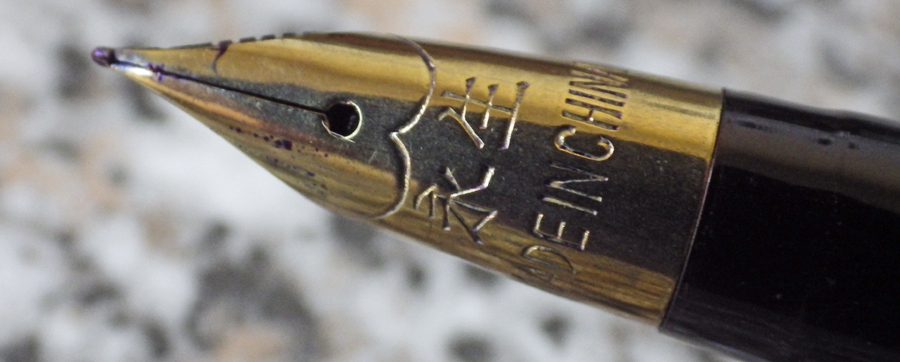
Perhaps the most eye-catching and interesting part of this pen is the nib and feed. The nib is conical and made from a yellow metal that isn’t gold and is too light for brass, so is probably some alloy. It bears some Chinese characters that are probably Wing Sung and “made in China”. The feed is multi-finned.

The most obvious resemblance of this nib is to Sheaffer’s Triumph nib. It is said that Wing Sung inherited a Sheaffer factory or Sheaffer capital equipment. I don’t know what the truth of that is. It seems to me that if one had jigs that had been made to machine Sheaffer Triumph nibs, one would be able to make a nib that resembled the original rather more closely than this one does. Whether or not the machinery that was used to make this pen once belonged to Sheaffer, a tubular nib is not an especially hard thing to design or manufacture, no more so than a traditional open nib or the slender tubular nib in a Parker 51. Let’s say it shows inspiration from the Sheaffer Triumph. Of course there are those who will gripe about the Chinese copying things, but every nation has copied at one time or another.

Leaving all that aside, how well does this pen write? The short answer is very well indeed, or it wouldn’t have been a regular user of mine for all these years. Longer answer is it’s a fine, just short of medium with splendid ink delivery laid on by that complex feed. The nib is smooth enough to write well with no pressure at all, but there is feedback. A moment or two with Micromesh would be enough to remove it and make the nib totally smooth but I like that slight resistance on the paper.

It’s a slender pen, so not for everyone. Posted, it’s an adequate length and it posts well and deeply, making it completely secure. Aesthetically, it’s perhaps a mixture of mercies, taking inspiration from several Western pens. It works for me, though, and I enjoy its appearance as well as its performance.

I believe it’s a remarkable pen for its price. I can’t really point to anything that indicates a reduction in quality to save money. The squeeze-filler looks a little flimsy but that’s deceptive. This pen has had a lot of use for 12 years or so, and it has stood up well. Those who believe that weight equals quality and like pens made out of brass tubing will not like such a light pen, perhaps the lightest I’ve ever had, but that’s because it’s made from some aluminium alloy, light but strong. If I’m still around in another ten years’ time, I’m quite confident I’ll still be using this pen.

Mabie Todd & Bard Eyedropper

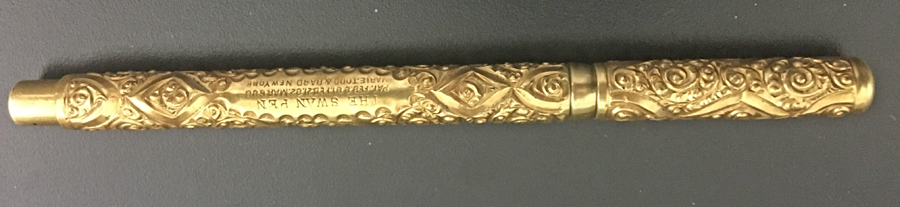
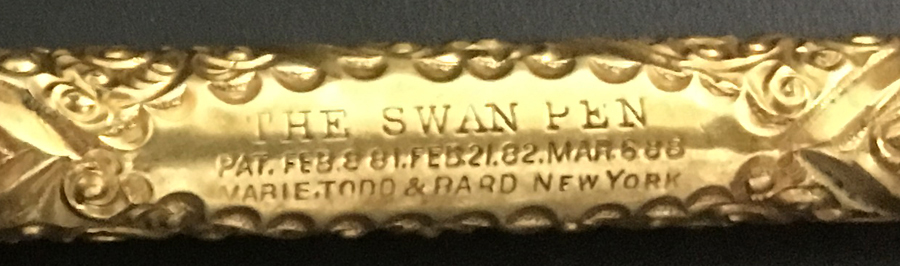
Here’s a gold-plated Mabie Todd & Bard Swan eyedropper. It’s not mine, I’m sorry to say. I’ve had one or two of these in the past but in nowhere near as good condition as this one. We know that it is before 1907 because that’s when Bard left Mabie Todd.

From what I can see of it – and I understand that the photographs were taken under difficult circumstances – is in very good condition with just some plating loss on the section.

What’s the date and what’s it worth?

Ink

What can I write about for your delectation today? I don’t happen to have to hand some unusual pen that you’ve never heard of, though I’m sure I will, shortly. Today I want to talk about ink, but not as someone in Fountain Pen Network would. You know the sort of thing, he’s verging on a nervous breakdown because among his 400 bottles of ink there isn’t one that will suit his new limited edition fluorescent pink Montblanc that contains the DNA of Liberace.

No, I’m more inclined to talk about ink getting into the wrong places. For many years I only used fountain pens to write with and I was very careful filling them. I might get the occasional spot of ink on my fingers but by the time I’d washed the dishes it had faded to near-invisible.

I began restoring and selling pens. In the early days when I was selling in eBay, I might be write testing as many as 20 at a time. Doing as many as that and flushing them too, it was impossible to keep the ink off my little paws. And not just the occasional spot, either. Even washing the dishes and doing the housecleaning was not enough to remove it. I know that some of you wear it as a badge of honor but I think it’s quite unsightly on my ladylike pinkies.

I ordered a box of black latex gloves, the ones that some tattoo artists use. They were great. Not only did they keep the tide of ink at bay, they improved my grip when I was taking pens apart. A few weeks later, though, I began to feel itchy and uncomfortable wearing them. I know that latex allergy is common and I began buying nitrile gloves instead. It’s equally grippy and not at all allergenic. I believe it’s what most of the other tattoo artists use.

Problem solved, no more ink-staining of the digits unless I got impatient and started messing with pens without putting on the gloves. But that wasn’t the end of my concerns with ink. I’ve never had one of those horrible major accidents (touch wood) where an entire bottle of ink gets tipped over and you need to make an insurance claim for everything in the room, but ink, like blood, when escaped, leaves traces of its presence all around.

When the pens are ready for testing, I set out my necessaries – two grades of paper, several grades of micromesh, kitchen towel and the all-important ink bottle. I don’t do as many pens as I used to but thoroughly testing ten pens will take most of an afternoon. A few spots of ink will escape unnoticed until later, when I’m tidying up. As I’m working on our gorgeous oak dining table, it becomes a matter of some anxiety and concern to remove every last trace or shadow of ink. I use Diamine Sargasso Sea which wipes up very well but I don’t like taking risks with our lovely table. I found a plastic table cover which relieves my mind immensely.

To finish up this rambling discourse on ink, I know I was a smidgen sarcastic about those people who become a little obsessed with ink. Each to his own. Many inks are absolutely lovely. I often read those beautifully and scientifically constructed reviews of inks that Chrissy does in Fountain Pen Geeks. She is undoubtedly a great asset to the fountain pen world.

There are a couple of reasons why I don’t have more inks. First of all, many of them are very expensive. I spend a lot of money on pens and there isn’t much left over for inks. Also, as well as the Diamine ink I usually use, I have several vintage inks, Swan, Colliers and the original Webster’s Diamine among them, and I like to use those sometimes. Finally, and I hope I don’t cause too much offense saying this, my love is for pens, not ink.

The Super-Flex and the Nail

When I came back to fountain pens it wasn’t long before I found flex and I loved it.  It made my handwriting look good and it gave an extra dimension to writing.  For years I wouldn’t use anything else and I was one of those who sneered at inflexible nibs and called them nails.  Of course I didn’t know what I was talking about, a situation I have often found myself in.  The reality was that I didn’t write much in those days.  Some correspondence, over which I could take my time and make the most of the line variation and the shading.  The word got out that I could write moderately well and I did invitations and place settings.  Then I took a couple of university courses.  I found that my usual flexible pen just wouldn’t allow me to write at the pace I needed for note-taking.  I refused to invest in a ‘nail’, of course, but I had a Conway Stewart 388 that was semi-flexible and I persevered with that.  It worked but it was far from perfect for the purpose.  Someone gave me a Rotring pen, a heavy ugly thing with a rigid nib.  We had an end-of-year exam and I stuck a few pens in my pocket as an insurance policy.  I had a lot of writing to do and very limited time to do it in.  For some reason I tried the Rotring and it flew.  With the right pen – which in this case was the Rotring – I’m a fast writer.  I got all my ideas down in the examination booklet.  I came away very pleased with this pen that I had hardly considered before.

I write a lot now.  All the posts that appear here are first hand-written.  I write an equal amount in another blog that I do.  I have better tools than the Rotring pen now and I enjoy the challenge of writing well, or at least legibly, at speed with a fine nib.  I still have flexible pens and I still enjoy writing with them but they are not my everyday  writers.  Prove me wrong if you will but I don’t think that it’s possible to write at high speed with a very flexible nib.

Of course that doesn’t mean that I like all firm nibs.  Many are utterly characterless.  Those ball-shaped lumps of tipping material make for an unpleasant writing experience.  They appear on many modern pens but strangely enough some Mentmores as far back as the forties had that lump of iridium, too.  Very rigid nibs with tips polished so smooth that it feels like writing on glass don’t suit me either.  I like a little feedback.  I have one or two modern pens that work well for me and some older ones, too.  There’s a Swan with a fine Eternal nib that I love and use a lot.  I have a 1950s English Duofold with a fine, springy nib that I enjoy.

For the simple practicality of getting my work done, those fine firm pens are always in my pen pouch.  There’s another incidental benefit:  They’re cheaper than similar pens with flexible nibs.  The fountain pen world has gone slightly mad over flexibility.  If a pen has a nib that shows line variation, it’s suddenly worth much more.  I see sales sites online with flexible pens at very high prices.  At times it seems that that is the only thing people want from vintage pens and they ignore all the other aspects that make them so attractive to me.

Though they have a long way to go before they will equal the flexibility of the old Swans, Watermans or Wahl Eversharps, some manufacturers are making a real effort to produce flexible nibs.  More power to their elbow!  I look forward to a time – and I’m sure it will come – when those who want flexibility can buy a new pen at a reasonable price that will fulfill that requirement.  Then, perhaps, will end the ridiculously inflated prices that flexible vintage pens are fetching today, and we may return to a situation where people buy vintage pens for their beauty, age, historical significance and technical wizardry, not just because the nibs bend.