A Mystery Parker

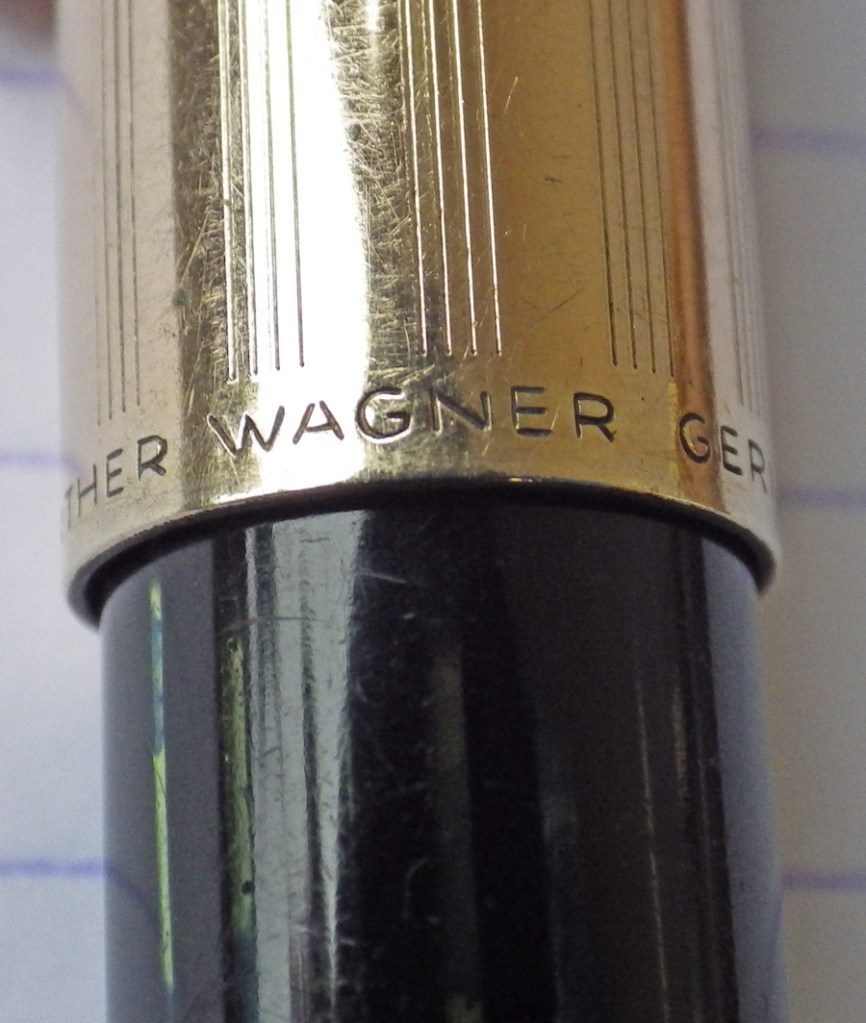
Here’s a mystery pen. I would be grateful for your comments. I’m no expert on the Parker brand but I’m not entirely ignorant of it either. However, this mixture of mercies has me beat. I might mention that it was raised in Fountain Pen Network but they were not helpful, I’m informed. That’s how I remember FPN when I was a member some years ago. Long on opinions, short on facts. To be fair, though, FPN is first class when you need to know what colour of ink to put in your latest Montblanc.


All that aside, here’s the story with the pen. It’s short at 115 mm capped. Parker Duofold is stamped on the barrel, off-centre towards the section. The aforesaid section is translucent. Was there ever a Duofold with a translucent section? It also has a Televisor-style multi-part pressure bar. I confess I cannot remember whether any of the Duofolds ever had that style of bar. The pattern is in the style of the earliest Newhaven Duofolds and Victories. The nib is imprinted, “Parker USA” and does not have the usual indication of 14K gold, though that is undoubtedly what it’s made from. I believe that the nib and feed are replacements.

The pen bears enough of a resemblance to the pens made for Parker by Valentine to be one of that production run and its size might indicate a “Lady” pen. I seem to remember that the USA Streamline Lady Duofolds were around that size. It’s the odd accoutrements that puzzle me. It might be that some part of this arises from replacement parts being fitted but that doesn’t really work as an explanation because the translucent section and compound pressure bar work together. A screw-in section could not be replaced by a friction-fit one without machining. In any case, a friction-fit section would be pushed out by a traditional bar.

What do you think?

Pelikan 500

I’ve owned a few Pelikans, the modern Souverans and some of the older pens, but I don’t really understand the range of Pelikans in the way I do with Conway Stewarts, Mabie Todds or even Watermans.

Take, for instance, this 500. Correct me if I’m wrong, but I believe it to be an upgraded 400, made in the mid 50s. A medium-sized pen at 12.6 cm capped, it is strikingly handsome with its gold-filled cap and blind cap. The barrel is green/black striated and translucent.

It has the nesting Pelikan emblem on the cap top and the traditional Pelikan clip. The gold nib is fine and semi-flexible.

There is a professional personalisation on the barrel. The gold is in good condition and shows no wear. This is a pen with a lot of bling but it is also eminently practical.

It’s a pen that you really want to write with. I’ve had other good Pelikans, early pens with very flexible nibs, but this is the best writer of them all.

Value and Price

There are many areas of collection where the price of an object is by no means always easy to establish. Often, those with little expertise in an area of, say, collectables, immediately assume that the old item that has come their way must be precious. Rarity is regarded in the same way.

For example, a charity shop that I include in my regular local sweep had a selection of fountain pens, each on offer for £50. Sadly, not one of them was worth so much. I offered to value the pens for them. Initially they were a little suspicious but I assured them that I wouldn’t buy any of them myself. They were greatly disappointed by the prices I put on their collection of Osmiroids, Platignums and Sheaffer school pens. Even then, at my greatly reduced prices the pens didn’t sell. The trouble was that there weren’t many fountain pen collectors or users in that district. For all I know they may still have the pens in their stock. Something has no value if nobody wants it. If those pens had had gold nibs, doubtless one of those critters who tour around looking for gold, silver and “antiques” might have bought them. Stainless steel isn’t so attractive.

I rarely sell by auction these days but when I did I always hoped for a bidding war to break out over one of my pens. It occasionally happened. A pen that was maybe worth £40 sold for twice that. That was about the best I did but I have seen some auctions exceeding their value by very much more.

Then there is the seller who doesn’t know how valuable his pen is. I remember buying a Waterman 52 from a seller who also had a Conway Stewart Floral 22 up for auction that day. He started both pens at £10. I paid £28 for the Waterman. Someone paid £300 for the Floral. I congratulated him on a good price. He was astounded by the “value” of the Conway Stewart. He had inherited both pens from a relative and had no idea of their actual price. The 52, a larger and more solid pen was the most valuable, in his estimation. The bidding and final price on the Conway Stewart absolutely floored him!

Personally, I would agree with his original valuation. The Waterman 52 is one of the best pens ever made whereas the Conway Stewart Floral is a trashy little thing with a paper pattern behind clear plastic. The market thinks differently, however, and the market rules.

In modern pens, the inclusion of a gold nib rather than a stainless steel one elevates the price by a multiple of the value of the very small amount of gold. People buy those pens at the asking price so it seems once more that the market determines the price, not the value of the components plus a normal level of profit.

One might say, I suppose, that value in something as straightforward as fountain pens – unlike fine art or footballers – is capable of calculation, taking into account such variables as rarity and desirability. Price, on the other hand, is incalculable, rather like the winning number in the National Lottery.

In general, of course, price doesn’t vary greatly from some reasonable calculation of value. EBay, and auctions generally, are the great levellers of expectations and establishers of that place where price and value meet. If you don’t believe that, have a look at how prices for unrestored fountain pens have changed over the last decade. They have consistently risen. Occasionally there would be a leap but mostly the rise has been gradual. Is that because demand has increased? I see no evidence for that. For vintage pens it may even be falling. It’s supply that is in decline. Old pens are a finite resource. They’re not making any more of them!
Parker Vacumatic

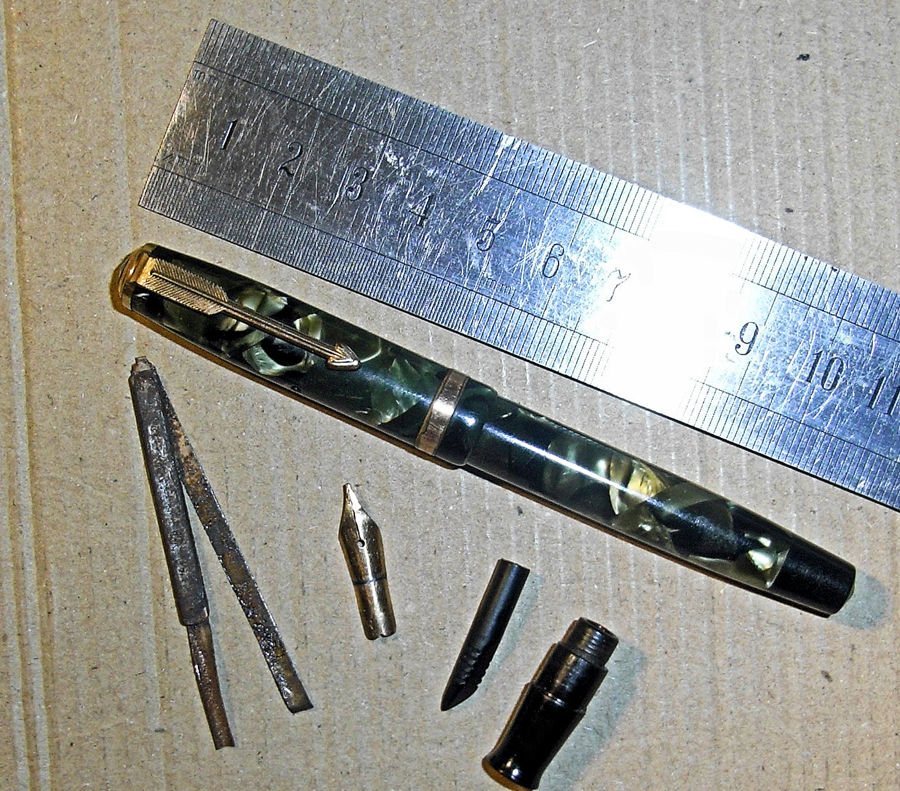
I know nothing about Parker Vacumatics. Can anyone tell me which model this is?

I’ve studied the various websites like parker.com and Richard Binder’s. The more I study the more confused I get!

It measures 139 mm capped. It has the plastic plunger and the threaded collar is metal. It has a plain diamond clip.

Old Inks

I have enough ink here to last me for several lifetimes. The oldest, I suppose, is the Stephens Blue/Black in the ceramic bottle. It’s excellent ink. The rest are good too with the exception of the Websters Diamine which is faded.

Though those inks don’t have the very bright colours of some modern inks, they are very pleasant and they go very well with the old pens I handle.

The Cap

I am frequently asked for advice by people intent on repairing their own pens.  Apart from the ever popular inquiry about sac sizes – which I can rarely answer with certainty – the most frequent are about the section and the cap.  Hardly surprising.  The section with its attachment to the barrel, its contents of nib and feed and often threads for the cap is the source of much difficulty.  The simple-seeming cap is actually a complicated assembly.  Clip screw, clip, decorative bands and means of attachment to the barrel, all can cause problems.  Caps also do love to crack, usually at the lip.

Soaking any part of a pen is usually bad practice; this applies especially to the cap.  Apart from the usual dangers to the material it is made from, the cap often contains interior parts that hold the clip in place.  They can rust and cause serious problems later.  There are occasions when you might want to apply liquid to the interior of the cap.  Perhaps you wish to remove old ink from aesthetic considerations or to detach the clip from a pen with a clip screw.  In the first instance, make that liquid naptha which will leave no harmful residue.  In the second, a few drops of water will do no harm as you will be disassembling the cap and will have the opportunity to ensure all the parts are dried thoroughly.

Removing a clip screw exposes the cap to another danger:  the temptation by the impatient to use sharp and destructive ordinary pliers.  That’s fine if you really intend to ruin your pen.  Otherwise, get hold of section pliers, one of the most useful tools you’ll ever buy.  Some caps have very long threaded areas on clip screws (Croxleys come to mind).  Those require patience and steady hands because though less fragile than the lip, the upper end of the cap can crack too.

Those more complex clips that fit through the material of the barrel will usually require an inner cap puller.  There are alternative methods of getting the inner cap out to give access to the interior part of the clip but they’re generally best avoided.  This is often a job for the expert, partly because it can be difficult but also because the inner cap puller is expensive, too expensive to buy to fix one pen.

Next come cap rings.  Plastics can shrink over time and the rings become loose or lost altogether.  Replacing or tightening rings in such a way that they will give no further trouble is not a trivial repair.  They have to be swaged back in place and that’s one for the professional.

Lip cracks reduce the value of a pen out of all proportion to their tiny size.  If the cap is made from hard rubber the cracks cannot be permanently repaired.  For a very expensive pen, a replacement lip can be crafted, not a job for the absolute beginner.  Caps made from other materials can usually have lip cracks repaired.  For repairs like this it’s a good idea to practice on cheap pens before you begin work on your Swan or Onoto.  Look after your safety, too, as many of the materials are decidedly noxious.

I’m getting writer’s cramp now.  Sections are for another day.

Onoto 4601

I’ve written before of my admiration for Onotos – all Onotos except the very last ones which are spoiled by a tendency for the hoods to crack.  Those long, slender pens from the 1920s have some of the best nibs I have ever written with, often flexible, sometimes stubbed or oblique.  The quality of the pens and nibs remained consistant until late in the company’s history.  I’ve had several 4601s over the years and there is always one in the box of my own pens.  Though it’s around 70 years old, I think it has quite a modern appearance.  The long, slender section may be the most dated part of the pen, but I find it makes for a comfortable fit in the hand.

It has been said that the reason that the plunger-filling system was abandoned in favour of the German style piston filler was because the plunger was outdated.  I don’t agree with that.  Filling systems don’t date.  I believe the cause of the change was economic, not practical.  You only have to look around at the plethora of filling systems available today, almost every method of getting ink into a pen that there has ever been.

The 4601 is a fine example of the Onoto.  As always with this filler it takes a barrelful of ink which lasts even me for ages.  I like colourful pens but the engine-chased black celluloid is appealing, too.  Catching the light as it does, it’s a subtly beautiful finish.  Like other Onotos, those pens fetch a premium price, not because they’re especially rare – thankfully they are not – but because they are of the very highest quality.

Baystate Blue

The postman delivered an unexpected package this morning.  It was a large bottle of ink and an accompanying letter, from which I quote:  “I offered to give it away on the Fountain Pen Network forum and someone suggested I send it to you.  So here it is.  I hope that you love (or at least don’t hate) it.  If not then feel free to throw it in the bin.  I don’t recommend pouring it down your sink unless you are prepared to replace your sink and possibly your entire kitchen.”

So this is the famous, or perhaps infamous Baystate Blue, one of Nathan Tardiff’s more controversial inks.  I remember Tardiff from many years ago when he was an expert in re-tipping pens and produced some highly unusual nib tips.  Where he upset some was in re-tipping uncommon vintage nibs, an absolute no-no in the collector world.  He went on to produce a new range of inks with great success.

I believe Tardiff is a species of genius, highly original and very capable but he is also a troubled spirit, constantly seeking controversy.  The titles of some of his inks unnecessarily reflect his politics which some would refer to as patriotic while others, including me, would say he is aggressively right wing, which I regard as a thoroughly unpleasant creed.

Leaving that aside, this is the first of his inks that I have used.  It is very beautiful, a startlingly intense blue, clearly a super-saturated ink.  I am not unaware of its reputation for staining everything it comes near and destroying pens.  It is said that the process whereby it damages feeds and sections is that it reacts with traces of other inks that remain in the pen.  A warning is given on the bottle to ensure that the pen is absolutely clean.  I am taking no risks and have filled a cheap Chinese pen that has never been used before.  Hopefully it will survive and become my Baystate Blue pen because I love this ink.

Normally I pay little attention to ink.  As I may have mentioned before, I have some Parker and Diamine inks and several bottles of very old inks, Stephens, Swan and some others.  I stopped buying ink quite a while ago.  That makes it all the more surprising to me that I am very impressed with Baystate Blue.

Yet Another Osmiroid

I’ve always liked Osmiroids. The 65 and 75 are very basic pens, almost an afterthought by Edmund Perry, the manufacturer of the excellent nibs. Therein lies their great practicality and even charm. They are there to write with and nothing else. They are not objects of admiration or collector’s items. Nowadays, they are regarded purely as calligraphic pens but that was not always so. My husband used one as his everyday pen in his schooldays.

A kind friend gave me this Osmiroid 65. It comes fitted with a soft medium nib, the kind you would use for ordinary writing, and a very good writer it is too. It can even be induced to provide a little line variation. I’m sure I have other Osmiroid nibs somewhere and I must hunt them down.

The Osmiroid writing system is often compared with the Esterbrook. They will accept each other’s nibs, which is handy. The nibs will fit some Burnhams too, as well as a few German school pens. Looking at the pens themselves, the Esterbrook is the clear winner. Whereas both 65 and 75 Osmiroids are subject to plastic shrinkage, the Esterbrook is generally stable. It is better made and comes in more attractive finishes.

When we come to the nibs, it is by no means so clear which is the better. The build quality of both is good though the Esterbrook may have an edge. I am no calligrapher but some of those who are tell me that they prefer the Osmiroid nibs. I can’t really go into why this should be so, being a shade ignorant of the subject. It isn’t a silly nationalistic thing though, because some of those who favour the Osmiroid nibs are American. If you would be interested in following this further, the search facilities of the pen discussion groups will assist.

A good 65 with no shrinkage, like this one, is a real asset to the calligrapher. The later versions of the Osmiroid, though no longer compatible with the other pens, have their followers too. The later filling systems, squeeze and cartridge fillers, may attract some. The cartridges are becoming hard to find.

I suppose that those 65s and 75s whose plastic hasn’t shrunk so far are likely to remain stable. If that’s the case the 65s will go on forever, just needing the occasional sac replacement. So far as I know, the piston system of the 75 can’t be repaired but it doesn’t seem to need it, provided the barrel hasn’t shrunk. It doesn’t have a huge capacity of ink but being so easily filled that probably isn’t a serious failing.

The other calligraphic system, popular in its day, was a Mentmore product under the Platignum name. The screw fitting of the nibs to the section is different from that of the Osmiroid/Esterbrook. Those pens, or at least nibs, still have their users though nowhere near so many. The various Platignum models which accept them vary in quality though most are undeniably poor. The nibs lack the clean, sharp edges of the Osmiroid. Nonetheless, some splendid calligraphic work has been done with them.