Whither Cursive?

This is just a question. It doesn’t pretend – or even aspire – to provide an answer. To what degree,  if any, does the popularity and utility of the fountain pen depend on cursive writing?

I think it’s worth saying that the decline in popularity of the fountain pen is now historic. Without exact figures to support it, I would say that the popularity of the fountain pen has stabilised. It may even be increasing slightly. Both modern and old fountain pens seem to be doing well.

Cursive writing, on the other hand, seems to be dying a death. In many schools it is no longer taught and it is the case that many younger people have difficulty reading it. Of course calligraphy, which includes versions of cursive script, is probably more popular than it has ever been but in a way that’s an irrelevance. Any style of writing can only be regarded as in good health if it is a commonly used means of communication.

Many younger people, when they write at all, seem to use a script somewhat similar to what they see on the printed page. It may or may not be easier to write in that fashion with a fountain pen, but ballpoints rule the roost, with other forms of nibless pens in a minority.

What do you think?
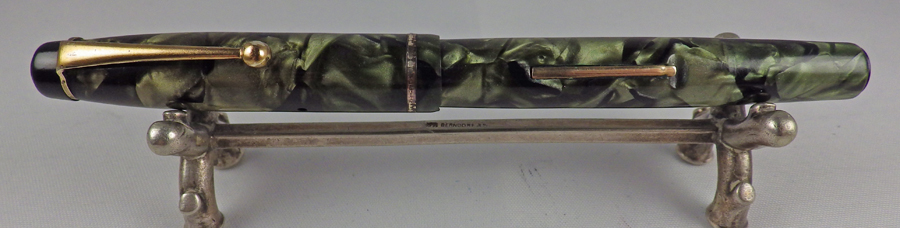
Wyvern Perfect Pen No 60

Wyverns are always interesting and sometimes a little annoying: annoying because of the occasional left-hand thread and the confusing re-use of names and model numbers. They are particularly interesting because of their long history and extensive model range.

This pen re-uses both a name and a number but it bears little resemblance to the earlier pens that bore them. This new style of Perfect Pen went into production in 1951 and remained available until the end of fountain pen production in 1955*. It appears to have sold quite well and is not uncommon today.

The designer of this pen attempted to straddle two horses, as it were: tradition and modernity. It shows the influence of the Parker 51 in the long section and partially hooded nib. People were impressed by the modern lines of the Parker 51 and looked for something similar though retaining brand loyalty. The appearance of tradition in the pen was perhaps inescapable. It’s a celluloid pen machined from solid stock, this at a time when injection moulded plastic was taking over. This choice of an older type of material may have been dictated by what was in stock that had to be used up.

Despite its appearance this pen is technically entirely traditional, using methods that go all the way back to the early 1920s. It is a lever filler with a traditional nib, feed, pressure bar, lever and sac. This would certainly have been due to the cost of re-tooling to produce a pen with more modern internals.

It has been said that the more modern-looking British pens like this one and some Mentmores ultimately failed because of their dated filling systems and ink delivery. I don’t see the evidence to support that view. It wouldn’t have mattered how truly modern the fountain pens were made, their future was bleak anyway. The ballpoint was accepted even earlier in Britain than in the US simply because of the advantages its practicality conferred.

Personally I rather like the Perfect Pen No 60. I like the fact that initially, with its patterned celluloid, black end to the barrel and black clip screw, it appears a perfectly traditional British fountain pen. Then there’s a little surprise when the cap is removed to reveal the long, tapered section and semi-hooded nib.

*Stephen Hull: The English Fountain Pen Industry 1875 – 1975

The Swan Metal Pocket

In the years before fixed clips came along, there were various ideas to make pens portable. That most of them sold so well makes it clear that people wanted to bring their pens with them when they left home, usually to be used at work.

The Swan Metal Pocket was one of the most successful of these innovations. It was sturdily made from pressed steel and bears the Swan logo on the part that would appear outside the pocket, so acting as an advertisement too. That the Conway Stewart version was so similar suggests that they were both made by the same company contracted to produce them.

Though they are anything but ephemeral, being durable in the extreme, to a collector they would count as ephemera. They could, of course, still be used for their original purpose but a word of caution is required here. Many have succumbed to rust internally and will scratch a pen. It is possible to restore them to use with emery cloth or wire wool

Dutch Winstona Piston Filler

Beyond the fact that it is Dutch, I know nothing of the history of the Winstona. Searching online I found one other example. It was the same model of pen in a similar pattern, just black and white instead of wine and black. There are things about it the remind me of other pens, but only by accident. It is roughly the size and feel of the Parker Slimfold, slender but solid. The clip is Pelikan-like and at the top the clip becomes almost a cowl, a little reminiscent of some of the better 1950s Conway Stewarts. And, of course, the pattern is a little like the Parker Vac.

But of course this pen is very different from all those, being a piston filler. Removing the black blind cap reveals a turn-button which moves the piston. The barrel is partly transparent and has good clarity.

It’d be interesting to know what the original nib was but it has been replaced. The small Parker nib, from a Junior or late Victory, fits well and is a good writer as Parker nibs generally are.

I know of only a few Dutch pens. Like this Winstona, they resemble German pens and are equally well made. Quite how this one made the journey across the North Sea we will never know but I’m glad it did. I’m grateful for the opportunity to see this uncommon and attractive pen.

Eversharp Symphony 917

Late Eversharps are a little hard to identify, for me at least, not being very familiar with them. There are several similar pens that come under the heading, “Symphony”. This example I believe with its plastic cap and broad cap band, is a Symphony 917, made in Chicago in the early fifties. The 18 carat nib suggests that it was aimed for export to France.

In the twenties and thirties Wahl Eversharp made great pens. By the nineteen fifties the quality had declined somewhat, in line with the company’s slide from its earlier great success. This is still a good pen, however, with a pleasant stubbish nib that allows for a little line variation. By the nineteen fifties injection moulded plastics had begun to stabilise and this pen has none of the shrinkage that continued to afflict some others – and not just the inexpensive ones either.

The gold plating has held up well on the cap band and lever but the clip is worn. The torpedo shape is in line with the fashion of the time. This pen, like most Eversharps, has a breather tube, making it fill very efficiently. Taken all in all, this is a pen that continues to hold up the good name of Eversharp.

English Parker Duofold Aerometric

Still with Parkers, but across the Atlantic Ocean to look at the Newhaven Aerometric Duofold. These were introduced in 1953 so the oldest ones have reached retirement age but they are set to go on for at least another 65 years. They need very little in the way of servicing. Perhaps a good flush. The sacs rarely fail, though I occasionally come upon one whose sac has popped off the section. That’s easy enough to correct: just pull off the sac protector, shellac the sac back in place, leave it to cure and reassemble. Other failings – not many. The cap lip can crack but certainly no more often than other pens and much less frequently than many. The “jewel” can crack. Replacements only come from other pens. The plating is good but after sixty-odd years it isn’t surprising that some wear shows. The material that the casing is made from is quite soft. It shines up beautifully but the downside is that the barrel imprints can fade away.

So these are the detractions and they are neither many nor severe. These are among the most practical vintage pens. They come in several sizes. This one is a Standard, there are also the Junior, Demi, Senior and Maxima. The Slimfold came along a little later and the Lady, with a hooded nib, completed the range. They come in black, red, blue and green. The nibs are usually inflexible.

The English Duofold has been an influential pen. Though the high-quality Japanese pens are often said to emulate the Montblanc, their classic torpedo shape is very like the Duofold. Most writers today prefer firm nibs and the English Parker Duofold nibs are the equal of anything produced today by Pilot, Sailor or Platinum. Compared with the Conway Stewart and Swans, they remain inexpensive today. The Standard or Senior is an excellent writer and a high status pen at a bargain price.


Excuse the photography.  This pen is blue, though you’d hardly believe it!  The light was not co-operating with me.

Parker Junior Streamline Long

Are you tired of Parkers yet? I hope not because I have a few more to go. This one, at a hair’s-breadth less than 12 cm, appears to be a Duofold Junior Streamline Long. It was made sometime between 1929 and 1934, so not far short of 90 years old. It’s in splendid condition, the jet black Permanite as shiny as when it was new. The gold-filled trim remains good, with just a little loss here and there.

It’s a stocky pen but when posted is a comfortable length. Like other Duofolds of this period it has the hanging pressure bar. It’s very efficient and takes a considerable amount of ink. The button-filling system exerts quite a bit of pressure on the sac. This enabled us (or at least those of us who had button fillers) to fire ink an appreciable distance across the classroom, to the disapproval of the teacher and of our mothers who had to try to get the ink out of our clothes.

Enough about my wild childhood. The Junior version of the Duofold, whether this slightly larger pen or the Standard, was evidently very popular. What was the target market? Was it gifted to school students? Bearing a clip and being a little larger, it would not have been a vest pocket pen. Perhaps it was seen as a more affordable alternative to the full-size Duofold. In any case it appears to have sold very well as there are still many about today.

The one fault with this example is that the nib is a more modern replacement, the number 10 indicating that it came from an English Duofold Junior of the fifties or sixties. Several of the older Parkers I have written about recently have replacement nibs, which is surprising considering how robust Parker nibs usually are. I suppose it’s a consequence of the pens’ long survival.

Parker Televisor Slender

I have yet another small 1930s Parker to add to my recent list. All of these have been Canadian, reflecting the protectionism of the times that kept US pens out of the UK. I’m not sure whether the Televisor qualifies as another “thrift time” pen. It was in the medium price range.

I have written about the Televisor before: on that occasion it was a Junior that was featured. As always, if that is your interest the search box at the top right will take you there. This version is the Mark 1. I believe it is a “Slender” being a little slighter and shorter than the “Standard”. These pens came in a variety of attractive patterns; this one is black, but none the less impressive for that. This was not intended to be an economical pen as the contemporary Challenger was. The gold filled clip and three cap bands have worn well. The design of the clip with its elongated diamond cartouche bearing the word “Parker” is shared with the Challenger. This clip most obviously defines the Mark 1, with its ball ended design. The visualated section is a useful feature. There was also a pencil, though it is seldom seen. That’s surprising in a way, as this pen was seen as a potential gift, particularly for students, and was often sold as part of a set.

This form of Televisor remained in production for three years, being superseded by the Mark II in 1938. Set between the “thrift time” pens and the more expensive Duofold, it proved very popular in Britain and often turns up nowadays. Its popularity was justified: it is an excellent pen with a good nib that often has some line variation. The filling system utilised the efficient “suspended” pressure bar. It was made from good materials and often appears in very good condition today.

Latest Sales Site Update

You know those gems, the pens in the box
Which rattle forlornly; the ‘difficult’ stock.
‘I’ll fix them sometime,’ so the mantra goes,
But they languish on, in near-death-throes.

Along comes the day when an idle glance through
Makes the thought sneak in: ‘I should see to these, too.’
Then puzzles are sorted, pressure bars put in place;
With each one I fix there’s a smile on my face.

One pen after another receives a new sac
Held safely in place with a bit of shellac.
A buff and a shine and the days work is done;
It’s so good to revive yet another one!

For the past few weeks I’ve never been bored
While ever more pens at last were restored.
They’ve been prepared and the prices are right:
Won’t you have a look at them on my sales site?
