Harking back to my recent post about unbranded pens, here’s a splendid set issued by The Daily Herald in 1935.

Many thanks to Paul Stirling for sight of this beautiful set.
Harking back to my recent post about unbranded pens, here’s a splendid set issued by The Daily Herald in 1935.
Many thanks to Paul Stirling for sight of this beautiful set.
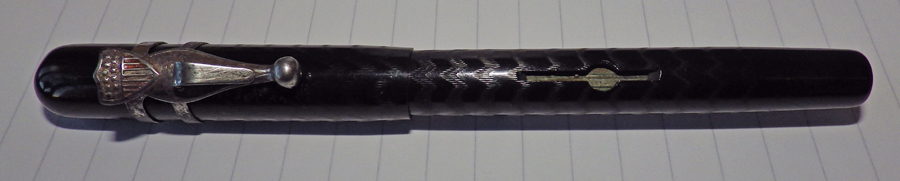
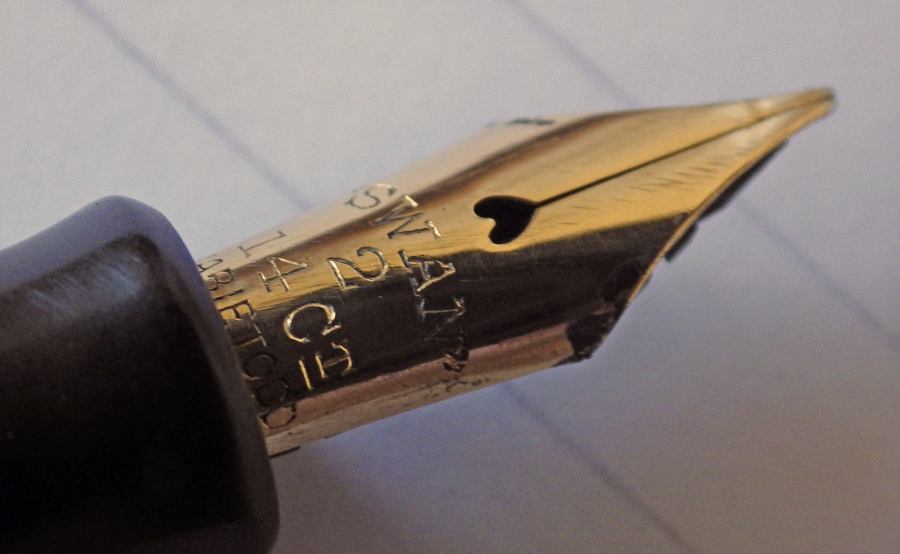
I’m fond of mysteries but there are times when I wish for a solution. This handsome coin filler gives no indication of its manufacturer. There is no barrel imprint and the original nib is long gone with any helpful information that might have borne. I cannot even say with any certainty which is its country of origin. At 13.5 cm it is a medium-sized pen, though it takes a very large nib for the pen’s size. When it came to me it was fitted with a folded tip, gold-washed replacement nib. I tried various nibs from my stock; a Swan Eternal No 4 fitted perfectly. The slip-on cap fits securely. It is quite long, as slip caps go. The original black has been retained and the chasing is good. It has the usual slot for a coin but there is also a circular aperture for a matchstick. I find that quite unusual

The seller put a date of 1910 on it. Certainly patents for coin fillers were taken out in that year and perhaps that’s where he got the date from. Viewing the shape and the style of the pen overall, I would estimate a date a few years later, perhaps 1915 or 16. The pen is graced with a spring accommodation clip bearing a representation of the Stars & Stripes. It has worn quite well and there’s even some colour in the flag. The accommodation clip is certainly American. Is the pen American too? I suspect that it might be. Coin and matchstick fillers were more popular in the US than here in the UK.
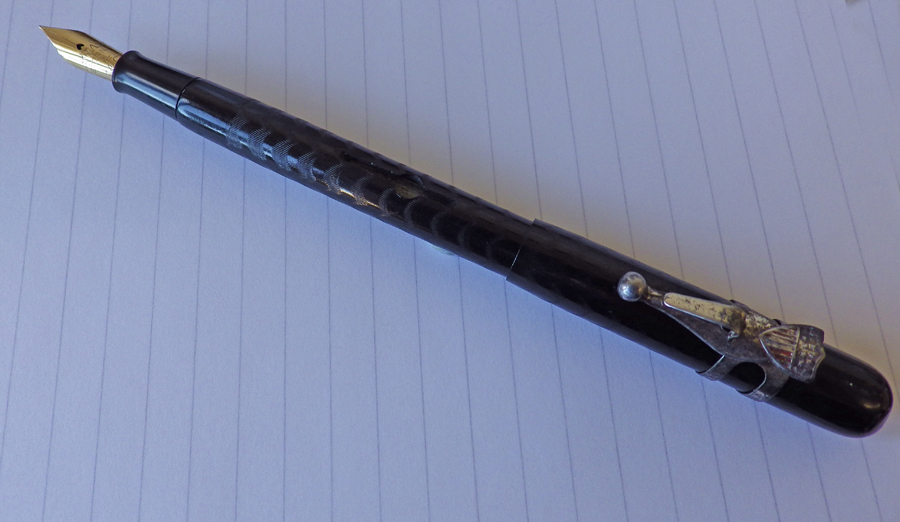
I’m pleased with it as a writer. The coin filling system is quite efficient so the pen takes a good draught of ink. It feels comfortable and balanced whether posted or not. The clip is quite light and doesn’t overbalance the pen. As a replacement, the Swan Eternal nib doesn’t really form part of the judgement of the pen, but as always with Eternals it is wonderfully smooth and pleasing in use.
So there it is: a 100-year-old mystery and a great rarity while still being a very practical pen.
Though I’ve probably written about it before (after all this time I’ve written about many things before) the splendid Swan 3250 is worthy of further consideration.

The burgundy is so dark that it appears black in anything but bright light. This is one of the earlier examples with brass barrel threads. The company returned to plastic threads later, probably because of cost. The brass threads wear the cap threads but not quickly enough to have influenced Mabie Todd’s decision, I would have thought. After all, almost 70 years later this example is still closing firmly with a single turn.
The gold plating has worn quite well, not always Mabie Todd’s strong point. The No 2 nib is not flexible but it has some spring which makes it very comfortable to write with. For me and for someone with larger hands than mine, it is a comfortable pen to hold and use. It is so well made, from such good materials, that it feels like a new pen.
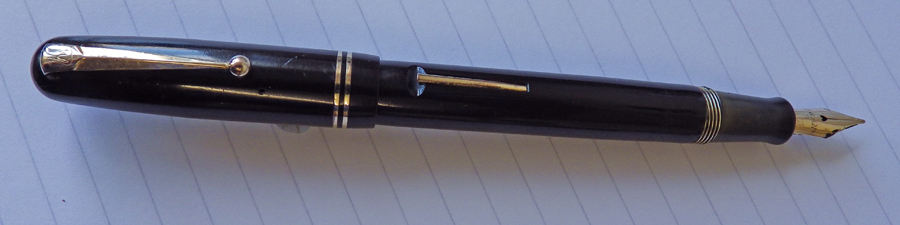
We are blessed with the gift (or curse) of hindsight, and we see this pen as completely in line with its high-quality predecessors. We are, of course, aware of the fall to come in a few short years, when very inferior products will be turned out bearing the Swan name. That makes these fine late examples all the more precious, I believe.
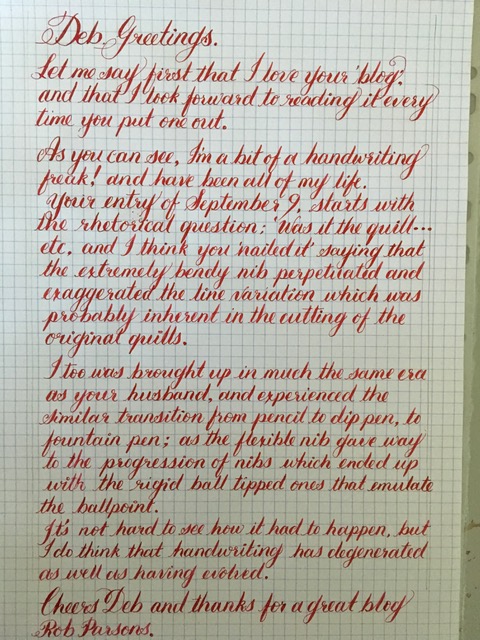
Many thanks for your kind words and permission to use this beautiful image.
Was it the quill which gave rise to that style of writing we so admire today; those scripts which employed the instrument’s capability of producing line variation? There can be no doubt that the extremely bendy steel dip nib perpetuated it and maybe even exaggerated it. It served no practical purpose: it did not make the script more legible than it would have been without line variation. It was, however, undoubtedly beautiful and admirable. It was also generally aspired to. I have seen it in the writings of registrars, of ministers of religion, in military clerks’ writings and in everyday correspondence. It was not something separate from usual writing. For a time it was usual writing.
In quite a short period it appears to have diminished. It took quite a while to disappear altogether from formal writing. In the UK more than the US it left a trail behind it. British fountain pens continued to offer flexibility until they were supplanted by the ballpoint. It was, however, the fountain pen that was the instrument of its demise. First World War soldiers’ records, written in fountain pen, more often than not show no line variation and where it is present it is as a flourish in the later business style of writing.
My husband remembers being taught that version of cursive – or longhand as it was then expressed – in the mid fifties. It was insisted that, using pencil, down strokes should be heavier than up strokes. This was probably in preparation for utilising line variation when the move came from pencils to dip pens. It was wholly an anachronism by then; nobody wrote that way any more.
Copperplate and its cousins have gone from being communication to a branch of art today. Calligraphy, whether commercial or hobbyist, is not used any more where the primary purpose is to inform. I think it’s fair to raise the question why was it ever the general cursive? Writing with the dip pen was naturally slower than using a fountain pen because of the need to refresh the ink on the nib but it was not that slow. Painting letters, which copperplate is, must have been very slow even when practised by the proficient. One may say that it was used in a slower age but that’s a modern myth. The Victorian period was anything but slow. Clerks, transcribing legal documents, were paid by the word.
It remains a puzzle to me, but I’m grateful for its existence. I can but admire it.
I see the occasional modern unbranded pen but they’re not common. Back in the 1920s and 30s it was another matter. There was a proliferation of unbranded pens, many of which have survived. Some unbranded pens were used for promotion or advertising and usually bear some indication of their purpose, like the famous Typhoo Tea pens. Others were undoubtedly just sold, like branded pens. How did one go about buying such a pen?
Buyer enters a stationery shop.
“I’d like to buy a fountain pen please.”
“Certainly, madam,” replies the shop assistant, “would you like a Swan, Conway Stewart or maybe a De La Rue Onoto?” After a slight pause, with a discernible sneer, “or perhaps a Platignum?”
“Don’t bother me with all that,” she replied, “I’m in a hurry. Just give me a pen!”
So the shop assistant offers a mottled hard rubber pen with no maker’s name. She grabs it, hands over the paltry sum required and dashes off to write whatever it was she so urgently had to write.

Some of these pens were probably churned out by well known pen manufacturers like Mentmore or Wyvern when trade was slack. Others may have been made by companies we’ve never heard of who did nothing else but make unbranded pens. Whether in black chased hard rubber or mottled red and black hard rubber, they have a consistent appearance. Made from two tubes, the wider forming the cap, they are about as simple as a lever-fill pen can be. The nibs are always warranted when they are gold but sometimes they have steel nibs, plated or otherwise.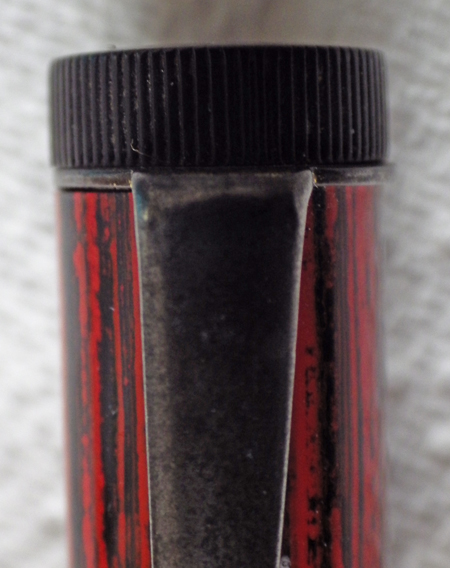
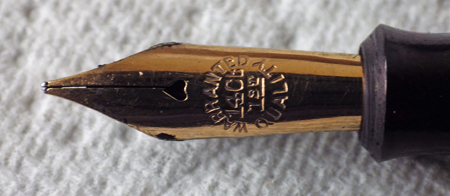
This one is a handsome specimen. The milled clip screw hints vaguely at the Duofold. That’s the one attempt at style. The lollipop clip with its cloverleaf or shamrock imprint is a common bought-in item. The nib is warranted 14 carat and of a reasonable size. The pen’s glory is in the rich reds and blacks of the hard rubber, the colours as strong and intense as the day it was made. The clip was once gilded but the gold has gone almost entirely, leaving a faint memory in the crease before the ball end. This pen would probably date to the late 20s.
I’m fond of these unpretentious pens. They were practical when made and, with a little attention, they remain practical now. These pens were not bought to show off the owner’s wealth or taste, just to do a necessary job. They were the pens that completed decades of sales or purchase ledgers, which kept families in touch with emigrated children or were carried in a soldier’s pack to write home from the outposts of Empire.

In this case, the pen has survived to show off colours more eye-catching and handsome than that of many a much more expensive pen.
The name Waterman was a guarantee of quality for five decades and more. It is unnecessary to list the brand’s achievements but from eyedropper fillers to the glories of the ripple pens, then some of the finest celluloid patterns in the thirties, Waterman pens had an immense appeal. The heart of any Waterman pen was the nib. Whether firm fines for accountants or wonderful flexible nibs for those who had the skills to use them, Waterman’s “Ideal” nibs were internationally recognised as among the best.

After World War II Waterman’s business declined but there were still some good pens to come. The “W” series of pens introduced in 1955 employed splendidly patterned celluloid, perhaps the company’s swansong before they, like so many others, began using the cheaper injection-moulded plastics and plated nibs that were but a faint echo of the high-quality gold “Ideal”.
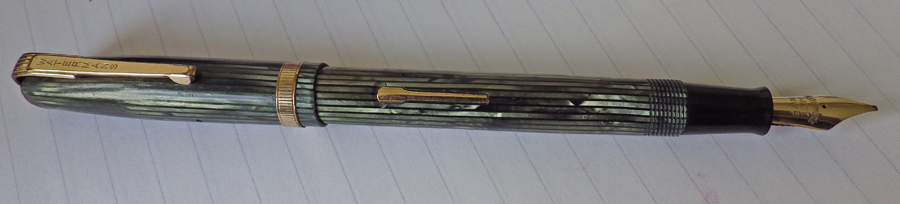
This series retains the Art Deco clip of its predecessors but the box lever has been retired to be replaced by a simpler spatulate lever. I’m not quite sure how to describe this green and black pattern: not so much striated as striped perhaps. The cap band is vertically incised.

This British pen no longer has the Ideal nib. It is an NW3. W3 reflects a number of the pen – I don’t know what the “N” denotes. Nonetheless it’s a good quality 14 carat Waterman nib – in this case a stub. It isn’t flexible but still gives pleasing line variation.
These pens have their failings. The gold plating tends to suffer, especially on the clip – though this example is quite good. Otherwise they are quite robust and this pen, at 63 years old, looks ready to serve another generation or two.
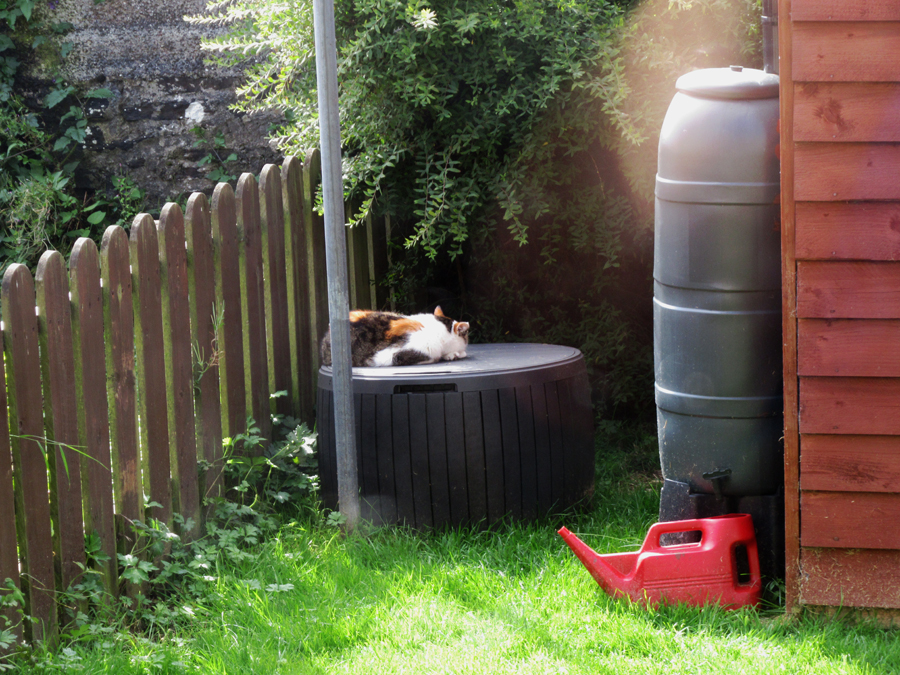
My assistant is very busy today as you can see.
For many years I used nothing other than pens with flexible nibs. It might be worth saying that in those days I didn’t write several pages at a sitting and when I began to do so I found my flexible nibs less than convenient. I wanted to write fast, as the thoughts flowed, and flexible nibs were too demanding for that. I also relished the challenge of writing well – or at least legibly – at speed. Experimentation showed me that I do best with a firm fine nib. I don’t have much use for medium or broad firms. I can imagine work for which these nibs would be good but they don’t relate to the way I work.
I do still enjoy writing with flexible nibs and I keep one or two though I have no practical use for them. I also like stubs which can confer a different type of line variation. Some of the old manufacturers made wonderful stubs, particularly Swan, Conway Stewart and Onoto. At the moment I have a superb example engraved with the name of Philips, Oxford, the last official service agent for Swans and Onotos. Slant a stub a little and you have an oblique. It is generally said that obliques were supplied for those who habitually turn their pens. While I’m sure that is so, I habitually turn my pens with oblique nibs so that I can enjoy them – not the other way round.
A good, sharp italic can make for wonderful lettering and I enjoy their unforgiving accuracy, but again, that’s a nib style I have no practical use for. The sharpness of its tip precludes fast writing, for me, at least. There are italic nibs with rounded corners these days, called cursive italic nibs. Aren’t they just stubs?
There are other more unusual nibs like the architect and the Japanese fude nib and perhaps a few others I haven’t heard of – oh, and there’s a nib that’s a stub or italic turned through 90° for writing in other scripts such as Persian.
Coming back to my everyday writing with firm fine nibs there are a few manufacturers whose nibs suit me best. I love Newhaven Parkers. They are just about the ideal nib for me. I have several fine-nib Duofolds and I’m writing this with a 45. It’s not the finest nib I have but within the range I like and totally reliable. Modern Japanese nibs are quite similar to English Duofolds, I find, or at least some of the Pilots and Platinums are.
There are so many nibs to enjoy, modern and vintage. We are very well served.

My assistant likes to sit out on the window ledge and enjoy the sun. She really isn’t much help.

I’ve written about the Swan 3160 before but this pen makes it necessary to write about it again. 3160s are fairly common – as the cheapest of the Swan range I expect that they sold in considerable numbers. They’re great pens to write with but they are not my favourite to restore because of the screw-in section which can be awkward. I’ve never seen the benefit of a screw-in section in a lever fill pen.
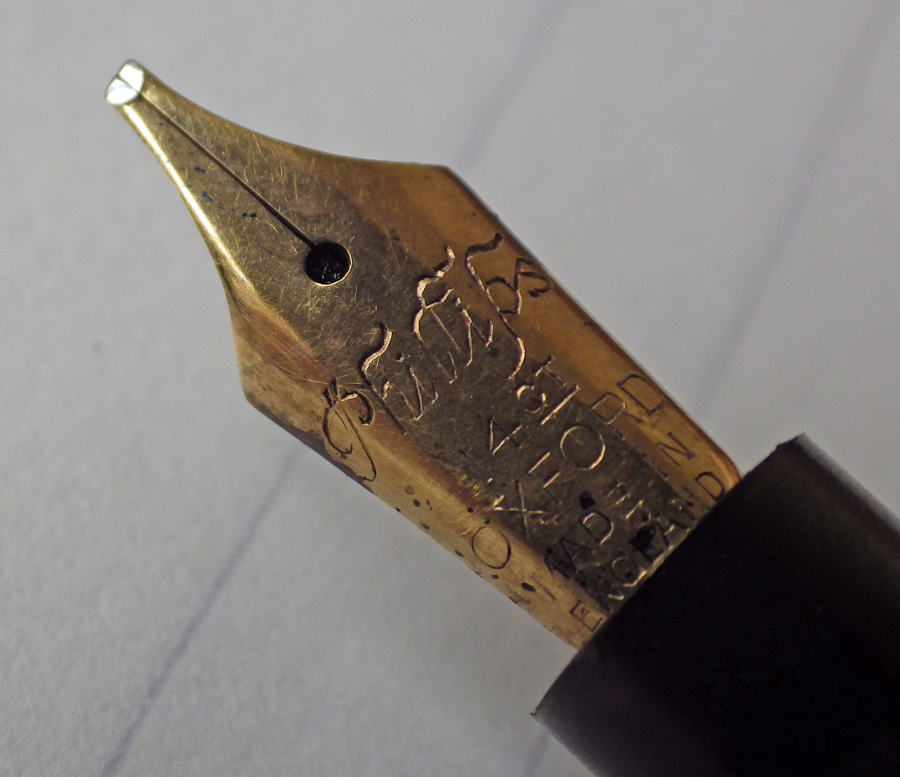
Anyway this pen is special because of the nib, which is a gently oblique stub with some flexibility – a truly lovely nib. I’ve had many Swan stubs over the years but this is the first one by Phillips of Oxford.

Perhaps this nib was a replacement for one that was damaged, or it might have been that the owner had a yearning for an oblique stub and had his nib changed. As it has “Phillips Oxford” on it, we know that the nib would have come from Mr Brown who took over Marrians the nib makers and supplied Reg Phillips. It’s not impossible that this pen was made up from a barrel and cap which was part of the stock that Phillips took over when Mabie Todd went out of the fountain pen business, effectively a “new” Mabie Todd Swan 3160 from around 1960.
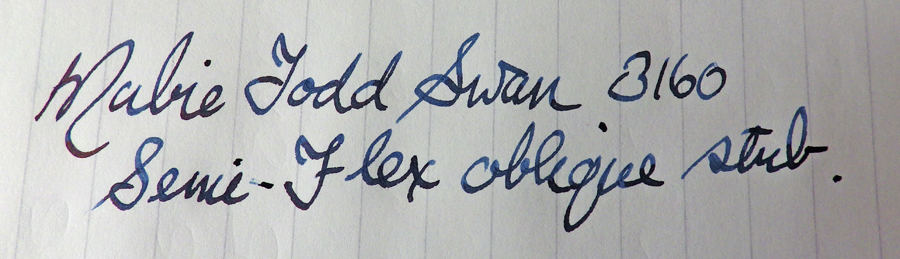
The information comes from Stephen Hull’s magnificent The English Fountain Pen Industry 1875 – 1975.
Discussion of Chinese pens draws heat that may have more to do with politics than pens. Taken purely on the basis of how well and dependably they lay ink on paper, Chinese pens have come a long way in the last few years. I have Chinese pens that are so reliable that one may be the only pen I carry on a particular day. That’s not to say that there aren’t some Chinese pens of poor quality; they’re mass market products and at the price they are offered they can’t receive the inspection and quality control attention that we assume pens ten and twenty times their price receive. Of course we may not always be correct in that assumption but that’s a subject for another day.

It was something of a red-letter day when Chinese piston fillers arrived on the market. Not all of them have been perfect – some have been subject to cracking – but the Wing Sung 698 seems to be about the best of them with few faults reported that I have seen. In some packaging the word “Hero” appears and it may have been that the pen was designed by Hero which has since been taken over by Wing Sung. The pen seems a little unsure about what it is; the packaging says “Wings 698” and the clip is inscribed “Lucky”. But what’s in a name? It’s the pen that matters.
Mine came in a plastic casing with a converter filled with silicone grease to lubricate a piston – rather a nice touch. I’ve read that some packages come with an extra nib, an EF. Mine didn’t, it just had the fine nib I had requested. This Wing Sung nib, together with the feed, gives excellent ink delivery. No skipping or hard starting and the nib is smooth with just enough feedback to avoid being slippery. The pen has a locking knob to avoid ink-spilling accidents once the pen has been filled. It works well as does the piston filler. The pen has good ink capacity. It does what it’s meant to do and it does it very well.

There isn’t much to say about it aesthetically. It’s a very plain pen. Such trim as there is, is in chromed metal, though the tassie appears to be made from some plastic which emulates chromed metal. At the time I bought mine, the transparent version was all that was available. I’m not fond of these “demonstrator” pens and they do tend to stain. Now there is a black one available. For the information of those who post their pens, I find it back-heavy in that configuration. Just above the section there are the barrel threads. Depending on how you hold your pen, your fingers may come in contact with the threads. They’re not sharp. I don’t find this bothersome but some people may.
The cost is ridiculously little for such a good pen. Amazon charges £23 for the pen and its packaging. It’s available on eBay UK for £14.59 with the packaging and some sellers offer it at £9.99 without. As the packaging confers little benefit and you can find silicone grease anywhere, the latter is the better deal.
 Goodwriterspens's Blog