Entropy

The second law of thermodynamics tells us that disorder always increases. Everything is subject to entropy, even fountain pens. Decay and degeneration goes all the way from the hardened sac to casein rot. The first is, of course, easily dealt with, the second is beyond repair.

Not all pens degrade at the same pace. I’ve had high quality black hard rubber Swans in a dreadful state; what was once shiny black now dirty yellow, gold plating gone, nib bent and cracked. Against that I’ve had cheap and cheerful no-name 1920s advertising black hard rubber pens as black as night with their original shine, perfect except for a decayed sac. Clearly there was a difference in the hard rubber because it happens too often to be a freak.

We hear, in the pen boards, about celluloid so decayed that the barrel of the pen is falling apart. I must be lucky because I’ve never had a celluloid pen like that but I’ve had casein Burnhams disintegrating in the same way.

These are consequences of chemistry and time. Other things that can cause major problems come from the user. Pen nibbling or even chewing reduces a pen to a condition where no one will want it. Hard rubber has memory. Heat is enough to trigger a return to its original condition if the chomping isn’t too bad. With some other materials the solution takes longer and is more arduous.

Then there’s the user that puts something in the pen that shouldn’t be there. Artists’ inks and old iron gall inks can thoroughly clog up the works. I have spent hours on a feed and section of a pen left to dry up with ink that turned to concrete.

People drop pens. I understand that. I’m clumsy myself, though I’ve never been unfortunate enough to drop a pen nib-first onto hard flooring. I’ve dealt with the consequences often enough. I understand that some modern pens will shatter. That’s really not my area but I’ve often had to deal with nibs that looked like a propeller. If they’re not cracked they can usually be recovered but it is time-consuming and difficult. There are geniuses who can return such a nib to its original condition. If I can achieve a respectable appearance and a good writer I congratulate myself.

Most pens can be fixed. Sometimes the repair will take so much time that it doesn’t make financial sense. Sometimes I do it anyway. Other times the pen becomes spares. It’s very rare indeed for me to pitch a pen into the trash and when I do it’s invariably a modern pen that cannot be repaired due to its defective manufacture. So even those pens that I can’t repair live on, rescuing another pen by providing parts.

Entropy does destroy many things but fountain pens fight back. Many of the pens I work on are twice as old as I am and there is every reason to think they will still be writing a century from now.
Latest Uploads

Even though there’s this damn virus
We just don’t want it to retire us.
We’re working, still, with diligence
On pens, some of magnificence!

Eleven Swans, one Bird of Black;
We offer up a lovely stack
Of twelve new uploads for your view,
But don’t forget the others, too.

A plethora of pens await
Your kind perusal on this date.
We don’t just have M.T. & Co.
There’s quite a lot to see, you know!

So please see what’s there on our site
And if there is a pen you might
Want for your very own, just shout
And we will work the details out.

The site’s still ‘closed’ it must be said,
But sales continue on ahead
Just email me about your choice;
And I’ll send you a new invoice.

https://www.goodwriterssales.com/

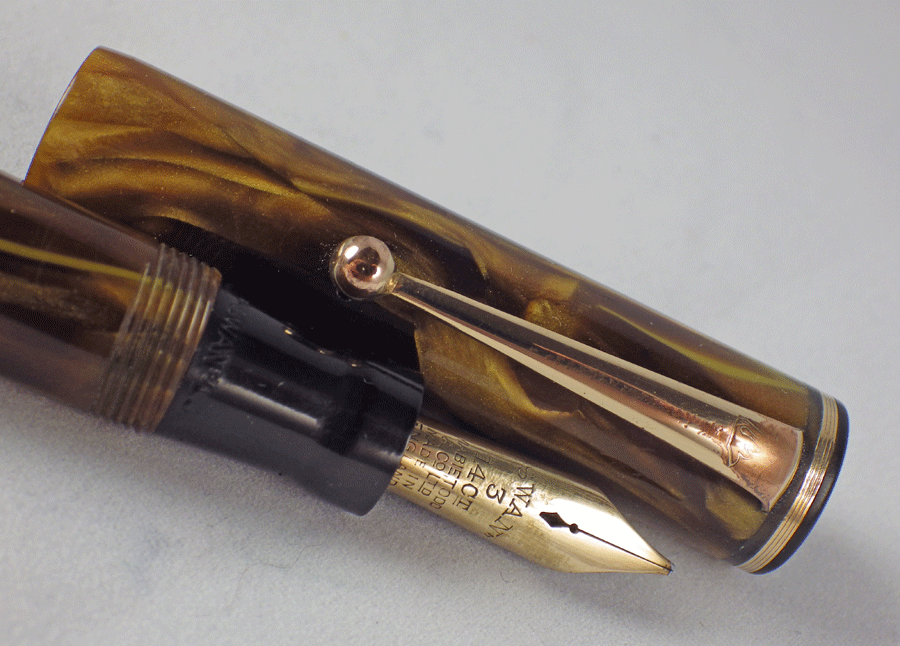
Swan Leverless L330/64

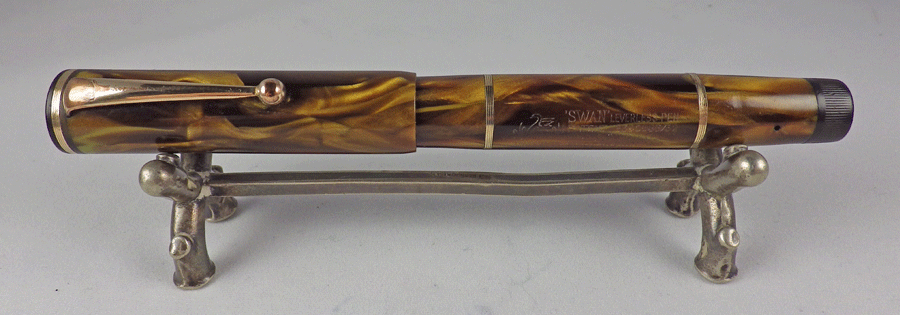
I had decided to keep the green Swan from my recent capture and I cannot keep them all, but I do admire this L330/64, certainly one of the finest of Mabie Todd’s patterns and very uncommon.

It is described by the company as brown and amber and that’s accurate though prosaic. It’s like the swirling colours of hot, home-made caramel, stirred in the pan. And there’s a reminder of dark, rich heather honey.

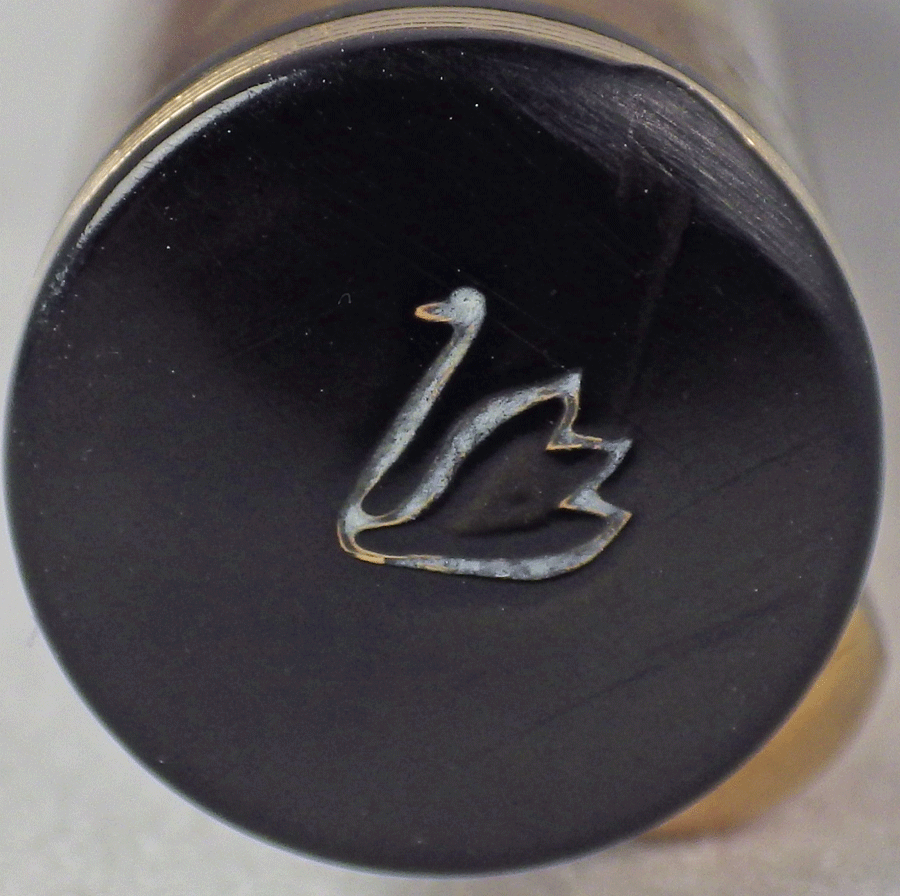
This is an earlier pen than the Swan L245B/62 I wrote about recently. Early to mid thirties would cover it, I think. It’s an exceptional design, even beyond the pattern. Harmony is created by the two narrow barrel bands and one at the top of the cap. It continues with the black turn-button, top of the cap and section. The top of the cap is also graced with a Swan outline in white.

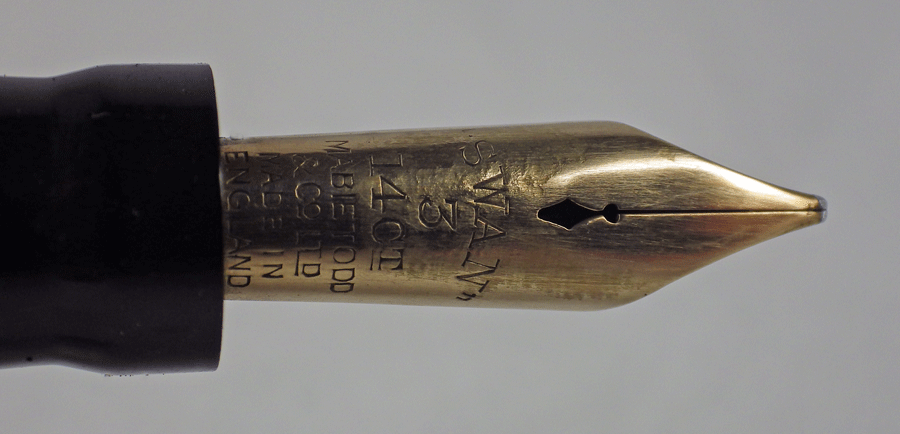
The treasures are not over! The Swan No 3 nib is one of those with a breather hole we call a keyhole. It isn’t quite as keyhole-like as the Waterman one but as descriptions go it will do. In any case it makes for an exceptionally elegant nib.

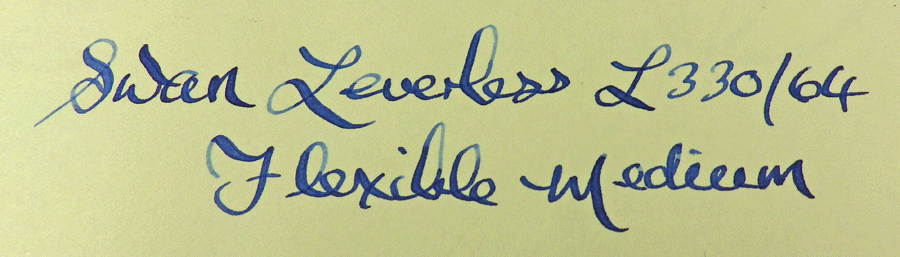
It’s a splendid writer, having plenty of the flexibility that many like nowadays. It’s very smooth, just short of glassy and with the slightest pressure the tines spread and lay down an expanding line. Lifted, the nib snaps back to its natural line instantly.

Because the L330/64 is uncommon, bordering on rare, this pen may go to a collector who will never use it. I cannot comment on that; once the buyer has his/her pen it is no business of mine what they do with it. It may be that the collector gets just as much pleasure from viewing their pen as the writer does from using it. After all, it is a visual delight and an objet d’art from the swirling pattern to the milled bands.

Swan Leverless L245B/62

First, a word about the model designation: “B” is usually associated with a short version of the pen. This pen is only a fraction of an inch shorter than an L2 without the “B” designation. In fact, it is well within the normal variation that we see in these pens.

Most 1930s Mabie Todd celluloid patterns are subtle; this /62 is not! The wine red positively glows and the silver and black contrast well. There is even a little patch of russet here and there.

I have written about a pen with this pattern before. This one has additional cap decoration, a medium milled band between two narrow ones. Such a beautiful pen must have been the source of much pride to its first owner but it shows little in the way of signs of use. Perhaps it was kept for best and only produced to write the occasional letter.

I’m not too knowledgeable about celluloid and how patterns were made but the British Xylonite Company who supplied Mabie Todd with their material produced exceptional patterns. Waterman in the US and Mabie Todd in England turned out pens in really outstanding patterns, better than anything we have seen since. Combine any of those 1930s Xylonite patterns with the elegance of the Leverless design and you have a memorable, enviable pen.

Mabie Todd Swan Visofil VT340/76

One of these days I may own a Visofil, an ambition yet to be fulfilled. These photos are kindly supplied by Jens. This is the very beautiful green and silver /76 pattern. This later, VT version of the Visofil comes in several candy stripe patterns.

The first version of the Visofil, introduced in 1935, is the easier to repair. It is Swan’s answer to the fashion for ink-in-the-barrel pens with ink viewing windows.

In 1937 Mabie Todd brought out an entirely new version of the Visofil and unfortunately little consideration was given to servicing. Perhaps it is enough to say that it takes four pages in the Marshall & Oldfield repair book to describe servicing this pen.

Repair, then, is not for the faint-hearted but there are a few very skilled and experienced repairers who will take on this work. I’m not one of them, I hasten to add!

The Unique

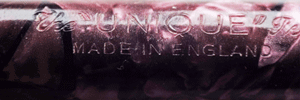
My husband re-sacced this Unique along with a Dinkie 14 years ago. They were used a little, then set aside. When I checked them a few days ago, the sac in the Unique was hard while the sac in the Dinkie was as good as new. I don’t know what conclusion to draw from that.

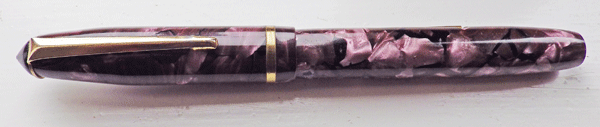
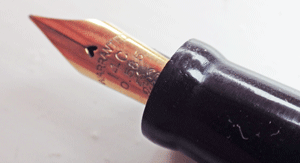
This Unique is a charming pen in a pink and black marbled pattern. At 13.1 cm capped it is an average-sized pen for its time, which I guess would be immediately post war. The gold – little more than a wash – shows some wear throughout. The cap is a little darker than the barrel. The pointed black clip screw is not matched by black at the barrel end as one might expect with some other brands. Uncapped, the small nib is a surprise at first.

Leaving all that aside, this Unique is a decent writer with good ink flow, no hard starting or drying up. I’ve found that to be usually the case with Uniques. They are reliable. The material of the barrel and cap will stand comparison with Conway Stewart or Burnham. The nib, though small, is gold, unlike Platignums, Osmiroids or school Burnhams. The filling mechanism works well. It is only really let down by the thin gold plating, which isn’t too worn in this example.

Like some other pens at the lower end of the market the Unique was built to a price, most obviously in the size of the nib, but they were well built to that price. It would be my guess that the pen was aimed at the school pupil market. I would think that the kid who got a Unique would not feel as deprived as the one who got a Platignum. His or her fingers would be less ink-stained and he or she would not feel the need to conceal the pen. It’s actually a pretty decent pen.

The Parker 25 Revisited

I sold a Parker 25 this week. I’ve written about this pen before. I didn’t like it and I said so, only to be rightly rebuked by several people who not only appreciate the 25 but hold it in high regard.

That forced me to reassess my own ideas about the pen. There are two things I can never force myself to like: the squashed appearance of the nib and the strange shape of the barrel. Against that I must say that the pen writes adequately well and just because no-one else made a suddenly tapering, narrowing barrel is no reason why Parker shouldn’t do it.

I have to accept that the 25 is a pen that is almost entirely problem-free and it sold in numbers that reflected that. This flighter is so robust that it could be used as an illustration for the word “robust”. It uses the cartridge/converter system that I don’t really like but most of the rest of the world does. In timely fashion, someone reminded me* that the filling system is of little consequence; what really matters is what happens when the ink is in the pen and the 25 is faultless in that regard. Not admirable, outstanding or inspiring, you understand, but faultless.

What about the barrel? Why does it have that sudden taper followed by a narrower part of the barrel? Does it serve a purpose? You may say that it enables secure posting but the Swan Leverless 1060 I am drafting this with posts perfectly securely without this abrupt taper. Like many, many other pens, the rear of the barrel of the 1060 tapers gently to reflect the shape of the cap, making a pleasantly balanced design. The 25 is not balanced, pleasantly or any other way.

Not everything has to be balanced, as the great builders of the Gothic period celebrated, but the Parker 25 isn’t Chartres Cathedral. It’s an inexpensive fountain pen that many people like and which will still be writing in the 22nd century. I won’t be around then and even if I was I still wouldn’t like it.

*Thank you, Jens!

Lever or Button?

In the years after the First World War there was a scramble to find a successful method of ‘self filling’ a fountain pen. Sheaffer’s lever filler led the way and, of course, their version was denied to everyone else. All sorts of methods of compressing a latex sac were offered to the public with varying degrees of success. Only the Conklin Crescent filler lasted and even that eventually died away. Waterman created a version of the lever sufficiently different that Sheaffer could not successfully claim it was a copy of their design. Parker re-thought the whole process of flattening the sac and created the button filler.

These two sac fill designs dominated fountain pen design for many years. Which is the most efficient? Which proved the most popular then and among vintage pen fanciers now?

There’s an aesthetic consideration. The button filler provides an unbroken barrel and a different coloured blind cap may echo a clip screw and/or a section. Until it becomes worn and loses its plating, Waterman’s box lever may be seen as a handsome interruption to the plain or patterned barrel. That design has been copied many times, by companies such as Conway Stewart, Wyvern and De La Rue.

There is another, less visible issue with lever fillers. Waterman designed a swing pressure bar that met the sac quite flat and squeezed the air out very efficiently. Conway Stewart used a similar system, perhaps licensed from Waterman. Other manufacturers adopted the j-bar which is cheaper but addresses the sac at an angle and does not compress it so well. Mabie Todd pens use their own version of the j-bar developed to be more effective.

It is generally assumed that Parker designed the button filler to avoid Sheaffer’s patent and that is undoubtedly so but as a result they created a very efficient system – or a couple of systems, one transferring the pressure of bending the pressure bar to a screw-in section, the other applying it to the button aperture.

I have heard those who occasionally repair a pen say that they dislike the button filler because it is a more difficult repair. There may be a little more to it but of course it isn’t more difficult. In the hands of the user, I would say it is a little easier to fill, though there isn’t much between them. Which system do you prefer, and why?

A Little Old Nib

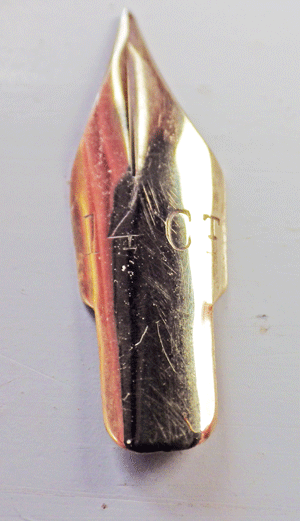
This tiny nib appeared in a Swan eyedropper that I bought. I swapped it out for a correct nib and I have hung onto it in the hope that it will eventually become clear which pen it began life with. It’s properly tapered for a split feed eyedropper filler but at 16.7 mm long it would be just swallowed up by any pen I can think of.

Suggestions?

New Uploads To Sales Site

I will be uploading some pens, mostly Mabie Todd, to my sales site later today. It still is not open for sales in the usual way because there remain some locations where delivery is uncertain. I don’t want to send pens out that will end up being lost in the system. So what I am doing is taking orders by email from those places where I can be reasonably sure of safe and timely delivery. Payment by PayPal for overseas clients. The same for UK though bank transfer can be used if preferred.

I do wish this pesky coronavirus would just go away and we could get back to normal life and I could get back to website automated sales which involve me in much less work than doing it this way! However, I do realise that I am moaning about a very small detail at a time when many poor souls are suffering terribly, physically or emotionally. Please take care.

https://www.goodwriterssales.com/