Disassembling A Mentmore Diploma

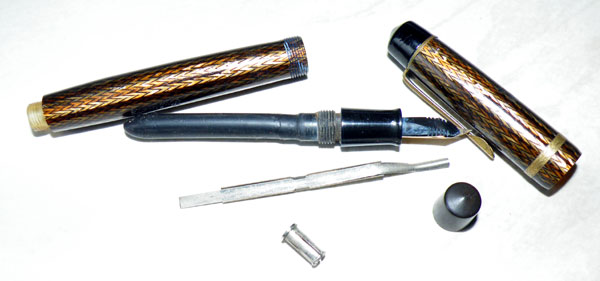
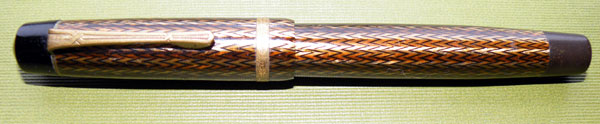
Looking through yesterday’s search terms I find “how to disassemble a Mentmore Autoflow”.  As it happens, I don’t have an Autoflow but I have a Mentmore Diploma which disassembles in exactly the same way.
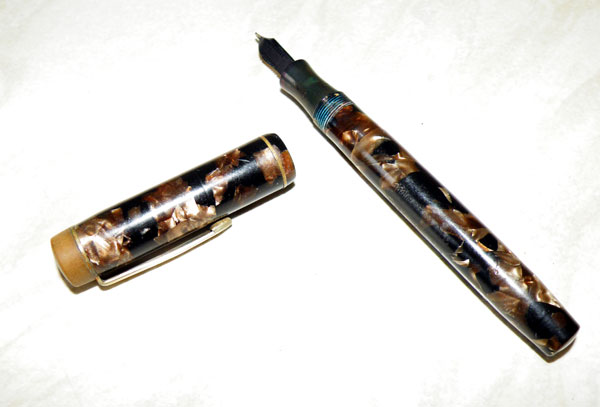
Mentmore Autoflows and Diplomas are the epitome of the standard thirties/forties/fifties British pen. Once you’ve taken one of these apart, you’ll find that 75% of other British pens will come apart in the same way.

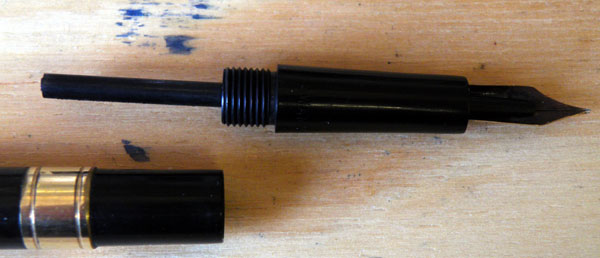
The section is a friction fit. I was able just to pull this one out with my fingers but mostly they’ll need a little dry heat to loosen them up. Don’t soak the section – it’s black hard rubber and it will fade. Soaking is mostly ineffective anyway.
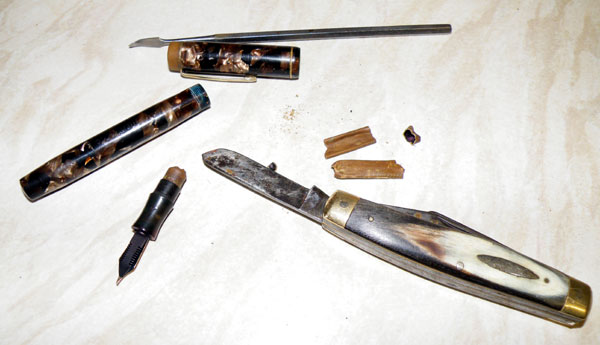
Ensure you get all pieces of sac out. I use a dental pick to get inside the barrel. Check with an inspection light or torch. I use my trusty pocket knife to scrape the remnants of sac off the section nipple.
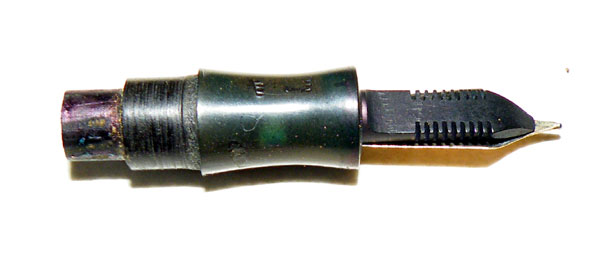
It isn’t always necessary to remove the nib and feed from the section. I was able to run water through the section and the nib is perfectly aligned, so I leave it alone.
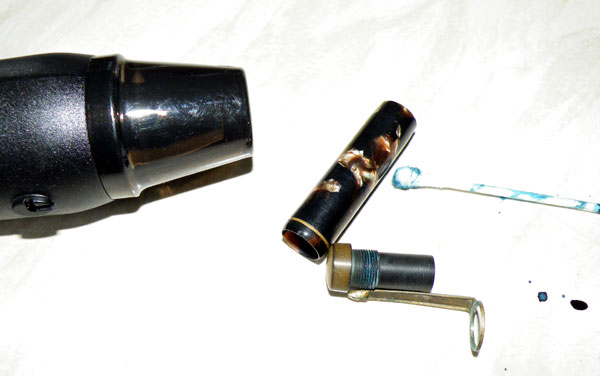
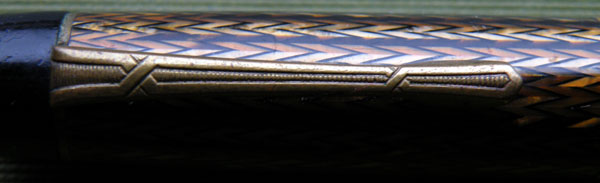
In a similar way, you usually won’t need to remove the clip screw, but this one has faded to white, so I’ll want to polish it back to a more acceptable colour. The other reason for removing the clip screw is if the clip is bent. Again, no soaking! This is what your friend the heat gun (or hair dryer) is for. Clip screws can have long threads and are often gummed up with dried ink. I trickle a little water into the cap, drain it and clean of the excess ink with q-tips. If necessary, section pliers can be used on the clip screw. Once it’s apart I rinse off the rest of the ink in the cap and clean the threads in the cap and the screw. Q-tips and kitchen towels will do the job.
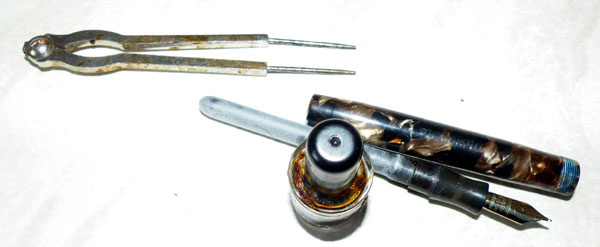
You’ll want the biggest sac you can put in the barrel without touching the sides; in this case a size 18 sac is correct. I use a pair of dividers with the points ground off as a sac spreader. Allow the shellac to dry and dust with talc or French chalk.

I polished the clip screw until it was dark brown. Taking it all the way back to black would be inappropriate on what is a quite well-worn pen. You might want to polish the nib at this point. Avoid liquid or paste polishes which can dry between the tines and in the section; I use jeweller’s rouge. Polish the plastic and metal trim.

Reassemble and test. That’s it!

Of course, they might have meant an Autoflow button-filler…

Disassembling A Mabie Todd Swan Eyedropper Filler

One of the many good things about having a WordPress blog is that I can see the search terms that people have used that have brought them to my blog. One that has been repeated in various forms of words is, “how to disassemble an old Mabie Todd Swan eyedropper”. In the hope that those in need of assistance will call again, here’s a how-to.

Many of you, I know, will regard disassembly of an eyedropper as one of the easier tasks, but it can be a puzzle for someone who hasn’t done it before. I’m using a Swan 1500 for illustration but the method remains the same for many earlier Swan eyedroppers, and also most ones made by other manufacturers.

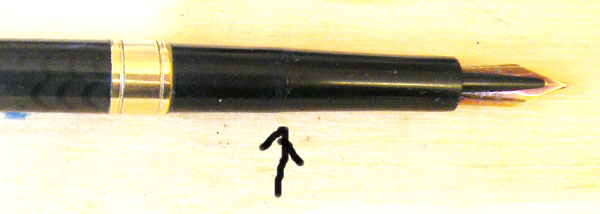
One of the commonest problems on well-made pens like Swans is that it can be very hard to see where the pen opens. The join between barrel and section can be so fine that it’s virtually invisible. Use strong light and magnification if necessary. I’ve shown here with my crudely drawn black arrow where the faintly-visible join is on the 1500. It will be in a similar position on most eyedroppers.

Someone will correct me if they’ve found different examples, but all Swans and indeed all the other eyedroppers I’ve worked on are conventionally threaded. In other words, the section will unscrew from the barrel with an anti-clockwise turn. Expect the threaded part to be quite long Sometimes these are reluctant to move because they are stuck with old ink. Gentle dry heat will loosen them up; remember that these are black hard rubber pens – soaking is not advised.*

Assuming the need to disassemble further, this is one of the few occasion where using a knock-out block to remove the feed and nib would be wrong and could cause damage. Grip the feed from the rear of the section and pull it out. The nib will be left in place. Then simply pull out the nib from the front. Sometimes the feed will be stuck with dried ink. Carefully trickle water through the assembly, taking care not to soak the outside as this may cause fading.

For reassembly after you’ve reinserted the feed, you will note that the tail of the nib is narrowed. Look inside the nib end of the section;

there are slots to slide the nib into. Adjust the feed until it sits right on the nib and reinsert the silver wire into the back of the section. That’s it!

Some people apply silicone grease to the threads of eyedroppers to prevent leaking. It’s rare that this is actually required. These long, very finely cut threads are almost always ink-tight in my experience, and the application of unnecessary grease is likely to be a messy nuisance. By all means, if the pen actually leaks at the joint, use silicone grease but don’t do it by default.

*Opinions vary about soaking but in my experience water, whether hot or cold, is best kept away from the visible exterior of black hard rubber pens. Some rubber, and particularly rubber as old as the material in these eyedroppers, has often already deteriorated through oxidization, though it isn’t visible. Any contact with water will make it fade at once. Then you’ll have to rub the part down to return it to black and it probably won’t match the rest of the pen. You may even resort to one of the several potions and processes you’ll find on the internet, none of which I can recommend. Better to avoid the necessity in the first place.

An Early Swan Nib

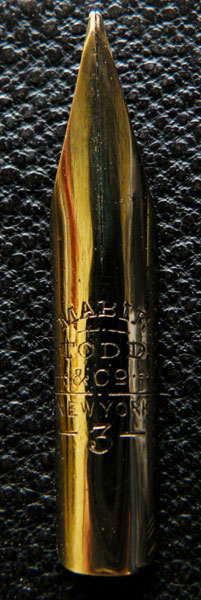
Isn’t that a beautiful thing?

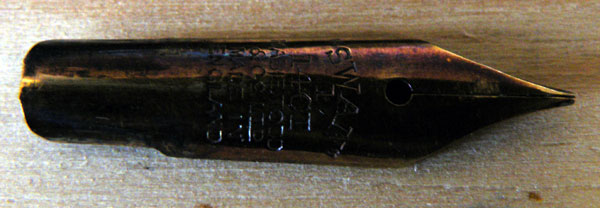
It’s an early No 3 Swan nib – quite how early I can’t say at the moment, though I expect research will turn up a ball-park date eventually. No breather hole. It’ll be interesting to see how well that works when I get a pen to fit it in. It’s also very flexible, expanding from fine to triple broad at a touch.

The nib turned up on its own in eBay a few months ago. Bidding was hot and fast at the end and I paid nearly £40.00 for it, and was glad to get it at that price. I just need the rest of the pen now…

Actually, in a way, I won’t be especially aggrieved if I never find a pen for it. It’s such a jewel on its own, wonderfully evocative of an early stage in fountain pen development. It’s an inch-long masterpiece.

A Late Blackbird

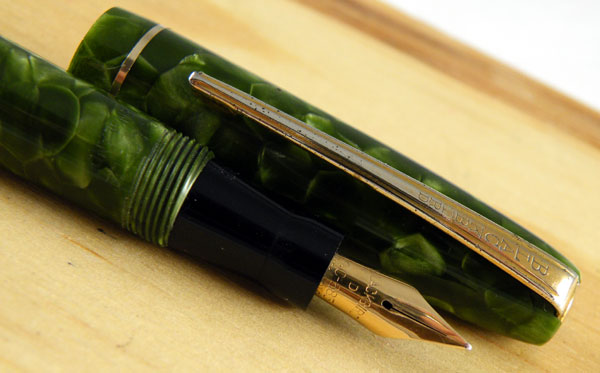
Strangely, though the last of the Swans were execrable pens, the late Blackbirds were nowhere near as bad.


This pen comes in the twist-filler or lever filler forms. Though there has been a decline in quality from earlier pens , it is still, to my mind, a quite admirable writing instrument which has survived the passage of the years in good shape.


The only real failing is the appearance of tiny spots of corrosion coming through the thin plating on the clip. Otherwise it’s pretty good. The patterned plastic is attractive, it hasn’t discoloured or distorted, the filling system works faultlessly and the pen has a good nib. Another sign of cost saving is the clip, which is now held by a stud at the top of the cap instead of the earlier clip which was directly inserted into the plastic of the cap. This can hardly be regarded as a very bad failing as Waterman, among others, used this style of clip for many years.


Different sources give slightly different dates for this pen. Some say 1950 – 55, others 1954 – 58. It’s only speculation on my part but I’d be inclined to go with the later dates. My thinking goes like this: this pen bears little resemblance to anything that had gone before in either the Blackbird or Swan lines. Mabie Todd was taken over and became Biro Swan in 1952. It would seem to me likely that such an extensively redesigned pen as this came from the new company. The 1954 – 58 dates would have this pen in production until fountain pen manufacturing ceased. As I know of no later Blackbird, that seems reasonable to me. However, if you know know better…


One of my tests of quality in a pen is how well it has survived. I ran some water through the section/nib assembly to clear out any old ink, popped in a new sac and the pen was ready to write. That’s not much to do to a fifty-odd-year-old pen, I’d say. I’d be perfectly happy with this pen as a daily user, both in terms of writing quality and aesthetics. It’s still a good looking pen.


The Rubinette (Part Two)


I finally got around to disassembling the Rubinette for repair. It turns out to be a perfectly straightforward button filler, and there were no internal clues to its origin.


It scrubbed up pretty well, apart from some ink traces on the barrel threads which I’ll remove later – I have my methods! Further extensive searching online and in my reference materials found no reference to this pen nor any tie-up with the 1950s Rubidor ball-point.

A Progress Report

My apologies for the lack of updates recently. It’s pandemonium here. Completion of my retail site is, if not quite imminent, well within sight now. I have plenty of restored pens ready, but they all need to be photographed, the photos need edited, written descriptions have to be prepared for each pen – and so on it goes. It has quite worn out my assistant:

And I’m only marginally better myself.

The Rubinette Button-Filler


It’s always been my aim to get a set of all the herringbone pattern colours that Conway Stewart used for their late fifties/early sixties pens. I’ll probably never achieve that but I found a herringbone celluloid that they didn’t use: this beautiful gold-coloured Rubinette button filler.


I have yet to restore this pen, but it’s a lovely piece as it is. The clip and cap ring are patterned and the mount for the button is made of clear plastic. Searching for Rubinette didn’t help me much. It’s a variety of apple and there’s a Rubinette Way in Winchester. Oh, and it’s a seldom-used synonym for “ruby”. Nothing about pens.


So if you know anything about the Rubinette, please share the wisdom!

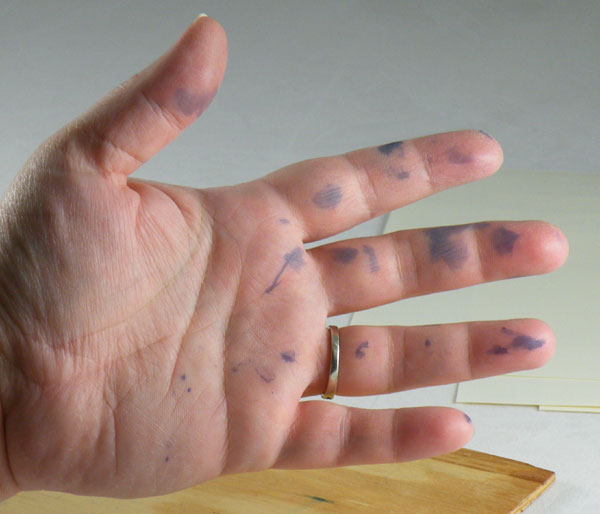
On another topic, ink’s a useful substance in the bottle or the pen or on paper but anywhere else it’s a messy nuisance. Handling pens all day as I do, there are plenty of opportunities to get inked, so I glove up to work on pens and even to do writing samples. Now, it seems, I need to put on gloves to open the mail:


Please, please drain and flush pens before sending them out…

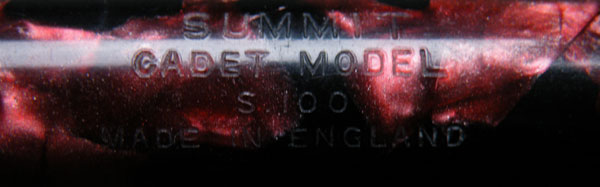
Summit S100 Cadet

This rose marbled pattern plastic is, I think, unique to Summit. I’ve seen somewhat similar patterns on Stephens pens and on some Parkettes, but they don’t have the intensity of this colour. It almost glows in the dark like the slumbering embers of a rested fire.


After World War II the S100 became the S100 Cadet Model and I think it’s reasonable to assume that this pen was aimed at the school pupil market. That doesn’t imply a decline in quality; this is still a well-made pen, crafted with attention to detail.


The 14ct gold nib is marked “Cadet” now to match the pen. Compared with the more streamlined pens being produced by Conway Stewart at this date, or the hooded-nib Mentmores, the Cadet may be regarded as conservative – and justly so. A case can be made for conservatism in pen design. Streamlining is purely aesthetic; it confers no practical benefit on the writer. Mentmore’s hooded nib was just an ordinary small nib enclosed in plastic, unlike the Parker 51 it emulated which at least had a redesigned ink delivery system to justify its shape. It might be said that sticking with the tried and tested traditional pen shape gave the owner a better writing instrument.

Certainly, enough of them sold for Cadets to be quite plentiful still, though not all are in this glorious colour. This example has survived in near-perfect condition and it’s a comfortable and well-balanced pen in the hand. It writes well with a consistent medium line.

The Mabie Todd Swan 230/60

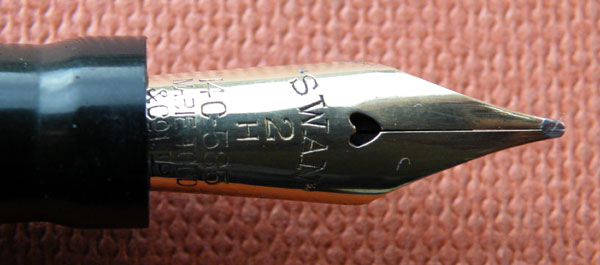
The range of handsome black hard rubber pens of which this is one were made for most of the nineteen-twenties. For those of you still struggling with the Mabie Todd numbering systems (and I confess there are some numbers that remain a complete puzzle to me) the 2 is the nib size, the 3 means that there’s one band at the top of the cap and two on the barrel and the 0 means there’s no band at the cap lip. I neglected to photograph it but there’s a mottled hard rubber insert at the top of the cap with a white Swan emblem.


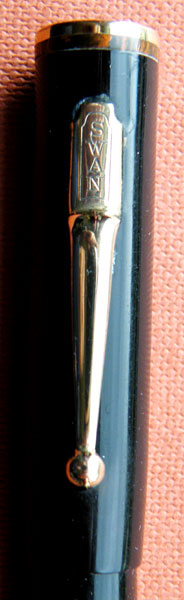
The clip is a slightly smaller version of the stepped clip Swan had been using for some years, with the word “Swan” imprinted on it rather than the patent date used earlier. With three bands, a stepped clip and a cap insert, this wasn’t one of the company’s cheaper pens. Though it has the comparatively small No 2 nib this pen probably sat above the middle in the Swan price range.


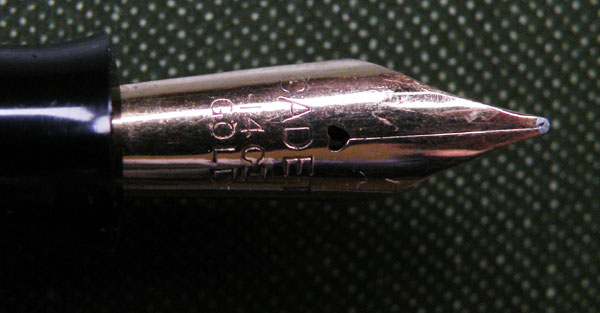
As is so often the case with Swan pens of this date, the beautifully engraved nib has considerable flexibility. This nib has an ‘H’ designation. Anyone know what that means?


These 1920s Swan have it all for me. They’re light, they have perfect balance in the hand, the nibs are invariably splendid and the filling system, with its long lever, works very well. All in all, this pen must rank as one of the best ever made, by any manufacturer.

The Conway Stewart 475 Forest Green and Other Stories

Sometimes there’s a tantalising serendipity in our lives. It’s almost as if the universe was about to uncover all its secrets for our satisfaction, but actually it’s just the meaningless hand of coincidence at work. Last week I showed you the seldom seen chocolate brown Conway Stewart 475 and that very day I was able to secure an equally uncommon forest green example.


Are these Conway Stewart’s only full-size self-coloured pens from the pre-war period? I don’t mean black or red hard rubber, I mean coloured celluloid. Answers on a postcard to… well, no, answers here if you have them. I’d really like to know.

On a different subject I received this illuminating missive from eBay this morning:

Thank you for writing to eBay Customer Support regarding international visibility of your items.

Deborah, I appreciate your patience and apologise for delay in resolving your issue. As of now you have not listed any item in your account. Meanwhile you can keep listing on your UK site. I am again esclating this concern to an appropriate department and the higher authority. I will rech back to you as soon as I get reply from them.

I trust this information is useful. Please write back to us if you have any concern.
Kind regards,


I can’t begin to tell you how far this drivel is from addressing the problem. It’s enough to make you rech – or is that retch? I don’t know how many times they’ve “esclated” this to a higher authority, which said authority doesn’t give a damn.

Yeah, sure. I might just list a pen or two when I’m assured the problem is solved and I can see the evidence myself, but not before then and maybe not even then.

It’s too little, too late. I’ve had enough. I engaged the services of a company to write me an e-commerce site yesterday, so you can look out for Goodwriters’ pen sales in a few weeks. I note that there are many companies who invite you to put together your own site for rather less money, but I know what my design sense is like. I couldn’t build a dog kennel, never mind a successful online store. To be sure, it’s an investment, but it works out at about three months eBay fees or a bit less. I think it will be worth it in the long run. At least this way I get to run my own show, and I’m not at the mercy of an uncaring international monopoly.