A Feast Of Kingswoods

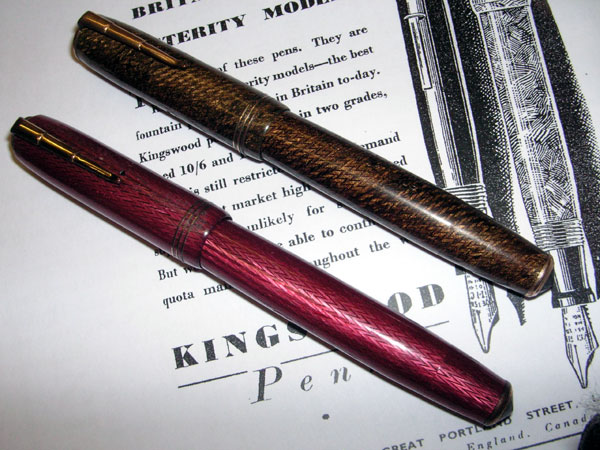
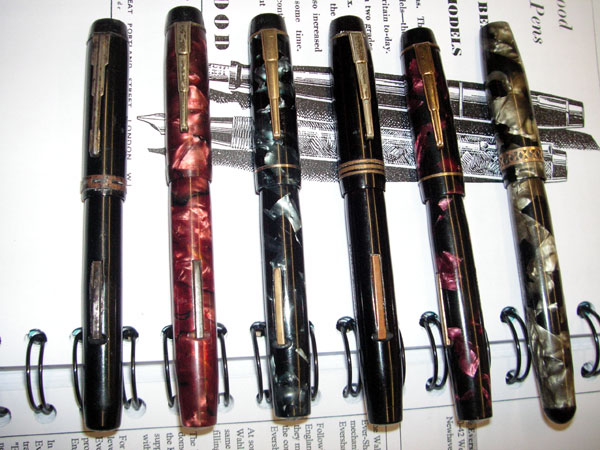
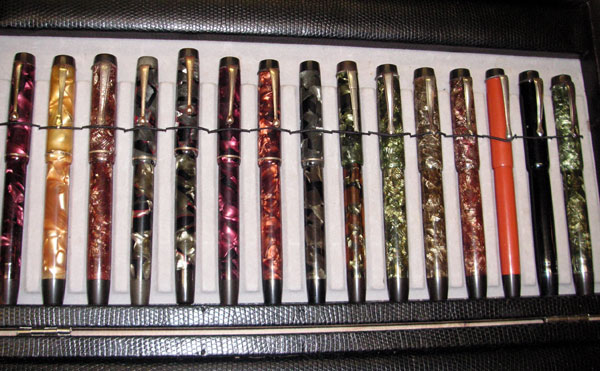
Some time ago Simon (Waudok) and I had a discussion about Kingswoods and I asked to see some of the examples he has collected. Good as his word, he sent me these pictures the other day and has kindly allowed me to reproduce them here.

These button-fillers are, I think, quite uncommon. Looking at the patterns of celluloid used, I would have little difficulty in believing that these were made by Valentine, sharing the same material they used for their own pens. I think there can be little doubt that Valentine is the source of most, if not all of these pens. That said, there are Kingswoods that are very Summit-like and share that company’s materials too. I have no doubt that the sleuthing of our dedicated researchers will, one day soon, solve the puzzle of the origins of the various Kingswoods.

These zig-zag patterned pens are outstandingly beautiful. They’re very reminiscent of Conway Stewart’s herring-bone patterns, though they employ a different celluloid.

Among the lever-fillers there are some that I haven’t seen before, notably the burgundy marble with no cap ring and the black three-ring example. It would be useful to establish a time-line for all of these pens but it’s a bit beyond me. I’d hazard a guess that the pen on the extreme right, missing its clip and with a pierced cap band, is later than the rest. It’s quite a common pen and I’ve had a few examples in different colours. Simon believes this pen was made by Unique.

There was a time, not so long ago either, it seems to me, when you could pick up Kingswoods for very little. Though they’re still by no means expensive, they have a stronger market now. Appreciation of the excellent Eversharp nib contributes to that, I have no doubt, together with the realisation that these are sound pens with a fascinating history.

My thanks to Simon for his generosity in allowing me to share these beautiful pens with you.

Applying The Clue-Bat.

I’m easily amused. For instance, it’s a great source of chuckles for me to note the differing methods of applying discipline in Fountain Pen Network and The Fountain Pen Board. If you make a nuisance of yourself in FPN, an admin will have a severe word in your shell-like ear. If you persist in your peskiness your offending posts may be disappeared and you’ll be booted out without further ado. Seems fair to me.

The Fountain Pen Board was set up, in part at least, in protest against the perceived heavy-handedness of the moderation in FPN. Much is made by the board’s owner and moderator of the absence of interference in the dialogue. That’s a very good thing, and the discussion in FPB is of a high quality, due, to some extent, to that very freedom to say whatever you want to say without fear of censure. But what do you do about the out-and-out pest who ruins everyone else’s fun with their hidden agenda, their inanity or their general peskiness?

Brutality seems to be the answer, carefully crafted verbal brutality of a high quality. So far, I would have to say, it hasn’t been especially effective in driving away the pestilential or making them mend their ways, but it’s in there with a chance and it’s hugely entertaining. Of course, it’s only likely to work well if the pesky don’t have the wherewithal to fight back effectively. The mod, to be fair, has a good left jab of sarcasm and a mighty roundhouse right of invective, but it doesn’t matter how good a fighter you are, someone bigger and better is just around the corner. If someone like that turns up, I suspect the group will become a blood-soaked battlefield with little room or time for pen discussion, but until that time draw up a chair and pass the popcorn.

A Late Ormiston & Glass Camel

Among the pioneers of fountain pen making in Britain is the firm of Ormiston & Glass. The company was established in 1868, probably as a manufacturer of steel nibs, among other stationery products. In 1902 the company was incorporated as a limited company and began the production of fountain and stylographic pens in that period. They were an innovative company and provided a wide range of fountain pens and stylos. In later years, probably after 1915, the company stopped making fountain pens and continued with a varied range of other products.

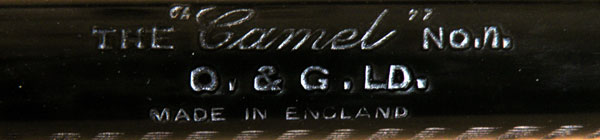
One of their most famous pens was the Camel, and I’ve tried to get my hands on one of these pens for several years without success until now. This is a late version – possibly a No 7, though it’s hard to tell as the barrel stamp is indistinct.

As a lever-filler it cannot, I would think, be earlier than 1912 when Sheaffer brought out the first of this type of filling system, and indeed even 1915 would show the company as being quick off the mark, though it is possible. Waterman brought out their box lever in that year and this pen copies it very closely.

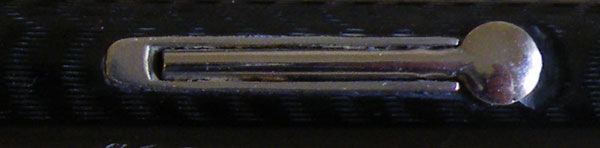
In style – straight-sided with a very slight taper at the end of the barrel, chased black hard rubber, flat-topped with a gently concave section – it would not be out of place in 1915, but I think we might consider a slightly later date as at least a possibility. The riveted clip might be original or an after-market addition as it bears no imprint.

The name “Camel”, one would imagine, implies a pen that contained an exceptional amount of ink but this one doesn’t. Indeed, it’s a quite ordinary pen, though well-executed. I’ve seen a hint somewhere that the Camel range of pens had something special about the feed but I’m denied the opportunity to see that here as someone has been at the repairing before me, and employed a wholly inappropriate Swan feed and an even more inappropriate (if that were possible) Waterman Skywriter nib! I have no idea what a Camel feed looked like or whether Ormiston & Glass produced their own branded nibs or used warranted ones. Perhaps someone can tell me.

The black of this pen is unfaded and the chasing and imprint remain razor-sharp. Though not in any way outstanding, this is a high-quality pen and one that was well worth the wait.

A Mottled Hard Rubber Fleet Pen

I wrote about the Fleet pen back here http://wp.me/p17T6K-iC. Much of the interest in this pen comes from its cultural context, but not all, as I discovered recently. I had thought that the two models I have often seen – a BCHR eyedropper and a BHR lever filler – were all there was in the way of Fleet pens.

Then this example appeared in eBay a few weeks ago. Sadly, it’s missing its original clip, which would have been interesting to see, but the medium cap band and lever show very little wear. The construction is still essentially two straight-sided tubes, with the same concave section as the BHR model, but the colourful Mottled Hard Rubber improves the pen’s appearance no end. What a difference a change of material can make! The nib, as before, is a medium-sized warranted one, roughly equivalent in size to a Swan No 2. It has a useful degree of flexibility.

Though doubtless still aimed at the school pupil market, this is a better pen with its gold trim and medium cap band, and it must have cost a bit more. The adverts I have seen make no mention of gold trim or a cap band. Perhaps this one is a little later and I may come upon advertising for it yet, or maybe this slightly more prestigious pen was sold in a more conventional way, though I’ve seen no trade press adverts yet either.

Scarcity, Demand And The Conway Stewart International 350

I made a remark in FPN this week about the difference between rarity and desirability. It sank without trace. I suspect that it may not have been what the original poster wanted to hear, but it’s a valid point all the same. Scarcity of a particular model doesn’t always influence value. In fact, the rarity of some models or makes of pen acts in the other way; they’re so uncommon that hardly anyone knows they exist, so no-one’s looking for them and they will barely sell.

There are, of course, serious collectors who will pay whatever they need to pay to acquire a scarce pen to complete a series. However, as the average buyer knows little and cares less about many of these uncommon pens, there’s little competition for the privilege of acquiring them and the price remains low.

Take, for example, the distinctly uncommon Conway Stewart International 350. It’s close to the range of numbers occupied by the common black hard rubber Scribes, the 330 and 333, which it closely resembles in size and appearance. Indeed, some 350s even have the threaded barrel end in common with the Scribes. The main difference between them is that the 350 had a short production run and is seldom seen now, whereas the Scribes are very common, having been the basic clerk’s pen of industry. At times you’ll hardly sell a Scribe 330 or 333 (the colourful 336s are in a different league) but surely the International 350 must be more valuable by virtue of it rarity? Nope. Not in my experience.

It is worth noting, though, should an International 350 ever come your way that it may well be a better pen than the Scribe. Though there are exceptions, most Scribes seem to be nails. The few 350s I’ve owned have all had some degree of flexibility.

This whole area of scarcity and demand illustrates a difference between the British and American markets of yesteryear and collection practices today. It wouldn’t be too hard to name a dozen rare and very expensive Watermans, Parkers and the like, pens that are hotly pursued by many collectors and change hands, when they appear, for more than the price of a nearly-new Honda VFR1200F. I just can’t make a similar list for British pens. Yes, there are some moderately highly-priced Swans and Onotos around, but there are very few – if any – British pens that will have collectors re-mortgaging their houses. It’s not rarity that sells pens here. It’s utility, I believe, and colour. Stick with the Tiger’s Eyes, the Cracked Ices, and the Floral No 22s and leave those grungy old rare pens to me.

Encouraging The Workers

As you may imagine, the never-ending delays and the stupid errors that have held back the launch of my sales website for what seems like forever don’t lead to the most friendly of correspondence with the developer. My emails go from reasonable and helpful to tetchy to angry and mildly abusive to full-on, purple-in-the-features rage with insults and death threats.

The contemptible Jugoslav, when he was the “developer” (I use that term advisedly) never responded to my heavy sarcasm and out-and-out insults. He didn’t fix any of his schoolboy errors either, of course. Marija is a bit more feisty and she bites back when I question her honesty, ability and commitment to getting the job done. I admire that. It makes life more interesting.

It doesn’t alter the fact that if she’d been working for me she’d be begging on a street corner by now…

You may say, of course, in your reasonable way, that baiting and insulting the developers is counter-productive. They have no incentive to work well if all they can look forward to are insults and slurs on their paternity. I say in response that I tried reasonable. It was a long while ago but I remember that it was just as ineffective as my present policy but I enjoy this one more. So long as I’m raining curses and invective down on their miserable heads I feel I’m getting some entertainment for my money. It’s not much, but it’s something.

All that having been said the site pretty much works now. A wee bit of adjustment in some minor areas and I should be selling pens.

The Golden Guinea Pen

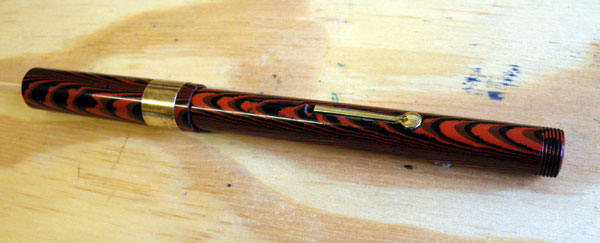
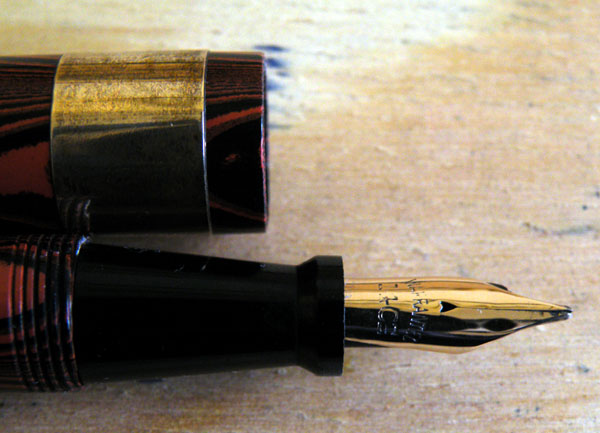
It’s not often you see a true red ripple pattern (as opposed to the other versions of mottled hard rubber) in a pen that isn’t a Waterman, but here’s one. It’s a 1920s or possibly 1930s Golden Guinea, and in case you were in any doubt, yes, the name does refer to the price.

Was it worth the money? It’s the simplest type of pen, two tubes that fit one inside the other.


The steeply tapered BHR section makes me think this pen is from the twenties rather than later. The feed is about as simple as they come.

The barrel end is threaded to take the posted cap – in itself an indication of a low-priced pen usually. The nib is very small (and exceptionally flexible) and the broad cap band has thin plating that shows considerable wear. If you consider that in 1926 a Conway Stewart 200M in Mottled Hard Rubber (an altogether better quality pen) cost 10/6d, exactly half the price of the Golden Guinea, you might be forgiven for having doubts. Be that as it may, this model and later ones, some of them very beautiful, kept Golden Guinea in business for quite a few years. There were both lever and button fillers in hard rubber and later in celluloid.

Who made them? I confess to remaining clueless about this one. There’s very little documentation. I’ve seen it suggested somewhere that they were made by Conway Stewart but I’ve seen no evidence to that effect and, frankly, given the quality of these pens, it would surprise me. Wyvern or Mentmore would seem more likely, but in truth it could be any one of half-a-dozen known pen makers, or, for all I know, there might have been a Golden Guinea company that made them in-house.

Another mystery pen, then, and a rather beautiful one!

Another Update

There was a Great Leap Forward, as Mao Zedung used to say back in the day, in my e-commerce site.

My firm of developers – who shall remain nameless for the moment – appear to farm all the coding out to our erstwhile comrades in the former Soviet Union. The execrable, incompetent buffoon Jugoslav has finally been booted off the job and he’s been replaced by the rather more able and sensible Marija. Suddenly, things on the site begin to work as I have pleaded for them to do, yea these many, many days. About eight weeks of them, in fact. One can amble through the site in a logical sequence without once being shunted off into HTML limbo and graphics appear as they are meant to! I can upload stuff! It works!

I profoundly hope that Jugoslav has been exiled to the steppes, where he shivers over a reluctantly smouldering fire of yak dung as he guards the herd with his trusty dog, which has at least a 30-point lead in IQ over him. I fear for the yak herd, though, if Jugoslav is as good at defending them against the wily and rapacious wolf of the steppe as he was at slinging code.

Too early to crow, though, as the shopping basket and checkout softwares still have to be integrated into the site. Will Marija the Muscovite Coding Maiden get it all together by next week or will she follow in Jugo’s footsteps and make a total bollox of it?

For further thrilling instalments, tune in to your favourite pen blog!

A Basic Pen Repair Tool-Kit

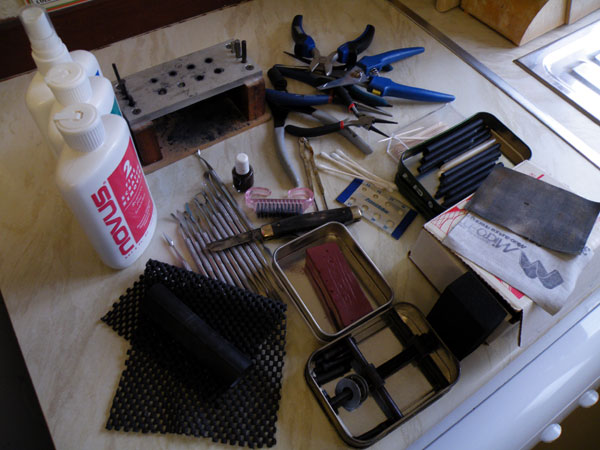
In recent days I’ve twice seen people asking for advice on restoring pens without any tools whatsoever. Really, that’s not going to fly. You have to have a basic tool-kit or you’re going to break pens.

If repairing a pen is something you’re going to do once in a blue moon, it’s probably cheaper and better to send it to a good repairer. If, however, you have an interest in bringing old pens back to life, your initial outlay is likely to be quite modest.

First you’ll need to examine the pen. A 30x21mm  jeweller’s loupe is adequate and can be had for three or four pounds. If, as time goes on, you get deeper into repair and restoration, this is one of the areas you can spend quite a bit of money on as you acquire bench magnifiers and Donegan headsets, but an ordinary loupe is all you’ll really need for inspection.

Next you have to get the pen apart. Though there are occasions when there’s no alternative, such as with Lucky Curve Parkers and some old eyedroppers, it’s not good practice to try to pull the nib and/or feed out of a pen with your fingers. The likelihood of damaging the nib and even breaking the feed is quite high. Get a knock-out block. You can pay quite a bit of money for these but Penworkshop and Cathedral Pens both have them for under £20.00. Or you can make one to Ron Zorn’s plan: http://mainstreetpens.com/articles/cheaptools_1.htm In practice, it’s often unnecessary to remove the nib and feed from the section. Why do it unless you must?

Before you can get to the back of the feed, though, you have to separate the barrel and section. Some soak them, I use dry heat. A hair dryer will be enough and if you don’t have one (if you’re bald, f’rinstance) you can buy a perfectly good little travel hair drier for under a fiver! Even if you have soaked the barrel and section (and I would suggest that you don’t bother) always apply heat. It reduces the brittleness of the materials and makes breaking much less likely. For actually pulling them apart I generally say if you can’t do it with your fingers you shouldn’t be repairing pens, but that’s just me. You can improve your grip with latex gloves or rubber bicycle inner tubing. If you must be a wuss, you can buy section pliers. Personally, I never use them for this purpose and in the wrong hands they’re the worst pen-breakers of all, but with gentle heat and a lot of caution, they can do a good job. Caution really is the watchword here: between the squeezing action of the pliers and the greatly increased torque that the leverage of the handles gives you, you can break a pen surprisingly easily until you get a feel for the force you need to employ.

Another warning: even a hair drier can destroy a pen if it isn’t used with caution. It’s unlikely to set celluloid alight as a heat gun can do, but it can certainly apply enough heat to irreparably distort a barrel. A little practice will tell you how close to hold the nozzle and how long to apply the heat to free up a tight section or soften shellac.

So the section and barrel have been pulled apart. First thing you’ll see on the sort of pen you’re likely to tackle as a beginner is a perished sac. A pocket knife is good for scraping the remains of the sac off the nipple. Inside the barrel, the sac may have attached itself to the barrel and the pressure bar, and will need to be scraped out. A dental pick will do the job. A good 6-piece set of these with the various bends and twists that will let you get anywhere in the barrel will cost a fiver or less in eBay. Sometimes the sac has become very sticky and forceps are good for getting that out. Curved, angled or straight four or six-inch forceps cost very little – often only a couple of pounds.

For fitting a new sac you’ll need shellac. The eBay seller chillipea (among others) sells small bottles of shellac with a brush for around £6.00 in eBay. Pricey, perhaps, but convenient and the little bottle will fix hundreds of pens. If you want to be more economical, you can buy shellac in larger quantities or make it up yourself.

You’ve got the pen apart, removed the old sac and dealt with the nib and feed if it was necessary. Time to fit a new sac. How do you know which sac to fit? Penworkshop provide a sac gauge for £9.00. Seems a bit expensive for all it is, and there’s more to choosing a sac than determining which size of sac fits the nipple best. You want the biggest sac size that will not touch the sides of the barrel. Don’t buy sacs one at a time. Given today’s postage costs that’s fiendishly expensive. Buy one of the kits of several popular sac sizes that many vendors offer. You’ll soon work out which sacs you use most, given the type of pen that you collect. Sometimes the correct size of sac can be a little difficult to fit on the nipple. Some vendors (Ian Williamson of Cathedral Pens is one) provide a sac fitting tool. Myself, I use a set of dividers with the sharp points ground down and rounded off.

Apply some talc or French chalk to the sac, fit, and reassemble the pen. That’s about it for the most straightforward repair, sac replacement. You might want to brighten up your pen a bit. The Novus polishes are excellent, with No 1 being all you need for most pens. Jeweller’s rouge will shine the metalwork without being too abrasive.

You can buy a pen repair kit which includes all you’ll need for a start from Penworkshop for £45.00 which isn’t a bad price, but you might do better picking up the various tools wherever they’re cheapest. As you become more ambitious, you’ll want other things. There’s a variety of types of pliers that are useful in pen repair. Needle-nosed pliers are pretty much essential and you don’t want to scrimp on them. Get good quality, as the cheap ones don’t grip well. Your ultimate tool-kit is limited only by the repair jobs you’re prepared to tackle. You’ll begin to haunt the aisles of DIY shops.

Then there are the specialist tools, some of which you can buy. They’re not cheap, because the market is so small. Others you may make yourself, if you’re knacky that way, like a spanning screwdriver for Conway Stewart clip fixings, or a tool to remove the pressure bar from Swan Leverless pens.

Then there’s a vice, power tools, a workshop and …

You get the idea.
Parker Televisor Junior Mark II

When you think of Parker Thrift-Time pens the Televisor Junior Mark II probably isn’t the first one to come to mind. It’s quite uncommon and this one wasn’t recognised by the seller, who listed it as a Challenger. There are resemblances, so it’s forgivable, I suppose, though the Televisor is an altogether better and more interesting pen.

In the 1930s – and for some time thereafter – international trade was restricted by tariffs and import duties put in place by national governments to protect their own industries. American pens were made very expensive in Britain by this policy, and to get around it Parker (and several other companies) set up production facilities in Canada, which as a Commonwealth country was not subject to these tariffs. Initially the Canadian plant assembled parts made in the USA but in time it became a manufacturing facility with some degree of design independence. The Televisor, in 1935, was the first wholly Canadian Parker. Instantly recognised as a high quality pen at a moderate price, the Televisors sold well in Britain. The pen was redesigned in 1938 as the Mark II and it remained in production for another two years.

Though it is quite a small pen and was in the middle of the 1938 Parker price range, the Televisor is much sought after today because of its excellent build quality. Parker used its anchor bar in this pen, a clever three-piece pressure bar that transfers the back resistance to the rear of the pen instead of the section, obviating the need for a screw-in section. The section is transparent to allow the ink to be checked, a feature that was popular at the time.

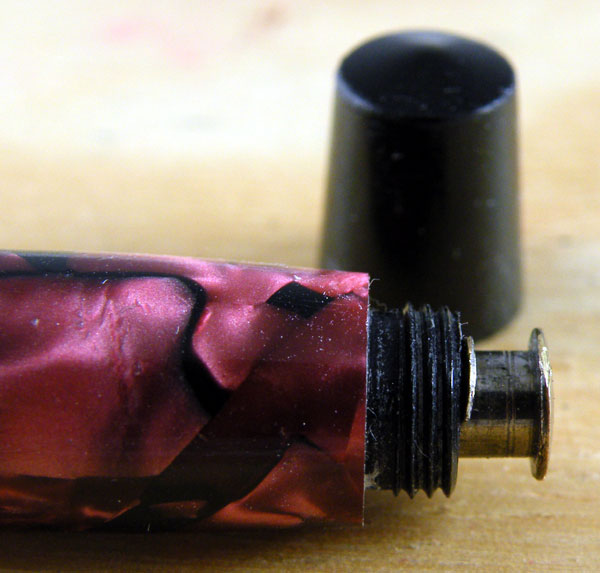
This example is in marbled burgundy, one of several colours the Televisor shared with the Challenger. With its gold-filled tapered clip and medium cap band, it makes a very handsome pen and it’s an excellent writer with some flexibility.