Ebay Musings and The Mentmore 46

Just to redress the balance after a couple of days of grouching about an eBay seller (with whom I am now in dispute) I want to say that most eBay sellers are good, some are excellent, and many exceed all expectations. Ebay comes in for a lot of stick on boards like FPN, mostly from people who clearly should not be allowed out by themselves. Ebay’s like anything else: if you don’t research it before you get involved, and if you don’t strain your teaspoonful of firing synapses to grasp how the thing works, you won’t do well with it. It’s a bit like trying to drive a car without ever having seen or heard of one before – it’s likely to end badly and you have no-one to blame but yourself. Soon after it began, I used eBay intermittently for the odd purchase. It wasn’t long before I began to get the idea that eBay could be a large part of a small but sufficient business for me. It took a few years before I was in a position to take advantage of it but now my use of eBay is intense. I don’t sell there as much as I once did, but procurement of stock would be impossible without eBay. There are many sellers that I buy from week after week, confident in the honesty of their descriptions and their dealing.

I wrote about the Mentmore 46 in October last year (http://wp.me/p17T6K-c) but it’s such an exceptional pen that it’s worth writing about again. The 46 was first issued around 1946 (strangely enough), a truly hopeful time for pen manufacturers. The war was over, labour and materials were being liberated up and it was back to business as usual. Swan was planning its torpedo-shaped range, Conway Stewart was moving from its very traditional pre-war pen shapes on to a new, more streamlined range. There was an air of cautious optimism. It was time for something new, the pen manufacturers thought, but not too new. A little refinement here and there, some rounding of the general pen shapes. In other words, some limited novelty but let’s not startle the horses.

Mentmore didn’t agree with that timid advance. Instead, they made this:
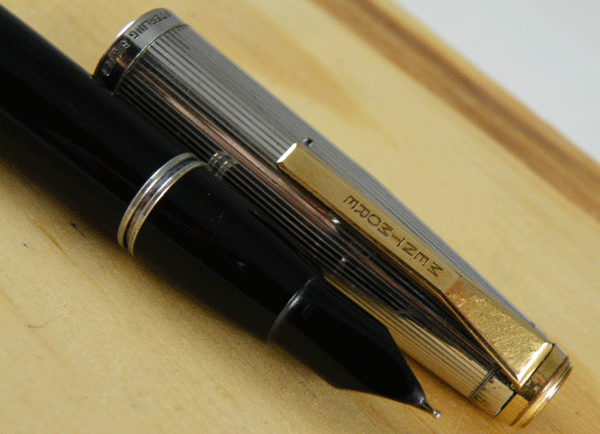
Clearly, they had taken a look at Parker’s 51 and decided that they had something there, but they would do it better and spare no expense on the way. In its own way, the 46 is as well made a pen as the Parker 51 – though it’s by no means as innovative, despite appearances. Under the hood (and what a piece of sculpture that is) the 46 is a completely traditional button filler with a normal nib. All the effort has been put into futuristic looks and style.
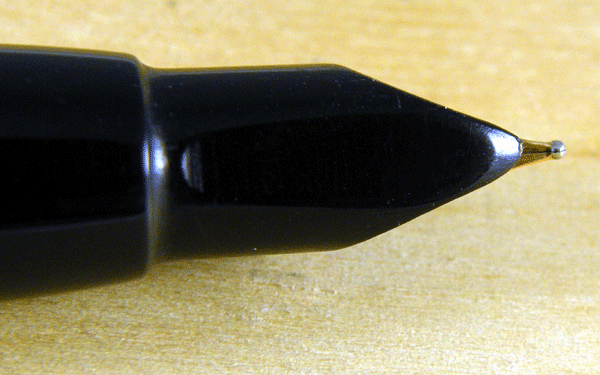
The style, one must say, is not entirely to everyone’s taste, then as now. Doubtless Mentmore expected this high-prestige pen with its gold-filled or sterling silver cap to be a winner. It wasn’t. Judging by how many are around today, it sold steadily but was vastly outsold by the traditional – dare I say dull – Autoflow.

We’re left with one of the best made of all British pens, solid, quite opulent but a little eccentric. Perhaps if we were not so accustomed to think of the smooth lines of the Parker 51 as the norm for a hooded-nib pen we might appreciate the geometry of the the 46 more. I don’t know, but I do know that they grow on you. I’ve repaired and sold several of these and I’m always on the look-out for more. I might just keep the next one I find. Quality is quality, in whatever unexpected place you find it.
This Cracks Me Up!

As I said yesterday, two pens with broken caps were delivered. One was a real heartbreaker – a Lapis Lazuli Duofold Junior in otherwise excellent condition. The other was an everyday Blackbird Self-Filling Fountpen. The first seller apologised and asked that I return the pen for a full refund. No problems there: it was a hairline crack that I, too, might have missed. The seller’s response was the appropriate one. I’ll be leaving good feedback.

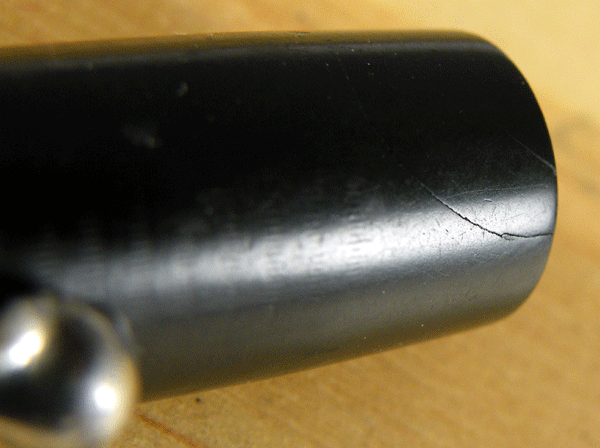
The other one didn’t behave so well. In response to my initial email he replied, “I’m sorry the lid is cracked. Can you send a photo of the crack please as I was not aware of any exterior defects.” Why would you need a photo? The pen’s coming back anyway! Nevertheless I set up the mini-studio and took a photo which I reduced in the normal way, to 600 pixels on the longest side. Here’s the photo, showing a crack that you could drive a bus through.

Prince Charming’s reply was, “Thank you for the photo. The photo is very small so it is hard to see the crack in detail. Perhaps it happened in transit. I will refund the pen if you send it back. We will both be out of pocket for the postage.”

Have a look at that crack. It has worn edges and it has the same degree of fading as the rest of the pen. It didn’t happen in transit. And there’s no reason on earth that I should be out of pocket because someone tried to sell me a pen with a gaping crack in the cap! I sent Price Charming a full-size photo which I hope choked his broadband to death. I also made him aware that I expect return postage to be paid. I have yet to hear his considered reply. I suspect that this one will end up in eBay’s dispute resolution centre. And I will win, as I have before in similar cases. And then I will leave appropriate feedback.

I’m not whining about people making mistakes. I’ve made a few myself and I’ve had customers return a pen with damage that I had missed. When they did they were given a full refund including postage both ways. Even when the pen was coming back from Spain or America. That’s only fair. Why should a buyer lose the cost of returning a deficient item? No fault resides with him; he shouldn’t be penalised.

It Annoys Me A Little…

When a body has been hung, drawn and quartered it’s not like a jigsaw puzzle. It doesn’t even remotely look like it could be put back together. The hanging distorts the neck in an amusing way and the disembowelling flattens the body somewhat. Stepping carefully over the untidy pile of entrails, I began to tidy up my execution tools.

Looking back at my handiwork I mused, “That’ll teach him to sell me a pen with an undeclared crack in the cap!”

Christmas Swans

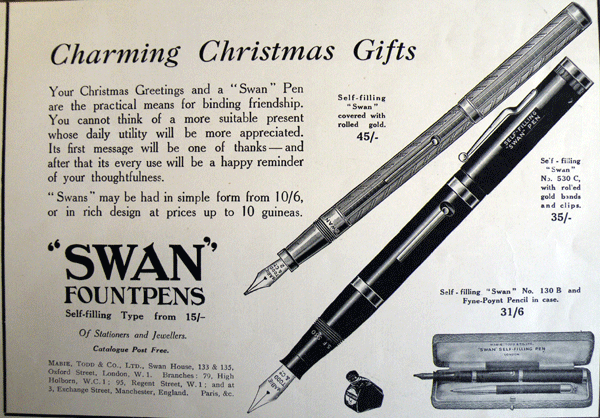
The days are getting shorter and the nights are getting colder. You can’t walk into a shop without tripping over Santa and his reindeer and being deafened with the jingle bells music. I know it’s only November but I get the idea the shopkeepers want it to be Christmas.

I look around but I don’t see anything I crave for Christmas. Spirit me back to 1925 or so and I might find something though.

35/- for that SF 530 C. That’s – what, £1.75? Can’t buy a bottle of ink for that now. I know, I know, in real terms it was a lot of money back then and if they were capable of making one, an SF 530 would cost a lot today, but let me dream!

Come to think of it, I’ve never even seen an SF 530.

A Well-Travelled Blackbird

Here’s a perfectly ordinary Blackbird Self-Filling pen from the teens and twenties of last century. I covered these pens before, back here: http://wp.me/p17T6K-6O. I was in some doubt as to whether or not to buy this example because of the scratches on the cap, no doubt inflicted by the unusual after-market clip. In the end I went ahead and I’m glad I did.

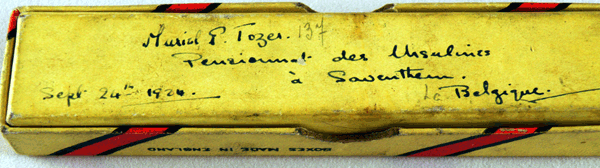
On the underside of the box is written, “Muriel G. Tozer, Pensionnat des Ursulines, Saventhem, Belgique.” The date, September 24th 1924 is there too, as is the price, 13 Belgian Francs. The “Belgian” part of that is important. In 1924 the French Franc was in hyper-inflation and the Blackbird would have cost at least 500 Francs!

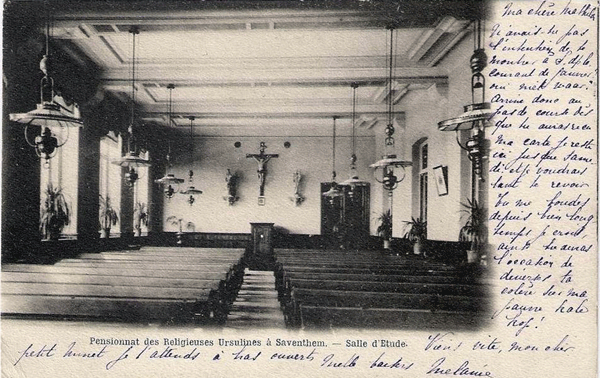
A pensionnat is a boarding school. The Ursulines aren’t quite a teaching order but they have a teaching role, primarily for the development and fulfilment of women. I found several run by the Ursuline order in Belgium and here in Britain, and I eventually found some postcards of Saventhem.

Here it is, looking distinctly forbidding.

The refectory looks nice, though.

As does the chapel.

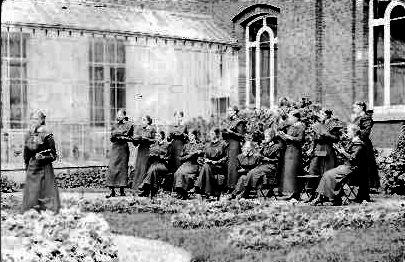
Here’s a group of the pupils, though by their dress it’s a decade or two before Muriel was there. (My apologies for the eye-hurting graininess of the photo – best I could do with what I had)  Sadly, I was unable to find any more references to Muriel. Was she a child of a military or diplomatic family, sent to school in Belgium while her parents served abroad? Did she come from a devoutly Catholic family? Did she go on to become a Sister of the order herself, as many former pupils did?

We often talk of scratches, cracks and discolouring as being part of the history of the pen. So they are, if you accept a tenuous enough definition of history, but usually history means more of a narrative, events and places that the pen can be associated with. This pen has a history.

The Wyvern No 33 Clip Filler

Like the matchstick filler which it so closely resembles, the clip filler was temporarily accepted as a solution to the problem of getting ink into the pen, not because it was so technically elegant, but because the better methods were covered by patents that hadn’t been hacked yet.

I wrote about a clip filler before, back here: http://wp.me/p17T6K-kn and I had assumed that like this Aiken Lambert, all clip fillers were American. It turns out not to be so. Wyvern had their own clip filler.

By the late teens of the twentieth century, Wyvern was experimenting with self-filling pens. There was a matchstick filler of 1918 and it seems likely that this pen followed very soon after. It’s a slight improvement in convenience; you might not have a match handy but you’ll always have the cap at hand.

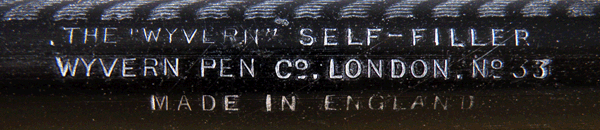
It’s a well-made pen of a very traditional appearance, straight-sided except for a gentle taper at the barrel end. This example looks like it has never been used. The black of the black hard rubber isn’t at all faded and the chasing is sharp, as is the barrel imprint.

Actually, though I suggest above that the filling system isn’t elegant, there’s something to be said for minimalist simplicity. When it comes down to it, there’s no real need for a lever, crescent or hump if you can apply pressure directly to the pressure bar! It works unfailingly because there’s so little that can go wrong.

The nib is warranted and is likely to be original. Wyvern bought in nibs until the mid-twenties when they established their own nib plant. The nib has a modicum of flexibility.

All in all, this is an interesting, historical and practical pen. It’s an intriguing stage along the trail to the modern fountain pen.


My thanks to Shrikaanth Krishnamurthy for allowing me to see and photograph his beautiful pen.

The Mentmore Spot

When Mentmore started out one of their earliest pens was the Spot. The first version was a handsome flat-top mottled hard rubber pen and it was issued in 1923. It caught on quite well – it was a lot of pen for comparatively little money – and Spot became established almost as a separate brand in its own right. It was strongly marketed with the slogan “None genuine without the spot.” Spot pencils and ink were produced also.

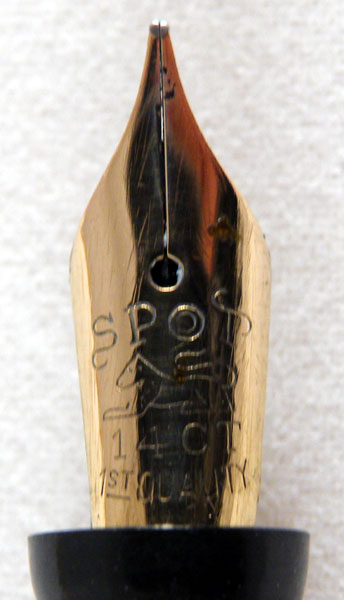
This one’s a later version, still hard rubber (quite faded in this case) but now streamlined and quite modern-looking. I can’t accurately date this pen but I’d guess at the late thirties. It has the leopard logo on both the nib and the barrel, and the cap band has the “stack of coins” form. It’s a solid, well-made pen, though this example has seen a lot of use.

Spot has a collector following and early examples are snapped up pretty quickly. It has been said – and appears to be true – that Spot used the white dot before Sheaffer used the same thing to indicate a lifetime warranty.

The Desbeau Advertising Pens

I frequently buy lots of pens in eBay. Quite often, it isn’t all that apparent what’s in the lot, but if it doesn’t go too high I’ll always take a chance. Apart from anything else, poor pictures and bad descriptions scare other bidders off, so if there’s anything decent in the lot, you score.

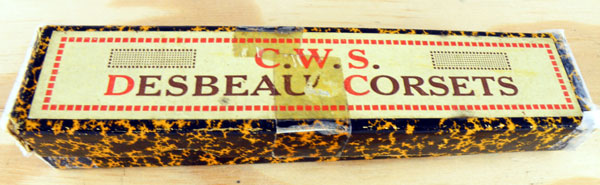
Among the other pens in this lot was this strange box.

And in it were two glorious pens, a mottled hard rubber lever filler from the twenties, which looks like it has never been used, and a later, maybe forties, button filler in striking green/black marbled celluloid. Score? Well, maybe…

Now I may be wrong, but I don’t think my customers will be beating a path to my door to lay claim to pens that bear the legend “Desbeau Corsets”. If I’m proved to be wrong I’ll happily sell them, but if not I’ll equally happily keep them as users. They’re gorgeous pens.

Of course my curiosity was piqued and I went a-googlin’ to see what I could find. CWS, as the Brits among us will recognise, is the Cooperative Workers Society. DesBeau Corsets were popular support garments made at the factory in Desborough from about 1920 to 1970. They were well marketed; as well as the pens, there were advertising pocket mirrors, fruit knives and thimbles.

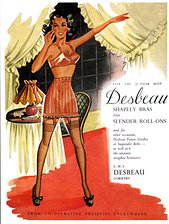
And there were adverts, like this one:

Does this imply that sex existed back in the nineteen-thirties?

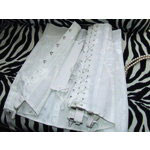
And finally, here’s the dread garment itself:

The famous Desbeau Corset!

The Paragon

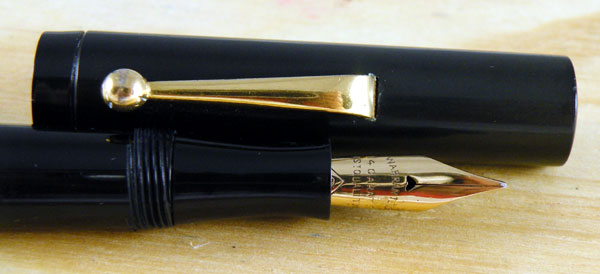
This one’s a total mystery to me and if anyone knows anything about it, I’d be delighted if you would chime in. It’s the Paragon and that’s all I know with certainty. Stylistically, I’d say it was made in the nineteen-twenties. It’s the typical flat-top of that period though at 13.8cm capped it’s larger than most.

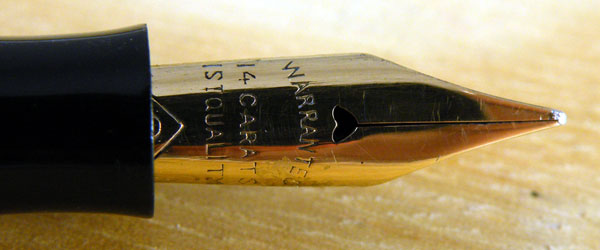
It has a large and elegant warranted 14ct nib and the lever bears a four-leaf-clover symbol. I believe these were parts that could be bought in. The clip is inserted through the celluloid of the cap and retained by an inner cap. The barrel imprint is the single word “Paragon”. Not another hint as to who made it or where, though there’s every reason to believe that it’s English.

This isn’t one of those cheap pens that were turned out in their hundreds as advertising give-aways or sold for a few shillings. This is a pen with a solid feel, well made, robust and quite impressive in its size.

Info, anyone?