Handwriting

Since my far-off college days I’ve been a keyboard kid, both for work and for leisure, though when I write I do it with a fountain pen.  Given that most things I write go into a word processor or a spreadsheet, is handwriting still necessary for me?  The answer is emphatically “yes”.  I’ve never been able to make use of those computer note-taking programs or screen sticky-notes.  They just seem like a lot of work for something I can do in a more straightforward way – pick up a pen and take a note!  There’s always an A4 tablet – ruled or plain, whatever’s cheapest – by my keyboard, and a page may last a day.  I can’t work, indeed I can’t think without taking notes.

Then there’s lists – “to do” lists, lists of pens to be uploaded, lists of pens I’m watching in eBay today; they’re all done with pen on paper.  I know that clever people have created software programs to handle your “to do” lists but they’re wasted on me.  Then there’s correspondence: all correspondence with pen people is done with a fountain pen.  It would be a bit weird not to.  One thing I seem to have less call for these days is invitations and place settings, which gave me a chance to play with my flexy pens.  It’s about time someone was getting married!

A few years ago I spent some time educating a teenager in the use of his computer.  He was a very smart kid and didn’t require all that much of my time, but one thing I noticed: he had a pad at the side of his keyboard and took notes as he went along.  Admittedly, he was using a ballpoint and his writing was like a drunken hen staggering in the snow, but he was handwriting.  Perhaps all these scare stories we hear about school children being unable to write are not entirely true, or not true everywhere.  I suspect that handwriting will survive.

Soaking Pens And Other Stories

I hate to drone on about this but it maybe does need re-emphasising.  Do not soak entire pens! In fact, before you soak any part of a pen, have a good think about it.  Water will liquefy dried ink and that’s about the only benefit it has.  On the downside, it can discolour black hard rubber, destroy casein, discolour some celluloids and rust metal internals.  Heat will soften and expand  BHR, casein, celluloid and other plastics, allowing you to pull things apart without damage.

My assistant went out in the rainstorm to try soaking.  She didn’t like it.
wetsmartie
I bought another book from Andy Evans of Andy’s Pens.  This time, on the basis of “know thine enemy” it was The Incredible Ball Point Pen by Gostony and Schneider.  I haven’t really read it yet but at first glance I can tell you that it’s mostly American and stops at around 1980.  Fair enough, I don’t think that there have been any ground-breaking developments since then.  The point I want to make, though, is how quick Andy’s deliveries are.  I’m sure it isn’t Royal Mail that delivers it.  They deliver nothing else as quickly.  No, I think Andy has a wee guy with a monster sports car – maybe a 1933 aero-engined Napier Railton, and the wee guy has goggles, a flying helmet and a white silk scarf.  And an expression of seething madness.  He sits outside Andy’s shop awaiting a purchase in need of delivery and instantly takes off in a burst of wheel-spin and a cloud of dust and races to deposit his parcel on, in this case, my welcome mat.  He breaks every speed limit and most of the rules in the Highway Code to get here but that’s OK.  The police have nothing fast enough to catch him.

That’s enough crazed rambling for today.  I have pens to describe if I’m to upload them in the next few days

Isn’t It Obvious?

I have an app for BBC news on my tablet and I was working my way through the daily dose of drama, incompetence and misery when I came upon an article about spying.  Since computers have been so thoroughly taken over, both by Google and the authorities, many diplomats and senior civil servants have taken to using typewriters.  Unfortunately they are no safer, it seems.  Whole reports can be restored from a typewriter ribbon, and with concealed listening devices crafty spies can tell which part of a typewriter ball is striking the paper and thereby transcribe what is being written.   In some cases customs inspectors have attached bugs to typewriters when they were imported.  DSCF4403

Conway Stewart 496 Set

IMGP5134 IMGP5135

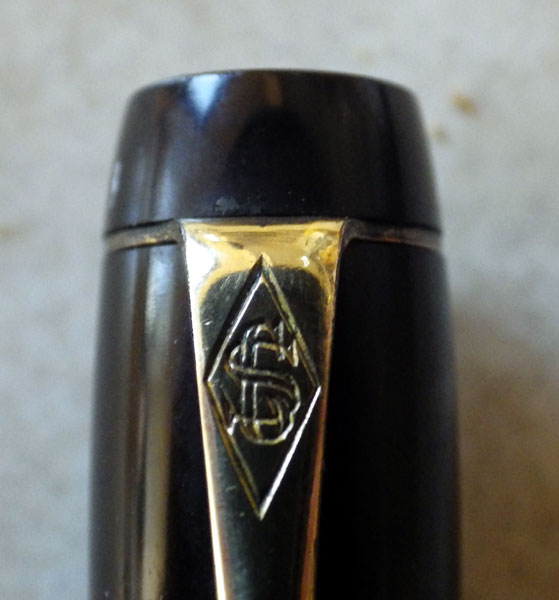
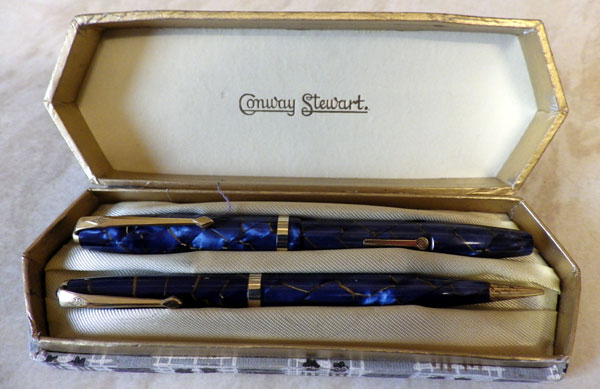
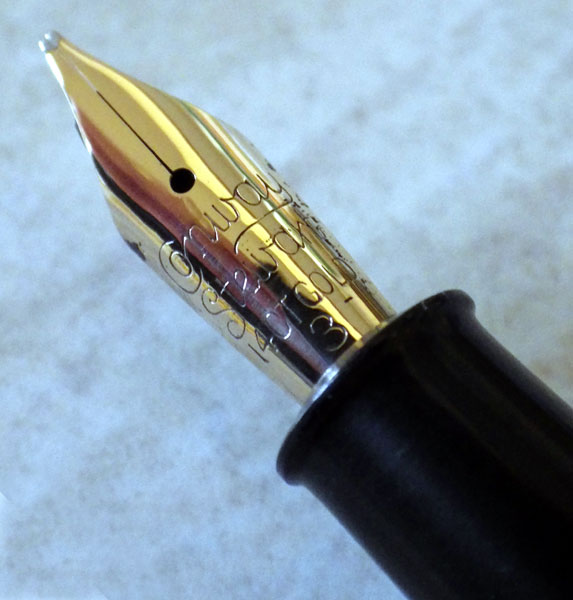
The 496 is not often seen and that’s a pity because it’s a beautiful pen.  The patterned ones are exceptionally lovely in their schist-like colours but even the black pen is inordinately handsome and stands out from other Conway Stewarts of the time, which is around 1930 – 1935.  The taper at the top of the cap sets it off as something unusual and refined.  It’s not the only Conway Stewart with that elegant profile – I had a piston filler that looked the same some time ago.  The number for that one has slipped from my colander memory, I’m afraid.  You see a similar tapered top in some Onotos and De La Rue pens.  It takes as little as changing the taper on the cap top to take a pen from pleasant to exquisite.

IMGP5141
IMGP5144

The pencil is a handsome Duro Point which has no number.  I can’t tell if these make a true set as they came in a box which is not original and Donahaye’s list shows no paired pencil for the 496.  However, with their matching twin rings they look as though they should be together.
swansac
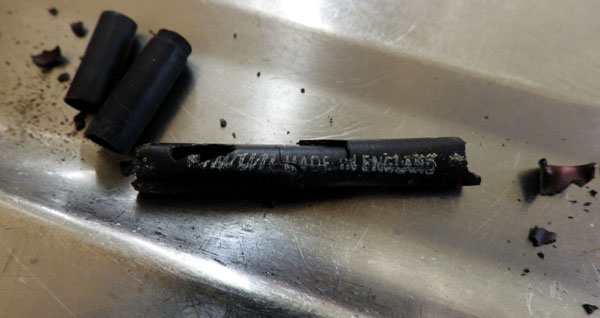
On an entirely different subject, I see crusty old ossified Conway Stewart sacs all the time.  I showed some a few posts back, in fact.  Mabie Todd ones are rather less common but I found one this week and here it is.  Sorry that the closed end had crumbled  but enough remains to make it recognisable, I think.

Are More People Joining Our Hobby?

As a suggestion for a post, Stuart said,”I hear that fountain pens are enjoying a resurgence and I’d be interested to know how and if that impacts you.”  I think that sentence goes a step too far too soon.  The interesting question, for me, at least, is, “Is there a resurgence of interest in fountain pens?”

It’s certainly true that prices for unrestored pens have leapt in the last year or so.  I’m thinking here of eBay UK; the same may not have happened elsewhere.  Anyway, a price rise of around 50% across the board certainly means that something’s going on.  However, it may not just be increased demand because there are more new people trying to buy old pens.  It seems to me that there are far fewer good quality really old pens on offer.  Ebay’s numbers are kept up by a proliferation of newer pens, nineteen-sixties or later.  Are we coming to the end of the supply of earlier pens, and is that spurring people on to pay more?  Another factor is the training courses that WES has mounted.  In these difficult times it may be that many are trying to turn their new skill-set into a business and vying with each other for pens to restore.  Or it may be that all of these factors are contributing, including an influx of new pen fanciers.

I read the Fountain Pen Board and Fountain Pen Geeks.  Both of these discussion groups have seen a significant rise in numbers over the last year.  Admittedly, some of that was from the trouble in Fountain Pen Network which caused many people, including yours truly, to leave and look for somewhere else to discuss pens.  However, that was the best part of a year ago, and the numbers of those joining remain high.  That’s the most positive sign I’ve seen that suggests that there is a resurgence of interest in fountain pens.  True, Pentrace is in a “it’s closing, no, it’s not, yes, it is” phase at the moment but that doesn’t reflect a loss of passion for pens, more an outburst of frustration at some of the internecine warfare that goes on there.  There is a suggestion that even if the owner does walk away someone else may keep it alive.  I do hope so; pendom hasn’t been good at picking up its casualties: Lion & Pen, perhaps the best board of all despite its faults, lies moribund today with no sign that there may be a recovery.

All in all, I think there are signs of an increase in interest in fountain pens, both old and new.  How does it affect me?  Rising prices make my life more interesting than I would want it to be, but overall I welcome and applaud more people joining our hobby.  I’d like to see numbers and interest rise a lot more, perhaps even back to the glory days of the late nineties.

Useful Pen Sites

Many of you will know these sites already, but they may be helpful to others.

Sites I refer to all the time for pen identification:
For Burnham pens:
http://www.pengrauncher.co.uk/

For Swan pens:
http://www.mabietoddpenlists.co.uk/index.html

For Conway Stewart pens:
http://jonathandonahaye.conwaystewart.info/index.html

For Summit and other Langs pens:
http://www.summit.ch944.net/index.php

For Parker pens:
http://parkerpens.net/

For American pens:
http://www.richardspens.com/

Other sites
For a most entertaining and informative blog:
http://munsonpens.wordpress.com/

For pen discussion:
http://fountainpenboard.com/forum/

http://fpgeeks.com/forum/forum.php

http://www.pentrace.net/mboard.htm

There’s also
http://www.fountainpennetwork.com/forum/

I don’t go there, but to each his own.

For UK pen repair:
http://eckiethump.webs.com/

For nib work and USA pen repair:
http://gregminuskin.com/

For pen repair tools and supplies:
http://cathedralpens.co.uk/

That’s a start.  Tell me your most useful pen URLs.

Which Conway Stewart?

Thank you for the suggestions.  Keep ’em coming!

One question that perplexes me that would likely be within your realm of expertise regards the pens by Conway Stewart. I wonder just what is the REAL difference between the various models? I understand that like car manufacturers, the pen company is pressure-bound to come up with ever newer “improved” models in order to maintain their competitive position within the industry. But what REALLY is the difference between a #27 and a #28? Is it just a slight variation of length of the barrel or the cap? Is there a double cap band instead of a triple band? Is the lever a bit lower or higher on the barrel? For me, these are not really differences. There ought to be something more SIGNIFICANT to qualify as a GENUINE difference between the various models. But is this really the case. I am not restricting my question to just the models 27 and 28, of course. I am referring to all the various models over the years in this one company. I would grant that going from hard rubber to celluloid to casein represent significant changes in the pens – or going from lever filler to button filler to piston filler or clip to ring-top but is there anything else ? The same question would apply to the other companies as well…
Stuart (scratching my head across the pond)

This is a matter of perception, really.  If you compare one pen of the same period with another, the differences do appear contrived and trivial, but the short answer to your question is that the difference between the No 27 and the No 28 is the price point that they are produced to meet.  We may think of Conway Stewart’s product as being this pen or that; they would have seen the entire range as their product.  It was their aim to provide pens that would suit the taste and pocket of everyone and they chose to do that (as did many other manufacturers) by producing pens of different size and trim with a range of nibs.  Within the grasp of the financially hard-pressed parent buying for a school pupil were the No15s and 16s, small with no cap band and a small nib, whereas at the other end of the income scale were the more opulent Nos 27, 58, 60, and 100 with much more gold trim, larger size and big Duro or No 5 nibs.  Between these extremes are a host of pens separated from each other only by a few shillings, if that.  However much you could afford to spend, there was a pen of the size, colour and trim that you wanted.

I have used post-war pens to explain this point, but exactly the same pattern emerges in the study of nineteen-thirties Conway Stewarts.  The company made a price differentiation on the basis of appearance and size, not how they wrote.  They were not alone in that, of course.  Most producers did pretty much the same.  Though Conway Stewart, like other British pen companies, didn’t make innovation a selling point they did innovate from time to time.  Though they produced excellent piston fillers and stud fillers in the pre-war period and the Speedy Phil after the war, it was always the traditional lever filler that made up the vast bulk of their output.  You can only differentiate one lever filler from another so far.  That lies with the customer rather than the manufacturer, to a great degree.  The British pen-buying public distrusted innovation for its own sake, and preferred to stick with the tried-and-trusted lever filler or button filler.  Neither Conway Stewart’s Speedy Phil nor, in an earlier period, Swan’s Visofil sold in anything like the numbers that had been anticipated.  Hence the policy of creating what was essentially one pen and dressing it up in slightly different clothing to suit different requirements.

Immensely successful though they were, Conway Stewart didn’t capture all the economic groups that they aimed at.  At the very top, whether of the professions, the forces or industry, Swans and Onotos were chosen rather than Conway Stewart 60s and 100s, hence the comparative scarcity of these more opulent models.

Today, collectors and users alike can be grateful for the number of different models Conway Stewart produced.  There’s still something for everyone and we all have our favourites, despite the fact that they’re all pretty much the same pen.
Where Do We Go From Here?

I expect that however long I continue to write this blog, there will always be old pens coming along that I haven’t written about before.  Less all the time, though, I’m afraid.  I’ve covered all the major manufacturers and quite a few minor ones too.  Also, I’ve written about the main models made by the various manufacturers.  Frankly, it’s becoming quite difficult to find subjects to write about.  Where do we go from here?

I’ve written about pen books, or at least quite a few of them.  Given the cost, it’s unlikely that I’ll be buying many more.  Anyway, not all that many publications that deal with our subject come out in a decade , never mind a year.  I’ve discussed some of the issues that surround our hobby but it’s not every day that something newsworthy comes up.

I have, I am happy to say, a large and varied readership.  I would be delighted to hear suggestions from any of you and I’ll be happy to take them up if I can.  The blog is a two-way street and it never would have lasted this long (since October 2010!) without feedback.  Your input has been invaluable and it could help to rejuvenate the blog.

There are parameters within which I must work.  My knowledge and interest lies with pre-1970 British pens.  I can dabble a little in American pens and I like European pens, though I know very little about them.  Modern pens hold no interest  for me.  Also, it would be pointless for me to cover subjects that have been comprehensively covered by other authors.  Beyond that, the sky’s the limit!

Marshall & Oldfield: Pen Repair Third Edition

I bought the first edition of this book, skipped the second and now I have the third.  There are many changes.  The third edition is much larger, 280 pages to 194.  Though there are some new sections, most of this increase in size comes from expansion of the chapters that were there in the first edition.  The inside front page is a detailed contents list and there’s a useful index at the back.

Though the book now has a smart outer cover, it retains it spiral-back format, which means that it lies flat on your bench if you need to consult it during a repair.  It’s not for repairers alone, though, there’s a mass of fascinating information about, for instance, different filling methods and about British pens.

Having only received the book today I can’t give a thorough review but I thought it was important to write about it right away.  If you want one, now’s not the time to hesitate – go and get it, because the last new edition went pretty fast and a lot of people were disappointed.  It will be £30 well spent.

Conway Stewart 85L Blue With Gold Veins

IMGP5107

I wrote about the 85L before, back here: http://wp.me/p17T6K-cI, where I suggest that the 85L is a successor more to the 84 than the 85.  Be that as it may, the 85L is a pen that stands out among the other models of its time (late fifties early sixties).  It a little longer and slightly more slender than the other Conway Stewart pens of  the period and it comes in some outstanding colour patterns like this bright blue with gold veins.  Judging by the numbers that turn up nowadays it was a very popular pen back in the day and it remains so with buyers today.
IMGP5105
I’ve been going after boxed pens and pen and pencil sets whenever I can.  The prices can be a little steep but they’re worth it, especially when they and their box are in such good condition,  It’s almost like getting a nineteen-fifties pen new.  In comparison with real new pens of similar quality, they’re very cheap, in fact.
IMGP5110
And, of course, they write better…