The Latest Daily Writer

I’ve been using the Parson’s Italix as my everyday writer for a while but it’s time for a change.  What I look for in a pen for daily use is that it be a good writer and not worth a lot.
IMGP5479
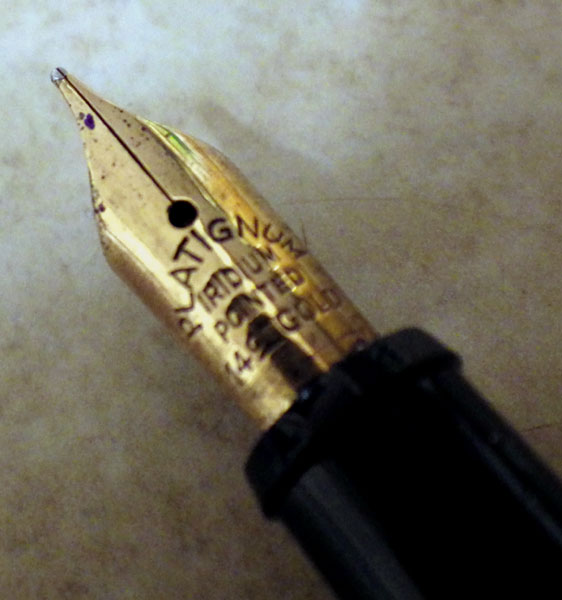
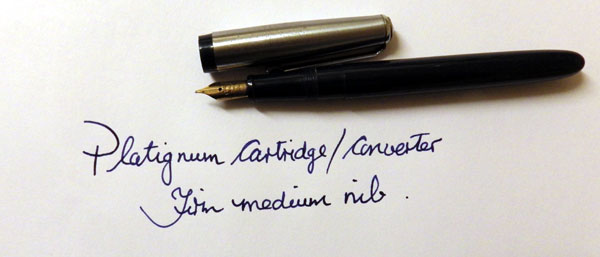
This pen turned up in a lot I bought recently,  It’s a smart pen, feels good in the hand and writes very well, though without any flex.  It’s worth very little.  What is it?
IMGP5483
Yes, it’s a Platignum.  A gold-nibbed Platignum, though, and one with a solid feel to it.  Not really typical of the brand, though some of their post-war output, like this one, was made with the eye on quality that had been previously applied to the by-then shelved Mentmore*.  I think it will do very well.  As ever, firm-nibbed pens are a challenge to me.  I don’t automatically write well with them and I have to try a bit harder.  It’s character-forming.
IMGP5477

*That was one of the most convoluted sentences I’ve ever been guilty of.  Of which I’ve ever been guilty.  Now I’m ending the sentence with a trailing preposition.  Sorry for hammering the grammar.

The Truepoint

Looking back on it you would say that 1948 might not have been the most auspicious year to launch a new high-quality fountain pen.  The ballpoint, which took off more quickly and more successfully in Britain than in the USA, was already making inroads into fountain pen sales.  The country was struggling to recover from World War II and there was strong competition from brands like Swan and Parker.  Nonetheless, it was in this year that Truepoint made their bid for a place in the market.  It was doomed to fail but it left us with an exceptionally well-made rarity that probably outshone its competitors in terms of quality though it never achieved the market share to succeed.
IMGP5468
This is a big pen, 14cms long capped, with considerable girth.  It’s a button filler.  The blind cap blends into the barrel seamlessly.  It’s a tapered pen, sharing a shape with the English Duofolds or larger Conway Stewarts of the time.  The cowled, ball-ended clip is stamped with their “coat of arms” logo, as is the huge semi-flexible gold nib.  Unusually, maybe even uniquely, the cap band configuration is a broad and a narrow ring.
IMGP5469
This was a pen that should have succeeded given its first-rate build quality but not only did it fail, the company appears not to have sold many pens.  It’s rare today; this is only the second one I’ve seen in my many years of of interest in fountain pens.  Perhaps the price was set too high; the only advertisement I’ve seen doesn’t show a price.  Maybe the capital wasn’t there to market the brand properly or to carry the company until sales would have taken off.  This pen and a few others like appear to be all that survives of this proud venture.

Wyverns No 60C and 404

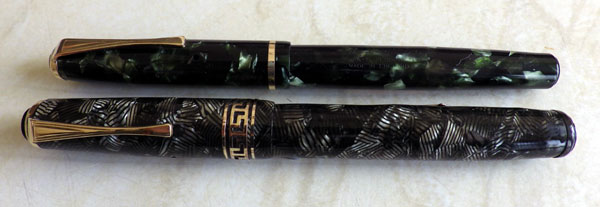
Months will go by when I don’t see a Wyvern, then I get two on the same day, beauties both of them.
IMGP5462
The No 60C is a bit of a puzzle.  It appears with different levels of trim and, indeed, as a completely different pen from this one, more slender and cheaper-looking.  This version, with its Greek Key cap ring and cowled clip is doubtless quite high in the range and probably post-war.
IMGP5463
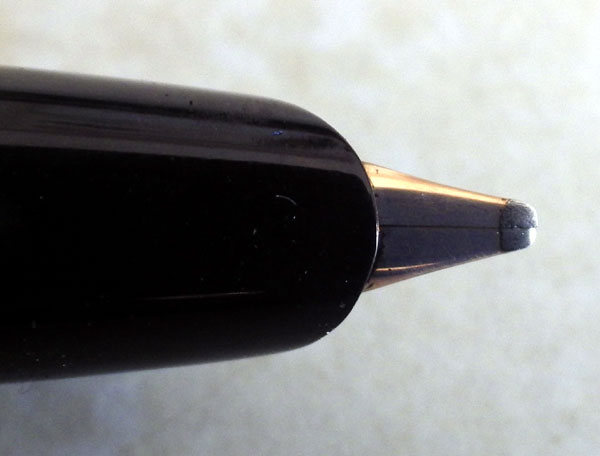
The 404 is definitely post-war.  The best dates I can find for it are 1948 to 1956, when pen sales came to an end.  The hooded nib hints at the Parker 51, though in fact it’s a perfectly traditional nib, not a tubular type as was featured in the Parker.  Indeed, though it looks a little more modern than the No 60C it’s made in exactly the same way.  There’s no collector in hiding beneath the hood, just an everyday feed.
IMGP5466
What makes this 404 especially interesting is the broad nib.  You don’t get many of them!

Deliveries

I never tire of opening packages, especially those that clearly contain pens.  Three arrived this morning.  The period from World War I to World War II is covered by these pens: a splendid slip-cap eyedropper that probably was made before World War I but I’m being conservative in my estimates here, and two late thirties/wartime lever fillers.  One is as it was found in drawer, attic or wherever, the other has been “restored” by a man I often buy from.  His restoration, I have to say, is not mine.  The pen is re-sacced and he seems to do that quite well.  Otherwise, there’s work to be done.  Annoyingly, he doesn’t flush pens thoroughly and if you’re not careful it’s inky fingers time, one of my pet hates.  The eyedropper is handsomely stamped with cursive initials on what appears to be a gold band even though it isn’t hallmarked.  It’s an over and under feed with a flexible nib, probably a medium.  The unrestored pen is in a repair box, clearly a few decades older than the pen it now contains.  The legend on the side is “This box only to be used for despatching pens which have been repaired” and on the ends of the box recipients of restored pens are advised to “use Swan ink.”

It’s a fine haul, the first of the deliveries which will go on for the remainder of the week and beyond, as I’ve been on a buying spree.  Some may well feature here as the week goes on.

Crack!

IMGP5455

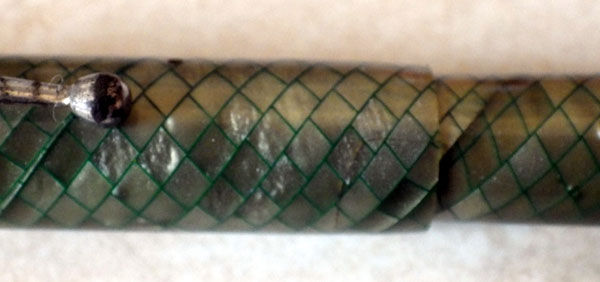
Beautiful pen, isn’t it?  Green lizard – or is it snake?  I’m never sure unless it’s numbered and this one isn’t.  It’s unrestored.  I can brighten up the metalwork.  But wait…  What’s that?
IMGP5456
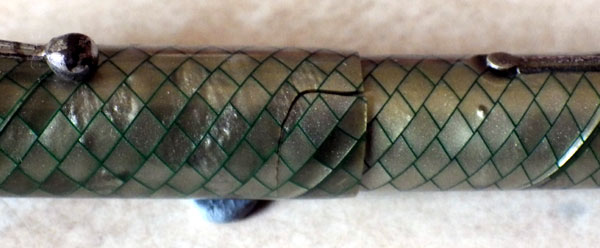
Could it be a crack?
IMGP5457

Yep!  It’s a crack.  About the size of the Grand Canyon.  I can’t believe the seller didn’t see that, and yet he was happy to take my £48.90 and £2.60 postage!  I’ve contacted him and he’s going to refund me in full including return postage, so that’s not so bad.  Some sellers blow up the minute you mention that there’s a fault, and the claim becomes very confrontational.  I’ve never had an occasion where I didn’t get my money back for a damaged pen but I’ve had a few threats.  I take those with a pinch of salt and  the husband growls, “Bring it on!” from his armchair where he sits sharpening his machete and flipping through Classic Arms & Militaria magazine.

I’m negotiating a major upgrade of the sales site and a move to a better web host.  If I get my way, there won’t be any change to the site, either in appearance or function.  The one or two things that don’t work now – like the routine for forgotten passwords – will finally be fixed but otherwise I’m not looking for change.  I hope to keep downtime to an absolute minimum.  Anyway, it’s early days and the changes probably won’t happen for a few months.

It will be nice to get away from the miserable bunch of crooks I’ve been stuck with for so long.  I won’t name them here but you will see their name on the sales website.  Avoid at all costs if you value your sanity.

Omas Limited Edition Phoenix Plated Fountain Pen With Diamonds

Have you seen this $48,000 Omas pen?  It’s reduced from $60,000 so I suppose that makes it a bargain.
$48,000!  Google tells me that’s £28,742.50.  That’s a lot of money when you can buy a perfectly good  Pilot V-Pen for £7.76.  I could buy a really snazzy car for that or, more to the point, a whole stable of hot motorbikes.  Or even enough used pens to fill my workshop to the roof.  I’d have them but I couldn’t work on them because I couldn’t get in.

Beauty is in the eye of the beholder, they say, but for me that’s one very ugly pen.  It’s bulbous, the colours are garish and the clip looks like the handle of a teapot.  In the sales-speak blurb they say “The highly original clip is inspired by movement and harmony.”  Yeah?  Well so’s my dog’s hind leg, the one he lifts at every lamp-post.

There are some comments on the page that are highly amusing.

Is this kind of thing good for our hobby or does it expose it to ridicule?  What do you think?

The British Parker Duofold Aerometric

IMGP5424

Throughout the fifties, there can be little doubt that the Duofold Aerometric was the most popular pen in Britain.  Hardly surprising, given its high quality.  The aerometric system made for easy, clean filling and the streamlined shape was not only satisfying in itself; it was influential right up to the present day.

IMGP5440

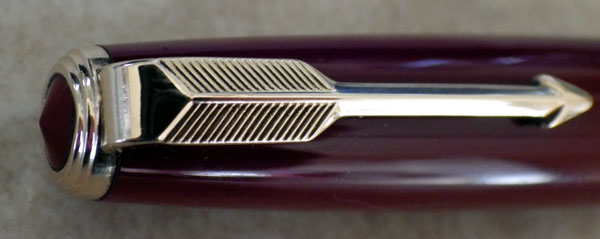
The beautifully cast arrow clip with its cowling and “jewel” sets off the cap perfectly.

IMGP5441

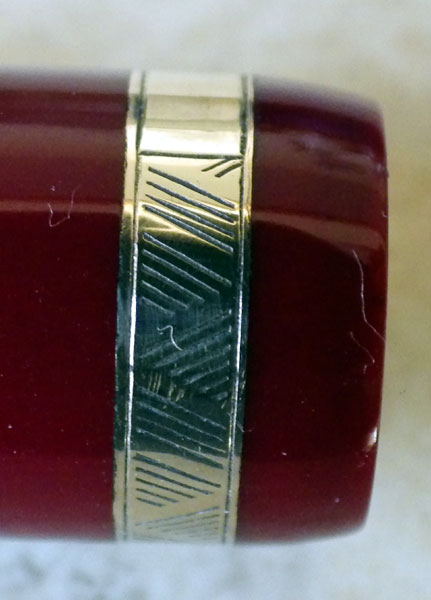
The chevrons make the cap ring instantly recognisable.

IMGP5436

Duofold nibs are usually inflexible – the time of the flexible nib had finally passed by, even in Britain – but they are reliable and the pen writes every time.  If British Duofolds have a fault, it is that the material they are made from is a little soft and the barrel imprint is often faint or missing.  A perceived fault these days is that they are bland.  Perhaps, and perhaps what is seen by some as blandness is just classic perfection.  Pared down to the essentials, with the only decoration being in the gold-filled trim, the modern eye isn’t always suited to such understatement.

These are great pens.  Everyone should have one.  The Fifties Duofold is the baseline against which you judge everything else.
IMGP5422
This one (in case you hadn’t noticed) is red – the deep red of fresh blood.  For me, this is the best Duofold.

The rest of today, for me, will be pen restoration.  My assistant says she will lend a paw.  Or two.

IMGP5450

Philip Hensher: The Missing Ink, How Handwriting Made Us Who We Are

This is a book about writing rather than pens though there is some stuff about fountain pens toward the end.  It’s a persuasive argument for the preservation of handwriting but it doesn’t go so far as to say it will survive.

Hensher takes us through the history of writing in his own inimitable way.  He’s quite emphatic in his beliefs about the subject and he doesn’t spare those that he regards as foolish.  The book really isn’t for the faint hearted.  He can be pretty explicit at times.

His central concern is that handwriting is generally not taught in either Britain or the USA with the result that kids grow up without the ability to write legibly.  Keyboard skills are all very well but they don’t help you when you are faced with a many-page form as happens in all sorts of circumstances.  Of equal concern is that kids can no longer read their elders’ cursive writing.  It’s a bit of a bind when Mama leaves a note on the fridge and it makes as much sense as Arabic to the kids!

The book is scholarly, funny and quite convincing in its central argument.  It’s also a very good read and I recommend it to everyone.

Something You Don’t See Every Day…

Last week I bought a small job lot for the sake of a couple of Parkers and a Croxley but there was a pink marbled New Bond Easiflow there as well.  When I unwrapped the pens it was apparent that the cap of the Easiflow didn’t fit too well.  When I removed it I saw why.  Someone had forced a much too large Scroll nib into the section.
IMGP5416
I put it aside to be dealt with later, and when later came along I had another look at the nib at realised that there was more to this than had at first met the eye.
IMGP5417
Someone had cut two curving slits in the nib, probably with a hobby saw.  Whatever other effect this might have had, it most obviously made it a nib that would flex.
IMGP5419
Before you start ripping into your Montblancs with hacksaws, be aware that this only half works.  The tines part like a good flex nib but they don’t snap back together when you release the pressure.  In fact you have to turn the nib over and press down to return them to their original position.  I think I have a warranted nib of the right size for the rather pretty Easiflow and the Scroll nib can go in the bucket.

The FPR Triveni Acrylic

IMGP5409

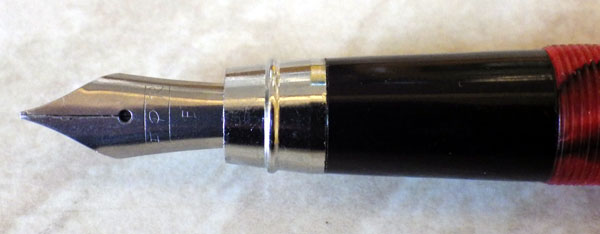
The only Indian pens I’ve had have been two Walitys, a medium-sized piston-filler (good) and a large eyedropper filler (dreadful), so I thought I might try something else from there as the pens are so inexpensive.  After looking through the plethora of pens available I settled on Fountain Pen Revolution and and chose their Triveni Acrylic.  According to the blurb: “The Triveni Sangam is a confluence of 3 rivers in India.  The handmade Triveni accepts 3 fill methods (converter, eyedropper, cartridge).”   That makes sense.  The pen cost me the princely sum of $45 (around £28 – £29).  It arrived this morning.  First impressions: it’s very long at 14.7cm.  The red and black acrylic is translucent and very beautiful.  The black tassie and blind cap set it off very well.  (These serve no purpose other than the aesthetic)  The fine nib is a nail.  The pen takes two and a half turns to close, which feels like a lot.  The chrome-plated metalwork is good.
IMGP5413
The syringe-type converter takes up a mere two-thirds of the barrel length, so the excessive length seems to be catering to modern tastes rather than serving a practical purpose.  The pen would be much better if it was 2cm shorter.  Thankfully Indian manufacturers seem to work honestly with their materials, unlike the Chinese who often bury lumps of brass pipe in their pens.  This pen, then, is the combination of the acrylic and a little thin metal, so it’s very light indeed, perhaps even at the lower end of acceptably light even for me, and that’s saying something.  The section is black plastic at the top.  That’s where I’d grip it and it feels comfortable.  Further down it’s metal.  Aesthetically, that seems like a mistake and I’ve known metal sections to corrode severely when in contact with ink.  The nib seems well enough made but it is noticeably scratchy.  I think that’s a function of the shape of the tip which is quite angular.  A spell on the micro-mesh may well cure that.  However, as I said above, the nib is an absolute nail.  I’m inclined to feel that with a nib like that, this is the pen for the person who wants no more from a fountain pen than he gets from a ballpoint.

IMGP5411
Another thing about this part of the pen: though this is a normal-sized nib, similar to a Swan No 2 in size, the excessive length of the barrel makes it appear very small and out of proportion with the rest of the pen.  If the pen is to be so very large, a bigger nib would look better.  The feed appears to work well but I haven’t used the pen enough to be sure.

I’ve been critical of those things about the pen that I don’t like, but overall this is a well-made pen.  All the parts fit together perfectly with a much finer tolerance than I’ve seen on much more expensive pens.  For instance, if the Sheaffer Intrigue of less than fond memory had fitted together as well as this pen, it wouldn’t have turned out nearly the bow-wow that it, sadly, is.  With some nib work it will probably be more pleasant to write with and I believe that FPR supply a flexible nib, which might be the way to go.  I can’t see this pen becoming one of my users, but I bet there are plenty of modern pen buyers out there who would find it impressive for the small amount of money it costs.  Finally, almost anything could be forgiven because of that delightful acrylic.  It looks good in blue or orange as well.