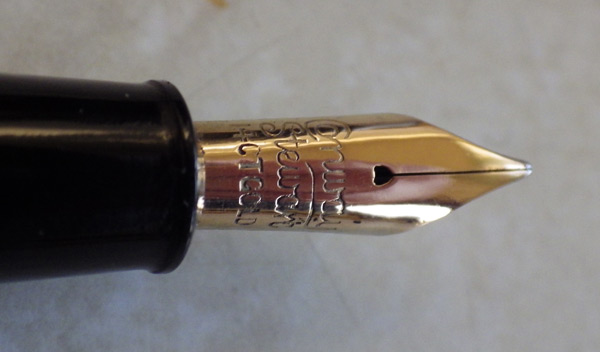
Picasso Red Flower

IMGP9867

I confess that I am sometimes drawn in by the allure of Chinese pens, but in my defence I maintain that they are much improved – or at least some of them are – and some, it seems to me, are not all that far behind much more expensive European and American pens in terms of quality and presentation.  A case in point is the Picasso Red Flower which I bought recently.
IMGP9870

IMGP9871
It’s extremely well presented.  It comes in a cardboard outer box decorated with a tiny image of a Picasso painting.  Inside is a hard case containing the pen, a quality inspection card and a well illustrated Picasso booklet.  Every bit as smart as any of the European pens I bought lately.
IMGP9868 IMGP9869
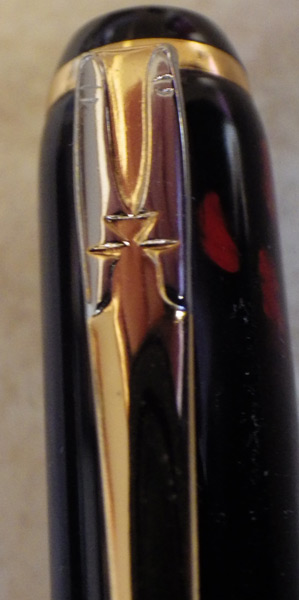
My one complaint about the pen would be that it is enamelled brass construction and therefore quite heavy, though so far I haven’t found that to be a great disadvantage in use because it’s quite well-balanced.  The pen is very pretty, black with splashes of red in a fairish imitation of urushi.  The clip is two-toned with an image that I can’t quite make out – maybe it’s a pen nib above an ink bottle, but maybe not.  Have a look – see what you think.
IMGP9877
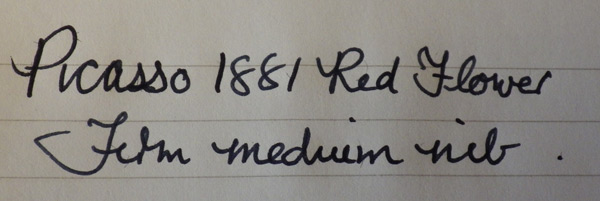
The push on cap fits very securely with a satisfying click.  The black plastic section has an embossed pattern which gives a good grip.  The nib is 22k gold-plated stainless steel, and is as smooth as any pen I have ever tried.  The ink flow is generous and after several pages of writing it hasn’t skipped yet.  Unscrewing the barrel exposes a twist converter which works well and of course the pen will take international cartridges.
IMGP9872
This is a lot of pen for under £20!  I’m not saying that it rocks the foundations of Mont Blanc or Visconti, but it does make one wonder about the prices that they are set at.  Undoubtedly, they are better pens but are they several hundreds of pounds better?
IMGP9878

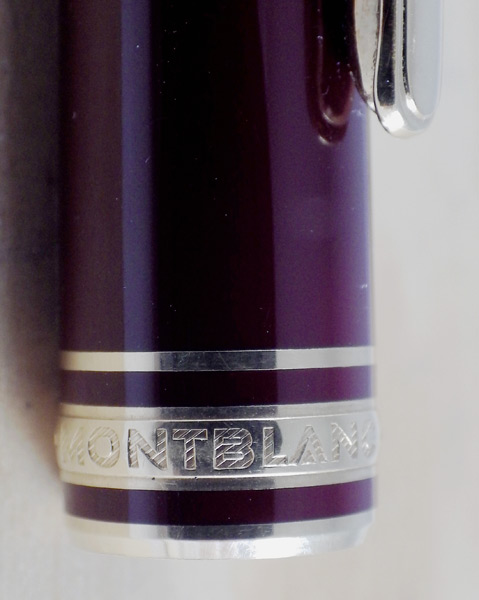
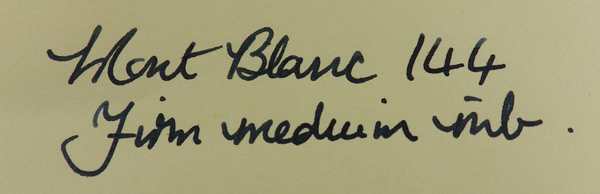
Montblanc Meisterstuck 144

IMGP9726

I confess that I bought this pen with the intention of sneering at it.  I’ve had several Montblancs over the years and I haven’t been unduly impressed with them.  At the same time, I have been very aware of the ridiculous hype and the even more ridiculous prices that are charged for Montblanc Meisterstucks.  They are status symbols, something that I despise, but I have to admit that they are something else as well – a very nice pen!
IMGP9729
This is the smaller Meisterstuck.  I believe it’s called the 144.  The plastic has kept its shine and the gold plating is nice.  The pen has a pleasing tapered shape and it evokes several vintage pens, to my mind, much more than it does any of the other modern pens.  It has a press-on cap which slips firmly into place without any drama.  It posts well too.  The gold nib is instantly recognisable as a Montblanc by its shape.  The nib is engraved “4810 MB 14 K Montblanc 585”.
IMGP9731
Unfortunately the 144 is a cartridge/converter filler, not a piston filler like it’s a bigger brothers.  However, once filled, the pen more than lives up to its reputation as a splendidly smooth writer.  This particular example is not flexible though I believe quite a few are.  Quite small for a modern pen, it nonetheless fits my hand very well and I find it very pleasant to write with.  What more can I say?  That’s all a fountain pen is required to do.  I don’t need it to boost my ego, nor to elevate my standing among my peers, so I can only judge it as a writing instrument and it is a very good one.
IMGP9738
All in all, I’m very pleased with it.  I would quite happily pay £100 for a pen like this.  Of course, I know that it costs more than that, but that is what I would regard as a reasonable price for such an excellent pen.

A Late Summit

IMGP9723

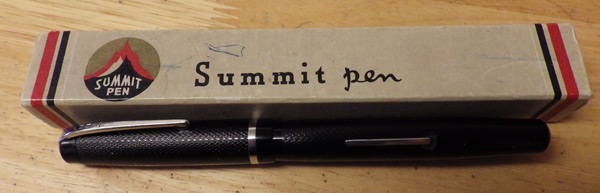
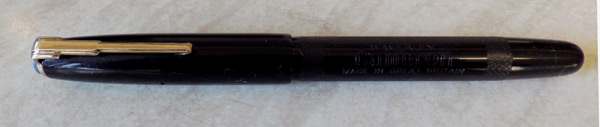
This Summit pen turned up in nearly unused condition – when I flushed it there was ink in the feed but it showed no other signs of having been used.  It’s a little unusual in that there is no barrel imprint, so I can’t say what model it is. Everything about it suggests that it is a late model, perhaps among the last range that Summit made before the company closed in 1955.  The “over the top” clip is a late feature.
IMGP9724
The machined pattern is very crisp and the chrome plating is immaculate.  The box, too, is in very good shape, though there is a little scribbling on the top.
IMGP9725
I suppose one might say that this is a fairly basic pen but it’s interesting in that it appears to be quite an uncommon model.  It is also unusual to find one in such good condition.

IMGP9721

Blackbird BB2/39

IMGP9700

Lately, time has been running away with me, with the result that I’ve done few blog entries.  I was determined to make up for that tonight, despite the fact that I had only a few minutes to spare.  Quick photos done under strip light don’t give the best results.  I know that, and yet I still continue to do it.  These photos don’t do justice to a rare and beautiful pen.
IMGP9703
It’s a Blackbird of the BB2 range and I believe that this grey, red, bronze and black marbled pattern is the one that is coded 39.  I’ve seen one occasionally but I’ve never had one in my hands before.  It was issued without a clip and an accommodation clip has been fitted later.
IMGP9714
It’s quite unlike any of the other Swan patterns that I have seen.  The individual patches of colour are small and the effect is like the fragmented colouring that you see in some geological samples.  It may be that this is one of the patterns that also appears in Visofils.
IMGP9712
As if that wasn’t enough, the small nib is a flexible stub!

Pens Uploaded

Would you care for a Swan, or a Water-man, or perhaps a Waverley Camer-on?
Flexing with grace, they may sell apace, so come and be the first in the race!
Such colours were made!  Even russet and jade, and one with a beautiful leafy-like ‘blade’.
They await your decision, these tools of precision, so come have a look – all in grand condition!

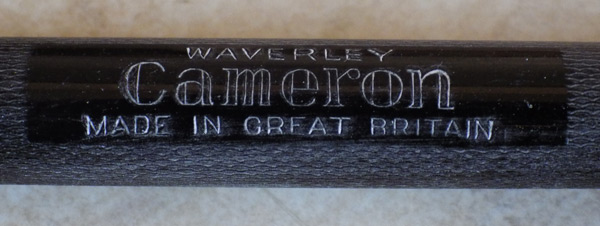
Waverley Cameron Eyedropper Filler

IMGP9561

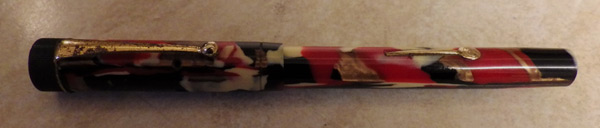
These Waverley Cameron pens were made in the immediately post-war period by Burnham, I believe.  They were intended for the subtropical market (where sacs deteriorate very quickly) but, for some reason or another, were not exported and appeared, boxed, on the market in great numbers here some years ago.
IMGP9563
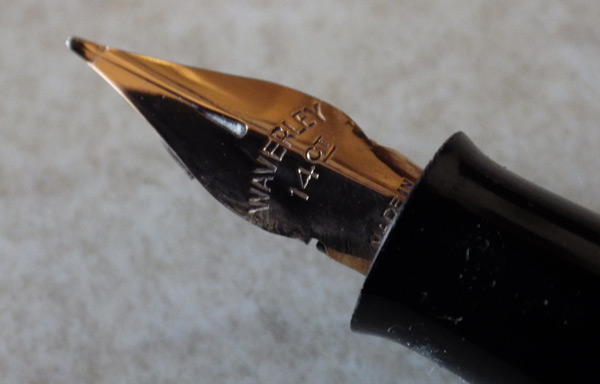
I hadn’t had one of these for quite a while and I’d forgotten what a good quality pen it is.  Everything fits together nicely, and the Macniven and Cameron leaf-shaped nib is often pleasantly flexible, as I believe this one is though I haven’t write tested it yet.

There is much to be said for a relatively modern eyedropper filler.  It’s never going to need a sac, diaphragm or seals and it doesn’t need filled very often.
IMGP9566
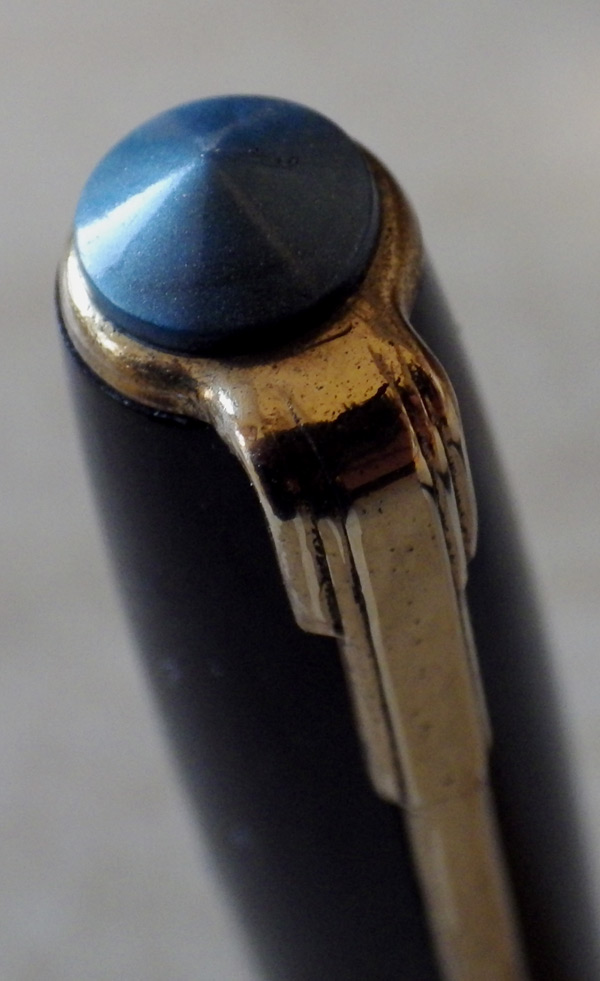
This model is quite visually attractive with the stepped clip, blue clip stud and deep engine chasing on the barrel.  There is a lever filler which I have written about before that was probably made around the same time, also by Burnham.  It is quite similar and shares the blue clip stud.
IMGP9565
The leaf-shaped nib is, in reality, no different from one of the more usual shape.  It’s part of the Macniven and Cameron tradition and harks back to their Waverley dip nib.
IMGP9567
These pens were quite common for a while but appear rather less often now.  More’s the pity, because they are pretty special pens.

A St. Michael Pen

IMGP9554

This must be the brightest pen I have ever seen, with the possible exception of the Chilton Clown.  The barrel imprint tells me that it is a St Michael pen, made in England.  Anything with a St Michael label was made for Marks & Spencer, a leading high street chain store.  Marks & Spencer still sell pens today but no longer use the St Michael label.  The current offering is a no-name pen which seems to be of moderate quality.  I can’t tell with certainty when this pen was made or who made it.  As to date, my best guess would be late 30s.  The maker could be any one of the major pen manufacturers, or any number of jobbers.  It has a Mentmore look but that is probably a red herring.
IMGP9556
It’s a pleasure to see such a cheerful pen, especially when you consider that black seems to have been the default choice among British pen buyers for several decades.  It has a nice warranted 14 carat gold nib.  The clip looks a bit weatherworn but I’m sure I can do something about that.  There is a shallow incision running around the bottom of the cap which might imply that there was once a cap ring there.  On the other hand, many pens were issued with that incision but no cap ring.  Considering that the cap screws onto the barrel very well there seems to have been no shrinkage which would cause a cap ring to fall off.  Given all of that, I think the pen is in the same condition now as when it was manufactured.

I think that we may be too serious, at times, about our fountain pens.  We need more bright, cheerful, multicoloured pens like this!

Latest Upload

It is an ancient Mariner,
And he stoppeth one of three.
‘By thy long grey beard and glittering eye,
Now wherefore stopp’st thou me?
.
Goodwriters’ doors are opened wide,
And I invite you in;
The pens are there, the prices, fair:
The buying may begin.’
.
Apologies to Coleridge

Conway Stewart 27 Tiger’s Eye

IMGP9424

I’ve always wanted to own one of the Conway Stewart Tiger’s Eye pens, just to see if they are as beautiful in reality as they appear in the various photographs I have seen.  Well, I can tell you that the Tiger’s Eye is more beautiful than it appears in any photograph, including, sadly, my own.  What photographs don’t seem to pick up is the light that shines within the pattern – this thing would almost glow in the dark!
IMGP9425
This is the Conway Stewart 27 version and it is in perfect condition without so much as a micro-scratch.  Where do people get these perfect pens?  It cost quite a lot but I think it’s worth every penny and I’m delighted to have it.  Of course, I won’t hang onto it for ever and it will appear on the sales site in due course.
IMGP9430
I wish the photographs were better so that they would give you more of an idea of how beautiful this thing is.  Excuse the dust which I never seem to be able to get rid of.  Anyway, enjoy the pictures!

IMGP9428

The Platignum Stylo

IMGP9413

I found this oddity among a mixed lot of pens I bought last week.  It’s a Platignum stylographic pen.

Stylographic pens were most common in the early years.  In fact they beat fountain pens to the market by about 10 years.  Given, in those days, a more rounded point, they were used for general writing right up to World War II.  Since then they are mostly technical pens for drafting, technical drawing and artist’s use.
IMGP9415
This Platignum one is a bit of a mystery.  The only reference I can find to Platignum stylographic pens refers to one of 1935.  My guess is that this one is quite a bit later, probably post-war as the cap and barrel are made from injection moulded plastic.  Strange that they should make this kind of pen so late, when the market for technical pens was dominated by companies like Staedtler, Rotring and Faber Castell.  Perhaps it was intended for school pupils learning technical drawing, at a guess.
IMGP9417
Anyway, it has not worn well over the years.  The plastic has not distorted as much as it commonly does on cheaper Platignum fountain pens but it has shrunk enough to lose a cap ring.  The clip rotates and there is no method of tightening it.  Otherwise, it functions as it should, writing well and screwing closed well.
IMGP9419
Considering that many people nowadays buy firm-nibbed pens that lay down a consistent line, one would think that now is the time when stylographic pens might come into their own and regain the popularity that they had before World War II, but there’s no sign of that happening.