Aurora EO8 Style

IMGP1396

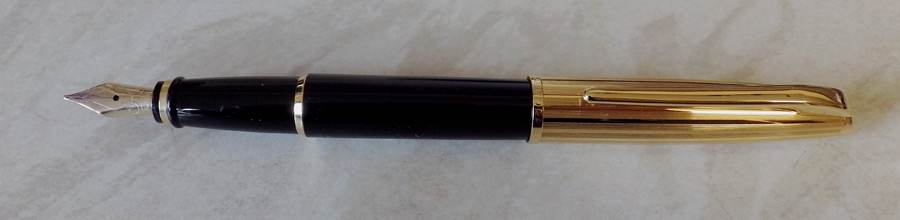
This is one of the rather more inexpensive Auroras.  I didn’t think there was such a thing.  I thought they were all expensive.  I got it for £48.26 with free postage, which I think was a bit of a deal as I generally see EO8 a little more highly priced.
IMGP1397
It’s a very beautiful pen.  The barrel is a deeply lustrous black which sets off the pinstriped gold-plated cap.  There’s also a black insert on top of the cap and the plain clip is nicely sprung and will hold on well.  The cap clicks in place firmly.  The plated Aurora nib is firm and it’s a medium.  My preference is always for a fine nib, but the medium seemed to be all that was available at the time that I bought it.  The Aurora takes the standard Parker cartridge, which is good to know.
IMGP1401
It’s a high quality pen for the money but is it outstanding in any way?  Aesthetically it is but in terms of its writing ability, it’s just another firm nibbed pen with good ink flow.  There is nothing to criticise about it but it’s indistinguishable in use from, say, a 1950s English Parker Duofold.  Apart from the fact that it is a cartridge filler it seems to me to be a backward-looking, very traditional fountain pen.  Not that that’s a bad thing!
IMGP1400
Had it not been for the medium nib, this would have been a keeper for me – beautifully balanced, light and faultless but it’s just too thick a point for me.  However, it is the prettiest pen I’ve seen in quite a while and, as someone remarked to me, it’s the day for Italian things, what with Ferrari winning the Hungarian Grand Prix and all…


IMGP1406

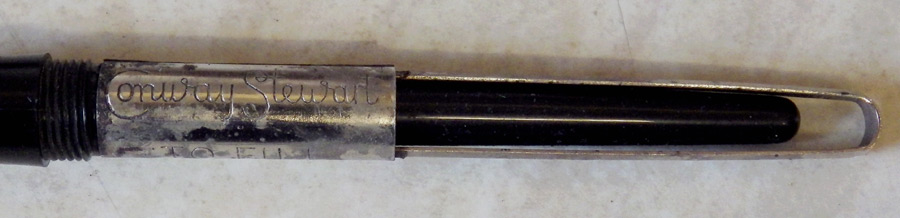
A Late Lamented Conway Stewart 150

An unexpected package arrived in the post today.  On examination, it proved to be a Conway Stewart 150 which the owner wanted me to repair.  If he had emailed me in advance I could have advised him that I’m not a general pen repairer.  I restore pens for my own sales website and I might do the occasional repair for a customer but that’s all.  Furthermore, I could have told him that I didn’t have any spares for this pen.  It’s one of Conway Stewart’s less desirable late offerings and I tend to avoid them as they are troublesome to repair and there isn’t much demand for them.
IMGP1387
You know those television programmes where the experts are called in to put things right after some DIY disaster?  Well, that’s pretty much what this is.
IMGP1389
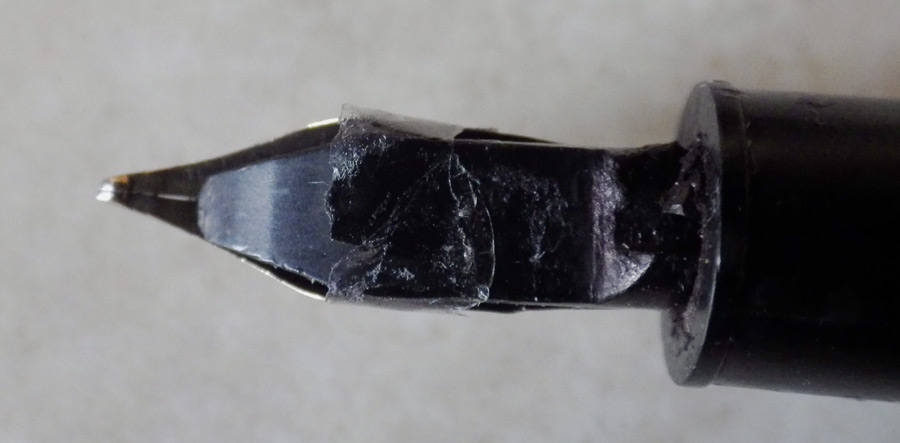
Much chewed with pliers!
IMGP1390
What can I say?  There’s about an entire tube of superglue on there!
IMGP1392
More glue here too!

The only parts of this pen that can be used again are the barrel, cap and nib.  I think there are two lessons to be learned from this experience.  First, contact your proposed repairer before sending a pen and secondly, take that tube of superglue and throw it as far away as you can.

Sadly, I could do nothing with the pen and had to send it back to its owner with some advice.  I suspect that if he must have a Conway Stewart 150 he’d be cheaper buying one in eBay than having the present sad case repaired.

Sheaffer Statesman Snorkel

IMGP1375

When the ballpoint began to gain ever-increasing market share, the fountain pen industry responded by making pens that were cleaner and easier to fill.  Parker made their famous 61 which filled by capillary action and Sheaffer’s response was the Snorkel.  Undoubtedly the most technically complex pen ever made, the Snorkel extended a filling tube beyond the tip of the nib, thereby enabling the pen to be filled with no need for subsequent wiping.
IMGP1377
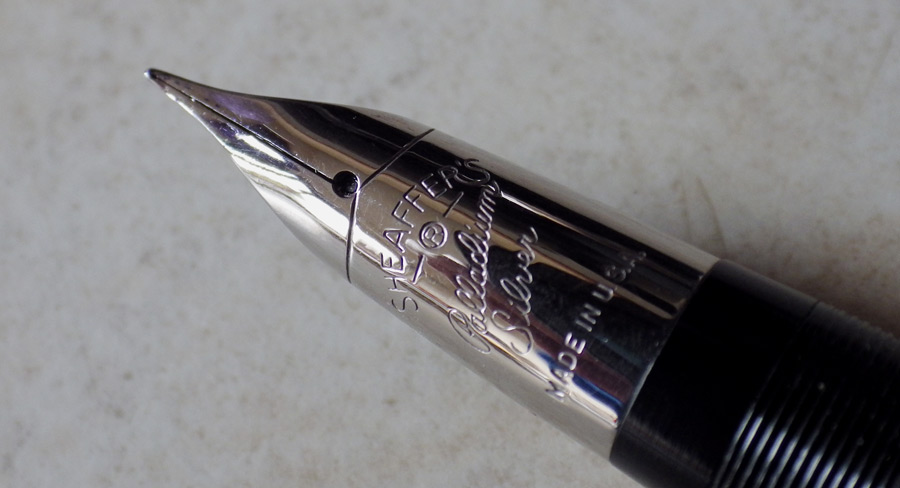
It is said that it was placed to compete against the very popular Parker 51 and outsold it.  Whether or not that is correct, the Snorkel sold in huge numbers judging by how many appear for sale today, some 55 years after it went out of production.  It was similar in appearance to the “Thin Model Touchdown” and was issued in no less than 13 models.  This is the Statesman, identified by its white dot and Palladium Silver wraparound nib.
IMGP1380
It is a fine example of the innovation which Americans have loved in their fountain pens.  Evidently, it filled a need sufficiently well to keep the ball point at bay for several years.  Is it a good fountain pen or is it an example of clever technology for its own sake?  There are a lot of bits and pieces inside that barrel to make the pen draw ink and to make the snorkel extend and withdraw.  The result is that it holds a small quantity of ink when compared with other fountain pens, e.g. the Snorkel holds 0.64 ml against the Balance 350 Lady at 1.42 ml.  This doesn’t matter so much when it is fitted with a fine nib but these pens offered the full range of nibs including broad and stub.  One would imagine that these returned to the ink bottle pretty frequently.
IMGP1381
My one is a fine.  It appears more like a fine/medium to me but perhaps I’m too used to pens from the Orient.  It will be interesting to see how long a fill of ink lasts.  It’s a beautiful pen made with the attention to detail for which Sheaffer was famous.  This version has a broad cap band and no writing on the clip.  The nib, especially, is a work of art with its beautiful cursive writing.
IMGP1385
I think, for me, this is an example of the thinking that imagined that in the future our cars would fly, we would be served by robots and we would ingest a full meal in a pill.  And, of course, we would write with a Snorkel.  I am disappointed about the lack of flying cars and robots but at least we have this amazing pen, clearly invented by a mad scientist!

IMGP1384

Pilot Kakuno

IMGP1367IMGP1368

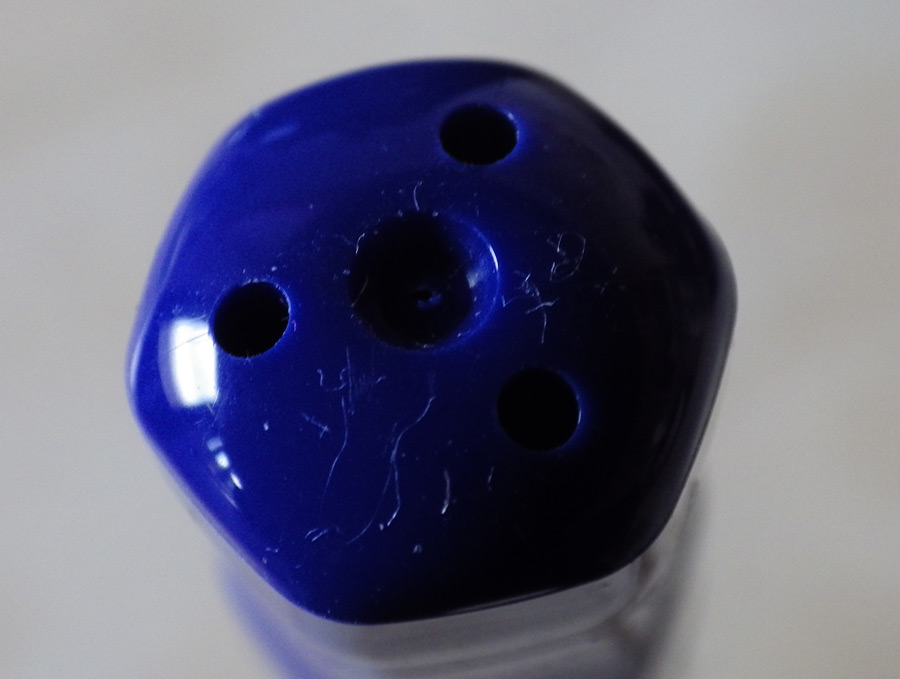
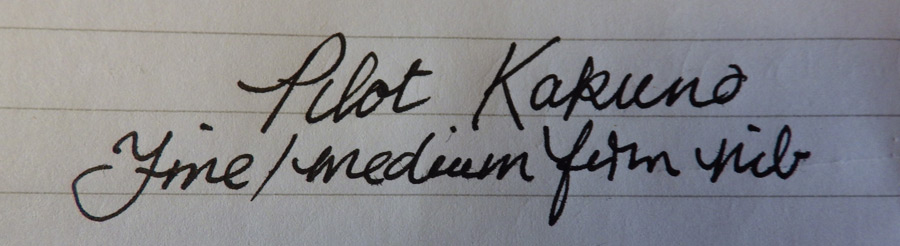
In terms of value for money the Pilot Kakuno has most of the opposition beat.  It costs the princely sum of £5.47 and comes with a Pilot cartridge.  It looks a little strange with a cap that’s a different colour from the barrel and a strangely bulbous profile to the cap.  It has six facets and a little protruding bump on the cap which prevents it rolling off the desk.  There are three holes on the top of the cap and two on the base of the barrel.  I believe those are there to prevent a child choking.  Mind you, a child young enough to wish to inhale pen parts probably won’t make much of a fountain pen.  The cap snaps on with an audible click.  It also posts securely.  It’s very light at 10 g. To me, it seems perfectly balanced.  The section has a three faceted grip similar to the Lamy Safari.  The section is transparent and gives you a view of the cartridge.  The steel nib has a smiley face.
IMGP1371
I chose a medium nib and it turns out to be on the fine end of medium.  It’s wonderfully smooth and the ink flow has been perfect from the first use.  It doesn’t dry out and it has been super-reliable over the three weeks that I have been using it.  Though it is aimed at children it isn’t a small pen at 13.1 cm capped.  It fits my quite small hands very well.
IMGP1372
It’s presented as a pen for the beginner.  I’m not sure what makes it so.  There’s the smiley face and the friendly font used in the word “Kakuno” but otherwise a pen’s a pen.  Because it’s cheap, it won’t matter if it’s lost or broken or laid aside because the child decides against using it.  However, that’s true of all the low-cost pens.  There is the tripoint grip on the section, but other pens have that and they are not sold as children’s pens.  Most likely, this is seen by Pilot as a way of boosting sales.  For myself, I think it’s a great pen and I’m mostly adult.  It will always be on my desk.
IMGP1373
My assistant pretends that she is interested in the Kakuno but she isn’t really, even though she got hair all over it when I was photographing it.  She’s much more interested in fighting with her nemesis, the dark grey cat which dares to come into our garden.  She’s gathering a fine collection of scars on her nose.

IMGP1360

Where Do We Go From Here?

I would hardly believe it but it’s almost 5 years since I started writing this blog.  That’s nice, but it brings a problem with it: I’ve written about most of the more common British pens – and quite a few less common ones.  Obviously, I will continue to try to get hold of all the pens that I haven’t written about yet but that isn’t going to happen very often.  In the meantime, I want to continue blogging about pens.  I don’t have many options about that.  At one time, I would have been happy to switch to American pens but given the outrageous expense of importing pens from America these days I think that’s out.  Yes, I can find a few American pens here in Britain but I’ve written about most of them.  That leaves me with another option: inexpensive modern pens.

Now I know that that will offend (or at least bore) those among you who only read me for old pens.  However, I have written about cheap modern pens recently and have got some good feedback so I think there will be some interest.  Obviously, I would prefer to be writing about old pens and I will do whenever I can to do so but but in between I will attempt to fill in with good examples from the wonderful world of comparatively cheap and absolutely cheap pens of today.

Tell me what you think.

Pen Rests

For years I’ve been looking, on and off, for pen rests that I can use in my pen photography.  I was aware that Chinese chopstick rests were my best bet, but I didn’t see any that appealed to me.  Those very minimalistic metal ones that you see just didn’t do anything for me.
IMGP1357
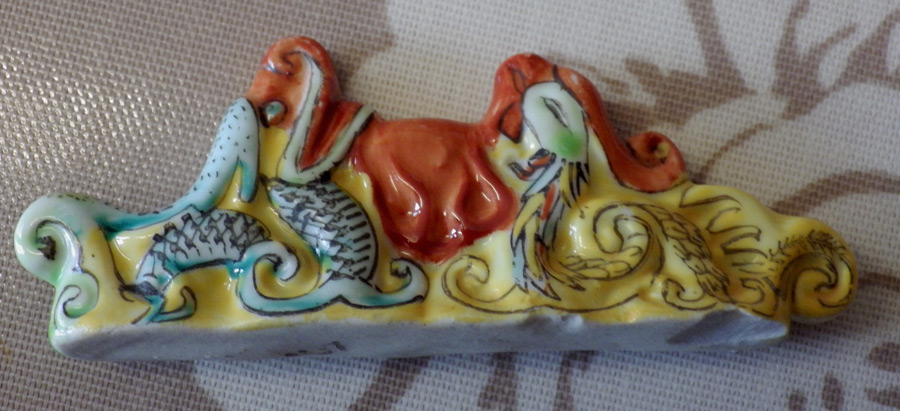
Last week I spotted these on sale in eBay.  I bid for them and was successful.  They are perfect, shapely and colourful, with a little story in them as well.
IMGP1355
There’s a fearsome dragon there and what I take to be a squid.  It might be that the dragon is about to eat the squid but it doesn’t really look like that.  It looks like they are in friendly conversation.  It would be nice to know what they’re talking about but I don’t suppose I ever will.

Taxes and Shellac

I did my taxes today.  I dread it every year but when I finally get to it it doesn’t take long and it’s not so bad.  It gives you a great feeling when it’s done and no longer hanging over you.  This was not my best year.  Both my husband and I were ill or in hospital at different times and that’s a really big distraction from work.  However, I have a lot of stock to work on and post on the sales site.

I noticed that it’s quite hard to find little bottles of shellac these days, and where you do find it it’s quite expensive.  So I thought I would make a batch, buy some bottles and offer it on the sales website.  I found, though, that it was very difficult – if not impossible – to do this on my sales site as it’s set up now.  There are complications about postage and to rejig the site to accommodate the bottles of shellac would cost me a lot of money which I would probably never get back.  Anyway, I have a whole lot of little bottles of shellac and if you want one just drop me an email at goodwriters@btinternet.com.  It’s £3.50 per bottle and postage is included in that price.  N.B. I can only send shellac to UK addresses.

Because last year was the least successful for a while, we were talking over the future of the business today.  We did consider dropping it and doing something else to make a living, but I realised that a life without fountain pen restoration would be completely unthinkable.  Pens are my life.  They fascinate and obsess me and are as much a part of my life as eating or breathing, and you can’t stop doing those things either.  So it looks like I’ll be around for a bit longer.

Platinum 3776 Century

I had heard many good things about the Platinum 3776 Century and, as it isn’t very expensive, I bought one to see if I agreed.
IMGP1221
It’s the standard cigar-shaped pen.  Where it differs from others is in the plastic (you’re supposed to say resin) which is a deep, rich burgundy and it’s translucent.  Very pretty.  Much prettier, in fact, than most transparent pens, usually sold as “demonstrators”.  It’s a matter of taste I suppose but I find them quite ugly.  The innards of this pen are visible if you hold it up to the light but otherwise it’s just a very shiny red pen.  The gold plated trim is nice, especially the cap band which bears the legend “Platinum 3776 made in Japan”.

It has the “Slip and Seal” closure mechanism which closes the pen so well that the nib does not dry out even during extended periods when it is not in use.  I haven’t had the pen long enough yet to be able to determine whether this innovation works or not, but it’s reasonable to assume that it does.  When the cap is screwed on, there is a slight tightening of the action in the last quarter turn which, I assume, is the additional piece of inner cap plastic closing the pen.
IMGP1223
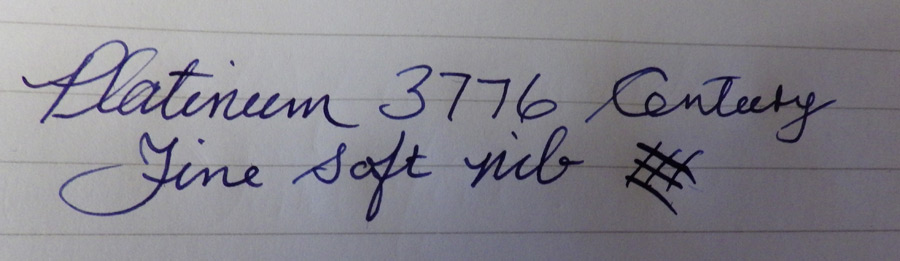
The 14 carat nib is pretty much standard fare, except that it is less curved than most modern nibs.  Quite flat in fact.  I chose the “soft fine” option.  Surprisingly, for an oriental pen, it’s quite a generous fine.  The nib is pleasantly springy and it is possible to force a little line variation, but it isn’t enough to be significant and that isn’t what you would buy this pen for.

The pen is a cartridge/converter filler and the one that I bought (courtesy of Amazon) came without the converter.  The cartridges are, of course, proprietary which possibly explains why a pen of this quality is as inexpensive as it is.  Platinum can make up any losses on the pen in sales of their cartridges, I’m sure.

It’s a light pen at around 20 g, something which meets with my approval.  It isn’t a large pen but I would say that it is more than adequate at 15.5 cm posted.  It posts securely and feels well-balanced.  The nib is smooth and the ink flow is perfect, neither dry nor too wet.
IMGP1226
My only complaint about this pen – and it’s a small one – is the step from the widest part of the barrel to the threads.  It doesn’t interfere with gripping the pen to write so it’s a purely aesthetic consideration.  I would prefer an unbroken smooth curve.
IMGP1222
This, then, is a modern pen of which I thoroughly approve.  I would approve of it even more if it had a proper filling system but you can’t have everything, I suppose, or at least not at the very economical price at which the Platinum 3776 Century is sold.

Waterman Concorde

IMGP1215

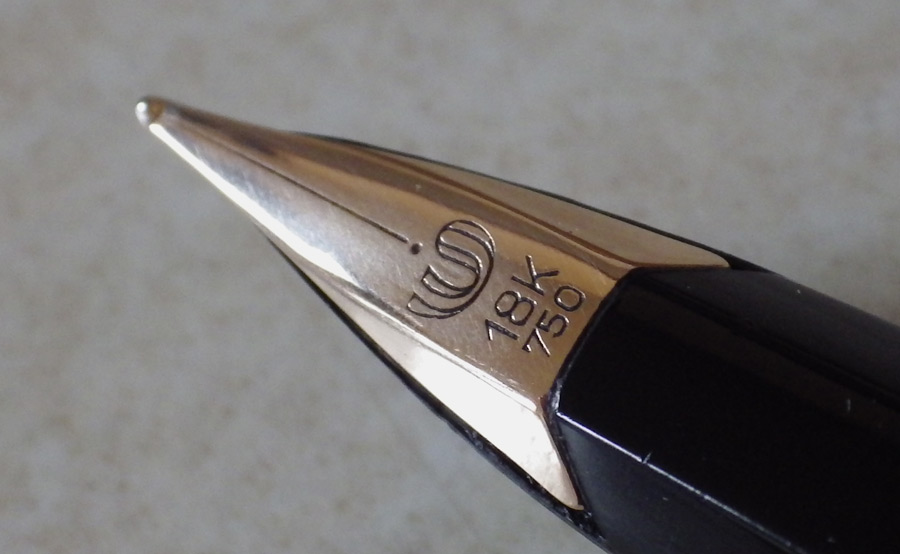
The Waterman Concorde was in production from, so far as I can establish, 1971 to 1978.  It’s a faceted pen with six sides to the barrel and a more complicated arrangement of two curves joined by two facets on the cap.  The angled cap top with the inset clip is very much of its time, and is a feature that is seen in some other pens.  The snap-on cap is removed to reveal a very handsome wraparound 18 carat nib.  It is filled with a squeeze converter.
IMGP1219
It’s an elegant pen with its complex geometry, good quality gold plating and beautifully designed angular nib.  The details are nice: a goldplated ring at the barrel end and thin and medium rings on the cap.
IMGP1217
I’ve seen it variously spelled as Concorde and Concord.  As it appears in Waterman advertising with the “e” and as it was made in France and that’s how they would spell it, I’m assuming that’s the correct spelling.  It isn’t a pen that you hear much about but it is obviously a quality product and very pleasant to write with too.  Perhaps it falls into that dead zone between vintage and modern.  It looks very modern to me.  Unlike most modern pens, however, it’s very light in the hand.  They didn’t use brass piping to make pens back then.