Another Pre-War Swan Leverless

The variety of Swan Leverless pens seems unlimited.  There’s always another one never seen before, or so it seems.

IMGP0005

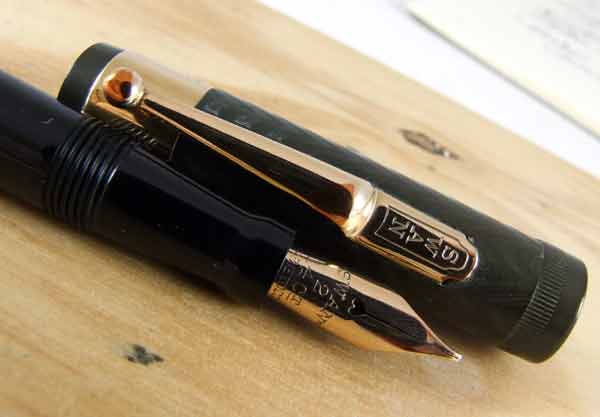
This one has no number on the barrel but we could work one out for it.  It’s Leverless and has a No 3 nib, so that’s L3  It has two barrel bands and a band on the crown of the cap, so that’s another 3.  There’s no band at the lip of the cap, so that’s 0 but it might be 4, because these are not the usual bands but the “stacked coin” type.  The pen is black so that’s 60, so we have an L330/60, or possibly an L334/60.  I favour the former.

IMGP0006
The shape of this pen suggests that it’s not quite the very first of the Leverless pens; new designs came along in 1935 and I think this is one of them.  It’s comparatively thick and it’s a centimeter or two shorter than most Leverlesses of the period.
IMGP0008
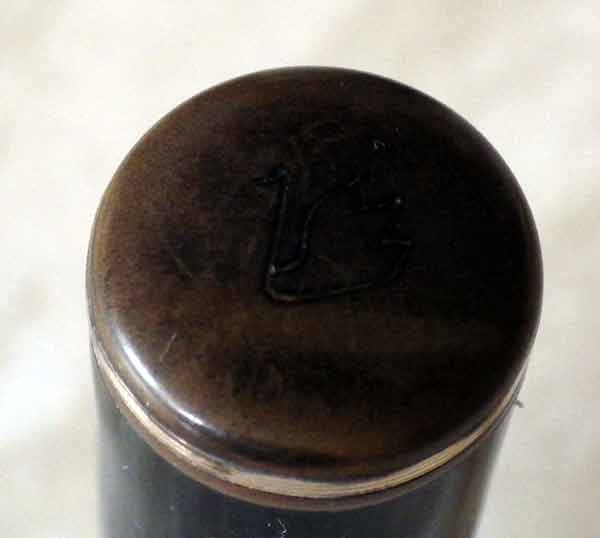
The clip stud once had more red in the mix; it has faded considerably.
IMGP0007

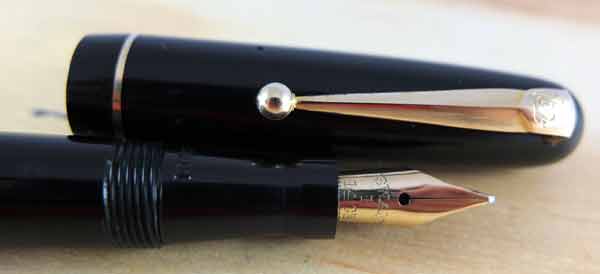
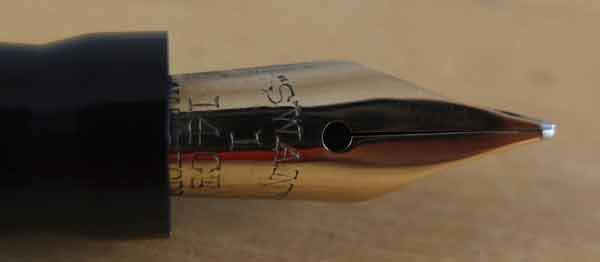
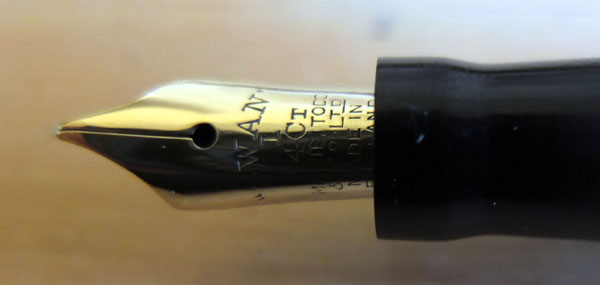
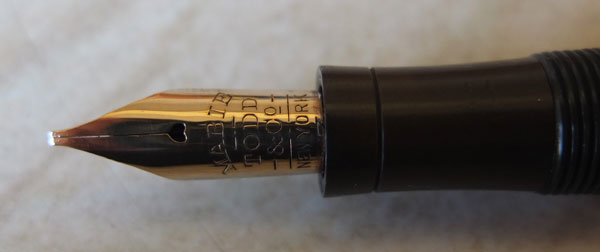
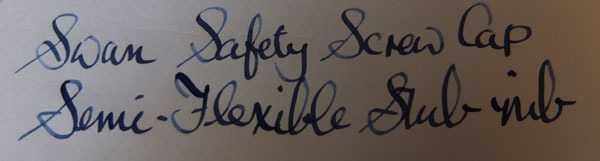
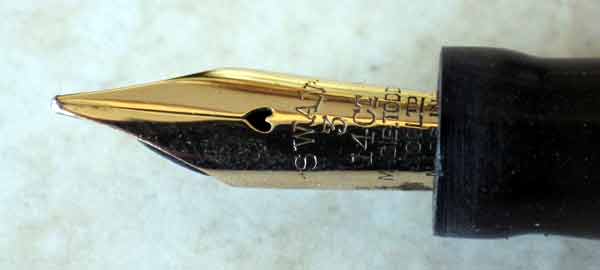
Many of these thirties Leverlesses have Eternal nibs.  They’re good nibs but I prefer a little flexibility and that’s what this pen has.  I have yet to write-test it properly but it appears to be a semi-flex.

For many years, Leverless pens suffered at the hands of the ignorant.  They didn’t work because they were re-sacced as if they were lever fill pens, and probably for this reason there were a few people who took every possible opportunity to disparage the Leverless.

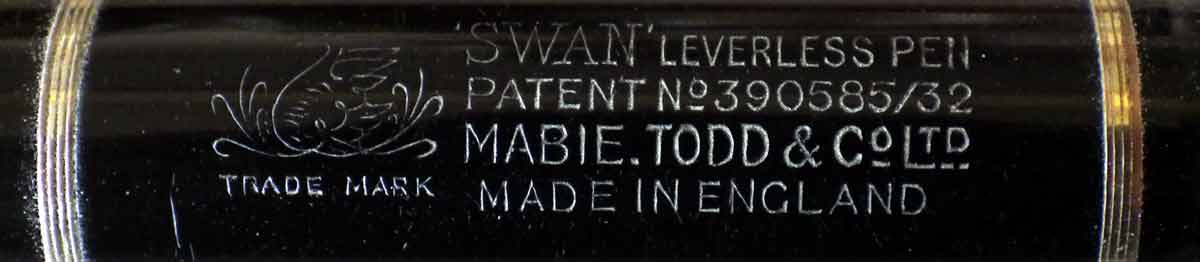
Thanks to the Marshall and Oldfield book, repairers now know how to fit a sac in a Leverless so that it will work as it should, and the popularity and value of the pens has risen tremendously in the last couple of years.

IMGP0009

Mabie Todd Swan 100/60

DSCF6807

Life can be such a nuisance at times, you know?  You just can’t get a thing done for life getting in the way, tripping you up and blocking you at every turn.  Hence the lack of posts recently.  I hope life is going to back off and behave itself and let me get on with some work.

DSCF6823

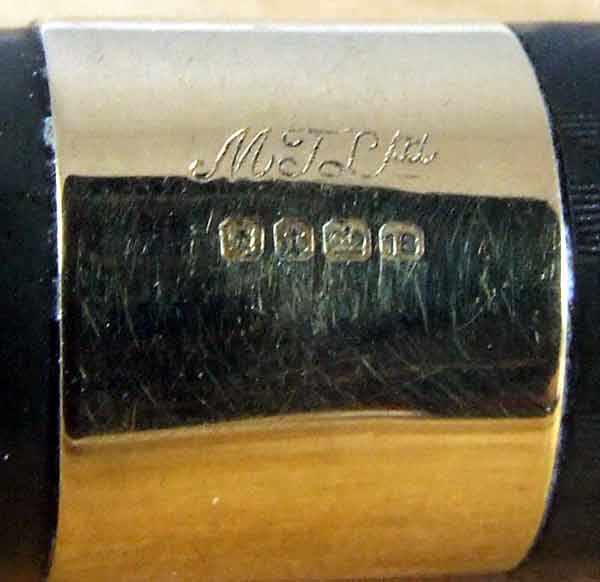
This is a Swan 100/60.  No SM or SF, just 100/60.   It’s a plain pen, essentially just two BCHR tubes with a little bit of taper at the end of the barrel.  It reminds one of its immediate predecessor, the SF1 and points further back to the eyedropper fillers of a few years previously.  However it has the handsome fixed clip that became a Swan icon, and it is embellished with a broad cap band.  The hallmark tells us the band was made in London in 1924 – 1925 and it is 18 carat.  That fits with the date I would put the pen at, so it’s not a later addition.

DSCF6811

The nib is, though, because this pen should have a No 1 nib, rather than this No 2.  I’m going to leave it there, though, because it fits well and has clearly been there for a long time.  It’s a lively and characterful semi-flex.

The Thin Blackbird Fount Pen


DSCF2764This is the Thin Blackbird Fountpen and it certainly is thin when compared with the BB2/60, but it’s not as thin as the original Fountpen, an eyedropper filler of 1911.

DSCF2773

The first lever filler Blackbird was introduced in 1922.  I suspect that was the Blackbird Self-Filling Pen with no assigned model number and a spoon feed.  Sometime soon after that (I assume) it was replaced with the BB2/60 which had a ladder feed.  As the  Thin Fountpen resembles the BB2/60 so closely and also has a ladder feed, it would be my guess that its dates are roughly the same.

DSCF2767

Why did Mabie Todd produce the Thin Fountpen?  It’s unlikely we’ll ever get an explanation, so we’re free to speculate.  Fountain pens started thin because they copied the style of dip pens.  Around 1920 they started getting noticeably thicker, as their dip pen ancestry drifted into the past and people wanted a pen that held plenty of ink in a sac inside the barrel, necessitating a thicker pen.  That might not have suited everybody, and there may have been customers who asked for a traditional, thin pen.  Perhaps the Blackbird Thin Fountpen was the result.  They’re not common, perhaps because the demand for them turned out to be less than expected and they were dropped after a short production run.

Mabie Todd Swan 3160

The post-war 31– range of Swans is often deprecated because of the small size of the nib.  Quite strange really, because the Swan No 1 is no smaller than many nibs that meet with approval, such as the bulk of the medium to lower-cost Conway Stewarts but I have seen people say that they avoid them because of their quality.  In truth, the build quality of the pen is same as that of its bigger siblings and the fact that so many of them have survived in very good condition supports that.
DSCF2667
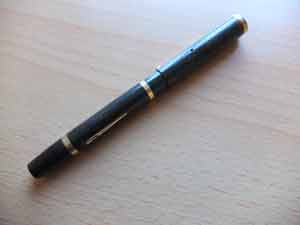
Judging by the very good condition of the gold plating, this 3160 hasn’t seen much use.  The plastic, too, has much less in the way of marks of everyday use than you would expect to see in a pen of this age.

DSCF2670

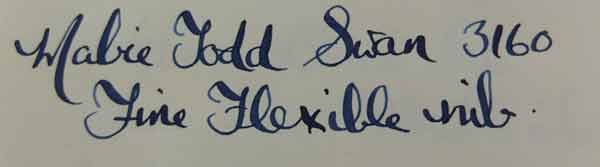
Like so many in the 31– range, this pen has an absolutely outstanding nib.  Its appearance gives no clue that this is one of the best flexible nibs to come my way in a long time.  It expands easily from fine to triple broad and the snap-back to its usual shape is instant.  The ladder feed supplies enough ink to meet the demands the nib makes.  I had some fun testing this pen after re-saccing.  Here’s a writing sample to give an idea of its capabilities:

DSCF2677

Repairing A Lever Fill Pen

DSCF2704

I keep being asked questions about fitting a new sac in a lever fill pen, so here goes: this is a Swan SF230 in need of repair.

DSCF2705

For a start, the section has to come out.  This is a black hard rubber pen so don’t soak it.  Personally, I never soak any pen to take the section out.  Dry heat is the way to go, and I’d say always use heat.    It expands things and softens them a little, and makes a cracked barrel much less likely.  These Swans are friction fit.  I just pull the section out with my fingers.  Latex or nitrile gloves help by giving you a better grip.  Some people use section pliers.


DSCF2707

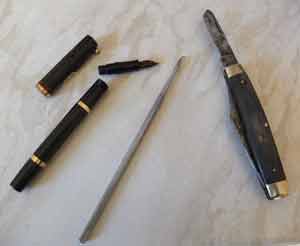
The section’s out and you’ll need some tools to remove the remains of the old sac.  I use a dental pick to get into the barrel and a pocket knife to chip the old sac off the peg.  Mostly, sacs are desiccated and crumble at a touch but sometimes they can assume the consistency of part-dried glue or very stiff chewing gum.  Clearing the barrel takes longer with a sac like that.
DSCF2714

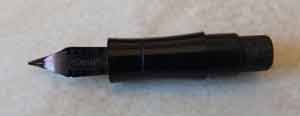
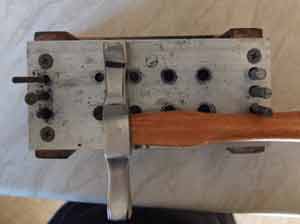
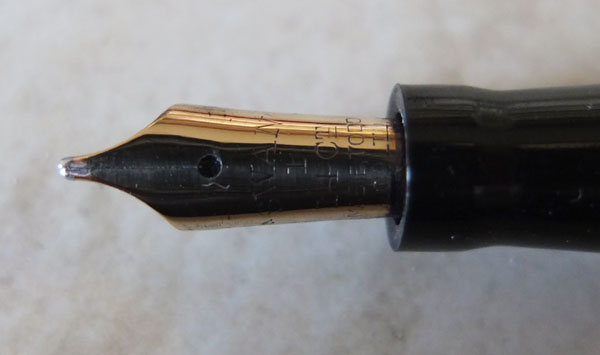
Once you have the barrel and peg cleaned up, the next move depends on the state of the nib and section.  If the nib is badly offset or damaged, you will have to drift it out.  That’s where the knock-out block comes in.  Most of those you get to buy are fiddly little things that tend to be unstable.  It’s best to make one yourself if you can.

DSCF2717

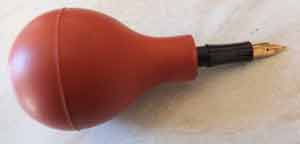
In this case there’s no need to remove the nib, and it’s best not to take it out unless you have to, as re-setting a nib isn’t a trivial task.  It needs a good flush to remove old ink, and that’s where this bulb is so useful.

DSCF2716

When that’s done and you’ve dried the exterior of the section, you’ll need an appropriate size of sac – 18 in this case – and some shellac.   A sac spreader is optional.  I like this pair of old dividers with the points cut off and ground smooth.

DSCF2719

Measure the sac and cut it to the correct length.

DSCF2720

Get a good coating of shellac on the peg and fit the sac.  Then apply some pure talc.  I see a lot of “repaired” pens where this step has been missed out.  Don’t.  It’s significant.  Without a covering of talc the latex sac will stick to the pressure bar and it will shorten the sac’s life considerably.

DSCF2725

Let it dry.  Half an hour will do it.  Then reassemble and give the pen a good clean up.

DSCF2728

You’re done!

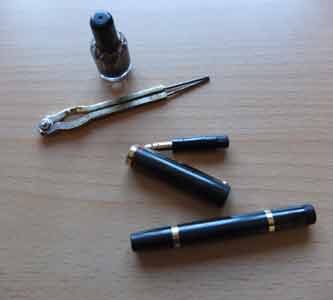
Mabie Todd & Bard Overlay Eyedropper Filler

DSCF2388

Unusually, I was aware of this pen before I had the opportunity to buy it.  The previous owner wrote about it in Fountain Pen Network and I would reference that post if I could.  However, FPN’s search facility, which is never very good, is grindingly slow today and I had to give up.

DSCF2391

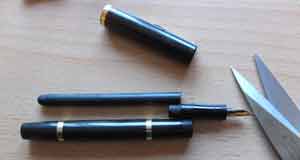
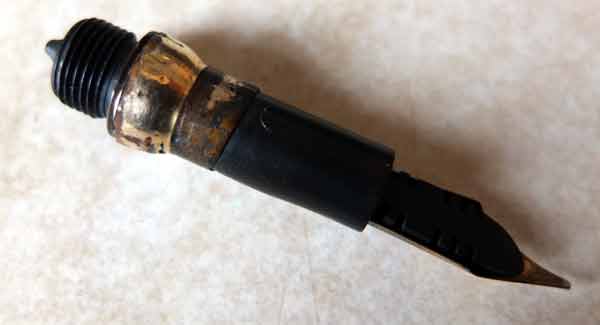
The pen is in worn condition and it’s almost an exercise in unoriginality but that’s neither here nor there with a pen of this quality.  The seller said the cap was not original.  Nor is the No3 nib or the ladder feed, both of which are replacements.  I may well have a nib that suits the pen better but I will leave the ladder feed.  It may be an anachronism but it’s also an improvement.

DSCF2399

I had a look through my reference files to see if I could discover which pen it actually is.

DSCF2400DSCF2401
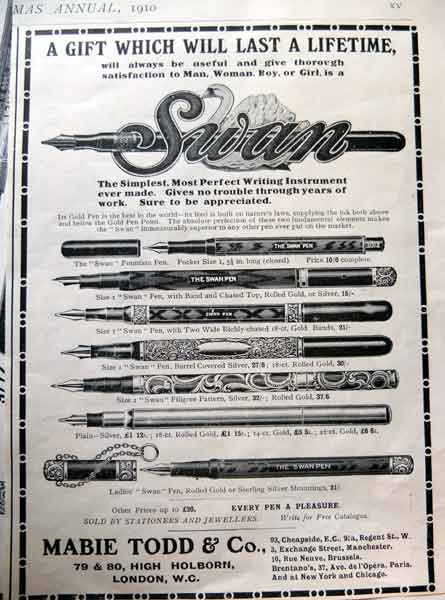
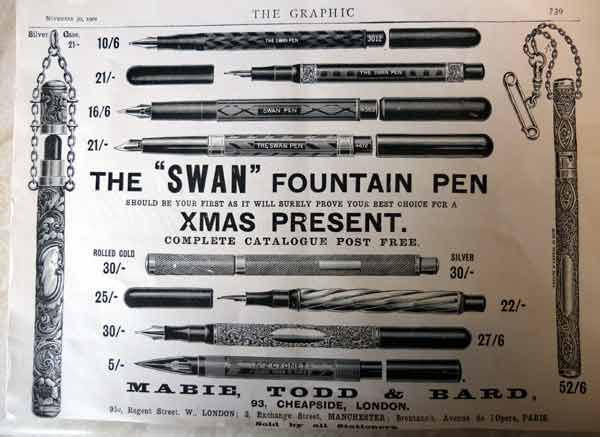
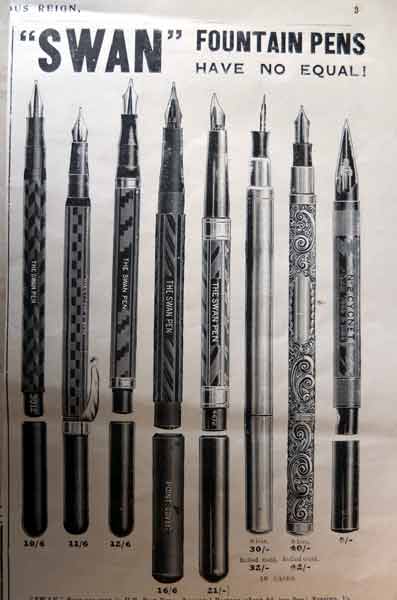
There were pens with overlay barrels and plain BHR caps as these advertisements show, but these are not this pen.

DSCF2402

I think the pen second from the right in this 1911 advert is the closest to this pen, if you look at the metal partially covering the section.  That’s the type though the date of the pen is impossible for me to determine exactly.

DSCF2393

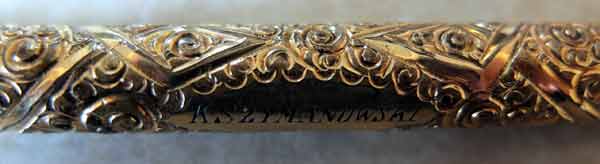
Could this pen have belonged to the Polish composer Karol Szymanowski?  I can find no good biography of  Szymanowski.  It is said that he travelled widely, but I can’t tell if he ever set foot on these shores.  Of course, there are a variety of other ways his pen might have arrived here, some more likely than others.  Perhaps Szymanowski is as common a name in Poland as Smith is here.  I don’t know.  The dates give no difficulty.  Szymanowski  lived from 1882 – 1937, so it would not be stretching things too far to say that he bought this pen in the early years of the twentieth century, then discarded it in later years when better designs came along.  It’s not unlikely, either, that a successful composer and musical director with a good sense of amour propre would buy a very expensive pen and have his name engraved on it.

Could this have been the pen he used to write the operas Król Roger and Hagith?  We’ll never know, but it can’t easily be disproved either.

Mabie Todd Swan SM100/63

DSCF1582

Swan had the best colours.  They don’t come any more beautiful than this.

DSCF1585

I expect that when this pen came on sale back in the thirties, it cost the same as the plain black one.  Things are a little different now.  These pens, like the colourful Visofils and Jackdaws are hard to come by now, and expensive when they do appear.  I count myself fortunate that this is the third russet/jade marble pen I’ve had in all the years I’ve been buying pens.

DSCF1589

This pen isn’t just a pretty face, either.  It has a high-shouldered oblique nib with a little flex to it, which makes for a nice writer.

I think it needs to be said at this point that I can’t make this pen available for private sale.  It will have to go up on the sales site.  I got into all sorts of hot water over privately selling a pen that everyone wanted recently. The burnt child minds the fire, as they say here in Scotland.

Want another look at those colours?  Go on, then!

DSCF1593


A Gold-Filled Swan Safety Screw Cap Ring-Top

Someone sent me photos of a beautiful old Swan for valuation this morning.  It was a half overlay eyedropper filler from around 1908, long and slender with an over-and-under feed.  A wonderful thing, but a pen of an earlier era, a time of gas lamps and foolscap paper, of top hats and horse traffic.

DSCF1573

Later, as I was restoring pens I came on this gold-filled Swan Safety Screw Cap.  It was made within a very few years of that earlier pen.  The Screw Caps went into production in 1911 and went on until around 1920, so only a short time separates the pens but in that brief period, the fountain pen has been transformed!  Gone is the over-and-under feed, the most evidently archaic feature of the earlier pen, to be replaced with Swans’s excellent and enduring ladder feed.  The proportions of the pen have changed.  Despite being a ring-top, this pen is entirely modern on shape.

DSCF1575

There’s some wear, particularly on the end of the barrel where the cap has been posted.  This pen evidently was not reserved as a thing of beauty (though it is!) but was well used over a lengthy period.

DSCF1576

And rightly so, too!  The stub nib is a complete delight to use, and the pen is large enough, and contains enough ink to be completely practical.  It’s both a wonderful writing instrument and a stepping-stone in the development of the modern fountain pen.
DSCF1580


Swan Snakeskin SM100/85

I wonder if somewhere someone has a full list of Swan colour codes.  Such a thing would be very good indeed!  I work off the the number interpreting list that was developed in FPN some time ago.  It’s very good but it consists essentially of the pens people had at the time, so it’s incomplete.  It’s also my assumption that these colour names are not those that Swan assigned.

DSCF0943

This one is a Swan SM100/85.  It’s the “85” part that I don’t have a good explanation for.  The seller of the pen described it as “ruby snakeskin” but that’s far from right.  So far as I’m aware there is no ruby snakeskin.  Garnet is the nearest to that colour and that’s very much brighter than this pen.

DSCF0942

These photos were taken in natural light and what I’m seeing on my monitor is close to identical to the colour of the actual pen.  Very close.  In fact, I can see no difference.  Monitors vary, of course, so you may be looking at something slightly different.  The colours I see vary from dark brown to light brown to dusky pink.  So what do you call that?  Brown snakeskin?  85 is “mauve snakeskin” in the list.  Well, maybe, I suppose, in certain lights.  But not really.  For it to be mauve it would need a lot more purple than it has.  There’s no evidence of fading, either.  Faded pens always have the original colour on that part of the barrel shielded by the cap.  There’s no brighter part under the cap here.

DSCF0941

These snakeskin and lizardskin pens have a tendency to plastic shrinkage, making them a challenge to disassemble.  Luckily, this one was an exception.  The section popped out with just a little heat.  It was a matter of moments to install a new sac and reset the nib which gone a little awry.  The chrome plating on the clip had seen better days – probably around seventy years ago – and I brightened that up, so far as possible.

DSCF0944

The nib, as is so often the way with these pens, is an oblique stub with a little flex.  They don’t come any sweeter.