Mabie Todd Pen List Live!

John Brindle’s list is available now here.  I’ve also added the URL to my blogroll, down on the right-hand side of this blog.  Many thanks to Martin Holloway who made a splendid job of creating the site.

As well as being a useful source as it stands, John’s list provides an excellent start-point for further research.

The Mabie Todd Pens List

Just a few quick lines today as my assistant and are up to our respective ears (hers are relatively higher than mine) in work.

The Mabie Todd  numbers site proceeds apace.  Many thanks to Martin Holloway who has acquired the domain and has begun work on the site.  He has been reading your comments with interest.  I think the way that it will work is that Martin will have the final say on what it is practical to do, under John Brindle’s ownership of the material which he is very generously making available.

Martin has suggested a downloadable .pdf file of the material, which seems like the way to go.  Illustrations of the pens seems the next logical step and Martin is looking into how that could be best implemented.

It will take some time and quite a lot of work but I’m looking forward with great anticipation to seeing this coming to fruition.

New Mabie Todd Research

A gentleman by name of John Brindle phoned the other night to speak to me.  I was unavailable at the time and my husband, another pen enthusiast, took the call.  John spent last winter researching Mabie Todd fountain pens, and he has drawn up a list correlating model number, colour, cap bands and filling system.  He has recorded – literally – hundreds of pens.

I have the list before me now and it’s an astonishing piece of work, clearly very valuable to Swan and Blackbird enthusiasts.  John seems amenable to the idea of having it published but I want to ascertain that more formally.  Then I would either need a copy of the original digitised document or I would have to key it in.  It shouldn’t be difficult to find somewhere to host it for a time to make it widely available.

A No-Number Nineteen-Twenties Swan

I often come across Swan pens with no model number.  Was the model number intentionally left off or was it an oversight?  If the latter, there seems to have been a lot of oversights and it was an omission that could easily have been returned by inspectors for rectification.  It’s just another Mabie Todd puzzle, like so many more.  Sometimes it’s absolutely clear what they are – if it’s streamlined, dark blue and has a No 1 nib, it’s a 3120 – but other times it’s harder or impossible to discern what model a pen is.
IMGP1196
Take this nineteen-twenties beauty that came my way the other day.  It’s barrel-stamped as a Self Filler but there’s no number on the barrel end.  Never has been, either, as it’s not at all worn.  It’s a very long pen at 14cm capped and an outstanding 17.5cm posted!  It’s slightly more slender than, say, an SF230 but it isn’t very slender.  It’s reminiscent of the Swan Minor range, though I seem to remember an SM2 as being shorter and having a machined pattern, whereas this has none.  Whatever it is, it’s a gorgeous pen and it feels good in the hand despite its length.

IMGP1202

The handsome No 2 nib is semi-flexible and a pleasure to write with.  In a recent email conversation, my correspondent and I concluded that semi-flexible is the way to go.  You want some line variation but a full and easily induced flex is just too much for everyday writing.

IMGP1206

In conclusion, though this pen has points of resemblance to several other pens of its time, I haven’t seen another quite like it  It’s quite special.

IMGP1198

Mabie Todd Swan 3230

It was in the early nineteen-fifties that the uniform grey pens were popular.  Almost every pen manufacturer made a grey pen.  It was a sign of the (very slightly) changing times.  It was a reserved, dignified colour but it wasn’t black.  For a few short years, in fact, grey was the new black.  Then many of these lovely grey pens began to show an unpleasant yellow discolouration.  Though it didn’t affect every pen, it was indiscriminate – Swans, Parkers, Wyverns – all were likely to suffer this malaise.  By the late fifties the grey pen had gone, never to return except for Conway Stewart which turned out a few in the seventies with the same sad results.  If it was decaying sacs that caused the discolouring, one would have thought it would have affected every pen but it didn’t.  Was it a widely – but not universally – used ink?  I don’t know, but it varied from slight patches of barely discernible yellowing to whole pens that took on a pale, ghastly corpse-like hue.  Not nice.
IMGP1189
This Swan 3230 is one of the few that didn’t succumb to the yellow plague.  Good thing too, because it’s a superb pen.  The gold plating has lasted well throughout and the plastic has readily taken a shine. 

IMGP1193

It’s my impression  – I may be wrong – that the grey plastic is harder than the other colours Swan used at this time, and doesn’t take scratches so easily.

IMGP1194

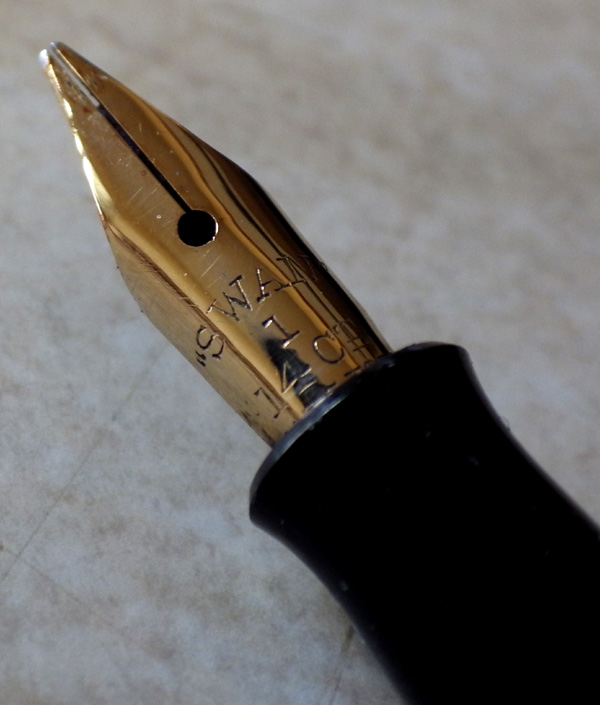
It has had the nib replaced, with a No 3 rather than the No 2 it originally had.  I’m happy to leave it where it is though.  It fits and writes well and it’s a rather nice broad, rarest of all the nib types back in the day.

The unpopularity of the grey pen remains today.  A grey Parker Victory, for instance, will always go for a few pounds less than an otherwise identical black one, and this bias persists across manufacturers.  If you want a bargain on a first rate Swan, wait until a grey one appears in ebay  But watch out for the dreaded yellow lurgy!

IMGP1191

Mabie Todd Swan SF8

The postie arrived with her usual burden of pens this morning.
IMGP1182
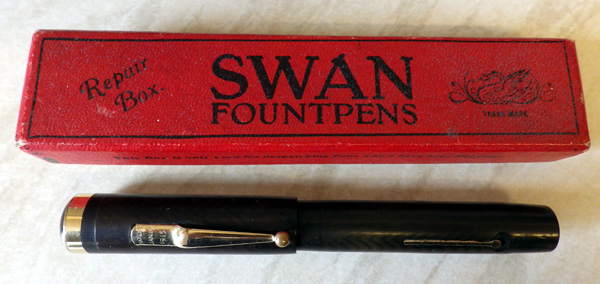
This one looks interesting – you don’t often see a Swan repair box.
IMGP1183
Pretty big, isn’t ?
IMGP1185
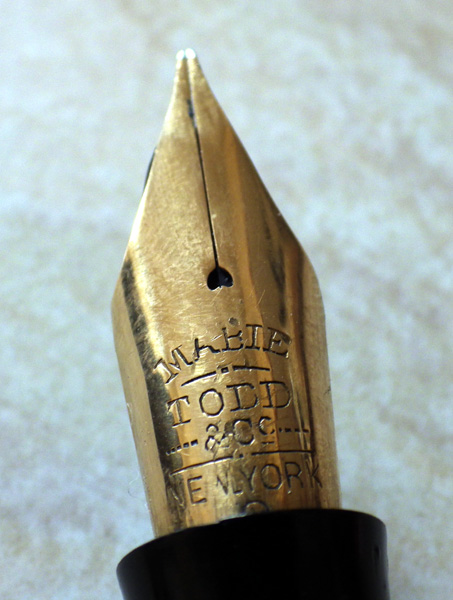
That’s a Swan No 8 nib, only the second I’ve ever seen.  It will be a real pleasure to bring this one back to working condition.

Nor’s Swan 1500

IMGP0853

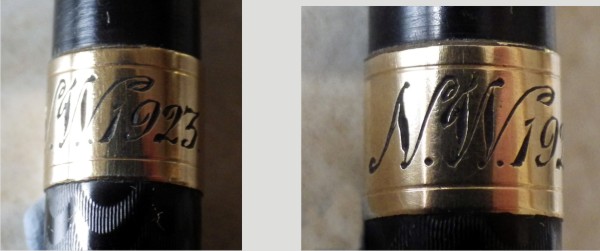
Yesterday I received a Swan 1500 in remarkably good condition.  Moreover, it was one of those pens with a story attached.  One of the two barrel bands is beautifully engraved: “N.W. 1923”.  In the box, on a Swan Christmas Pen slip of paper is, “To dear “little” Nor with love and all good wishes for Xmas and the New Year.  Xmas 1923.  From Ness.”
1500bands
By time Nor is being called “little” with inverted commas, we can safely assume that he (Norman?) or she (Norma?) is no longer little, but grown up, or almost so.  So this is a very adult present from a favourite aunt or family friend to someone about to make his or her way in the world.  That being the case, it’s unlikely they’re still around ninety years later this very year to tell us all about it.  The name and address on the bottom of the box is N Wilson.  As I have trouble reading the rest of the address, it would be impossible to hunt down this N. Wilson among all the others of the same name.
IMGP0855
It surpised me that the 1500 was still available as a new pen in 1923.  After all, lever filling Swans appeared in 1920.  People can be conservative, though, and stick with the tried and tested.  Evidently Ness was that sort of person.  But did little Nor prefer this old technology or would a self-filler have been preferred?  The latter, I fear, for though the pen had been inked (it took a few minutes in the ultrasonic cleaner to remove the ink from the nib) the pen is otherwise pristine with sharp machining and imprints.  As soon as little Nor got his hands on a lever filler, Ness’s birthday gift went in the drawer.
IMGP0862
The result is, of course, fortunate for us because we have a ninety year old pen in near-new condition.  So often when we come upon pristine old pens we are left to wonder why it should be.  This time we have a possible explanation.

One other thing, in passing, that struck me as different from other 1500s I’ve had.  Mabie Todd’s nibs were still being made in America at this time, though that was about to change.  Usually, such nibs are marked “New York”.  This one is imprinted “Made In USA”.

Mabie Todd Swan SF 2 (Yet Again)

IMGP0474

I’ve written about the Swan SF 2 several times before and I make no apology for doing so again.  They’re among my favourites, big, chunky pens which usually have nibs of character.
IMGP0477
My reason for highlighting this one is its remarkable condition.  Ninety years or so on from its date of production and it looks brand new!  A chased pattern as fresh as this gives a lovely textured feel in the hand.  As I’ve said elsewhere, Swan reached a zenith of design and manufacture in the nineteen-twenties.  This pen equals or surpasses just about every other pen made since, except maybe in colour.
IMGP0487
The two barrel bands add a touch of prestige to the pen, and closer examination reveals that they are solid gold and hall-marked, so quite a pricey pen in its time.  Was it reserved as a “special” pen and subsequently never used?  We’ll never know, but we can be thankful that we have the opportunity to see an SF2 in the condition it was produced all those years ago.

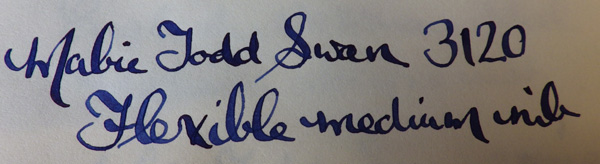
A Flexible Swan 3120


As those of you who have been reading this blog for a while will know, I broadened my horizons a while back.  I’d been a dedicated user of flexible nibs for years, but I tried using firm nibs and stuck with them until I began to understand the undoubted charm that many of them have too.

I usually have a flex pen or two, though.  My everyday user these days is a sadly beat-up Conklin Endura Symetrik.  It’s nothing to look at but it writes well with enough flexibility to allow the odd flourish.  Luckily I also had a full flex pen today when a Spanish customer who is a calligrapher came looking for one.
IMGP0436
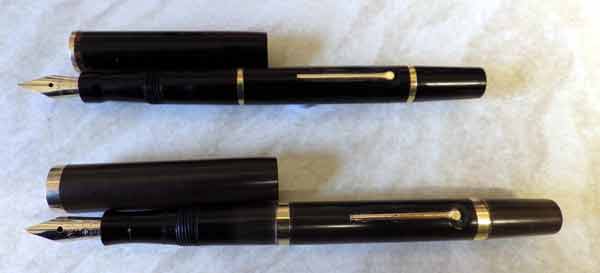
It’s a Swan 3120, the dark blue version of the No 1-nibbed Swan.  This one has the brass threads, so it’s the first run of the post-war redesigned Swans, made in 1948 or 1949.

IMGP0439

The nibs on these pens give little hint of their capability, the only clue with the present pen is that the tines are widely-gapped to enhance ink flow to keep up with the demands of the flexed nib.
IMGP0440
It has no difficulty keeping up though the nib certainly makes some large demands.  Unflexed, it’s a narrow medium, flexed it’s… well, judge for yourselves.  It snaps back to its unflexed state instantly, too.  Those little No 1 nibs never fail to impress.

It’s on its way to Spain now, to the hands of someone who can make infinitely better use of it than I can.

A Brace Of Swan SF1s


IMGP0391

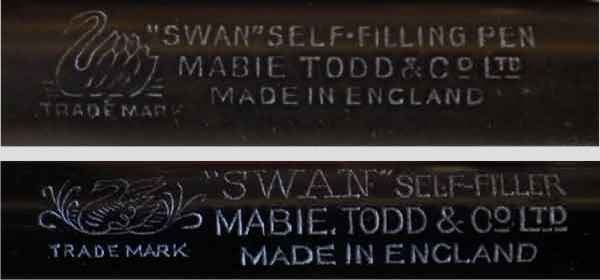
During the last couple of weeks I picked up two near-identical Swan SF1s.  Both are of the more prestigious three-band variety (the bands a little broader on one than on the other) , both, oddly enough, are personalised, one to “EH” and the other to “NM Pinfold”.  There aren’t many Pinfolds around; I hoped to be able to identify him but Google was not my friend today.  The Pinfold pen has been used quite a bit.  It’s a little faded and there is wear on the bands.  The EH pen is pristine.  Both have mottled hard rubber insets bearing the Swan image in the top of the cap.

There’s this minor difference:
SwanImprints
Lambrou reckons that you can date pens by the Swan image.  For myself, with the exception of the WWII central Swan, I can’t see it.  As is the case here, I’ve seen the same model of pen with different Swan imprints.  I suspect that a number of different Swan stamps were in use most of the time.

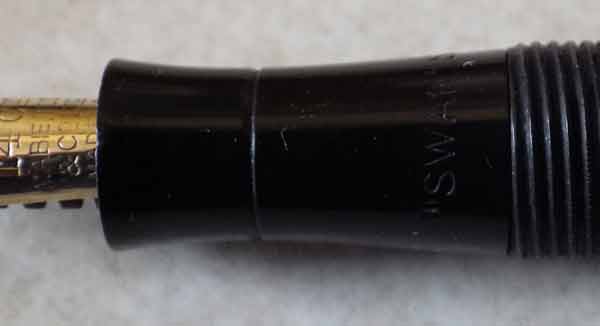
However, if you haven’t spotted it already, there’s another major point of difference.
IMGP0409

The Pinfold pen has the above section, undoubtedly correct for the model.  This shape of section began with the Swan Safety Cap Eyedropper Filler and was developed a little for the nineteen-twenties SF range.  So far as I am aware the SFs consistently use this section with the exception of the overlay pens, which have a section designed to accommodate the metal overlay.
IMGP0405

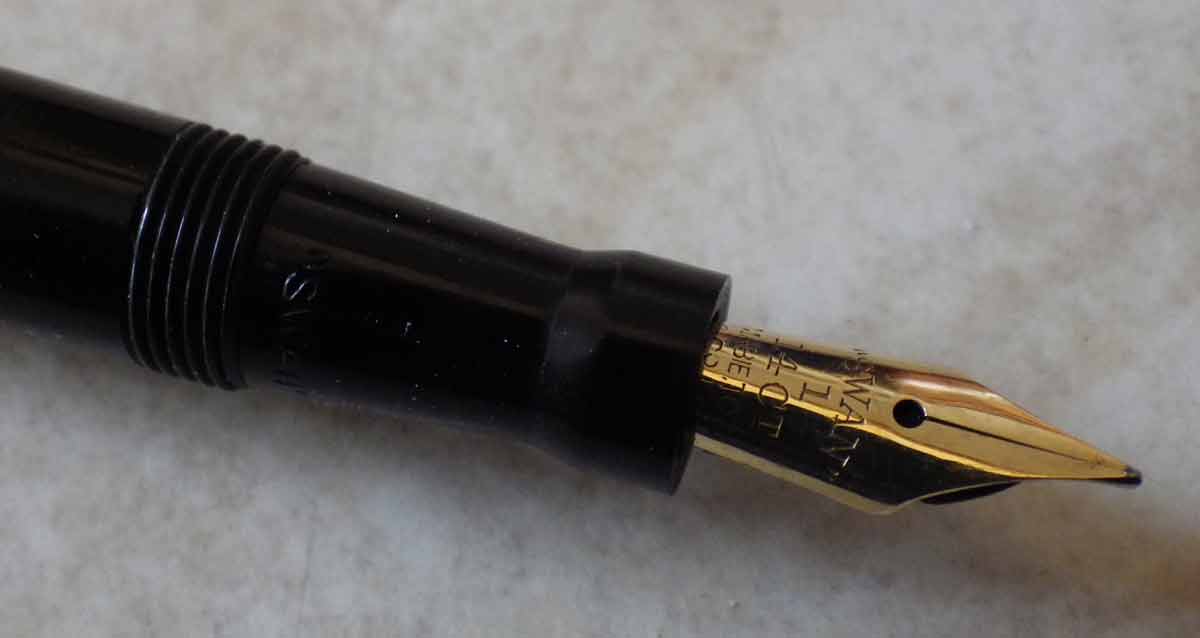
The EH pen has this section.  Never seen one of these on an SF before, though I’ve seen plenty on thirties pens like the SM range.  I would almost immediately dismiss it as a replacement were the EH pen not so perfect in every other respect.  It looks like it has never been used.  It would be easy enough to replace the section with an appropriate one as I have several spares, but would it be correct?

What do you think?