You’ll have to excuse the photographs today. Conditions were poor.
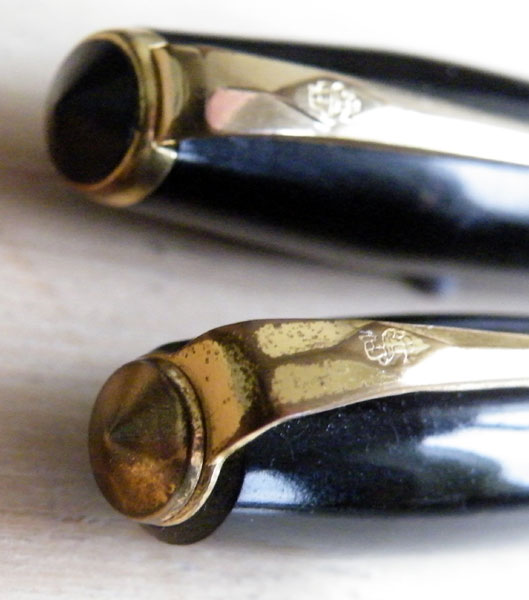
I like all Conway Stewarts – well, except those defective objects that were produced in the last, sad years of the company – but I like those from the twenties and early thirties best, especially those with the flange lever and the fixed clip.

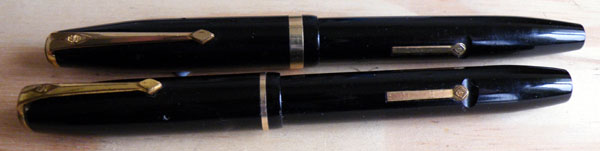
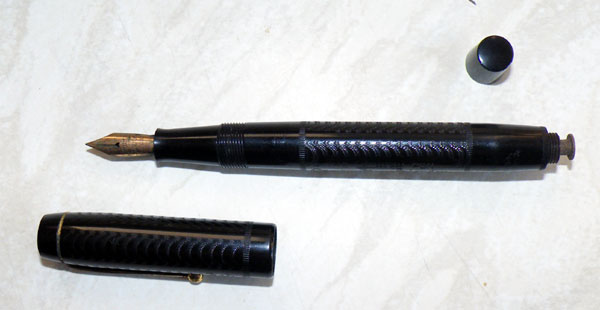
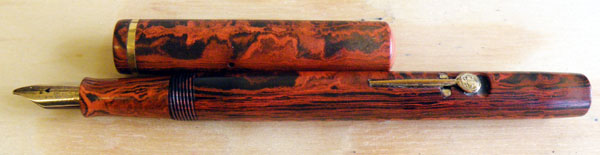
This is a Conway Stewart Universal 472. Anyone who takes an interest in Conway Stewarts will be aware of the usual Universal pen, the 479. This one is altogether less common. Donahaye is vague about it and Stephen Hull doesn’t mention it at all. It resembles the 479 quite closely but has gold-filled trim instead of chrome. In terms of date, it’s impossible to say exactly, but it’s likely to be around 1930.
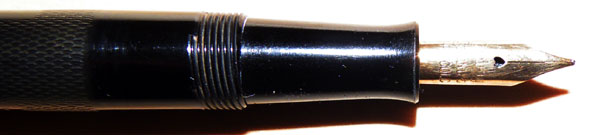
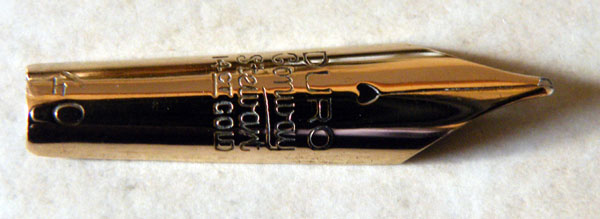
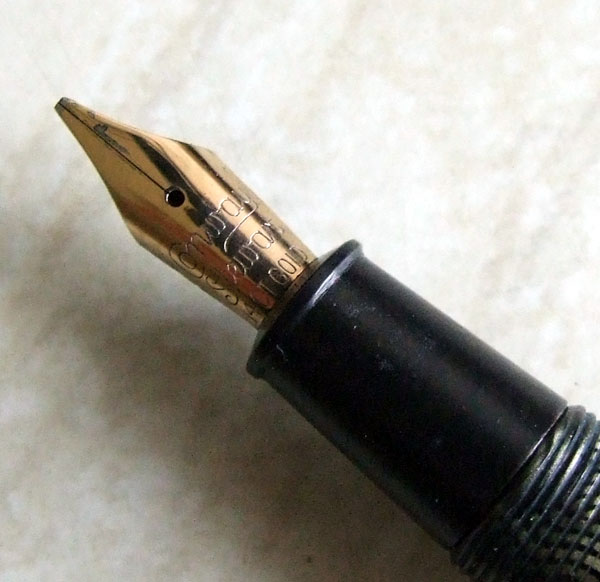
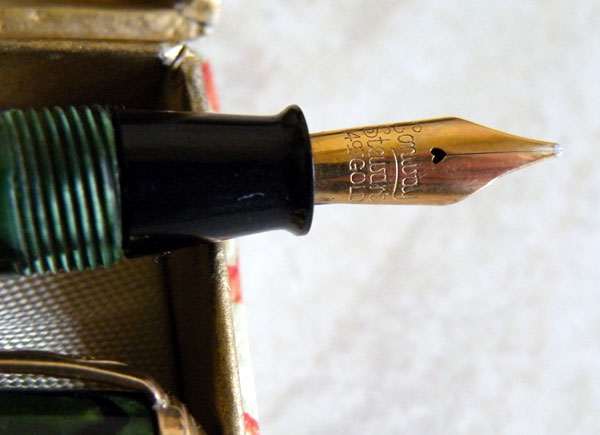
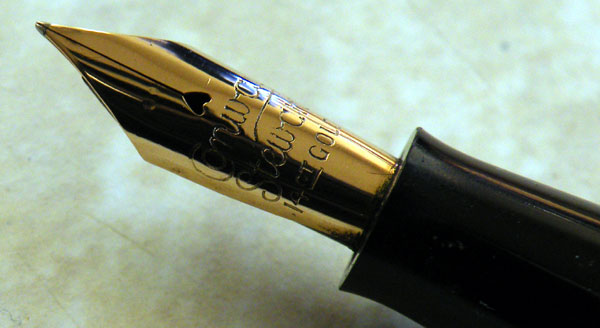
These pens are more than just superficially different from the later ones. The feed is thicker and the nib curves around it more.

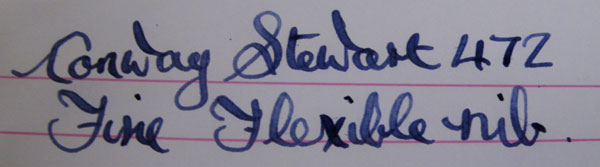
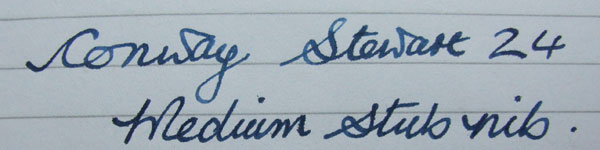
This example shows little sign of being eighty years old. The machine-chased pattern and barrel imprints are sharp, and the gold trim is very good. The end of the cap is a little faded. Perhaps it got wet or was exposed to the sun. In general, though, it’s a pen in great condition and it has a nice flexible nib, unusually for a Conway Stewart.
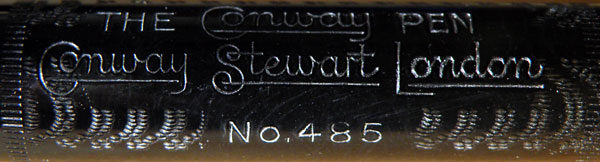
The cartouche is filled with the name E.H. Lockington – and I mean filled! The letters are large and they’ve been highlighted in white. E. H. Lockington wanted to be sure everyone knew this was his or her pen! Opinions vary about personalisations. Most dislike them, others (including me) see a value in them. Some will go to the extent of having them removed. There are two methods of doing that: heat or abrasion. Neither is for the faint of heart. Myself, I always leave them alone. They’re part of what the pen is. It’s not exactly history; I don’t know who E. H. Lockington was, and even if I did, it’s unlikely that there would be any record of the sequence of events from the pen’s first purchase until now. So pens don’t have a history, unless you consider the inferences that you might make from every scratch and scuff on a pen’s surface. From what I read in the pen boards, there are those who do consider that history. Most historians will disagree. However, judging by the excellent condition of the pen, old E. H. was proud of it and looked after it well. It would be a sad thing to break his/her association with it after all this time, so the personalisation stays where it is.
As I’ve said elsewhere, I don’t really have the collecting gene. Despite handling so many, I don’t actually own a lot of pens. Now and again, though, I come across a pen that I admire so much that I can’t bear to part with it. This is one such pen.

















 Goodwriterspens's Blog