Conway Stewart Universal 479 “Bottle Green”

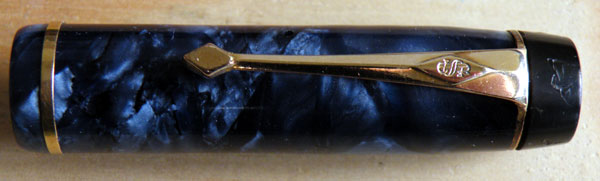
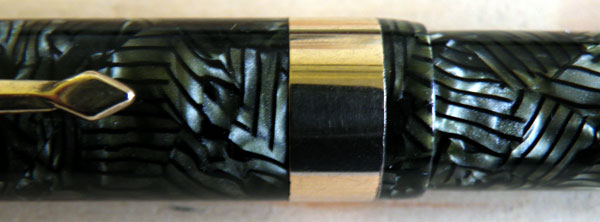
This is the second exceptionally colourful Universal 479 I’ve picked up in a few days. I believe this is the pattern Jonathan Donahaye called “bottle green”. It isn’t really the green of a bottle, but it is a very strong, vivid colour.

Before anyone suggest that because this is a bright colour it must be casein, let’s lay that one to rest. Yes, casein takes some wonderfully rich colours and displays them in often rather different patterns from celluloid, but celluloid comes in some pretty wild colours too. In fact, the surprising thing is that the colour capability of celluloid was so seldom exploited to the full. Generally, before World War II the bright, strong colours were mostly confined to the Dinkie range and were often in casein. Perhaps it was thought that the users of full-size pens were more conservative in their tastes, and would prefer the more sober patterns that predominate among surviving celluloid pens.

 

The 479s were something of an exception in this respect, having the brightest celluloid patterns in the pre-war Conway Stewart range. Perhaps this is, as Donahaye suggests, because these pens were often used for promotional purposes and it might have been thought they should be eye-catching.


Plum And Black Marbled Conway Stewart 479

The Universal 479 was among the longest produced of Conway Stewart pens, appearing first in 1931 and remaining in the catalogue until 1950. As you might expect, it changed quite a bit in that time. Indeed all that remained consistent was that it was bandless and had chrome plated trim. I have a fine old early thirties black chased hard rubber 479 with a fixed, stepped clip, original warranted nib and a flange lever and it bears little resemblance to the later output like this plum and black marbled example.

The last version of the Universal 479, of which this is one, has a lot of variety between models. The handsome, deeply chased black celluloid version looks like a different pen from the coloured examples. I’ve said before – and I doubtless will again – that bandless pens show off a pattern better than those whose lines are broken by a band across the lower part of the cap.

Up to the 1940s, Conway Stewart pens were issued without a clip, if that was the customer’s preference. I’d like to pretend that that was the case here, but the worn line just where the end of the clip would have been gives the lie to that suggestion. Conway Stewart clips are often interchangeable but not the 479 which is quite a thick pen. This one will just have to hang around until a donor 479 happens along.

A Conway Stewart 286 Stub

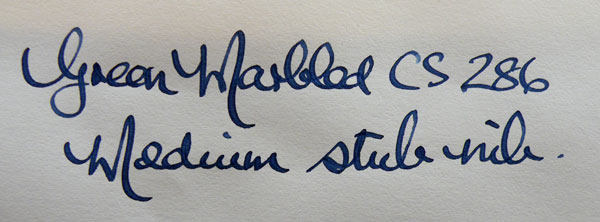
An ordinary, if rather pretty, Conway Stewart 286, you might think, but not quite. This one’s that rare thing, a Conway Stewart stub.

It’s a beauty, rigid, wide and giving easy line variation while it lays down a lot of ink.

Basing it on what passes over my bench, Conway Stewart made far less obliques, stubs and flexes than, say, Swan, but they could make a good one when they chose. The Conway Stewart approach to the stub is almost as if the tines were chopped off and the tipping material applied. Swan, when making a stub, used a high-shouldered nib with comparatively narrow tines, making a somewhat chisel-like shape at the nib-tip. This means that Swan stubs are often flexible whereas Conway Stewart ones are firm, or at least the ones I’ve handled are.

Plum Hatched Conway Stewart 28

Judging by the numbers that have survived the 28 and the slightly more expensive 27 were two of Conway Stewart’s most popular pens. Apart from the width of the cap band, they’re pretty near identical and come in the same colour patterns.

This is the burgundy or plum hatched variety of the 28. Plum seems more appropriate to me. The hatch is a beautiful pattern but the red versions are often faded by now. The visible areas look a little dull and there’s a sliver of the original brightness hiding under the cap. This one’s completely unfaded and presents the original glory of the pattern.

The 28 tends toward the long and slender. Perhaps not quite as much as the 85L (I don’t have one to compare at the moment) but more elegant-looking than, say, the stockier 85. It shows in the length of the clip as much as in the combined length of body and cap. To my eye the 85L looks a little stretched. I think the 28 has it just about right.

An Early Conway Stewart 479.

I picked this old 479 up in eBay, if not exactly for a song, at least not for a high price, which was a Good Thing. Examining it properly on the bench, I found a crack at the lever opening. Though the crack appears stable the pen’s not saleable like that. Usually, I would just contact the seller and arrange to return it for a refund but I hesitated with this one and in the end I decided I would just keep it.


There’s no repair for something like that. Hard rubber doesn’t take welding and in any case, a repair would be as bad as the crack, running through that prominent engine turning. If I returned this pen to the seller it would be scrapped or put in the parts bin, a sad end for a good pen.


I have an especial liking for Conway Stewarts of the early thirties. Domed cap, flanged lever, fixed clip, deep engine chasing; it adds up to what I see as the finest style of pen that Conway Stewart ever made. This, for me, is a better pen than all their glories of the forties or their colourful beauties of the fifties and sixties. You may disagree with me, of course, and I expect that most people will, but that’s how I see it. It’s just the right collection of attributes that adds up to be harmonious design. Like some Swans of the same period, it’s a perfect pen, not to be excelled.

As luck would have it, it has a very nice nib, a warranted which must be wrong for this date, but has a measure more flexibility than the correct nib would have had. The pen’s restored and filled and sitting in my desk set, awaiting use. I’ll keep an eye on the crack but I think it will be all right.

Conway Stewart 306

This is, at first glance, a rather ordinary old pen, black hard rubber quite faded on the barrel and formerly chrome-plated trim now down to the bare metal. It’s more interesting than it seems, though. This is my oldest Conway Stewart, a 306. It’s old enough for there to be debate over whether this pen was bought in from America or made in-house. Except for the level of quality, which is precisely where you’d expect a Conway Stewart to be, i.e. very good but not quite the best, not much about this pen resembles the company’s later output. The inserted ball-ended clip does appear on a few other models like the 382 and 353 Pixie but they, too, are suspected of being made abroad. We’re not used to seeing Conway Stewarts with straight levers but that’s how they began. The nib is warranted and that’s correct for the model. This pen has a j-bar, something Conway Stewart never quite dropped though the much more efficient slide-bar was what they usually employed.  The concave section is something you do see on other Conway Stewarts of the period.


Near as I can work out this pen was introduced around 1920 and was still in the range in 1926, when it cost 11/6d. Not the most expensive of the company’s pens, then, but well-made with deeply-cut chasing which has lasted well. You will note that the imprint states “Made In England” and who are we to question those nice people at the Conway Stewart of eighty-five or ninety years ago?


So that’s it – the oldest Conway Stewart that has so far landed on my bench. I’m very glad to have had the opportunity to examine it.


This is its box. Not original for sure, and quite a strange thing, made out of very thick cardboard and held together with mighty staples. Perhaps it’s a repair box. I’ve certainly never seen one of these before.

The Slippery Slope: The Onoto K2 And The Conway Stewart 150

These pens have something in common: they were made by companies in decline. Their dates of production are different, the Onoto being launched in 1955 and the Conway Stewart some eight years later, but the position that their respective companies found themselves in were quite similar. Sales were falling inexorably. Costs needed to be cut in a desperate attempt to regain market share and both companies also made an attempt to turn out a product that was more in tune with the the times.

In introducing the K series of pens, De La Rue threw the baby out with the bathwater. Whatever this K2 may be, it’s not an Onoto, that elegant pen with its plunger filling system. It’s something quite different. That said, despite some faults the K series are good pens. Their piston filling system is generally in excellent working condition today without any servicing. The gold plating is very good, the clutch still closes the pen firmly, the ink-view area of the barrel is still clear and it writes well. These pens were a limited success, but it wasn’t enough to save the company. De La Rue, after all, was not entirely dependent on pen production and they pulled the plug when the profit and loss statement said it was time.

The Conway Stewart 150, I would maintain, is still a respectable pen but it contains the seeds of decline. At first glance it’s little different from its illustrious forerunners of the fifties, but when you handle it you feel the difference. The pen feels a little slippery, a little waxy. Gone are the glowing celluloids and caseins; this is injection moulded plastic. No doubt it was the right decision from a cost point of view, but self-coloured pens don’t have quite the attraction of the patterns that made Conway Stewart what it was. There’s no lever. Now you have to screw off the barrel to find a metal squeezy device, the Conway Stewart Pressac filler. This, like the shape of the pen, is an attempt to emulate the Newhaven Parkers, but this isn’t like Parker’s Aerometric filler. It’s an older technology and you can squeeze away all you want, you’ll never fill the sac. Unlike the Parker, this system has no breather tube. It’s just a squeeze-filler like the Macniven & Camerons of 45 years earlier. In other respects it’s not too bad. The gold plating is, perhaps, not as good as the Onoto’s but that was always how it was. The nib is conspicuously small, but it’s still gold. On my example, the softness of the plastic has allowed a groove to develop around the cap where the clip was allowed to spin. However, it’s still quite a sound pen that would give good service.

Onoto at least got a clean, relatively quick death. The coup de grace was administered in 1958. Conway Stewart staggered on, turning out poorer and poorer pens until it ground to a halt in 1976.

The Conway Stewart Universal 476 (Among Others!)

If you want to really mangle your head, spend a morning trying to make sense of Conway Stewart Universals. The one we all know and love is the 479, usually presented in black with some of the best engine-chasing on celluloid there is. Beyond that, though, there’s (at my last rather shaky count and in no order except how I found ’em) the 476, the 467, the 466, the 480, the 486, the 464, the 470, the 466M, the 470M, the 479M, and, in a whole other range of numbers, the 356. Phew!

They’re all in the lower to middle price range for a full size pen. Some have cap rings, some don’t. Some of these were earlier pens that died out by the end of the thirties but a confusing variety still remained. At that time they cost five shillings and sixpence or more, a substantial amount. I wonder if even the clued-up buyer ever had any idea of what the full Conway Stewart range on offer to him was. How did one decide between, say, a Universal 479, with its wide array of colours and a Universal 356, with a different selection of colours that were unique to that pen alone?

Well, what you did was bought a Universal 476 instead. At least that’s what one discerning buyer did somewhere between 1935 and 1938. Then he took it home, placed it carefully in a drawer and never disturbed it again, judging by the freshness of its condition today:

The gold plating is absolutely perfect and the barrel imprint is about the sharpest I’ve ever seen on an old pen. The only fault is a scratch or two on the clip screw, otherwise the pen’s as new.

This blue marble is a wonderful pattern. Jonathan Donahaye assigned names to the various patterns. They have no authority; they’re not what Conway Stewart called the patterns on the rare occasions that they called them anything at all. Nonetheless, Jonathan’s pattern names are perfect. He called this one Marbled Slate-Grey Blue and that’s what it is. Exactly.

A Well-Worn Conway Stewart 356

As you may be aware from my earlier ramblings, well-worn pens and pens that have personalisations and other engravings hold an especial fascination for me. They’re more interesting – though obviously less valuable – than the pristine New Old Stock examples that occasionally turn up. Though those worn pens don’t have a history we can recount, they’ve clearly seen a lot of use and haven’t spent the bulk of the twentieth century in the back of a drawer.

This black hard rubber Conway Stewart 356 has a wonderful soft shine from much handling. The 356 came out in 1932 and at three shillings and ninepence was probably the company’s cheapest full-size pen at the time. It was produced in some delightful colours but the company which bought this one settled for chased hard rubber.

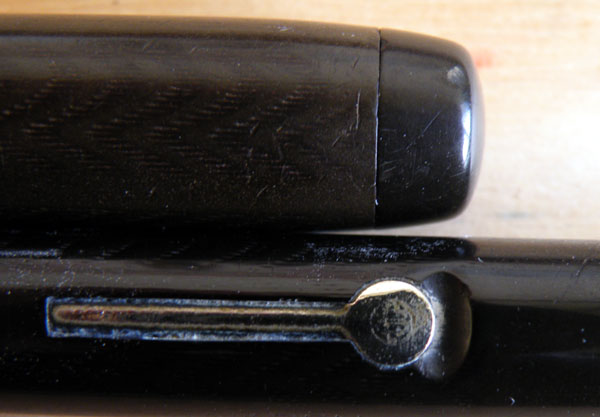
Judging by the tiny shield on the lever, this is one of the earliest ones. The chasing is shallower than it once was but it’s still there. The pen has no clip, and it doesn’t look like it ever had one – Conway Stewart made quite a feature of the “with or without clip” prices, and even of the fact that their clips could be easily removed.

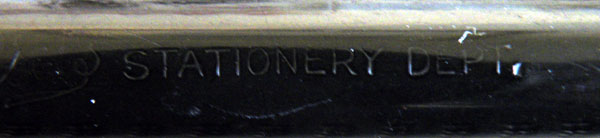
It’s clear that it was a company pen because the faint imprint “Stationery Dept.” can be seen in this enhanced photo (Thank you, Photoshop). I suppose it was available for everyone to fill out their stationery requisitions – a far cry from today’s attitudes, where it’s believed that lending your pen to someone else will irretrievably damage it. Of course, everyone knew how to write with a fountain pen back then, unlike today. Perhaps the clip was left off to make it less likely that someone would slip it into their pocket.

When it arrived on my bench it bore a modern plated nib. Worse still, when I opened it up, I found that the peg that the sac is attached to had been sawed off! I’m not sure why, or how the previous owner had thought the pen was going to work. Because the 356 is quite a slender pen with a concave section, it took quite a bit of hunting among the spares before I was able to return it to its original condition. But here it is, ready to write again. Perhaps it isn’t the most valuable pen I’ve worked on this week, but it’s a treasure all the same.

The Conway Stewart 27

The Conway Stewart 27 was produced for about ten years, from the early fifties to the early sixties. There were slight differences, mostly in the imprint, during that period and this is one of the later ones, from between 1958 and 1962, when it cost the princely sum of 27/6d. That was a high price, and the 27 is high-quality pen with its cowled clip, large nib and broad cap band. They sold well and are common today, but their quality ensures that they fetch a good price.

They came in some gorgeous colours: tiger’s eye, cracked ice and the full range of herringbone, hatched and marbled colours. This is the olive green hatched. Forgive the photography which doesn’t really do the colour justice.

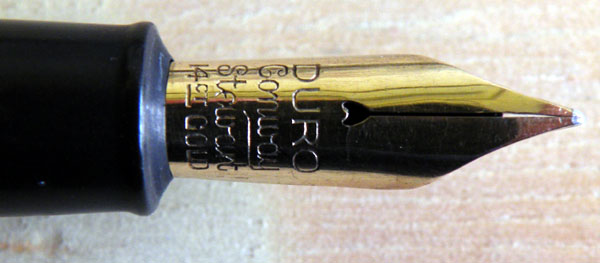
This one has a Duro 40 nib, and I’m pretty sure it shouldn’t. I think these always had No5 nibs. It shouldn’t be too much trouble to put that right.