An Unusual Kingswood

I wrote about Eversharp Kingswoods before, back here: http://wp.me/p17T6K-3k but I found out two new things about them today.

First, they were produced in this glorious pattern:

And second they were offered with this superb oblique stub:

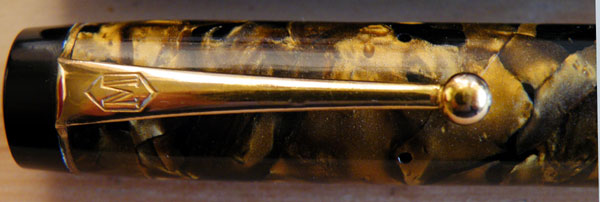
This is the earlier Kingswood with the Art Deco stepped clip and the pierced cap ring. The section is black hard rubber but, oddly, the clip screw is plastic. It shows the results of time and hard use. The plating (which is thin on these pens) has completely gone from the lever and the clip is little better. More remains on the cap band. The BHR section is a little faded and there are some nibbles on the clip screw. The nib has been bent and straightened. None of that makes much difference; this remains a glorious pen.
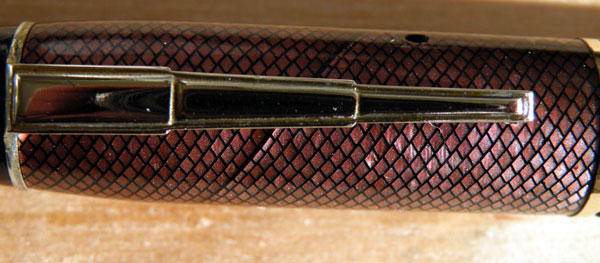
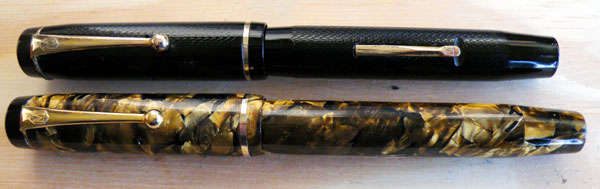
This pattern, in various forms, appears on several makes of pen: Swans, Blackbirds, Summits and Wyverns to name but a few from the British manufacturers. It’s sometimes called brickwork, I’ve seen some American collectors describe it as web, and here it’s mostly known as lizardskin. The fact that the pattern varies from dark to light is, I think, meant to evoke reptile skin. Here, it’s at an angle, whereas on Swans it tends to run parallel to the pen. I think this is because, rather than being machined from the rod, this cap and barrel are made from wrapped celluloid sheet. The pattern ran along the sheet, but the forming of the pen has set it at an angle.

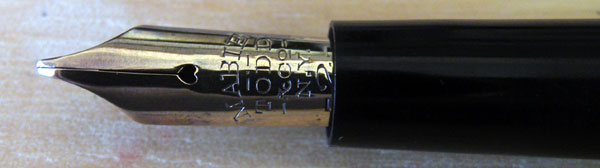
The nib is unlike the Eversharps I’ve seen in previous Kingswoods. “Eversharp 14K 0.585 Flexible Made In USA” is stamped on the nib. Along one side of the nib, in tiny writing is “A 14. 585©”  and on the other “WECO” .  I’ve long suspected that Parker began making Kingswoods to use up Eversharp nibs. Maybe this nib appears in other Eversharp models. Tell me if you’ve seen it elsewhere, please. The nib is soft rather than flexible (which might be because it has been bent and straightened) but the shape of the stub imparts some line variation.

In conclusion, this pen has caused me to reassess Kingswoods. I thought of them as no more than competently made workaday pens with really good nibs. This strikingly beautiful pen suggests that, on occasion at least, they could be more than that.

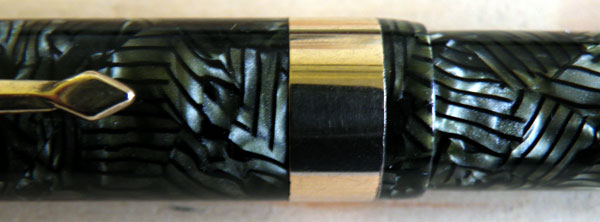
 

The Conway Stewart 27

The Conway Stewart 27 was produced for about ten years, from the early fifties to the early sixties. There were slight differences, mostly in the imprint, during that period and this is one of the later ones, from between 1958 and 1962, when it cost the princely sum of 27/6d. That was a high price, and the 27 is high-quality pen with its cowled clip, large nib and broad cap band. They sold well and are common today, but their quality ensures that they fetch a good price.

They came in some gorgeous colours: tiger’s eye, cracked ice and the full range of herringbone, hatched and marbled colours. This is the olive green hatched. Forgive the photography which doesn’t really do the colour justice.

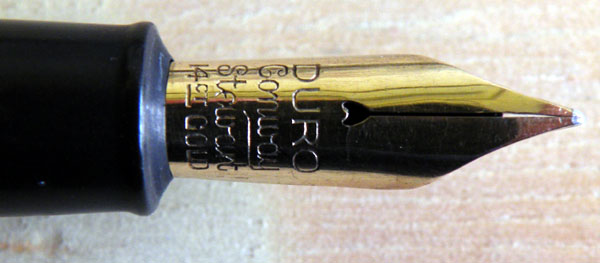
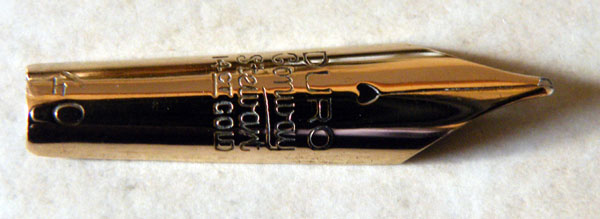
This one has a Duro 40 nib, and I’m pretty sure it shouldn’t. I think these always had No5 nibs. It shouldn’t be too much trouble to put that right.

Mentmores Again

I felt the need to get out and about this morning, so I fired up my time machine and went back to 1952 to buy these two Mentmores.

In truth, it’s rare to see sixty-year-old pens in as good condition as these. A speck of wear on the lever of the black chased one, and that’s all. Along with a few other pens, mostly Watermans, these came from a well-cherished collection that’s being sold off.

Though they’re not the kind of pen I use, because of their (mostly) stiff nibs, I admire Mentmores. I think they may have suffered a little from association with their budget brand, Platignum, but in actuality they’re very sound pens, at least the equivalent of Conway Stewart or Summit, and, in the case of their button-fillers, a more efficient filling system than either. Users of modern pens take to them readily, because they tend to have a larger iridium ball, like contemporary nibs.

It may be winter now, but looking at the button-filler, with its glorious golds and bronzes, transports me right back to autumn. No-one else uses that celluloid. It’s quite exceptional; bright, warm and satisfying to the eye.

There may be a little less to say about this sturdy lever-filler, but I do enjoy good, sharp engine-chasing. This is a fine example.

The Last Blackbird

The declining days of the once-proud Mabie Todd company were especially sad. Their fortunes did not revive in the post-war period and the company was taken over by the Biro Pen company in 1952. From then on it was known as Biro Swan and Mabie Todd was gone for good. Investment in the fountain pen arm of the company was low and little that was new was produced. As demand fell, so did production standards and quality control. Biro stopped production of fountain pens in 1958.

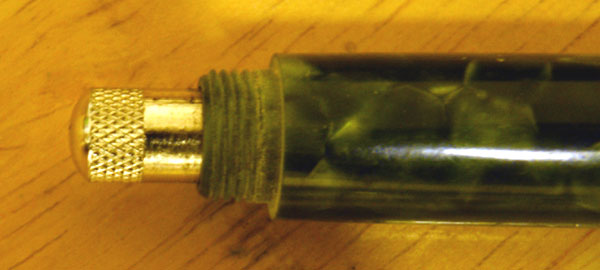
The main product in the later years was the Calligraph. At first a lever filler, it later used an improved Leverless filling system. A turn-button on the end of the barrel caused a cam to rotate, depressing an ordinary pressure bar. The end of the pressure bar located into a slot in the threaded section. This was an efficient system, but could be something of a swine to reassemble when re-saccing. This system has caused yours truly to (on occasion) utter words and phrases not usually heard in polite company.

I was aware that, towards the latter end, there was a further development of this system employed in Blackbirds, so I grabbed this pen when it appeared, not – I hasten to add – because I admired its quality, but so that I could take it to bits. It’s not that bad, actually, except for the clip which has rusted. Otherwise, the manufacturing quality is good.

The turn-button is now concealed beneath a blind cap, and it’s knurled aluminium. Quite smart, in fact. Is that an improvement? Probably not. It means you have an extra step to go through in filling your pen.

The pressure bar is now fitted with a cap, which aids in locating it securely into the mechanism. It helps to make reassembly rather easier and I achieved it without any oaths or imprecations, so that’s definitely an improvement!

There wasn’t much I could do with the clip, other than rub it down. The high-shouldered nib is actually quite good. The plastic is attractive, and it looks very like the plastics used on the continent. I suspect the building of this pen was contracted out to a German or Belgian firm, as happened with some other British fountain pen manufacturers. The barrel is imprinted “Blackbird – A Swan Product England” which is probably only partly true.

Taking it all in all, it’s not a bad pen. It hasn’t got the quality of a pre-war Swan, or even a 1940s one, but the machining is good and the plastic hasn’t distorted. The means of securing the clip with a metal stud is a step down from the usual inserted clips, but it’s the method Waterman used with success for years. If this Blackbird was the last of its kind – and I suspect that it is – it isn’t nearly as poorly made as, say, the last Conway Stewarts.

A Boxed Crox

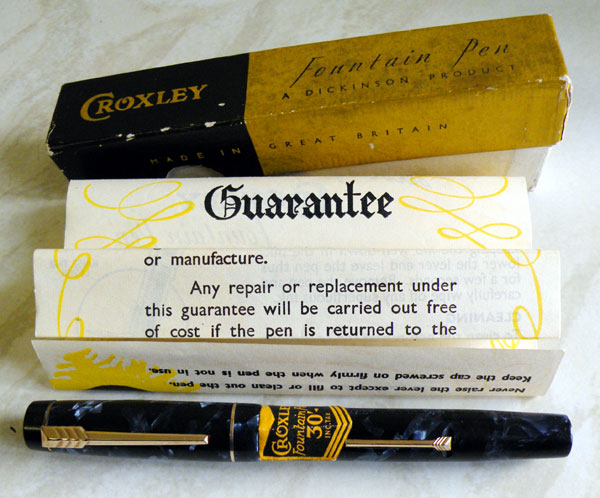
I’ve written about Dickinson Croxleys before, so you’ll know that I greatly approve of them. They’re well made, they write well, the gold plating is better than that on many of the larger manufacturers, and they’re stylish. If I have a complaint at all, it’s that 99% of their output seems to have been black. A colourful one does turn up sometimes, though and it’s all the better if it still has its box, guarantee and price label!

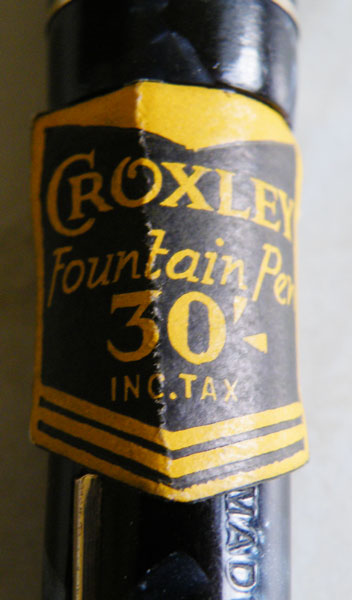
I’m guessing that this is quite a late example, because 30/- (£1.50) was a lot of money back in the day.

That clip is, to my mind, one of the best ever made, and the arrow feature is echoed in the lever. Like I said, stylish! The box is complete and sound but a little shop-soiled. I imagine it gathered dust on a shelf somewhere for a very long time…

The Conway Stewart Universal 472

You’ll have to excuse the photographs today. Conditions were poor.

I like all Conway Stewarts – well, except those defective objects that were produced in the last, sad years of the company – but I like those from the twenties and early thirties best, especially those with the flange lever and the fixed clip.

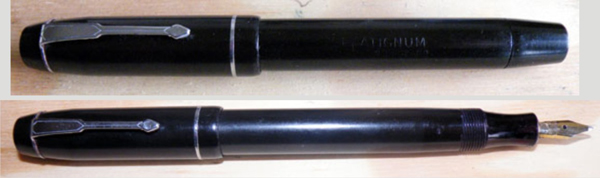
This is a Conway Stewart Universal 472. Anyone who takes an interest in Conway Stewarts will be aware of the usual Universal pen, the 479. This one is altogether less common. Donahaye is vague about it and Stephen Hull doesn’t mention it at all. It resembles the 479 quite closely but has gold-filled trim instead of chrome. In terms of date, it’s impossible to say exactly, but it’s likely to be around 1930.

These pens are more than just superficially different from the later ones.  The feed is thicker and the nib curves around it more.

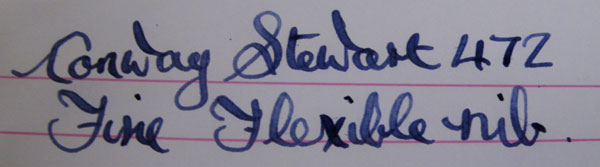
This example shows little sign of being eighty years old. The machine-chased pattern and barrel imprints are sharp, and the gold trim is very good. The end of the cap is a little faded. Perhaps it got wet or was exposed to the sun. In general, though, it’s a pen in great condition and it has a nice flexible nib, unusually for a Conway Stewart.

The cartouche is filled with the name E.H. Lockington – and I mean filled! The letters are large and they’ve been highlighted in white. E. H. Lockington wanted to be sure everyone knew this was his or her pen! Opinions vary about personalisations. Most dislike them, others (including me) see a value in them. Some will go to the extent of having them removed. There are two methods of doing that: heat or abrasion. Neither is for the faint of heart. Myself, I always leave them alone. They’re part of what the pen is. It’s not exactly history; I don’t know who E. H. Lockington was, and even if I did, it’s unlikely that there would be any record of the sequence of events from the pen’s first purchase until now. So pens don’t have a history, unless you consider the inferences that you might make from every scratch and scuff on a pen’s surface. From what I read in the pen boards, there are those who do consider that history. Most historians will disagree. However, judging by the excellent condition of the pen, old E. H. was proud of it and looked after it well. It would be a sad thing to break his/her association with it after all this time, so the personalisation stays where it is.

As I’ve said elsewhere, I don’t really have the collecting gene. Despite handling so many, I don’t actually own a lot of pens. Now and again, though, I come across a pen that I admire so much that I can’t bear to part with it. This is one such pen.

The Conway Stewart No 45

It seems only fair and right that Conway Stewart’s prestige range – the Duro – should be as confusing as the less expensive pens. There are pens with Duro nibs that aren’t imprinted as Duros, and there are Duro pens that don’t have Duro nibs. To be fair, these latter are among the earliest Duros, and they have CS6 nibs which are pretty much indistinguishable from Duro nibs.

Not all Duro nibs are made equal, either. Most commonly seen is the Duro 40, but I’ve also seen Duro 20s and Duro 26s, and yet others that are Duros without any number. Most are long-tined, but high-shouldered and even oblique Duros exist.

What seems to have happened is that Conway Stewart dropped the name “Duro” for their most prestigious pens sometime in the early forties, and thereafter those pens, including the 55, 45 and 47 – all bearing Duro nibs – became “The Conway Stewart”. The 55 is by far the most common of these and I’ve written about it before.

Today I have a much less common 45. It has a single cap ring instead of the the 55’s three, but it is still a large imposing pen, designed to impress. It had a comparatively short run, from 1943 to 1946, and it was then superseded by the more opulent 55.

The Duro 40 is a large and impressive nib. Like most Duros, it’s rigid. Sometimes you’ll hear that the hard-as-a-nail Duros were produced to satisfy a need for a nib that would make an impression through several carbons, but that seems an unlikely explanation. The Duro is rigid because it was made from a thicker blank. There are other, less expensive ways to make stiff nibs, and the ones that would have been used to penetrate carbons were among the cheapest, like the Scribe range. No, the Duro, like Swan’s Eternal, is about status and conspicuous consumption. It was made to be noticed, and perhaps envied.

Funny how bling brings out the worst in us!

Mabie Todd Swan 200

Yesterday was a Good Pen Day. Many fountain pens were restored and the postman brought this little gem:

It’s a Swan 200, perhaps the least common of the family of Swan eyedroppers. It resembles the 1500 quite closely. It has a Mabie Todd and Co Ltd. imprint on the barrel, which dates it to 1915 or later, but as it has a New York nib which appears original, it’s probably before 1920. Be that as it may, the pen’s not far off a century old, but it doesn’t look it. It’s completely unfaded, the black as dark and shining as the day it was made, and the machine patterning and imprints are pristine.

The high-shouldered nib is a No2, and it’s both oblique and flexible. The pen is a real delight to write with.

Over the years I’ve bought and repaired a lot of Mabie Todd pens. Sometimes I feel that there’s nothing new for me to see – but there is! I’ve seen pictures of the 200 before but I’ve never owned one, and that this one should be in such splendid condition really is the icing on the cake.

Today is write-testing day, along with aligning tines and nib-smoothing. I’m working my way through twenty restored pens, which will take all day.

Platignum Button-Filler

The very cheapest pens, like Queensways, Universals, Platignums and the like are consigned to my “spares and repairs” box, to be sold off as a job lot when enough have accumulated. This morning, however, this pen gave me pause for thought:

It’s a Platignum button-filler of indeterminate date that was included in a lot that I bought. The steel nib was rusted out, otherwise it appeared all right, and I decided to disassemble it. Once you have all the parts there and you can have a proper look at it, it’s a good, sturdy, well-made pen. Mentmore/Platignum always made very efficient button-fillers and this is no exception. Is it right to cast a good pen aside because it bears a less-than-popular name? It’s every bit as good a pen as a Mentmore or a Wyvern.


I resacced it, cleaned it up and fitted a little Kaweco nib that will never find an appropriate home elsewhere and fits well. It’s a great writer. I’ll offer it for sale at a low price that will cover my costs. If it sells I might fix up a few more, if not it’s back to the “spares and repairs” box.

Mentmore 46

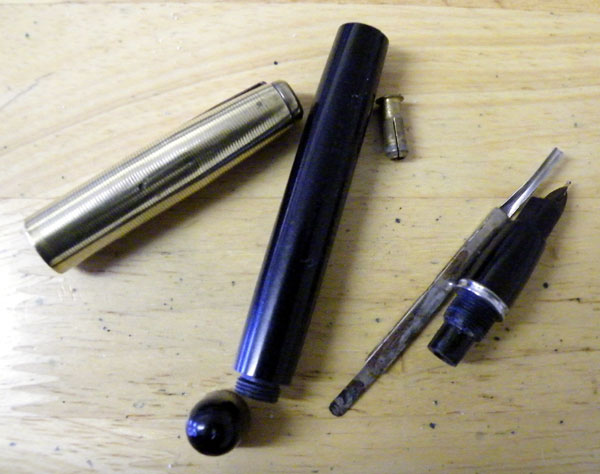
I have to admit that I’m a little traditional (some might say hidebound) in the type of pens I like. I don’t care for hooded nibs – too modern for me (even though the design is older than I am). I find shiny metal caps a bit flash and in poor taste. I don’t buy pens like that intentionally, but you never know what’s going to turn up in job lots, which is how I came by this strange beast:

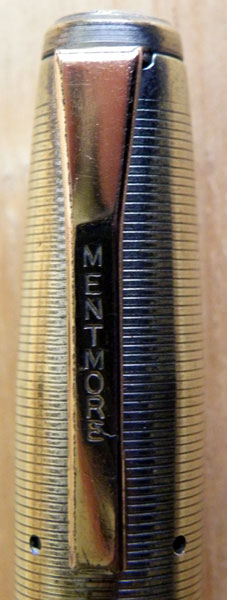
It’s a Mentmore 46, made around 1950. There were two versions, one with a silver-coloured cap at 17/-, and this one with a gold-filled cap at 25/-.

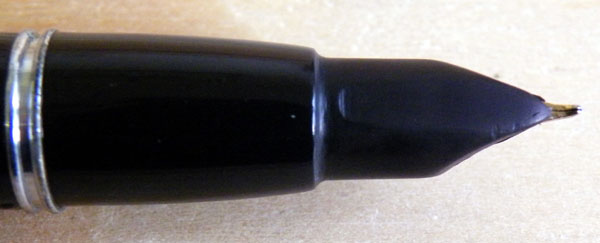
I stripped it down to find that it’s a much more traditional pen than it at first appears. It has a normal, if small, nib and a ladder feed. It’s a button filler. As usual with Mentmores the button was a swine to remove, but I have my methods. I fitted a new sac and reassembled it.

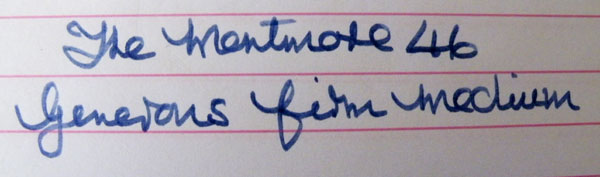
I have to admit (there’s that phrase again) that this turned out to be a much better pen than I expected it to be. It’s very well made, with sturdy components and good machining. It writes very well. It may be a little odd-looking, but no more so than any other hooded-nib forties or fifties pen.

The cap, with its clear engraving on the clip, is much less blingy and tasteless than many of these things are. All in all, if I saw another one at the right price, I’d buy it.