Big Ben pens can be quite confusing: there is a modern kit pen that goes by that name, there is a Big Ben that is a sub-brand of Wyvern and finally there is the excellent Danish piston filler.
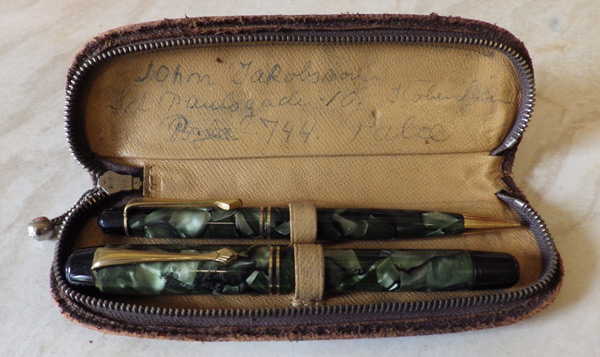
This is an example of the latter. The pen is in green marble with black lines and there is a translucent area so that you can check how much ink is left in the pen. The clip screw, blind cap and section are black. The nib is marked “Big Ben 14K 585 1” which doubtless means that this is their version of a number one nib, though it seems a little larger than I would expect for that size. The pencil is marked “Original Big Ben 15” and it works very well.

I find this pen quite hard to date but I suspect that it’s pre-war. The cap bears the the number 451168, which I astonished myself by being able to find in Espacenet. It relates to the piston filling system and was written by two Germans, Heinrich Hebborn and Heinrich Schlicksupp, trading as Hebborn and Co., Cologne. It’s dated 30th of July 1936.

I understand from Paul LeClercq’s troubles and tribulations reported in Fountain Pen Geeks that these pens can be very difficult, or even impossible to repair. This one is working – for the moment – but I won’t be selling it until I have it checked over by an expert. Which is not me, I hasten to add, where piston fillers are concerned.
Month: July 2014
Site Update
Work on the improved sales site continues apace! Testing has gone well (she said, hoping not to jinx it), and the last thing to work out is making the PayPal module play nicely with the site. I don’t know if I’ll make it all happen by August 1st, as I am also working on batches of new uploads…. but it will be close!
An Unusual Mentmore Diploma
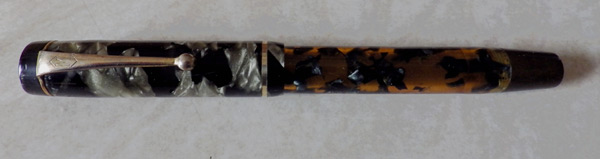
I think this one takes the biscuit for rarity and mystery. In most respects it’s a perfectly ordinary Mentmore Diploma. What makes it stand out from the crowd is its translucent barrel.
The explanation for this that comes first to mind is that it’s a demonstrator. There are a couple of problems with that, though. So far as I am aware, British manufacturers just didn’t do demonstrators in the 30s and 40s. We are used to ink-in-the-barrel demonstrators nowadays, and the idea of a clear barrel to demonstrate the operation of a button filler seems rather strange. It’s not impossible, though. We can’t discount the possibility.

Could it be, perhaps, a trial of a new and experimental celluloid? Others, like De La Rue, had developed semitransparent plastics. Mentmore was never afraid to try something new and perhaps this was a prototype that never went into production.
Finally, this may just be a freak celluloid that lost its colour and became transparent. This is the least likely explanation. One would expect there to be a batch of tens if not hundreds of similar pens, and they just don’t seem to exist. In my many years of fascination with pens, this is the one and only example that I have seen.
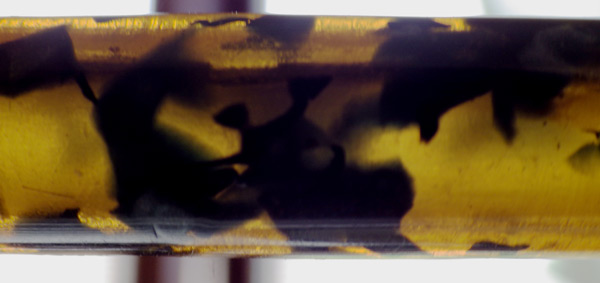
Whatever the explanation may be, it makes an interesting pen. Fitted with a translucent plastic sac as this one is, the amount of ink available is visible. Also, you can see the action of the pressure bar as the button is depressed. That’s not something you see every day!
Update
Things are busy busy busy here. I’m working with the developer on testing the site and all is going well, if slowly. At the same time I’m getting some pens prepared for upload so that there will be a good batch of new stuff for you to see when the site reopens. Lots of nice pens, a surprising amount of flex in Swans, Watermans and a Kaweco so far, with quite a few more to go.
My Assistant On the Look-Out For Pens

The Pento Sydney Eyedropper

This rather ordinary-looking eyedropper filler has a bit more to it than meets the eye – at least at first glance. It seems that you have the choice of filling it in the usual way, by unscrewing the section, or, in this case, by removing a screw-in plug at the end of the barrel and filling from there. I’m not sure what the benefit is in that or even if there’s a benefit at all. It may be just another place that has the potential to leak ink. That aside, it’s quite a conventional eyedropper pen, slender, with an over and under feed and engine chasing on the barrel but not on the tight fitting cap.
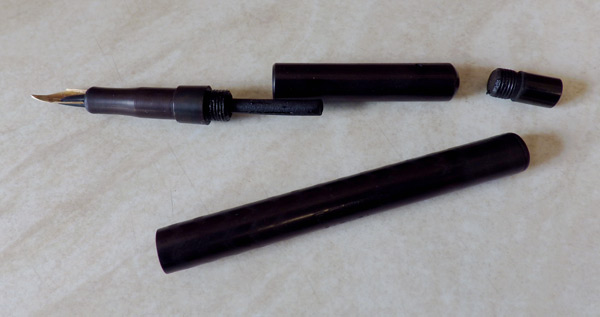
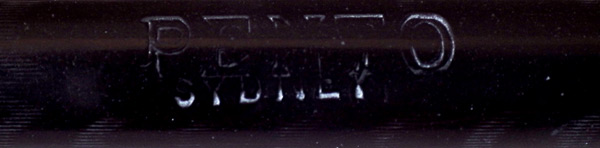
Stamped at a slight angle on the barrel is “Pento Sydney”. Stephen Hull,in his The English Fountain Pen Industry 1875 – 1975 records the Pento pen but his various references to it are all in the 1920s. This would seem to me to be quite a bit earlier than that, which is really all I can say about it. It may well be that the company began rather earlier.
Pento was one of those companies allied to Langs of Liverpool. The company was set up by WJ May at the Maypen Works in Twickenham. It went on to produce lever fillers and later a capless pen which does not appear to have been a success. The company was wound up with a considerable loss in 1927.(ibid).
Sales Site Update
It looks like I may have to take the sales website down for a few days while testing and completing of updates goes on, so don’t be surprised if it suddenly isn’t there! It will be back.
The site will certainly be there for the remainder of this week. It will probably disappear on Monday and I’m not sure at the moment how long that will last but I’ll keep you informed.
Uranus 621
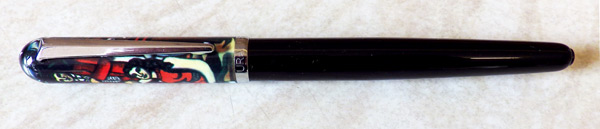
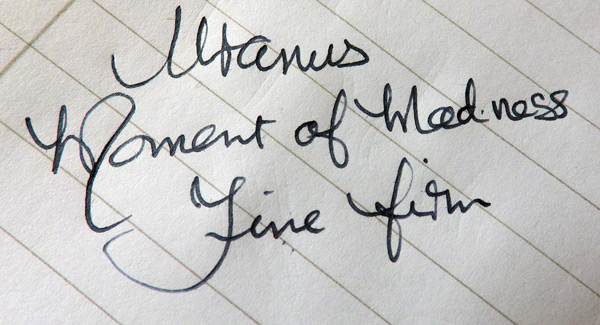
This is another of my Moments of Madness – yet another cheap Chinese pen! This one is a Uranus, and yes, I’ve heard all the jokes. This is a household where no pun, no matter how tiresome is allowed to pass without being commented upon to death.

Uranus, I am told, is a sub-brand of Duke. This is by no means a good recommendation so far as I am concerned. I’ve had Duke pens before – ugly, massively overweight, none too willing to write and with some of the worst casting I’ve ever seen in a pen. They tell me that the more expensive Duke pens are much better. Well, so they should be! I won’t be buying any to find out.
However, Uranus does seem to be rather better. For a start they weigh something within the range of what is acceptable for a fountain pen. Secondly, the clips are quite plain and without the extra decoration that falls foul of Duke’s poor casting methods. Anyway, I had to have this pen. The cap is decorated with a copy of Fernand Leger’s Leisure and I’m very fond of Leger who appears to have enjoyed life and was always more upbeat than many of his contemporaries. You can see one version of the painting here – he made several. There’s the option of several other artists including Picasso, if I remember correctly.

Okay so we’ve got this pretty pen that’s really nice to look at. Is it any good for writing with? Well, yes, actually it is! It’s a sensible size at 13.6 cm. It will post but not very securely. The nib which I’m told is medium is a European fine but not one of those hairline jobs. It takes the standard European small cartridges and it has a piston-type converter. I note for those of you who like to turn all pens into eyedroppers (horrible habit) that it has a very long barrel thread and seals well. The cap snaps into place very well by means of a projecting ring in the cap and a groove in the barrel. This means that the cap may continue to fit properly rather longer than is the case with many Chinese pens. The ink flow’s good and the nib is quite smooth. My only difficulty with it is that being a hooded nib pen I have to consciously line it up for writing in a way I don’t have to do with open nib pens.
I don’t remember exactly what I paid for it, nor even where I got it – they are available all over the place – but it was certainly less than the price of a cup of coffee at Starbucks.
Sheaffer Targa Gold Plated Chequered Classic

I had some general things to say about the Targa back here. This one’s the goldplated number 1007 Chequered Classic which was made between 1976 and 1979. Despite its name, the pattern isn’t quite one of chequers; rather it is (when the pen is held upright) a series of three vertical incised lines joined by wider spaced horizontal ones. It makes a very nice finish.

This pen has been well looked after and the gold plating is in very good order. Indeed, like most Targas, it has survived to the present day with very little sign of its 35 year existence.
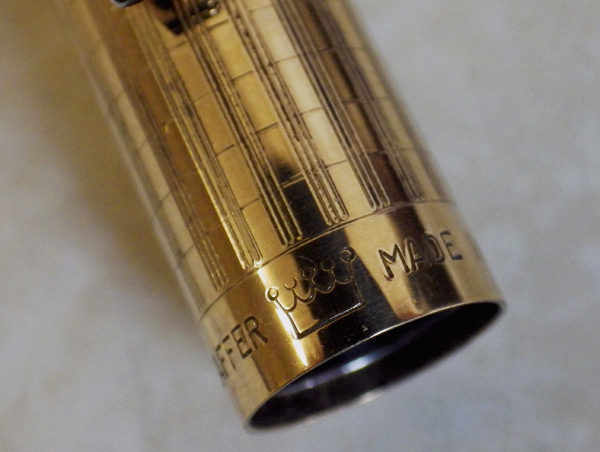
I have found Targas to be eminently practical pens, well-balanced, robust and always ready to write. They are more than that, though. Walter Sheaffer was a jeweller and until recent times Sheaffer pens have always reflected that. Though it is by no means delicate and easily damaged, the pattern on this pen does make it a form of jewellery – though a useful form. The famous Sheaffer inlaid nib, often firm but never a nail, is also a thing of beauty in its own right.
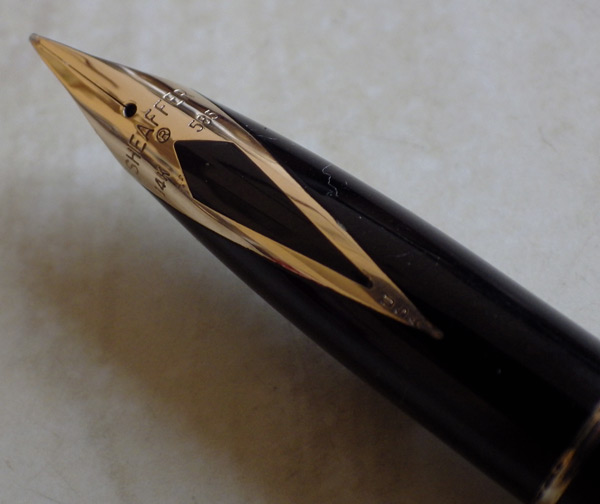
This one’s a medium with a hint of flex. It has a Sheaffer squeeze converter fitted.

A Very Flexible Waterman 52

I’ve outlined the history of the Waterman 52 before so there is no point in going over that again.

This very fine example of a US-made Waterman 52 in black chased hard rubber didn’t look quite so good when it arrived. It had accrued many years of dirt, mostly, I think, from being in a drawer somewhere. I say that because it doesn’t show the signs of long, continuous use. The chasing is crisp and the black hard rubber shows very little fading. A little cleaning and polishing returned it to something very close to what it looked like on that long ago day that it was bought and became someone’s pride and joy.

The pen bears a patented clip of a type that I see now and again. Though it has a patent number, there is no maker’s name on the clip, but it’s a clever little device that takes a firm grip of the cloth and can be released by pressing the tiny trigger.
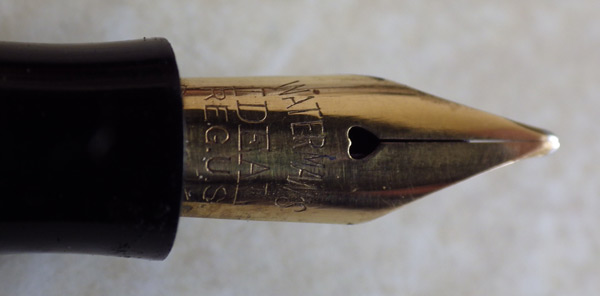
As is so often the case with Waterman 52s, the high point of the pen is the nib. It’s the most flexible nib I have had in quite a while and it snaps back to medium the instant the pressure is released – not that it takes very much pressure to produce a double-broad line.
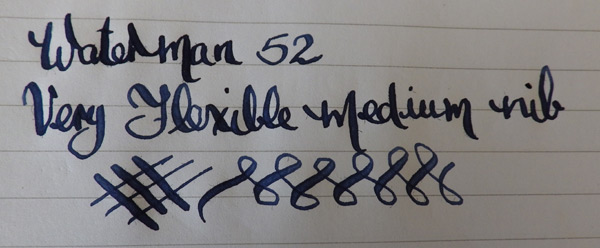
Pens like this are truly precious. There is no pen made today – or in the last few decades – that can compare with a really great Waterman 52 like this one, or for that matter, a flexible Swan or Onoto. We are very fortunate that these pens were made so well and have lasted to our day in such splendid condition.
 Goodwriterspens's Blog