An Unbranded Chinese Pen

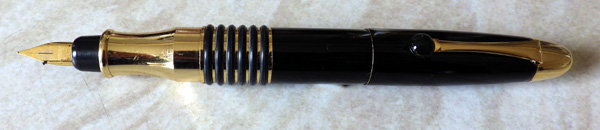
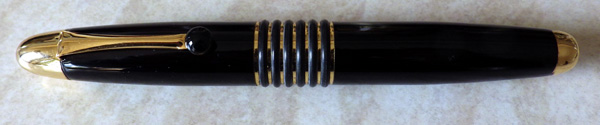
The other day I spotted a small lot in ebay that looked like it was worth a bid.  There were two Swans, a boxed Parker 45 and this… thing.
IMGP0939
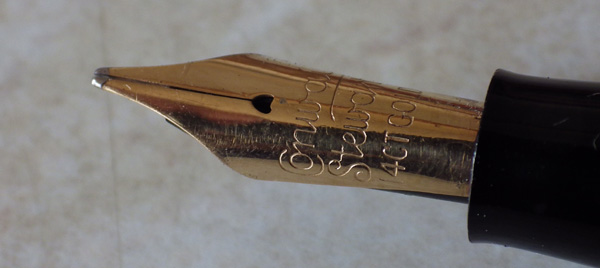
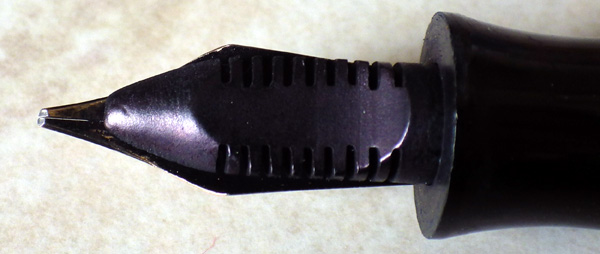
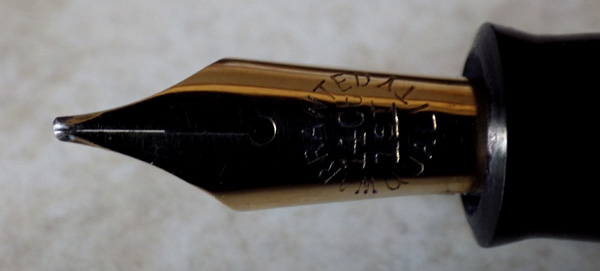
The lot arrived this morning.  I’m very pleased with the other pens and the thing has its curiosity value.  It’s an iridium-point Chinese pen.  I’ve seen them online before – once seen never forgotten!  What seeing it online doesn’t tell you is that this thing is solid lacquered brass, which means it’s monstrously heavy.  I defy anyone to tell me they could write two pages of A4 with this “pen”(I use the term advisedly) without requiring protracted physiotherapy thereafter.
IMGP0940
That’s not to say it isn’t useful.  It would make a passable doorstop.  Or I could keep it by the bed in case of home invasion.  Oh, and there’s one other thing about it – it’s the ugliest pen I have ever seen.  It’s so ugly that you could use it to discipline naughty children.

“You children stop that or I’ll SHOW YOU THE PEN!

“No, Mummy, please don’t!  We’ll be very, very good!”

Conway Stewart 84 Rose Marbled With Gold Veins

CSW84

I like the Conway Stewart 84.  It’s quite a short pen but no thinner than most other Conway Stewarts of the time, so it’s quite comfortable to write with for most people.  Its time was the early fifties to the early sixties and it must have sold extremely well during those years, as it remains one of the most commonly found Conway Stewarts today.
IMGP0933
The “rose marble with gold veins” pattern was one that was introduced with the 84, and it makes a beautiful, jewel-like pen.  All the signs indicate that this was a pen for the ladies but, so far as I’m aware, Conway Stewart don’t come right out and say that.  The medium cap band indicates that though the pen is comparatively small, it’s not intended to be an economy model.
IMGP0935
The CS4 nib fitted to the 84 is a larger nib than that in some of the bigger models.  This one is semi-flexible.

An Unbranded Pen

IMGP0880

I don’t usually write about unbranded pens but this one is exceptional.  It’s quite a large and chunky pen at 13.3cm capped.  It’s very well made and the gold plating has lasted well. The green and black celluloid has large blocks of colour like some of the Parker Thrift Pens.  Not that I think it’s a Parker, I don’t, but I do think it’s American.  That cap and fixed clip look American and the section is plastic rather than BHR, though I think the feed is BHR.  The diameter of the feed is greater than is usually found in British pens.
IMGP0877
There’s no hint or indication who might have made this pen.  The nib, though it’s a decent size, is warranted.  The tipping material is quite worn from long use and I’ll have to replace the nib.  The barrel and cap are free of any imprint.  The feed is quite sculpted and might be a clue to the pen’s origin.
IMGP0884
If any of my US readers can throw any light on this pen’s origin, I would be most grateful.

A Late Stephens 106

I somehow managed to catch the reflection of my strip-light in these photos.  Please forgive.
IMGP0865
Stephens had a 106 in their line-up from 1935 on, but this pen is clearly not of that date.  There’s no black art about Stephens’ numbers, unlike Conway Stewart or De La Rue.  A 106 cost ten shillings and sixpence.  It’s as simple as that.
IMGP0866
The pen is sturdily made with quite thick material in the barrel and cap.  This makes it feel a little more solid than some pens of the time.  The metal trim is generally good, though there’s a little bit of plating loss on the high points of the clip.  The nib, though a warranted one, is clearly good quality.  The streamlined shape of the pen suggests that it’s later than the more angular Stephens pens we usually see.
IMGP0873
From 1950 Stephens withdrew almost entirely from the production of gold-nibbed pens and concentrated on their inks and ballpoint pens.  In the late fifties, when there were talks between Stephens and Waterman with the possibility of a merger, Jif Waterman produced some colourful pens for Stephens, and I suspect that is what this is.
IMGP0870
It’s a beautiful pen with glowing patterned plastic.  It’s a pity that so few of these pens were made with the result that they’re not often seen now.

Nor’s Swan 1500

IMGP0853

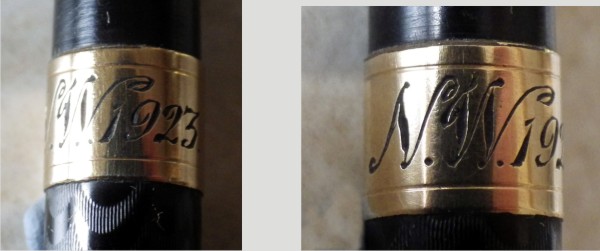
Yesterday I received a Swan 1500 in remarkably good condition.  Moreover, it was one of those pens with a story attached.  One of the two barrel bands is beautifully engraved: “N.W. 1923”.  In the box, on a Swan Christmas Pen slip of paper is, “To dear “little” Nor with love and all good wishes for Xmas and the New Year.  Xmas 1923.  From Ness.”
1500bands
By time Nor is being called “little” with inverted commas, we can safely assume that he (Norman?) or she (Norma?) is no longer little, but grown up, or almost so.  So this is a very adult present from a favourite aunt or family friend to someone about to make his or her way in the world.  That being the case, it’s unlikely they’re still around ninety years later this very year to tell us all about it.  The name and address on the bottom of the box is N Wilson.  As I have trouble reading the rest of the address, it would be impossible to hunt down this N. Wilson among all the others of the same name.

IMGP0855
It surpised me that the 1500 was still available as a new pen in 1923.  After all, lever filling Swans appeared in 1920.  People can be conservative, though, and stick with the tried and tested.  Evidently Ness was that sort of person.  But did little Nor prefer this old technology or would a self-filler have been preferred?  The latter, I fear, for though the pen had been inked (it took a few minutes in the ultrasonic cleaner to remove the ink from the nib) the pen is otherwise pristine with sharp machining and imprints.  As soon as little Nor got his hands on a lever filler, Ness’s birthday gift went in the drawer.

IMGP0862
The result is, of course, fortunate for us because we have a ninety year old pen in near-new condition.  So often when we come upon pristine old pens we are left to wonder why it should be.  This time we have a possible explanation.

One other thing, in passing, that struck me as different from other 1500s I’ve had.  Mabie Todd’s nibs were still being made in America at this time, though that was about to change.  Usually, such nibs are marked “New York”.  This one is imprinted “Made In USA”.
Mabie Todd Swan SF 2 (Yet Again)

IMGP0474

I’ve written about the Swan SF 2 several times before and I make no apology for doing so again.  They’re among my favourites, big, chunky pens which usually have nibs of character.
IMGP0477
My reason for highlighting this one is its remarkable condition.  Ninety years or so on from its date of production and it looks brand new!  A chased pattern as fresh as this gives a lovely textured feel in the hand.  As I’ve said elsewhere, Swan reached a zenith of design and manufacture in the nineteen-twenties.  This pen equals or surpasses just about every other pen made since, except maybe in colour.
IMGP0487
The two barrel bands add a touch of prestige to the pen, and closer examination reveals that they are solid gold and hall-marked, so quite a pricey pen in its time.  Was it reserved as a “special” pen and subsequently never used?  We’ll never know, but we can be thankful that we have the opportunity to see an SF2 in the condition it was produced all those years ago.