An interesting debate, and one that bears on the future of our hobby, I believe, is taking place in The Fountain Pen Board under Conway Stewart – The True History. This is the debate that was suppressed for years in Fountain Pen Network. I recommend it. It’s worth a read.
Month: June 2013
Montblanc Noblesse Slimline

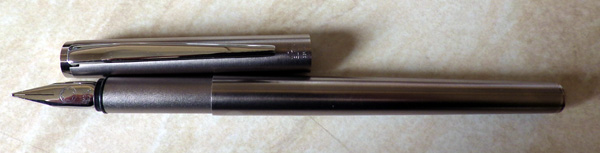
I didn’t expect that I would ever be featuring a Montblanc here but this one came my way and here it is. It’s not a Meisterstück, to be sure, but it’s a solid pen and I bet it didn’t come cheap. They never do. It dates to the seventies, I think, when these very slim pens were popular. It’s a cartridge/converter and it suffers from the same problem that afflicts all c/c pens: there are no interesting gubbins inside to tell you about. Once you’ve said it’s a cartridge/converter you’re left struggling in vain for something new and original to say that doesn’t apply to all the other cartridge/converters. It snaps shut with a positive and rather impressive click. It has a bird-splat on each end so that your work colleague will know that you have a Montblanc.

And it writes well with a consistent medium line. That’s about it. Oh, and it doesn’t post. I expect that’s a feature.
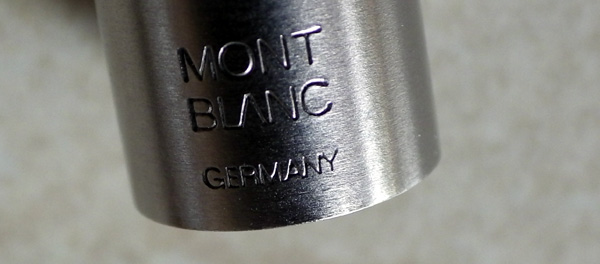
By the way, she said proudly, this is not my only Montblanc. I have a shiny black piston filler in my parts box with a cracked cap and no nib.
Another Golden Guinea Pen

I don’t think anyone has made a breakthrough since I last wrote about Golden Guinea (http://wp.me/p17T6K-u2). It’s still not known with certainty who made them.

Looking at this 1930s example, I strongly suspect that they were made by Mentmore. The whole impression of the pen reminds me strongly of Platignum at this time, especially the beautifully boxed colourful pen and pencil sets. Richly-coloured plastic unlike anything anyone else was using at the time, cap bands that are none too secure, tiny 14ct gold nib and button filling system – all are very like the Platignum output of the time. Was Golden Guinea one of Mentmore’s many sub-brands, or were these pens made for another company? For the moment we can’t tell, but I have no doubt all will come out one of these days.
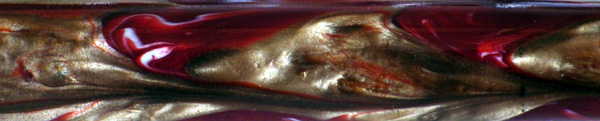
Be that as it may, this is a lovely pen, if only for the exceptional plastic that it’s made from. The filling system is efficient and the little nib is a smooth semi-flex.
Conway Stewart History Corrected
One of several annoying things about the present-day Conway Stewart company is the Soviet-style re-writing of history they present on their website. Though their only relationship with the original, long-defunct Conway Stewart company is that they purchased the rights to the name and trademarks, they claim the accomplishments of the original company as their own. In addition to publishing this nonsense on their site, it has been posted in Wikipedia, that magnificent source of dubious information.
To counter this disinformation, Andy Russell has made available, in .pdf format, a brief and accurate overview of Conway Stewart history. Go to Fountain Pen Board, seek out the post “Conway Stewart – The True History” and you can download it from there.
Many thanks to Andy for putting the record straight. The rebirth of dead companies is annoying enough to those of us who are interested only in the older pens, but at least the other re-born companies like Eversharp and Onoto have had the decency to mark a clear line between their output and that of their long-ago predecessors. Only Conway Stewart have had the brass neck to rewrite history to lay claim to the work of other, and dare I say better men.
Mabie Todd Swan SM100/63 Again

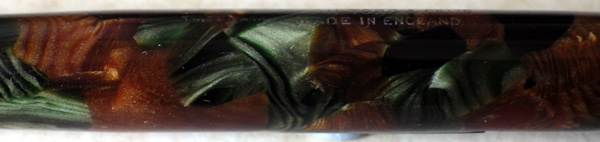
I’ve had these gorgeous pens from time to time; looking back through the blog I see I had one as recently as March 2nd this year (http://wp.me/p17T6K-CV). I always keep an eye out for another one because the colours are so beautiful.

This one has a nice flexible nib, too. It’s a delight to write with, but if it had been my working pen back in the thirties when it was new I would have got very little work done because you have to devote a reasonable amount of time to admiring the pattern. That would be a large part of the working day.
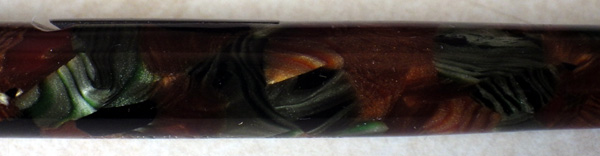
I can’t say much different from what I said back in March. These are just the most wonderful pens. One interesting thing: though they have quite a lot of jade in the barrel and cap, I’ve never seen one discoloured. Admittedly, this version of jade isn’t as pale as some others. Nonetheless it would not have surprised me if these colours were subject to damage from decaying sacs but it seems they are colourfast.
Chargers, Cameras and One Thing After Another
Nothing lasts, except maybe old fountain pens. This year I’ve had to replace a camera, a bread maker (nothing to do with fountain pens but woman cannot live by pens alone!) and now a universal charger. I bought the last one from Tesco not very long ago and I hadn’t used it very often. When I last went to use it one of the springs that hold the batteries in place had failed. Damn you, Tesco, and your shoddy merchandise! Between cameras, flashlights and various other doodads we use a lot of batteries so a dead charger is an emergency that needs prompt action.
The replacement is sold under the Duracell name so one would imagine it’s in their interest to ensure that it’s good. I hope so anyway. It came in the post today, and it was encased in that horrible, hard plastic that cuts you as you try to cut it. After much hacking and wrenching I got the charger out of the Packaging From Heck but not before it lifted a sizeable flap of skin on my knuckles. This pernicious stuff is of no benefit to the buyer. In fact it’s a menace. The only benefit is for the retailer. It’s like those annoying bubble-encased tablets that save the chemist having to count, but make the lives of the elderly and arthritic a total misery. Even those tiny metal batteries to power your watch come in an utterly impenetrable film of plastic.
Still, at least I can charge up my batteries and get the main camera going again. You’ll notice I said “main camera”. This is because when my old camera finally died I ended up buying two replacements. First I bought a Fujifilm X10 which is in most respects a wonderful camera – just not for what I need it to do. It has focusing problems when taking macro photos. I tried everything but couldn’t really successfully work around them. In the end, I went looking for another camera and settled on the aging but excellent Pentax X5. It’s perfect for pen photography. In fact it’s perfect for any photography but it’s quite big, so it’s the X10 that goes in my pocket when I go out.
I would really, really like the rest of my stuff to just go on working, please. All this purchasing is getting a little tiring, not to mention bank-account-emptying.
The Bury Pen

This is a Bury, an English-made pen I’ve never heard of before and about which I can discover precisely nothing. Was it made in Bury St. Edmunds? Is the pen so bad that it should be buried? Actually, no. It’s clearly a cheap pen. Going on the plastic feed and section, I’d guess at the early fifties. Whatever gold-alike substance was once on the trim has suffered quite a bit of wear.
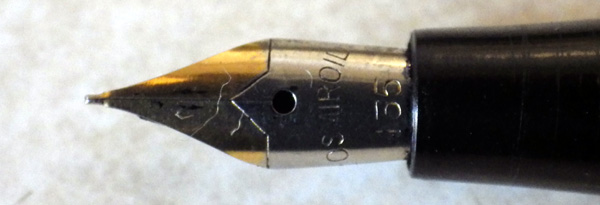
It has an Osmiroid 35 nib, the cheapo nib du jour from the thirties to the fifties. Having said all that, it’s robust and not without some style. If all you wanted was a pen to write with, this one would do – and it would serve you rather well for a long time, I expect.

But what’s it worth? Nothing. Zilch. Not a penny. This was one of a bunch of pens I bought for the sake of a quite good Parkette that was in it. I didn’t really want the poor Bury, and I suspect that no-one else does either. What does one do with these worthless pens that write and are actually rather good writers? What I’ll do is this: I’ll give them away for the cost of the postage, and I’ll find out what the cheapest method of mailing is to where you live. PayPal only. There will doubtless be others.
Anyway, my assistant is constantly on the look-out for good and interesting pens. She found one today, a glorious Swan SM 100/63, of which more anon. To save you looking it up in John’s estimable list, it’s the russet and jade one. Oh, by the way, there was discussion of John’s list on the Fountain Pen Board today – go and have a look!
Unique No 1 Pen & Pencil Set
As I’ve said often before, I’m not really a collector. Nonetheless, I have around thirty pens that I’ve hung onto because I found them especially interesting or attractive. They don’t have any great value and the next pen fancier along might not think much of them. One of the first pens I bought with the intention of keeping was a black hard rubber Unique No 51, made some time in the 1920s. The reason it appealed to me so much is the contrast it made with the last Uniques. Though still adequate pens, the 1950s Uniques were obviously placed low in the market, whereas the 1920s pens were extremely well made. They failed a little on the trim, but the design and machining of these early pens was very good, they are a pleasure to use and the nibs – at least on those I’ve acquired so far – are a smooth and flexible delight.
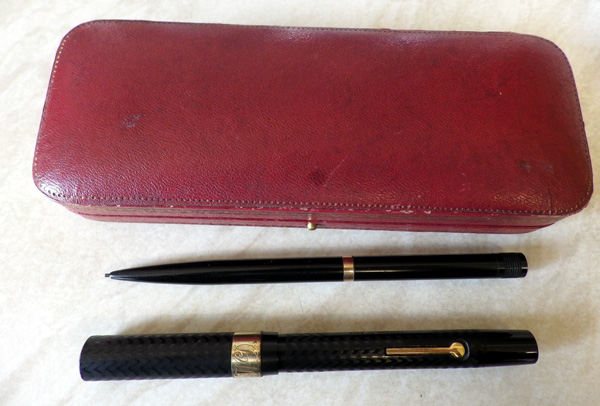
When this very fresh set appeared last week I put in a bid and got it. It arrived today, and I haven’t had time to restore it yet, so here it is in all its glory. The pen has been used enough to have acquired the very slightest fading to very dark brown. The pencil is pristine.

The Guarantee document is dated August 31st 1928, and it is assigned to EF Drury, 16 Chapel Street, Southport. The slightly tarnished cap band bears the initials WD in a flowing cursive script, so it was bought for a relative, perhaps a son or daughter. The pen, which is a Unique No 1, bears a strong resemblance to my No 51, with its deeply-cut engine chasing, clipless cap and concave section. It differs in that the nib is a warranted one rather than the Unique nib in the 51, but it’s a lovely nib with lots of flexibility.
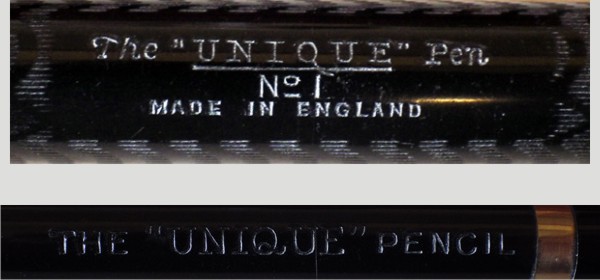
I’m impressed with the smooth, slender pencil in black hard rubber, bearing a single gold plated band. I wondered if it was still in working order, and a slight twist of the knurled end produced the lead at the business end. The plush-lined leather (or imitation leather) box is in good order and still retains its gold trim. As well as the guarantee, the box contains filling instructions and a price-list for replacement parts. A nib would cost you two shillings and sixpence and a cap was only a shilling. You are reminded to send fourpence for the return post. Today, a nib would cost you around £25 if you could find one to fit, and caps are rarer than hen’s teeth. Oh, and the postage would be more than £4.00!
Edited to add: Where are all the 1930s Uniques?
Mabie Todd Pen List Live!
John Brindle’s list is available now here. I’ve also added the URL to my blogroll, down on the right-hand side of this blog. Many thanks to Martin Holloway who made a splendid job of creating the site.
As well as being a useful source as it stands, John’s list provides an excellent start-point for further research.
A Jade National Security Button Filler
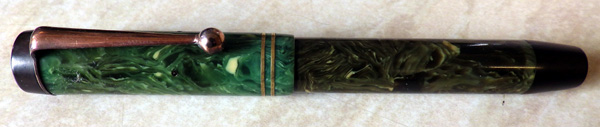
This National Security button filler is an unashamed copy of the Parker Duofold. If it was a Duofold the twin cap rings and streamlined profile would date it to the early thirties and that date will probably be right for this pen too. I have no doubt that it was made for National Security by Valentine, as they seemed to have carte blanche to copy Parker pens for their own range and for those pens they made for other companies.

I haven’t set to work to restore this pen yet. Like many jade pens it has a fair degree of discolouring on the barrel, though the cap is as fresh as the day it was made. There’s nothing I can do about the discolouration but it isn’t really unattractive. The warranted nib has no tipping material left, so I’ll have to find a replacement. That indicates a lot of use, but the barrel imprint is sharp and clear.
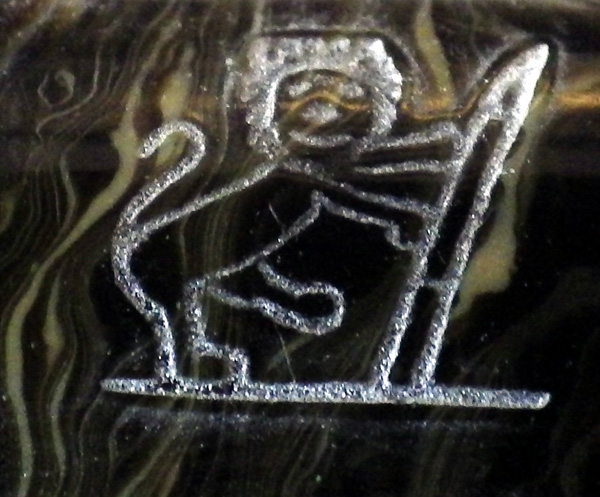
I’m very fond of the smiley lion. He’s my avatar in Fountain Pen Board, though that example was on a lapis lazuli pen.
National Security pens are by no means rare but we know surprisingly little about them. They along with Rosemary were the house brands of British Carbon Papers. Other than the fact that they were wound up in 1948 I can find little information on BCP. They shared premises at Farringdon Ave with Henry Stark, Son and Hamilton who made most of their early pens, while later ones appear to have been made by Valentine and Langs. Apparently BCP was not popular with the rest of the pen industry as they refused to join the price-fixing arrangement of the time and undercut their competitors.
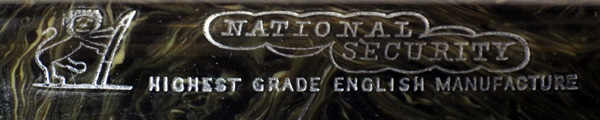
A tremendous range of pens was sold under the National Security imprint, and you never know what you might find, from obvious Duofold copies like this one, to bulb-fillers and snake-skins. They’re very collectable.
 Goodwriterspens's Blog