Re-blacking Again (and again and again and again…)

There is discussion of restoration materials, namely re-blacking and waxes, in Fountain Pen Geeks. I would continue posting there, but what I have to say on the subject is (as you might expect) a little long-winded for a board comment.

As a restorer, I believe that one should do the minimum necessary to a pen to bring it to good working condition and an acceptable appearance. If you want old pens that look like they came from the factory yesterday, try another restorer. I don’t do that kind of work.

Re-blacking is irreversible, no matter which method you use. Even Syd Saperstein’s Potion No 9, which does not remove any material, cannot be fully reversed. It will wash off smooth surfaces, but removing it from chasing and the marks a pen acquires over decades is very difficult or actually impossible. Methods that depend on removing the oxidised layer will also remove detail of chasing and imprints. Then, of course, it will oxidise again. So what do you do? Remove more surface layers?

If you have a common and inexpensive old hard rubber pen that has turned absolutely yellow with oxidisation, and you have no intention of selling it, then it seems to me that there is no great harm in using the latest product to come on the market to re-black it. It apparently removes very little material and it may make your pen more appealing to you for a time. It may fade again. After all, some black hard rubbers are more prone to fading than others. It may, for all we know, dissolve into a puddle of goo some way down the road. We don’t know the long-term effects of any of the current products. By time we do it may be too late.

My strongest word of caution is: don’t re-black uncommon and/or expensive pens. We have a duty of custodianship to our pens and to the hobby. Old pens are important historical artefacts and should be treated as such. That’s not to say don’t write with them, or keep them in a glass case but it seems sensible not to coat them with chemicals whose ultimate effect we don’t know. Black hard rubber is very durable and, left alone or conserved with the minimum of intervention, these pens will last a very long time. Using inappropriate substances on them may, in the long term, destroy them.

Most oxidisation is not unattractive. Careful hand polishing will make most hard rubber pens look good. That’s all that I do with the pens that pass through my hands.

I don’t have much to say about the use of waxes. I don’t believe they have a place in pen restoration. All, so far as I am aware, have been shown to contain chemicals that are, at the very least, dubious. Some attack metals. All seal the surface of the pen which doesn’t seem all that clever a thing to do. They are very, very hard to remove. They produce a wholly unnecessary gloss. Why do it?

Over the last decade I have seen the supply of old pens begin to reduce. Nobody is making any more old pens! We must look after those we have and that includes using a minimum of chemicals and only those we know to be trustworthy.
Waterman 52 (Again)

I’m sure I’ve written about the Waterman 52 before but as it’s a superb pen it’ll do no harm to eulogise it again.

Its immediate ancestor was the Waterman 12, and when the company brought out their lever filler it became the 52, the five denoting the lever filling system and the two for the size of the nib.

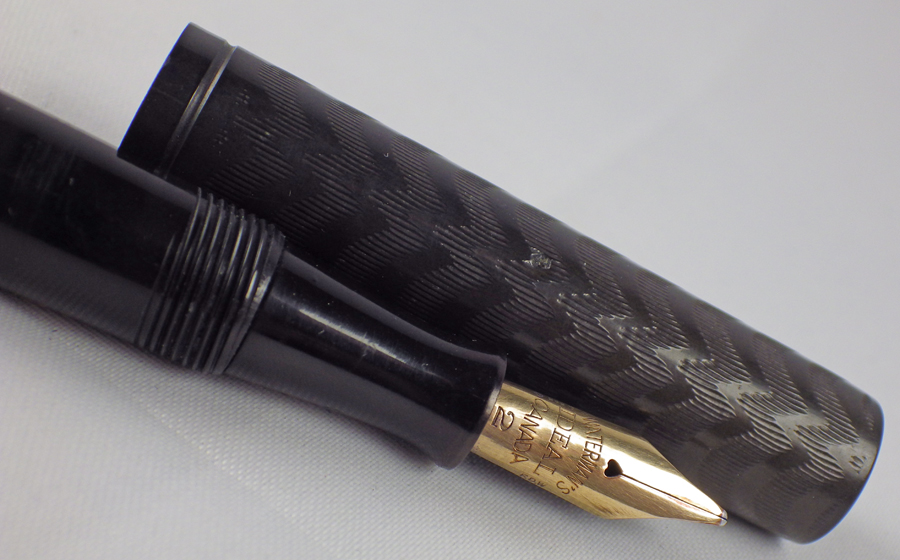
When you find a black one these days it’s usually quite faded and if it’s chased the pattern is well-worn.  This one has retained its original blackness and the chasing is sharp.  Perhaps it wasn’t used very much because it had a damaged nib.  The pen is US-made but it now has a Canadian flexible stub nib, a real beauty.

52s as you may be aware, came in a variety of guises.  There was the plain black hard rubber, then the chased version, like this one.  Rather rarer and more desirable are red hard rubber versions and the lovely ripple hard rubber in different colours.  If you wanted to spend a bit more you could have various cap and barrel bands and the most expensive models were encased in gold or silver overlays.

I like hard rubber.  It’s a great material and I’m grateful to Waterman for sticking with it as long as they did and making so many pens from it.  It didn’t do the company any good though, as the public wanted patterened celluloid by the 30s, and Waterman sales went into decline.  By the time they changed they had lost market share and they never quite recovered from it.  They made a celluloid 52 – same shape and size and same nib but for me it lacks the character of the hard rubber version.

The Waterman 52 was not an expensive pen when it was new.  Rather, it was a good quality pen for everyman.  Now as David Isaacson noted in his excellent blog* a couple of years ago, it has become an expensive pen.  This is due to the mistaken belief that all Waterman 52s have flexible nibs.  Some do, most don’t, but even a faded and battered example will cost you considerably more than a good one would have done a few years ago.

Pen prices are rising across the board, but the present high demand for pens with flexible nibs has distorted the market.  Various modern manufacturers are offering what they describe as flexible nibs but so far none of them approach vintage pens in that quality.  I really hope that someone comes up with a very good flexible nib soon, so that we can get back to a situation where the only people chasing vintage pens are those who really want vintage pens, not just a flexible nib.  I even hear of people putting vintage flexible nibs in modern pens.  For me that’s just desecration.

http://vacumaniablog.blogspot.co.uk/

Selsdon Ballpoints

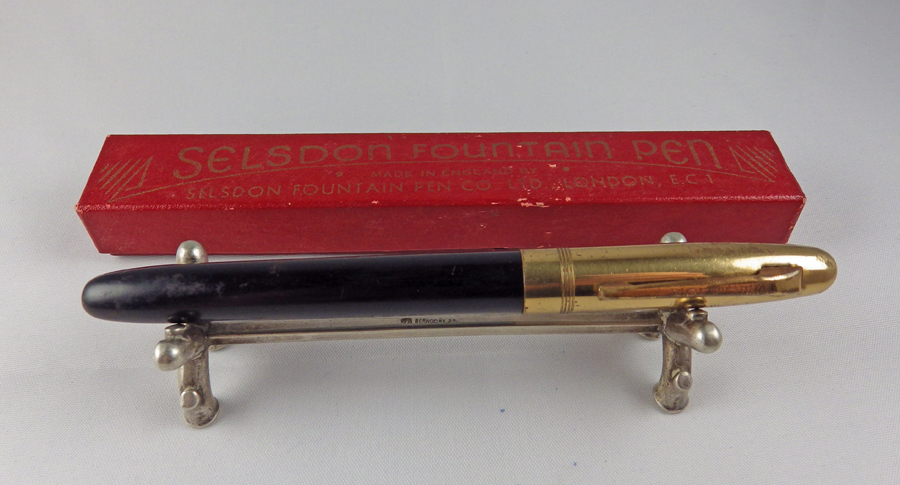
I bought a bunch of pens in a lot. There was nothing terribly exciting in it but it was cheap. There was a Waterman CF, a pen that I like, a Queensway with a stub nib and two Selsdons. I like Selsdons though their pens are often low-cost and it shows. They made some fairly decent ones too along with usable pencils. They appear to have experimented with plastics with some success. Selsdons generally restore well.

When the batch of pens arrived, the Selsdons were ballpoints! The seller hadn’t chosen to mention that and the pens were closed in the photographs. I considered returning them but I’d paid so little that I could bear the disappointment over the Selsdons.

Anyway, they proved quite interesting. According to the accompanying bit of paper, these ballpoints were made in 1948. That’s early days for ballpoints and they were not particularly reliable then. When I opened them, they were a mess of ink which had leaked out of the refill into the barrel. The refill is at least twice as wide as any modern one.

Though there is no money in it – ballpoint collectors are few and far between – I would love to bring these old ballpoints back to working condition. I’ve ordered a couple of refills that look as though they could be adapted to fit.

They are very like the fountain pens of the day in appearance, with their tapered barrels and gold coloured caps, held by a clutch ring. They actually look quite elegant, though I suppose they didn’t work well for long, based on the leaking in the barrel.

It didn’t take long before ballpoints began to assume a distinct shape of their own. It was in the 50s, I think, that Mentmore invented the clicky ballpoint with a point that came out and in of the barrel operated by a button on the base of the pen. Then Bic and Staedtler reduced the ballpoint to its absolute basics and gave the world a ballpoint that was made to be thrown away when the ink was used up. That doesn’t seem such a good idea now, in this polluted world.

I expect that Selsdon ballpoints were moderately expensive and the company expected that they would be treasured by their owners for years, replacing refills fairly frequently (they are quite short). Perhaps they were.

Heft

I read a review today about an Osmia. It was a good review, well written and nicely illustrated, but it raised an issue that always bothers me. The piston mechanism of the pen is metal which adds considerably to the weight. The reviewer equated weight, or “heft” as he put it, with quality.

It’s a recent idea to regard weight in a pen as a sign of quality. If heavier is better, then cheap Chinese pens must be best of all, composed as they are of lengths of brass tubing.

Frankly, this thinking makes no sense to me. Producers of writing instruments, whether fountain pens, mechanical pencils or even ballpoints, have never aimed for increased weight until recently. To my mind, as someone who has used fountain pens for decades, often for many hours at a time, the nearer to zero weight a pen is, the better. The best pens I have ever used have been hard rubber or celluloid Watermans, Wahl Eversharps, Onotos and Swans. The heaviest thing about them was the ink they contained.

Personally, I’m inclined to believe that the preference for a heavy pen indicates that the owner values other aspects of the pen over its writing qualities, and doesn’t actually fill a lot of pages. Indeed, it’s only since the fountain pen ceased to be one of the main ways of getting words on paper that weight has been seen as an indicator of quality.

The other main writing instrument until recent times was the wooden pencil. Millions of clerks filled millions of ledgers with all the indicators of business from production to sales and most of them did it with wooden pencils, sharpened until they were no more than a stub. So far as I’m aware, it was not a common complaint that pencils didn’t weigh enough, or that they would write better if they weighed more.

I’m aware that I may be falling behind the times, but I dislike heavy pens. I find them tiring, and from a purely practical point of view, they offend my sense of efficiency and good design.

Your mileage may vary of course.

Mechanical Pencils

I often buy mixed lots of writing instruments for the sake of a pen among them that I particularly want. Then I am left with various odds and ends of pens that have little value and the usual collection of old mechanical pencils. In a way, I’m surprised that they’re not more of a collector’s item. They seem to me to be a perfect example of the small object of desire: often beautifully finished, technically interesting and quite low cost.

I am gradually learning a little about them and I can usually load a new lead if I happened to have the right size. Sometimes it goes wrong though. Yesterday I prepared to load a new lead in a Parker Duofold pencil. Before my astonished eyes it fell apart and nothing that I could do would induce it to go together again. Most disappointing.

I don’t think I will ever go out of my way to buy vintage pencils but I must continue learning about them because they so often appear in mixed lots. If any among you has the skillz, I would love a tutorial on mechanical pencils.

Nails

When I first became interested in old pens my everyday writer was a Sheaffer  Targa, a sturdy and reliable pen that laid down an unvarying line.

One of the first old pens I found was a battered old Eversharp.  No amount of restorative effort was ever going to make it look good but that wasn’t important.  What made it so valuable to me, such a source of wonder, was the beautiful line made, varying from fine to broad with the least pressure.  That wonderful line made my writing look so much better!  From then the hunt was on for pens with flexible nibs and for years I never wrote with anything else.  When I developed a passion for British pens it was the glorious super-flexible Swans and Onotos that I kept for myself.

Pens with inflexible nibs were dismissed as ‘nails’, said with a hint of contempt.  All modern pens in those days had inflexible nibs so they didn’t interest me.  I loved the Onotos, Swans, Watermans and Wahl-Eversharps.

A few years ago I was in correspondence with another fountain pen fancier.  His interests were almost opposite to mine.  His collection was of Parkers, both American and British, Conway Stewarts and modern pens like Pelikans and Pilots.  He enthused about their wonderful writing qualities.  I couldn’t see it.  Those pens were dull and uninteresting to me.

It occurred to me that a large proportion of vintage pens and all new pens were inflexible and yet they all sold well.  People evidently liked them.  I began to consider that I was limiting myself by dismissing all those ‘nails’.  I made a conscious decision to lay aside my beloved flexible pens and try the ‘nails’ for a while.

At first, and for quite a while, I didn’t enjoy those inflexible pens.  I tried quite a few and it seemed to me that they were little different from ballpoints except that they didn’t need pressure and you could hold them at a better angle.  I persevered though, and I found that I did get a modicum of pleasure from fine points.  They demanded accuracy of letter formation and rhythm in the line.  When I could produce writing that looked good – to me at least – with a fine point, I felt I had gained something.

It opened other doors for me in a sense.  Now I could enjoy other pens I hadn’t understood before.  For instance, among my favourites are a Parker 45 and a Parker 17, pens I had completely dismissed before.  I enjoyed the convenience of the Vanishing Point.  I experimented with other Japanese pens and tried Chinese and Indian ones.  I still have semi-flexible and full flex pens and I still enjoy using them but I am thankful that my pleasure in fountain pens is no longer limited to them.  On the odd occasional I’m asked to produce invitations or place cards and that’s where those flexible pens can add charm and, yes, beauty even in my hand of write, but when I’m busy at my desk, corresponding with customers or taking notes for an article, it’s usually either my Parker 17, my Platinum 3776 or my Pilot 1911 that comes to hand.

Which Is The Best Filling System?

I expect I’ve written about this before but after all these years I’m entitled to repeat myself now and again!

I understand that many people – particularly those who like to try a lot of inks – enjoy what they regard as the convenience of the cartridge filler.  For myself, I have little interest in inks and I regard that system as an inelegant solution to the problem of getting ink into a pen.  It’s expensive and wasteful.  I appreciate that you can refill cartridges but I suspect that not many people do.  The converter option is a little better, but I still feel that it’s poor engineering that demands that you pull a pen apart every time you have to fill it.  Many converters seem to hold a very small quantity of ink, too.

Another relatively modern solution is the Aerometric, Parker’s improvement on the old squeeze filler.  At least it enables the use of bottled ink and it gives the pen a decent charge but, once again, there’s this business of pulling the pen apart to fill it.  I find that unsatisfactory.

I like sac fillers and I don’t see a lot of difference between the varieties:  lever fillers, button fillers, crescent fillers, matchstick fillers and various more esoteric methods.  They – allowing for the size of the pen – hold a decent amount of ink, are easy to operate and easy to service.  Over the decades inventors of sac filling systems showed a lot of ingenuity, though it might be said that none of these solutions are tremendously elegant.  They’re a little Heath Robinson and perhaps that’s part of the reason why we like them.

There is a variety of pens describe as vacuum fillers, not the best of descriptions as most pens fill by creating a vacuum.  There’s the Parker variety, essentially a bulb filler with delusions of grandeur.  In some ways it’s a good system, easy to use and giving a huge draught of ink but it’s complicated to service and in many cases has a comparatively short time between services.

The Sheaffer and Conklin versions are inferior copies of the De La Rue Onoto plunger filler.  Unlike the original, they do not appear to have been designed with servicing in mind.  That said, while they’re working they both provide excellent filling, easy to use and capacious.

I don’t know if anyone makes a basic bulb filler these days.  Langs and Mentmore made a variety of them in the 30s, some quite sophisticated and not all that different from the Parker vac.  When they were new they were probably good but as time and wear acted on them they suffered more and more from the major problems of many ink-in-the-barrel pens, blotting and leaking.  A big bulb filler holds enough ink to create considerable mayhem and that was probably the reason that they never became all that popular and were often a low-cost solution.

Another economical system that has been pretty well abandoned is the syringe filler.  Again, it may suffer from leakage problems and it’s clumsy, having a long activator filling most of the barrel when it’s extended.

What does that leave us with?  Well, there are Sheaffer’s various ink sac and plunger pens like the Touchdown and Snorkel.  They’re fun and they certainly have their adherents but as a filling system their limited capacity works against them.

Then there’s the good old eyedropper filler.  Well, it’s old.  I’m not so sure about good.  The system was pretty hastily abandoned the moment an alternative came along and that must tell you something.  There are many people today who delight in converting all sorts of pens into eyedroppers.  All I can say about that is that the pens are theirs and they’re entitled to do whatever they want with them.  I had a modern eyedropper once, a very large Indian Wality.  It was the worst pen I have ever owned, dripping ink every time you looked at it.  I’ve had Wality pens with other filling systems that were great.

Now we’re getting down to it.  There’s the piston filler and when it’s properly executed, as most German manufacturers seem to have managed so well, I think it’s one of the top two efficient, capacious and elegant filling systems.  The other one that I think is as good if not better is the Onoto plunger filler that I mentioned earlier. It’s one of the first self fillers and remains about the best.

I’ve probably missed a few systems, like the Parker 61 capillary filler.  Actually, that’s a good filling method, provided you don’t want to change the colour of ink you’re using.  If you do, you have to clean it out thoroughly, and that may well occupy a day or two of your time.

Naturally, I don’t expect everyone to agree with me.  In fact, I’ll be delighted to hear your counter-arguments provided they are backed up with reasoning and evidence.  “You suck!  Cartridges are great!” doesn’t really count as a cogent argument.

The John Holland Hatchet Filler

The John Holland company was around for a long time producing writing instruments of one kind or another. The company finally stopped making pens in 1950 but continued selling other items until the doors finally closed in 1980.

The glory days, however, were in the first 20 years of the 20th century. It was during that period that the company experimented with a variety of filling systems. It is said that they did so to avoid Waterman’s lever filler patent. The first successful method is known as the saddle filler. A metal button on the barrel held a loop which surrounded a pressure bar and sac. Lifting the button brought the pressure bar to bear on the sac, to enable it to draw in ink. This was quite a successful and efficient filling method.

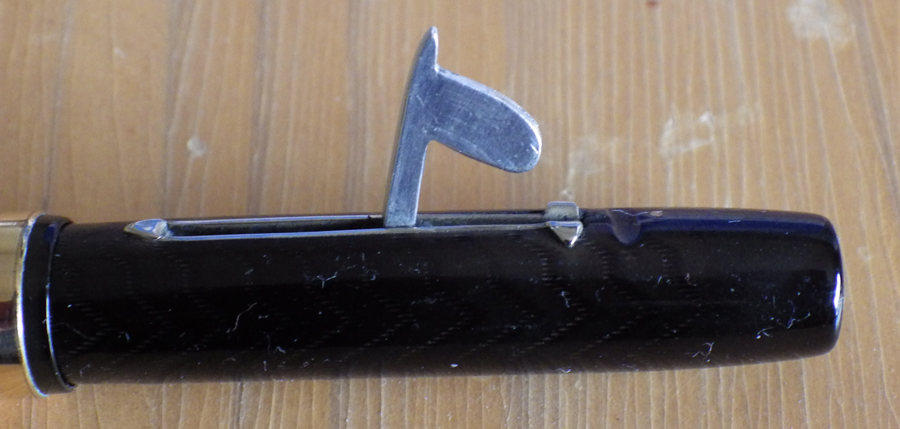
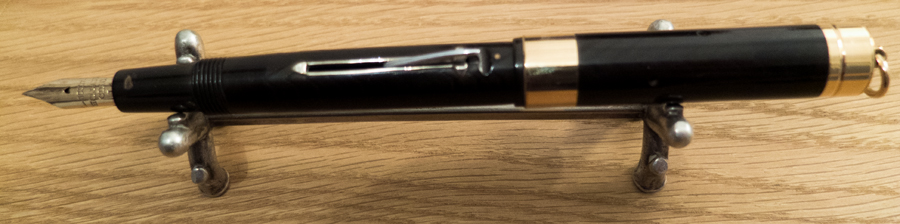
The next, and better-known method, is the hatchet filler, of which this is an example. At first glance it resembles a lever filler but the actual means of drawing ink into the pen is quite different.

Here the “hatchet” is shown elevated, ready to be pressed down on the pressure bar and sac as the nib is immersed in the ink. The hatchet is then released, allowing the ink to flow into the sac. The hatchet is then returned to its original position disappearing into the barrel.

Because space has to be allocated for the hatchet at rest, this method is not as efficient as either the saddle or the lever filler. In operation it resembles the crescent filler made by Conklin. In a sense it’s better, in that the mechanism is concealed and does not protrude but that’s at the cost of less ink being loaded at each fill.

After 1920 John Holland began to make lever fillers which did not stand out from the crowd of smaller fountain pen manufacturers. For a time they made strikingly beautiful fancy pens which have become popular and valuable but were not technically outstanding. The company is most remembered for the hatchet filler.

Sheaffers

As well as the varied products of our own thriving fountain pen industry, some foreign pens also sold well here. French pens didn’t seem to catch on. There were always some German pens around, mostly Pelikans. Most popular, though, were American pens. In order of popularity, I suppose, it went Parker, Waterman, Sheaffer, Wahl Eversharp and then odd examples of the rest.

My preference for these vintage pens runs a little differently. Sheaffer, Waterman, Parker would be my order, I think. I admire Sheaffer’s build quality and the ingenuity of their designs. Not that they got it perfectly right all the time: their Vac filler is an inferior copy of the Onoto plunger filler, designed to be disposed of rather than repaired when it inevitably failed. The snorkel is a complexity too far, only really coming into its own in large capacity pens with fine nibs because there’s so much technology in there that there is little room left for ink.

Those minor complaints aside, the rest is design and execution of the very highest quality. Their experiments with nibs were hugely successful. The variations of the Triumph nib are all a delight, both visually and practically. The later inlaid nib is elegance itself. Though, for the most part, Sheaffers are not pens for those who require flexible nibs, their other fine writing qualities are more than enough to compensate for the rest of us. I love a nail if it’s a nail that never skips or falters, gives just the right amount of feedback and always starts right away. That’s a Sheaffer nib! Even the little Stylepoint nib which was used on some of the Lady Sheaffers and other pens, though not as aesthetically impressive to my mind, is a splendid writer.

Sheaffer, of course, ceased to be Sheaffer in the end, passing through several hands and gradually losing the quality and identity that had made it a star of the fountain pen world for so long. The last new Sheaffer that I bought was an Intrigue. It disappointed. It was ridiculously heavy for its small size and it was poorly put together. The filling-system was unduly complicated and seemed designed to fail. Worst of all, it was a hard starter. It took a considerable amount of nib work to put that right. It was the first moderately expensive pen I bought that didn’t work properly out of the box (though there have been plenty since!) I didn’t keep it for long.

Thankfully, as other pens have become rarer, old Sheaffers are still quite common. Even the slightly more modern ones, cartridge/converters, are still splendid pens with great nibs, generally available at a bargain price.

I confess that I have no idea what sort of fountain pen comes out bearing the name Sheaffer these days. I rather lost interest as their products became more generic with little or nothing to make them stand out from the rest of the pack.