I’ve written about the Ty-Phoo pen before but it’s well worth another mention. Ty-Phoo believed that interaction with their customers was a good form of advertising. As well as the pen there were sets of collectible cards and printed materials for schools in which they informed pupils about how well they treated their workers in the then Ceylon (!)
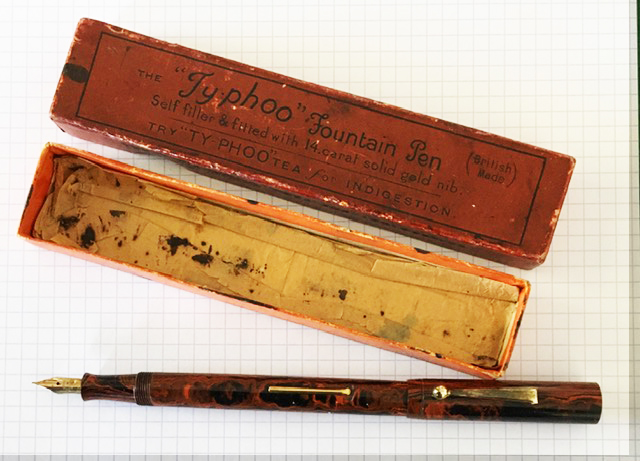
This particular pen belongs to Rob Parsons. It’s a splendid example and looks as if it hasn’t been used. The box is shabby as it might well be after kicking around in a drawer for ninety years. It has the full paperwork including, uniquely, the covering letter, complimenting the recipient on collecting all the coupons necessary to obtain the pen.

There has been much discussion over the years about the origin of the Ty-Phoo pen. It doesn’t closely resemble any of the production pens of the time and could have come from any of the factories. I’ve always favoured Wyvern, not from any evidence, but because that company especially was in the business of making pens for others. The mottled hard rubber version, like this one, is a beauty. One might say that the warranted nib is smaller than a pen of this size would seem to require but bearing in mind the price of gold and that this pen is essentially advertising, I would say I’m glad they stuck with 14ct gold and didn’t go for plated steel.
This form of advertising was not uncommon in the twenties or thirties. Several newspapers offered pens in the same way, with coupons cut from the paper. It made people buy the tea or the paper and it got talked about. By time you had collected all the coupons you may have grown to prefer the tea or the paper.
It won’t be long until the older, lever filled filled Ty-Phoo pens, like this one, are genuine, century-old antiques. It is a testament to their quality that so many have survived in such good condition.







 Goodwriterspens's Blog