What to do with the Longest Day
But send some fountain pens your way!
Conway Stewarts, Swans and such;
I hope you’ll like them very much!
What to do with the Longest Day
But send some fountain pens your way!
Conway Stewarts, Swans and such;
I hope you’ll like them very much!
It’s wonderful when I find a pristine pen, perhaps eighty years old with shining black hard rubber and immaculate gold plating. That doesn’t happen all that often. Many old pens I find need quite a lot of work to look presentable. Unlike some restorers I don’t aim to present a pen looking like it just came from the manufacturer. If it’s an old pen it will show its age. That’s part of its attraction.

Sometimes, however, I come upon a pen that is barely recognisable as what it once was. That’s the case with this Swan Leverless. Someone with good bodging skills went to work on this pen. Perhaps the pressure bar had broken off – it can happen with these pens.

In any case, he decided to fit a different filling system. The aerometric filler came from a Parker, maybe a 17. The job has been well done and the pen fills and writes well. What impresses me most is the back end of the barrel. The turn-button has been removed and the barrel closed off very neatly. The clip has been replaced with one that fits very well though it is not a Swan clip. Again, the work has been done well.

The nib lets it down, one of those two-tone ‘iridium tipped’ nibs that you sometimes see on Chinese pens. It’s not a bad nib but it’s inappropriate for this old pen. I’ll find something better, maybe a Swan nib, maybe not. It will be a 14 carat gold nib anyway, perhaps one with some flexibility.
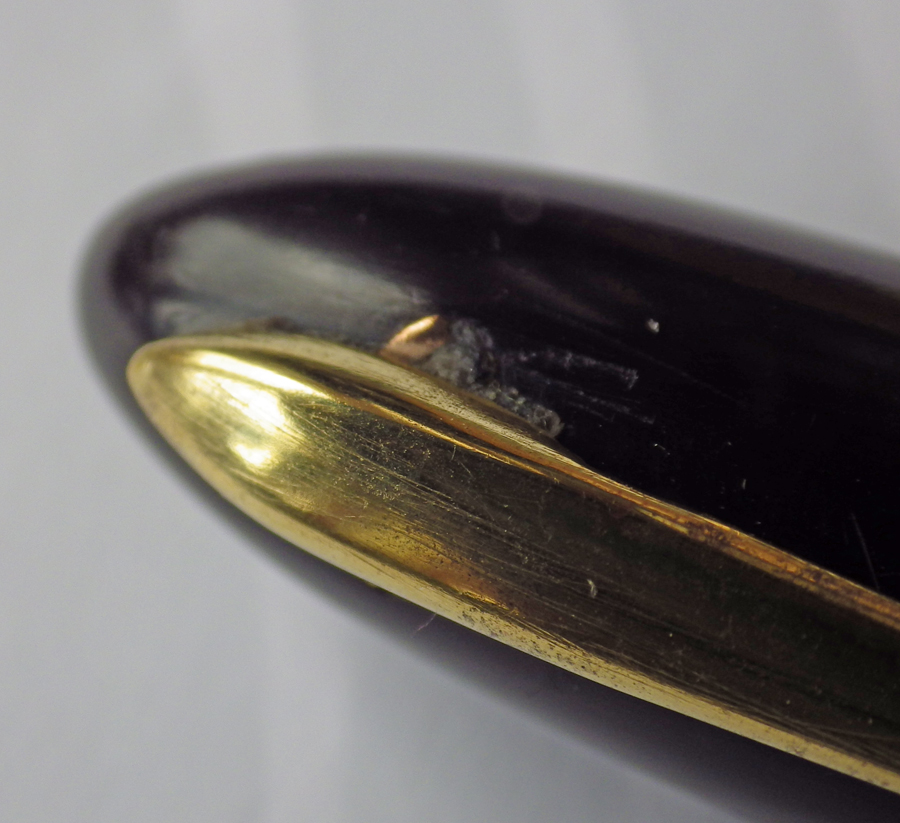
Given the changes this pen has undergone, it is perhaps the ultimate Frankenpen. I’m quite impressed with it. It’s unique and it’s a pen of character!

My assistant isn’t much help these days. The weather is good and she’s hanging around outside, eyeing the birds and beating up the neighbour cats. She said, “You can have your Blackbirds and Swans. I’d rather have a goldfinch!”


We’ve had much discussion about the otherwise rather ordinary Pitman pens, on the subject of their origin. Consensus was that several manufacturers were involved over the years. Peter Greenwood has kindly drawn my attention to this Pitman which sold on eBay recently.
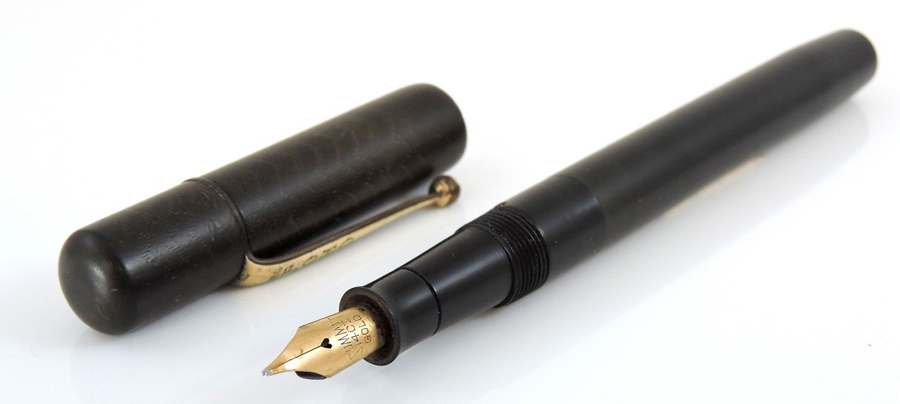
The photographs* show a fairly worn barrel imprint but the number 760 is visible. This was a model number used by Altura for a very similar – if not identical – pen sold under their own brand.
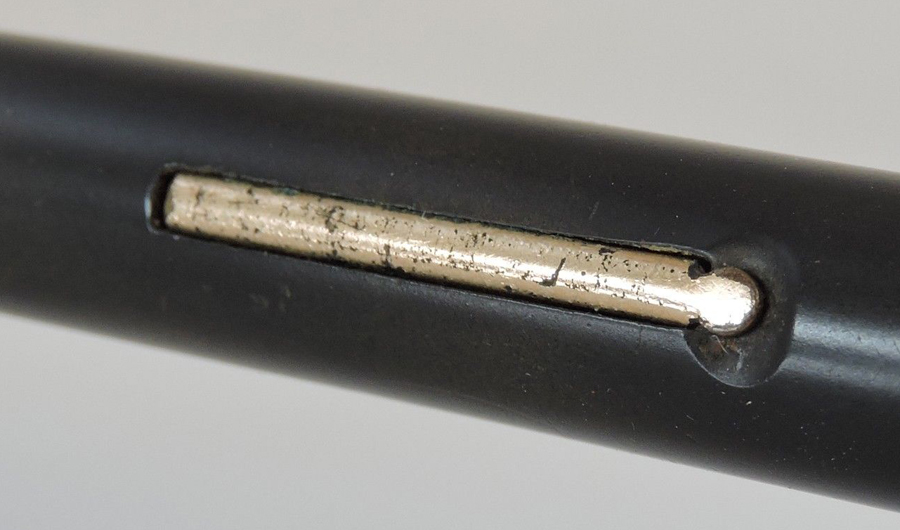
Could it be that most, if not all of the late 1920s and 30s Pitman pens were made by Altura/Waterman?
*Thanks to ashton_mill_auctions for permission to use their excellent photographs.

I’ve written about Stephens fountain pens before, though I’ve hardly provided a comprehensive history. The search box in the upper right will lead you to the earlier posts. Stephens pens are highly regarded for their colourful patterns and for what was probably the best button filling system of all, often referred to as the Stephens stud filler. Where it excelled was in the screw-down filler. Unlike other button fillers there was no blind cap to be mislaid.

Stephens didn’t make their own pens. At the peak of their popularity they were made by Langs and it was Langs who invented and patented the screw-down system. This post attempts to fill out the history of this brand by highlighting an unusual pen in the ownership of Peter Greenwood. My thanks to Peter for the photographs and information.
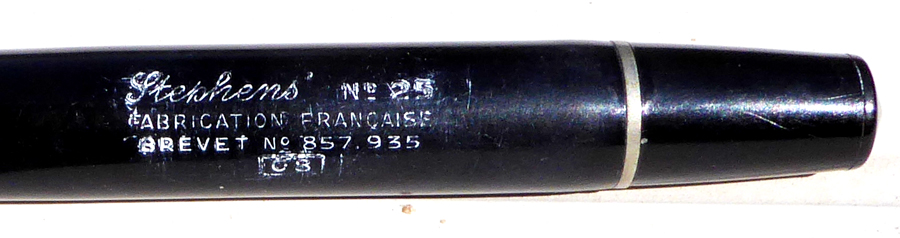
This rather unusual Stephens was made in France and bears the stud-filler which must have been licensed from Langs. The pen has been well-used and has lost its cap rings. It bears the patent number 857 and is dated 1935, making it an early example of the Stephens fountain pen. The steel nib, marked warranted and bearing what might be a seal’s head, is most likely a replacement.
 Andy adds: The patent was actually applied for in July 1939 and published in October 1940. The confusion arises from the way the French numbered their patents – the impression on the barrel is actually the complete patent number 857.935. The applicant was Compagnie des Encres, the French manufacturing company set up by Stephens some 10 years earlier. This possibly makes the pen more interesting, as it is quite likely it was produced while France was under German occupation.
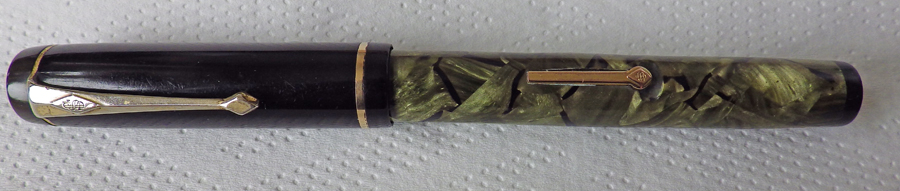
Here’s one of those wartime Conway Stewarts, when they mixed patterned barrels and black caps because of shortages. Actually, no it isn’t. I’m telling you lies (slaps wrist). Though Conway Stewart did mix and match in the way I describe this isn’t such a pen. This poor pen met with a serious accident involving pressure and heat, like maybe somebody dropped a hot soldering iron on it. The cap was smashed and there was a severe indentation on the barrel near the threads.
At first I thought it was only suitable for spares – it has a nice No 5 nib and the plating of the trim is spotless. Then I thought I might recover the barrel. I removed the section very carefully with a lot of heat, expecting every second that the barrel would crack. It didn’t! Success! Then I found that the remains of the sac were welded to the barrel and the pressure bar. I soaked it with naphtha which has the effect of making the sac more brittle so that you can break it out.

I re-sacced it and cleaned it up. It looked lovely. I searched through my spares for a matching cap but though I had some green marbled ones they were quite different from this unusual patterned barrel. Then, remembering the wartime Conway Stewarts I settled on a black cap. If it appeals to you, keep an eye on the Conway Stewart section of the sales website.

This is a handsome lever fill Onoto, probably 1940s. It has an excellent De La Rue 22 nib, medium, wet and with easily induced flexibility. It is noticeably tapered at both ends, has the ‘waterfall’ clip and a neat little black hard rubber tassie. In all respects it appears a very superior pen!

It has a very Watermanesque box lever and in the barrel there’s a hanging pressure bar, also just like the Waterman. The resemblance is so close that it’s reasonable to assume that De La Rue had licensed the patent from Waterman. It’s so typical of De La Rue. They had the best plunger fill system and when they decided to have a lever filler they went for the best there was.

Gorgeous pen. The phrase “they don’t make them like that any more” applies here!
I haven’t been writing much here recently. My only excuse is that the weather has been so good that the garden has taken precedence. I would repair pens outside if I could but it wouldn’t work out! I haven’t neglected my duties altogether, though. I got hold of some Conway Stewart pens and pencils and here they are:
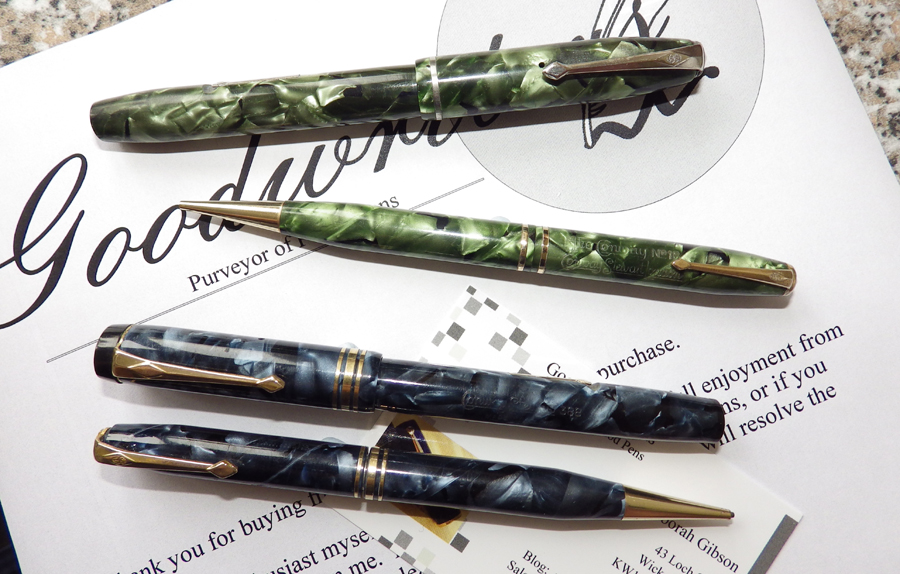
They were rather in need of work when they arrived. The pencil that accompanied the 388 was missing the clip and clip screw and it didn’t propel or repel. I found a suitable clip screw among my spares and when I stripped the pencil down I cleaned out a considerable quantity of graphite and it worked well again.
The 75 had met with an accident and the nib was quite wrinkled. A while with Laurence Oldfield’s excellent nib straightening equipment restored it to its original shape. The pencil that came with it is not the correct one; it has gold plating whereas the pen is chrome plated. Though the pattern is not exactly the same it is similar and I plan to keep them together.
The Conway Stewart 388, like the 55, retained an older type of design into the post-war period when the rest of Conway Stewart’s product line was more tapered and modern looking. Judging by the numbers that remain available today, the 388 was a market leader. It’s a splendid pen and the rounded profile of the 5N nib makes for an excellent writer.
The 75 fell into the lower middle in terms of price. The chrome rather than gold plating indicated a less expensive pen but the presence of a cap ring meant that it was not among the cheapest. It has a decent sized nib and these pens feel good in the hand. The marbled pattern is very attractive.
I never clip a pen to shirt or jacket so what is the clip for? For me, in use, it has the benefit of keeping the pen from rolling off the table. Otherwise, it’s a means of advertising the manufacturer and many have been the brilliant designs devised.
The earliest fountain pens did not have clips. The pen was desk furniture and there was little thought of carrying it on one’s person. Indeed it would not have been wise to carry some of the early eyedroppers; fine writing instruments on the desk but an accident waiting to happen when attached to clothing.
First came accommodation clips. Most of those available “over-the-counter” were quite clumsy things, brass or white metal plated with gold or chrome. Ones made by pen makers were better: Mabie Todd’s “Clipper” is light, elegant and bears a durable finish. All accommodation clips have their problems, though. They tend to overbalance posted pens and their finish is often not durable, spoiling the effect of the restored pen. Tightly fitting clips on hard rubber pens, in place for a century, can be tricky to remove. When caps are fragile the clip has to remain in place.
Some manufacturers, Mabie Todd and Conway Stewart come to mind, made “pockets.” When new these were a good solution but after decades in drawers many have rusted inside and will scratch the surface of a pen. They should not be used unless the interior has been polished clean.
If you happened to be writing in public – as people do with their laptops today – that provided the manufacturer with an opportunity to advertise that it was his pen that you were using. Whichever brand that was there had to be some means of identifying the pen. Simply engraving “Parker” or “Conway Stewart” on a pen was something but not much. Someone wishing to know which pen you used had to get close enough to read the script. Parker, like half a dozen others, chose the image of the arrow. It qualifies as a good signifier for a fountain pen in a variety of ways. The feather is common to the quill and the arrow. The fountain pen and the arrow have some similarity in shape; both are long in comparison with their breadth and both have a sharp business end.
The Chinese saw the benefit of the readily-identifiable pocket clip and made use of it but not in the most honest of ways. The Hero 616 appears to have been intended to be passed off as a Parker 51. The Wing Sung Vacumatic clearly isn’t a Parker 51 – the ink view window makes that obvious but the wish to be associated with Parker through the clip remains. The Chinese seem lacking in imagination. Apart from Lamy, the only pen they copy is Parker. There are many other famous old pens with recognisable clips that they could copy!
 The best-known Dickinson Croxley is the gently tapering one with an angular clip screw. It’s the typical British pen, strongly reminiscent of the Summits to which it is related and like Mentmores too. It was made at a time – the late forties – when new designs were appearing but the company made the clear decision to stick with a traditional shape – a decision that was amply rewarded, so many Croxleys are there around seventy years later. The small breaks with tradition are in the clip and lever, a fine piece of late Art Deco.

Price may have contributed to the Croxley’s popularity, along with reliability and very good nibs, many with some degree of flexibility. Popular they certainly were, most in plain black, others in a particularly beautiful gold marble, yet others in bright blue marble. There were other Croxleys, the most common among them being one with a debt to the Sheaffer Balance, the Silvern Cap button filler and matching pencils for all these models.

In the midst of plenty, it seems, Dickinson closed down production. Were the sales beginning to fall away, or did Dickinson see the eclipse of the fountain pen by the ballpoint coming?The company continued to prosper as a producer of fine papers and other stationery products. Several take-overs later the Dickinson name continues, associated with a line of envelopes.
I buy cheap modern pens – European, Japanese and Chinese – out of curiosity. Most, I have to say, are good writers though not exceptional in any way. Having tried them and perhaps written about them I sell them on or give them away.

I was preparing to get rid of this Baoer 388 and write-tested it to remind myself how it wrote. I haven’t used it, beyond playing with it a little when it arrived. On re-testing it I realised that it wasn’t my usual fine point. It’s an oblique, and thereby hangs a tale.
I remembered that I bought this pen because the seller offered an oblique. Obliques, in the vintage pens I normally use, must have been differentiated from other points at a fairly early stage of manufacture, being a stub ground to either the left or right oblique. This pen is different and I can see how the seller could offer the oblique at the same price (or perhaps a very little more, I don’t remember) as the medium or fine. They have taken a medium point and ground one side down into a slope. This they call an oblique and I cannot argue; it’s an oblique. It’s not a good oblique though. Because of the way the grind is made, it’s hard to find how to hold the pen. It’s not like what I would call a proper oblique where the only way to hold the pen is exactly the way a user of an oblique would want. It also has rather more feedback than I would wish.

It’s quite unsatisfactory as it stands but I believe it has potential. I would like to explore this way of making an oblique to see if with a bit of work it could be brought to an acceptable condition.
The Baoer 388 is, I understand, a shameless copy of one of the modern Parkers. I’m not familiar enough with recent Parkers to say which one. To my mind it’s one of the more old-fashioned Chinese pens, being made of lacquered brass, a construction they seem to be moving away from. Other Chinese pens I have bought in the last year or two are either made from plastic or much lighter metal. This is not a huge pen but it’s heavier than I’m comfortable with and completely unmanageable posted.
The pen closes firmly but without an actual clutch. What I believe happens is that the expanded end of the section slides over the inner cap which then holds the cap in place. Initially the inner cap takes a fearsome hold of the section, requiring the application of much muscle power to remove the cap. This puts unbearable stress on the plastic inner cap which eventually cracks. It’s then much easier to cap and open the pen but eventually it will wear to the point where the cap falls off.

As it has been reshaped I can’t say much more about the nib. There’s no maker’s name on it. The pen came with a converter of the piston type. It works well but I’ve had these converters fall apart before. I will treat it with caution! The pen has a red and black stripe which I don’t find appealing. The furniture is gold-coloured and well finished. There are worse pens around, I have to say. I believe that Baoer pens are rebadged Wing Sungs. There must be a reason for doing that but it escapes me.
 Goodwriterspens's Blog