Mabie Todd Swan Leverless 1060

I searched my previous posts and was surprised to find that I have never written about the Swan Leverless 1060 despite having restored many of them.

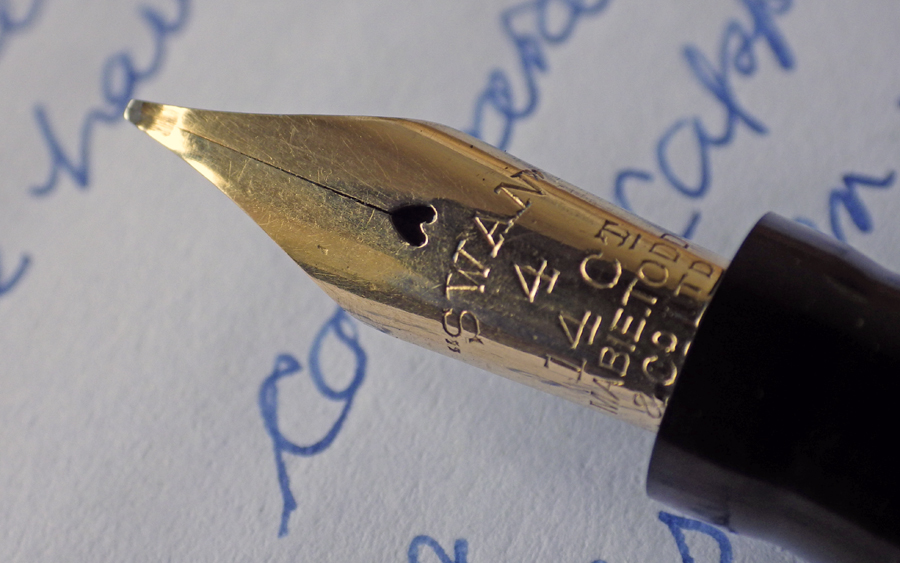
It’s a comparatively large chunky pen, measuring 13.5 cm capped. This is a 1950s pen, by which time Mabie Todd had given up using brass threads. The filling system comes in for some criticism on the pen discussion boards but it’s actually unjustified. Serviced properly the Leverless takes a good draught of ink and is notably convenient and clean to refill.

This pen has a very good Swan No 4 nib. There is a spoon-like depression at the tip of the nib, just before the tipping material. It thrusts the tip of the nib forward and upward giving an excellent writing angle, like some Sheaffer nibs or the Macniven and Cameron Waverley dip nib. I’m not sure when Mabie Todd began and ended making nibs in this way. One cannot really predict which pens will have this style of nib. I would be pleased if every Swan was fitted with this truly excellent nib.

Taking all its attributes together, the 1060 is one of Mabie Todd’s best post-war pens. Despite being quite expensive it sold in considerable numbers and we are fortunate that many have survived.

New Oxonian

Does anyone know anything about the New Oxonian fountain pen?  The barrel imprint also contains the words “Ryman London”.  The only Ryman company I can find is a stationer, still extant, so it might have been made for that company.  It’s an inexpensive-looking pen with a small warranted nib.

Why Collect Pens?

Of course the first question is why collect anything – why collect at all? It isn’t entirely inexplicable. A variety of theories spring to mind. The difficulty lies in deciding if any of them is correct. Perhaps it’s a remnant of the Paleolithic, when men went out and hunted animals, returning to the praise of their women-folk, who had also been busy, garnering fruits and nuts and edible roots. Or so we’re told. Then there’s the historical aspect, where collectors try to rebuild the past through the acquisition of defunct technologies. The ‘limited edition’ collectors – what is it that they do? Maybe it’s the pleasure of having things that few other people can attain (though many limited editions are not so rigidly limited as all that). Then there are the completist collectors, who must have every last production of their chosen subject. Without meaning to be insulting, this could be looked on as a form of neurosis.

Why pens, then? There are many alternatives, stamps, coins, pocket knives, books: there are as many types of collection as there are discrete objects. Pens are small, not requiring a huge amount of space in expensive property. Comparatively speaking, they are cheap, cheaper than jewellery or paintings, for example. They are decorative. Celluloid and casein produced glorious patterns, plating of base metals added lustre. Like many other collectables they exist within a pool of knowledge, about their technology and design, their manufacturers, their rarity or otherwise; subjects that collectors may discuss and develop expertise in. Is there a gender angle? Though I have no doubt that there are many women collectors, my own experience with my customers suggests that women more commonly by pens to use. So do many men, of course, but the serious collectors that I know are all men.

Perhaps one of the reasons for choosing pens as a subject for collection is that it is open-ended. It is very difficult to obtain every example of the output of one of the more prolific manufacturers, say Conway Stewart or Parker.

My own ancestry must have missed out on the collector gene. I love pens and have quite a few but those I retain are chosen for their writing ability. They bear little relationship to each other and are not displayed or recorded. Of course, a great many pens pass through my restoring hands and I do maintain a photographic and digital record of them all. Perhaps that’s my collection.

Parker Duofold Lady

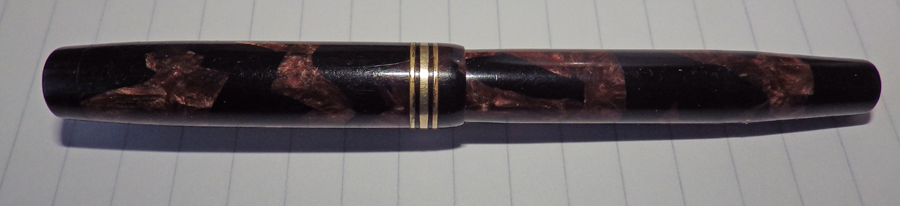
Here’s the other Parker button-filler I worked on the other day: a Duofold Lady in brown and black marble. It was once a ring-top but it has sadly lost its ring. Canadian-made like the Moderne, this is a very well designed and executed small pen. It has the clever ‘hanging’ pressure bar that keeps the pressure away from the section and thereby saved the cost of cutting threads.

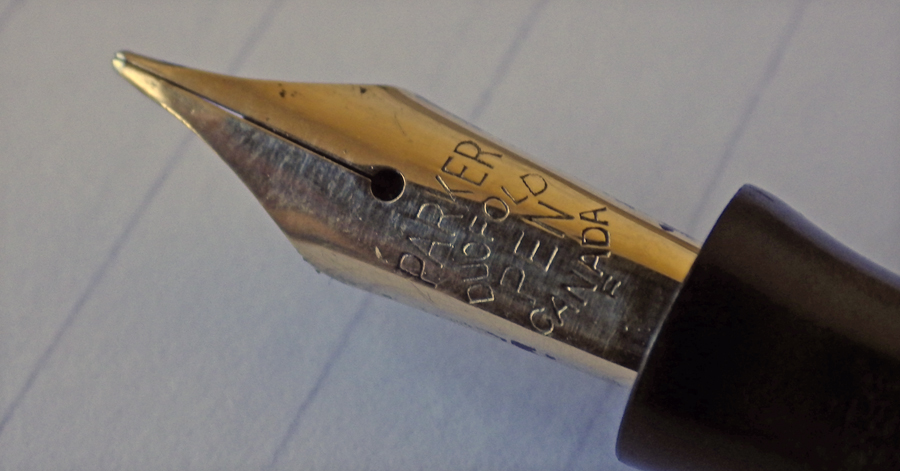
Parkers, unlike Watermans and Wahls are not especially known for flexible nibs but they do occur. Such a nib is this one, with effortless line variation and good snap-back.

Most of our 20s and 30s Parkers are Canadian. They were favoured in price due to trade agreements that excluded the US due to its puzzling unwillingness to remain part of the Empire and later the Commonwealth. It seems the world is being driven back to protectionism and trade wars but that’s okay. Most pens come from Germany and the Far East these days. Hopefully their prices will not be affected.

The Parker Moderne

I’ve been working on small button-fillers today, a Merlin and two Parkers, one a purse pen and the other a Moderne. I enjoy them. They take a little longer to re-sac than lever fillers but they are more satisfying.

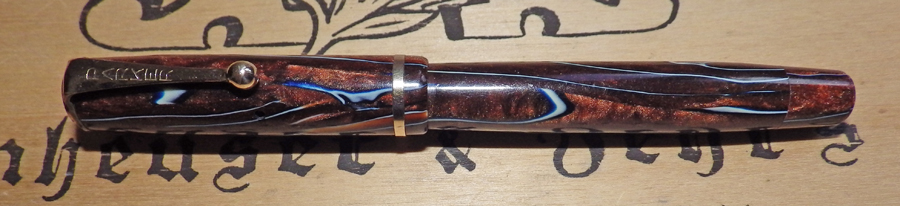
If I remember rightly, the Moderne was the Canadian pen and the US version was the Duette. These pens were Parker’s response to the Wall Street Crash and the hard times that followed it. It is said that the company’s sales were reduced to half and they decided to produce a pen for the times, more affordable to rather emptier pockets. At around $3.50, the Moderne was not cheap but it was a lot of pen for the money. This one is in marbled brown and russet with blue and white streaks here and there – a most attractive pattern. It has a gold-plated flattop, the word “Parker” on the clip, and a single gold-plated cap band. The plating is excellent, having stood the test of time well, showing wear only on the ball end.

The Moderne has a two-part pressure bar, unlike the little pocket pen I restored today which had Parker’s justly famous hanging bar. Both are very effective. At 11.4 cm capped the Moderne is perhaps a small pen by today’s tastes but it sold in its thousands in the mid-thirties.

As filling systems go, Parker’s interpretation of the button filler is hard to beat. Easily serviced, efficient, with a good capacity for the pen size, easy and clean to use. The pressure bar flattens the sac very well, ensuring a good fill of ink. Holding this beautiful little pen, I ask myself where the subsequent improvements in pen design are. I am forced to conclude that there have been few if any.

Small Parkers

I was picking through my jar of spare nibs some days ago when I came upon a Slimfold nib, an oblique stub. I thought the spares reserve was no place for such a glorious nib and I decided to see if I could pick up a cheap but attractive Slimfold, not a difficult thing to do as there is usually no great demand for them.

Paging through eBay’s list of Slimfolds I came upon one with good gold plating. I put in a bid and got it for a good price. It arrived a day or two later, a nice pen in its original box. Except that it wasn’t a Slimfold, it was a Duofold Junior. I accept that this error was partly my own fault. There wasn’t a good nib picture and I should have asked the seller what the number was on the nib, but I assumed that he knew what he was doing and could tell the difference between a Slimfold and a baseball bat. How wrong I was!

When I had finished growling and snarling I decided to keep the pen. It’s a nice example of a pen I didn’t really want but after a wash and brush up and some write-testing I’m sure someone will want it. As I still need a Slimfold I returned to eBay to have a look at their offerings. The first Slimfold listed was actually a Parker 45!

I suppose compulsory retraining of eBay pen sellers isn’t likely go down well and the ignorance of sellers can actually work to the buyer’s favour on the odd occasion, when a Platinum is listed as a Platignum for instance.

Thankfully I have been offered a Slimfold by someone who knows his ps and qs so my immediate problem is solved, for which I’m grateful. I have learned a lesson however, one that I had previously learned long ago but had become a little careless about.

The Silver Arrow

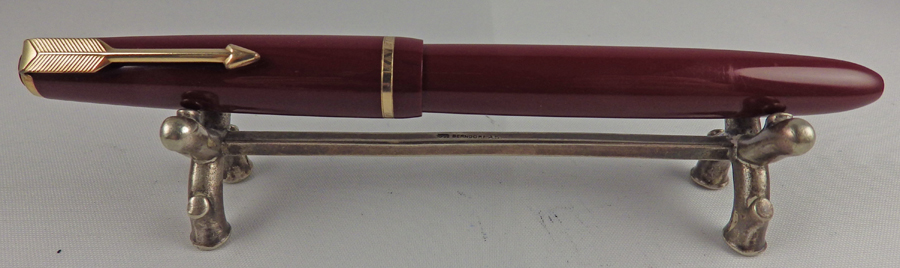
I enjoy oddities and this pen, the Silver Arrow, is certainly an oddity. This is only the third one I’ve seen. I had one about ten years ago and an online search revealed one other. It would qualify as distinctly uncommon, perhaps even rare. Rarity does not always equal valuable, however.

Stephen Hull dates this pen to 1948. After World War II there were many machine shops which had been involved in war work and were scratching around for something to do. I think that may well describe the firm that made the Silver Arrow. Everything about this pen suggests that it was made by people who knew very little about fountain pens.

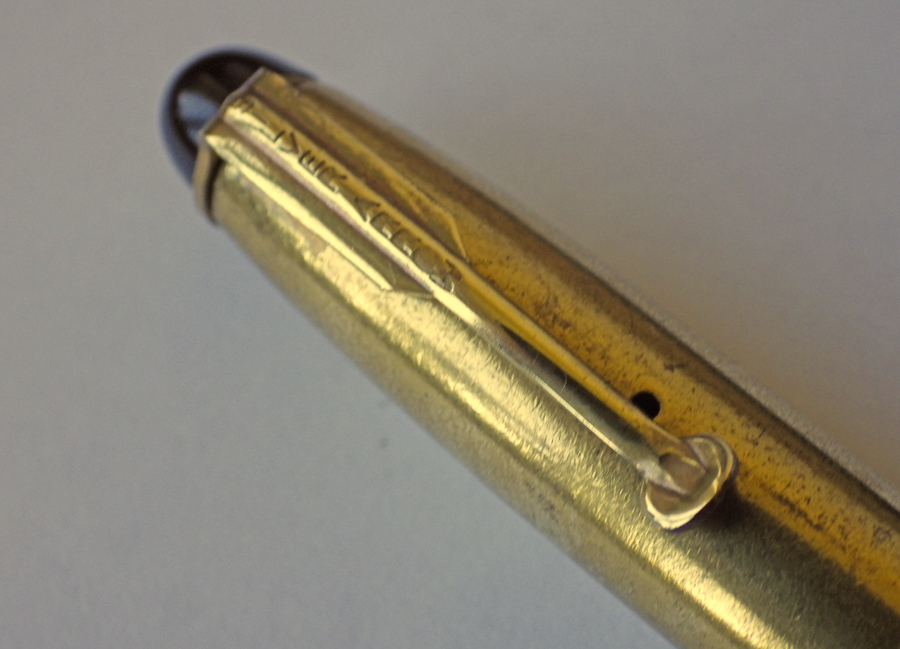
The cap is a very heavy hunk of brass. You wouldn’t be posting this pen! Among the bits and pieces that make up the pen are two washers. Washers don’t usually feature much in fountain pen assembly though they are very useful in general engineering. The cap is held on moderately firmly by being forced against a brass washer. The blind cap – this is a button filler – has a completely unnecessary loose washer. I’m amazed that it hasn’t been lost before now.

The rest is pretty much standard button filler assembly. The section, as you can see, is rather extremely tapered with a huge trumpet “stop” at the nib end. The nib is a gold-plated steel Osmiroid 40. This is original equipment as all three Silver Arrows I’m aware of have been fitted with this nib. It’s not a particularly common nib – the Osmiroid 35 is more often seen – but it’s a good nib of its kind. This one is fine and very smooth.

Judging by how seldom they are seen, the Silver Arrow was not a success and wasn’t around for long. Hardly surprising, really. Apart from the massive cap, it isn’t a BAD pen but there were many better pens on offer. The comparison might be with the Dickinson Croxley of a similar date, a resounding success because it was a good, sound pen without any of the oddity that makes the Silver Arrow interesting in an eccentric way.

Langs Bulb Filler

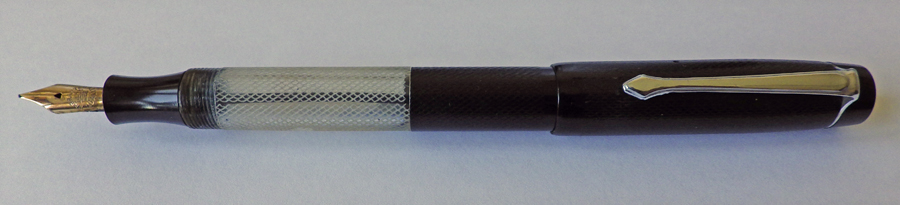
It has been quite a while since I’ve restored a bulb filler. I’ve written about them several times before, because I find them quite impressive. There are two very similar designs, one by Mentmore the other by Langs. This one, I feel sure, is by Langs. It is identical in design to National Security pen which was certainly by Langs, and the pattern of the engine turning is the same as other Langs pens I’ve worked on.

Though this pen does not appear to have been used much it has had some rough handling. The breather tube had been snapped off. I removed the remaining part easily enough but the breather tube I have is too thick. A few moments with the Archimedes drill solved that problem. I had a suitable sac to use as the bulb and I found the right size of nib among my spares. A dab of silicone grease on the section threads eased reassembling and helped to seal it.

These pens are both admirably simple yet sophisticated in design. Like other ink-in-the-barrel pens, they take a good charge of ink and are easy to fill fully. When compared with Parker’s Vacumatic, these pens come out ahead because of their ease of maintenance.

The Mystery of the Missing Pen

Restoring and selling pens is not always plain sailing. There’s sometimes the gorgeous pen that you have to set aside for want of a part. There can be a crack in a cap that will not mend, do what you will. It can happen, thankfully rarely, that a dispatched pen goes astray and is lost forever or – even worse – arrives damaged despite my care in packaging.

All these, and doubtless other calamities, arise because Lady Luck, a capricious wench, has turned her face against me. Yesterday there was an occurrence that had nothing to do with luck or happenstance. It came from another source.

My website informed me that I had sold a pen, and it was to a valued returning customer. It was a modern pen in its large box. When I looked in the drawer where it was supposed to be it wasn’t there! I was a little puzzled and I had a look around the room which we devote to pen restoration and storage. In vain, I hasten to add.

My husband and I searched the room. We emptied every cupboard, examined every shelf, poked in every corner where it might have fallen. We searched our records, digital and paper, but there was no trail to lead us to the missing pen. This was bad. It was, in fact, desperately bad. It seemed that I was offering for sale a pen I did not have, and I was going to have to disappoint a valued customer, the last thing in the world I wanted to do.

We decided that we would take the day to try to find the pen, though we had no idea where else to look. I was already mentally composing an email of the most profound apology. My husband was idly looking at the bookshelves in the living room as he racked his brains for the hideout of the missing pen. Then, suddenly, there was an imprecation which I will not repeat here as he lunged for the bookshelf behind my chair and came up with the missing pen!

I had listed that pen on the sales website in May. It was then that my husband was taken into hospital and transferred to the larger one one hundred miles away. I had set the pen aside on the bookshelf temporarily while I dealt with the resulting shenanigans. The sense of relief on its discovery was beyond my ability to render in words. I would not have to disappoint the customer and – though it is a lesser concern – I would not appear an idiot!

So where did that contretemps arise from? Old Lady Luck had nothing to do with it. Scatterbrainedness, if that’s a word. If it wasn’t before, it is now. Sometimes our actions don’t get saved to the human hard disk. Other concerns have greater weight at the time and the half-considered action flies away and disappears like a wisp of smoke.