Just Rambling

In reply to comments by Paul Stirling and Rob: surely, to each his own! You are not as alone as you think, Paul. I supply several collectors who never ink a pen. Most of my customers are writers but what or how much they write I cannot tell. I do have several correspondents though I don’t keep Royal Mail all that busy with our conversation. The main bulk of my writing is this blog and other things that I am involved in. Everything I produce is created in draft using a fountain pen. That’s thousands of words, day in day out.

For many years the only pens I wrote with were flexible but as I came to write more – and often in uncomfortable circumstances – I turned to firm nibs. What is most convenient for me and allows me to write at the speed that I wish, is a fine or EF nib. Those are the ones that are in my pen wrap that I take with me everywhere along with a spiral-back, hardcover A5 notebook which is convenient on the occasions when I wish to write but do not have a desk or table to hand. I still have flexible pens and I enjoy and admire them but they are not practical for everyday use.

It is the fountain pen’s place in social history that attracted me in the first place. Unlike many other items that we use, or used, the fountain pen, as the primary writing instrument, existed for a discrete period, say, eighteen ninety to nineteen seventy. Before that, it wasn’t efficient and after that it has become a purely specialist interest. The interplay between the development of the fountain pen, its manufacturing companies and the historical events of that period make it very interesting. The pen has reflected events on numerous occasions: ink pellets for soldiers at the front in the Great War, cheaper pens in the hard times of the 1930s, silver used as a base metal in World War II and innumerable other examples.

And you may start a sentence with any conjunction that you like, Paul; language is our servant, not our master.

(This was much too long for a comment so it became a post. My apologies to those who were looking for Parkers, Mentmores, Wyverns and the like. It’s a rambling day.)

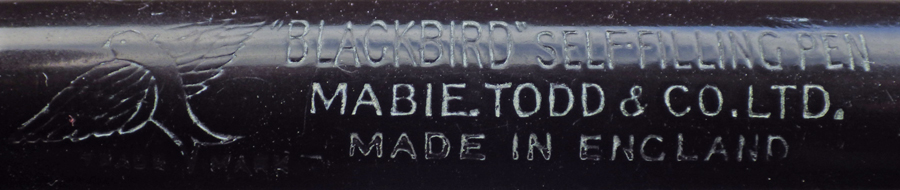
1920s Black Hard Rubber Blackbird

The 1920s Blackbirds remain common. They were big sellers to school pupils and students, being priced lower than Swans though they were built with the same quality. Perhaps the most common Blackbird of that period was the BB2/60 but there are others, similar in appearance but without any model number. Some have ladder feeds, others have the older “spoon” type feed.

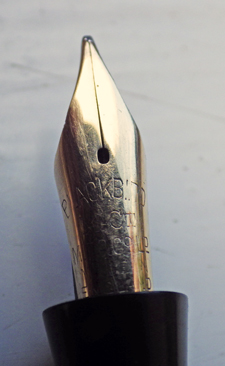
This is such a pen. The flat-top cap is entirely smooth. The barrel has faint chasing but the imprint seems unworn. The imprint describes it simply as a Blackbird Self-Filler and the pen was made in England. Blackbirds were quite a bit cheaper than Swans and most of the saving was in the nib. The material of the nib is thinner than Swan nibs and the tail of the nib is shorter too providing a considerable saving in gold.

Though the nibs write very well they are a little more fragile than Swan nibs and, as a consequence, Blackbird nibs are always in short supply.

The nib in this pen, happily, is in perfect condition, a medium with some flexibility. The lever is chrome plated, again a small saving from gold plated trim. The barrel has a gentle taper and the section is concave, making it pleasant to hold and write.

These 1920s blackbirds are practical pens, quite comparable with any pen being produced today. I’ve always had a Blackbird or two in my own accumulation of pens. They make very good everyday writers. They carry their ninety-odd years very well.

Conway Stewart 286

A potted history of Conway Stewarts: straight-sided, slight taper, cigar-shaped, followed by whatever could be copied.

The 286 falls into the gentle taper era, the most aesthetically pleasing to my mind. Priced in the centre area of the range of the time, the 286 sold well. It was a lot of pen for the money, nicely designed and perfectly executed. There are a lot of 286s around today which perhaps makes it a little under-appreciated. But not by me.

286s come in a host of colours. This one is green marbled. Very attractive. It may be a little over-polished. Again, not by me! It’s a pernicious practice. Electric-powered polisher wheels are the source of a lot of ignorant over-polishing. I expect that the appearance of the pen will settle down with regular use but I do wish people wouldn’t do it.

Though there are exceptions, Conway Stewart nibs don’t usually compare with Mabie Todd or Onoto but they are reliable, firm or giving slight line variation.  For the person seventy or eighty years ago just wishing to consign many words to paper without any attempt at artistry, they were the perfect nib.

For me, the 286 is the apex of Conway Stewart’s production. The slight taper suits my hand very well and I’m not overly fond of cigar-shaped pens. They seem a little excessive to me.

Because there are so many around, the 286 still sells at a reasonable price – a classic pen and a good writer that won’t break the bank

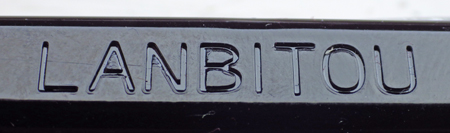
Lanbitou 3059

I said a while back that I was stopping buying cheap Chinese pens. I had a few for those jobs that you don’t want to expose a more expensive pen to: Baystate Blue or red ink. So that was a decision firmly made and not to be changed.

Except I saw an advert for these Lanbitou 3059 piston fillers. Four for the price of a cup of coffee. My research suggested that the first ones weren’t very good but later they improved. I paid for four in various colours including an utterly horrific lime green.

They arrived quite quickly. No fancy boxes with these pens, just a padded bag with some bubblewrap. They were all undamaged. I inked one up right away – no flushing with soapy water and it wrote well at once.

This is the most respectable-looking one, with a black cap and turn button. I filled it up with Diamine Sargasso Sea. The flow is good but it can hard-start. I’m not too concerned about that. Sargasso Sea is quite sticky, I find, and I’m sure that the Lanbitou will start well with Quink or Watermans.

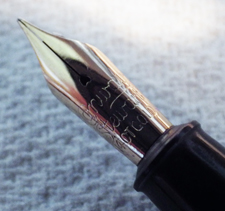
What can I tell you? It has a nib that looks like it came out of a Lamy Safari. It has a feature whereby a little extra turn of the button when filling will ensure that it is locked and there will be no accidental emission of ink. It’s quite a large pen at 14.5 cm capped. I think it would be ungainly posted but I don’t post. The section is indented for a triangular grip, similar to the Lamy pens but executed better so not so annoying. It holds a bucketful of ink.

The first Chinese piston filler was a cause of excitement and rightly so. Now there are several on the market and people say that this or that piston filler is a clone of this or that other pen. My view is that if you’re making a cheap transparent piston filler it will look a bit like any other.

My verdict: it works very well. As far as looks are concerned there is nothing much to say. I’m not fond of demonstrators. I don’t use clips but this one seems very firm. Time will tell whether this pen is durable or subject to the cracking that many of these transparent pens have developed. I’m enjoying writing with it. It’s worth the pittance that I spent on it.

The Waterman Keyhole Nib

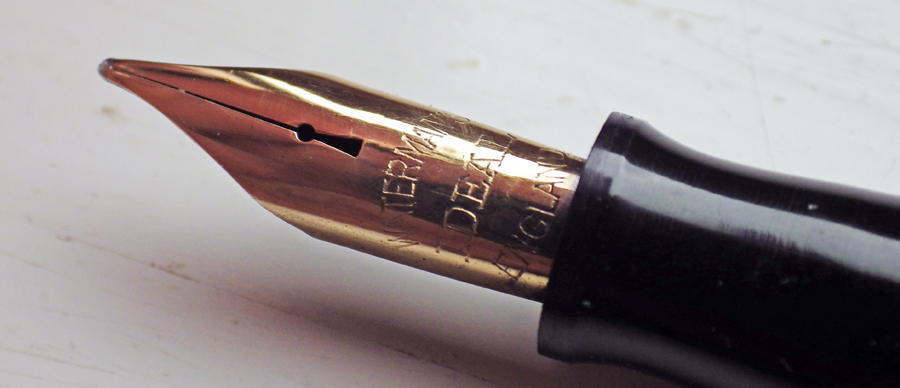
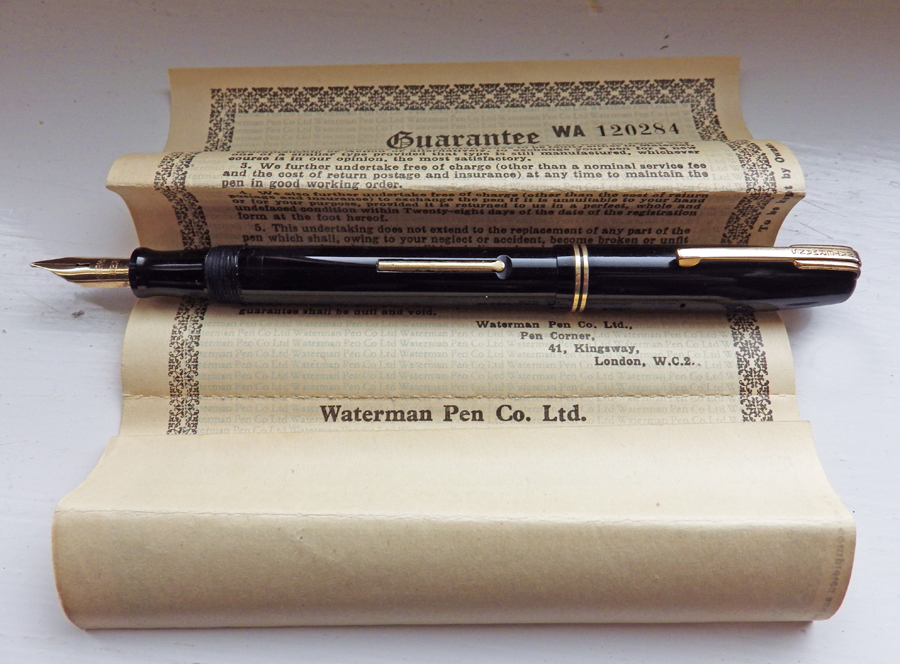
I haven’t had one of these for quite some time. It’s an English Waterman Ideal, quite large at 13.2 cm, an altogether substantial pen. It was made in the late forties and has been well looked after; the box and papers are in good condition like the pen itself. Neither the barrel imprint nor the nib engraving give any hint as to the name or model number of the pen.

Not that it matters. This pen really is all about the nib. These keyhole nibs are glorious, almost always flexible – this one is – and they are among the very best of the Waterman nibs, and that’s saying something! I think I was lucky to get this pen at the price I did. I use Alexa to remind me that it’s time to bid. I decided on the price I would go to and sat watching with my finger on the mouse button. I expected a barrage of bids in the last thirty seconds. There were one or two but the final price was well within my range. These little eBay battles do provide some excitement in the course of the day.

Working on the pen I remembered previous keyhole nibs I’ve had. They were all exceptional. Did Waterman market them in a special way? Were their qualities well known in the forties, famous enough that those in the know asked the shopkeeper for a keyhole nib? We may never know but I am delighted when one comes my way.

The “Active Service” Parker Challenger Set

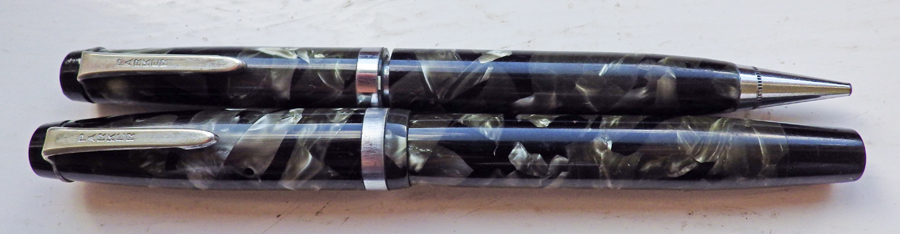
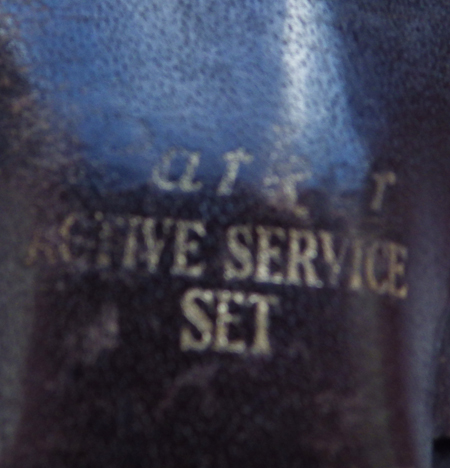
Everything that happens is a sales opportunity for someone. When World War II broke out, Parker Canada produced these pen and pencil sets marked, “Parker Active Service Set.” They were marketed throughout Britain and the Commonwealth. This is a Challenger set. Vacumatic sets were offered for sale in the same way.

It is easy to imagine wives, girlfriends, sisters and mothers buying these sets for their men as they enlisted or were called up. The purchase of the pen and pencil set was a vital matter – these were to be the means of communication in the dark years ahead.

This is the later version of the Challenger with the tapered clip. At 12.2 cm this is the Slender version. The pen and pencil, in black and grey marble, are discreetly beautiful. The set is in very good condition. They have been well used but looked after. The nib has appreciable flexibility.

The leather pouch is also in very good condition. The leather is thin, smooth and flexible with long handling. Though the history of this set has been irretrievably lost, it is more than likely that it was carried into some distant theatre of war. It is to be hoped that they returned with their owner rather than being sent back with his possessions.

Many years have passed since peace was declared at the end of World War II. It has drifted beyond memory and has become history, like the Crimean War or the Peninsular Campaign, but an object like this brings those violent years back with immediacy

Don’t You Hate Software?

… when it doesn’t work the way it should?

There’s a glitch on the sales website.  On a couple of items the thumbnail calls up the wrong image.  It’s most obvious on the Pilot Capless post but it affects one other.  When the thumbnail is clicked, the correct full-size image appears.  It’s all a bit beyond me (duh!) but highbrows are hunting down the cause even as I write!

Edit: Fixed!

Better Photos of the 1956 Blackbird

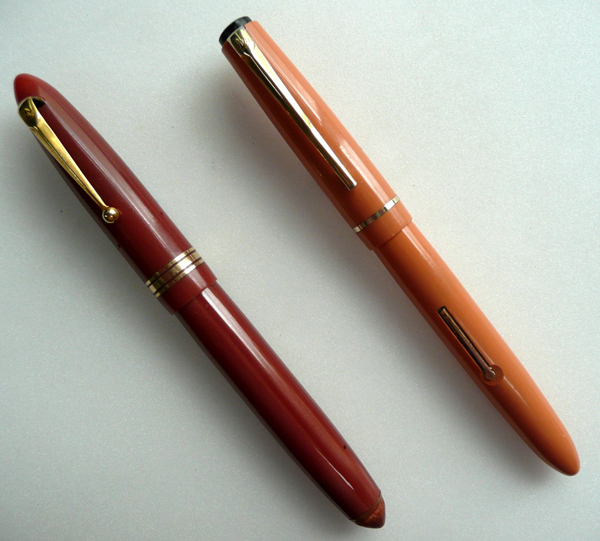
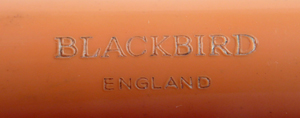
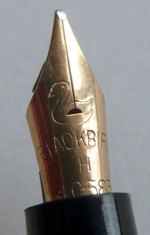
Here are some pictures of the 1956 Blackbird. Part of the difference from the picture I published before is down to the excellent work that Paul has done in cleaning and polishing the pen. Great work! The rest – well it’s almost inexplicable! The colour is entirely different from the seller’s photo.

This photo also shows the difference between what Paul has and the colour called “coral”. It doesn’t look much like that stuff that grows in reefs under the sea – in fact the nineteen fifty-six pen looks a little more like what I would expect coral to be. Never mind. It’s Mexican Tan and that’s a name that reflects its appearance.

The original photos that the seller provided are as bad as they were for all sorts of reasons. Poor camera – perhaps poor operator. My own photos are far from perfect but I’ve put some effort into ensuring the colours are as near reality as possible. When I got this monitor (many years ago) I spent some time calibrating it. I usually photograph with some white in the shot so I can get the balance right. All that means that what appears on my monitor is an image that is close to the colour of the pen.

Of course, what you see on your screens may be very different. The only way to solve that problem is for me to visit you all and adjust your monitors to be the same as mine. And I’m really too busy at the moment to do that.

Thanks to Paul S for the photos

Edit:  I’m coming back on this one more time because I think it would be wrong to leave it.  I remain convinced that this is a /73, coral pen.  It’s identical in colour to others I have seen bearing that number.

Yesterday’s Pens

Senator Regent

Platinum 3776 Century Bourgogne

Sailor Lecoule

Sheaffer Imperial IV

Jinhao 992

Pilot Celemo

The Jinhao is used for Baystate Blue.  The pen cost so little that it doesn’t matter what happens to it, but many months down the road it’s still working well.

Rotation

The subject of rotation comes up quite frequently in the discussion boards. One thing that is evident is that everyone does it differently. There are, of course, some who never write with their pens but maybe they take one out for a day to look at it and put it back and take another one the next day. Just surmising.

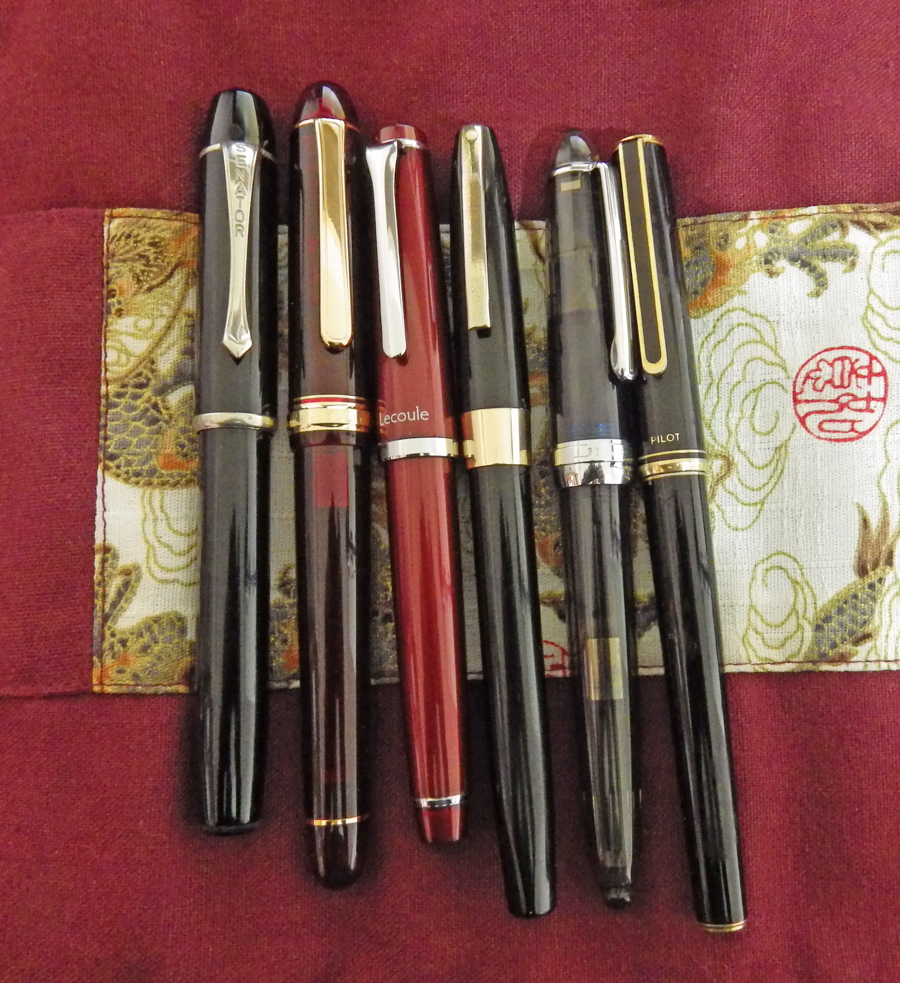
I’m semi-organised. I have a Japanese-style wrap that goes everywhere with me. It holds six pens. I could cram in a few more but six will do. As each pen is dried off it returns to the box and another one is chosen. There’s one exception, my Geha Schulfuller which is such a pleasure to write with that it is just refilled. Perpetually. I also make something of an exception for sac fillers because they are a bind to flush. I’ll go through several cycles of the same ink before the pen is dried off and put away.

I have a couple of pens on the desk: a 1940s BHR Swan and a red ink Pilot Varsity. If I’m working on pens the number on the desk and in use can increase exponentially. I’ve had more than a dozen being tested by being used for whatever I’m working on.

I don’t strip pens down to clean them. Nothing can wear a pen out faster than frequent total disassembly*. I just get all the water I can through them and dry them off when no colour shows.

Pens that are in rotation are also being constantly tested. Usually I confirm to myself that I was right to keep the pen as it suits my hand and writes the way I like. Occasionally, using a pen I’ve kept a while I’ll conclude that the line is too thick or the pen is a little awkward to work with. It goes on sale and I return to the hunt for my dream pen (which I probably have already, the Geha Schulfuller.)

Guess the pens in my wrap.  If anyone gets them all right I might think of some sort of prize.

*There are exceptions: the Conid Bulkfiller and some TWSBIs. These pens were made to be stripped down. There may be others – this is a little out of my area.

IMGP8097

Here’s a fairer pic of the pens.

Clue: They’re 50/50 old and new.