Continuity

Are there pens around today that have real continuity with their predecessors of eighty or one hundred years ago? Though their ownership has changed, Pelikan, Montblanc and Kaweco might be said to have such a relationship with earlier models. Parker, perhaps, too. Cross certainly. Sheaffer was producing models that showed a line of descent from those of the thirties until a few years ago but not so much now. Waterman is still producing some decent pens but the present owners of the company seem to have lost touch with their heritage.

Obviously any company that ceased trading and was revived many years later does not have that continuity, though several have claimed it. Wahl Eversharp, Conway Stewart, Onoto and Conklin come to mind – there are several others.

Does it matter? I think it does. The fountain pen is a traditional writing instrument and many of us must be traditionalists to wish to continue using it rather than a more modern pen, several types of which are quite acceptable writers. It would be nice to feel that the pens we use bear some relationship to those we admire from earlier years. That doesn’t apply to all fountain pen users, of course. Many are content with modern pens and have no interest in the age of the company that made them. I think, however, that most people reading my blog will have an interest in fountain pen history and how we have arrived where we are today.

A couple of years ago I bought a modern Conklin Durograph. When unboxed it looked okay, though it was evident that it was made from very different materials from its namesake and bore little physical resemblance to it. Despite my initial disappointment I kept it for a while and wrote with it often. It was heavy and not well balanced. The gold plated medium oblique steel nib delivered ink adequately well but was slippery and had a tiny sweet spot. I concluded that this was just a characterless Chinese pen, the equivalent of others I have bought for a small fraction of the price. I have a vintage Endura, which is a splendid pen. I felt that the company producing these pens was insulting the name of Conklin.

It’s just an example of how a lack of continuity when the name of a highly regarded old company is used leads to disappointment. There are many ways to view this subject. I don’t expect everyone to agree with me.


That Pointy Thing At The End Of Your Pen

That gold thing on the end of your pen that applies ink to the paper: that’s the nib, right? Most of us these days would agree that’s what it’s called, but not everyone. A regular poster in FPN has insisted for several years that it is the “point.” Eccentricity? Perhaps, but it does have historical authority.

Reading old Waterman publicity material yesterday, in one advertisement the nib was called both the “point” and the “pen.” That advert was as recent as 1933, though I think the “pen” might have been something of an anachronism even then.

So which is it? I think it’s a nib. Language changes and these other names are no longer specific enough. A “pen” now is the whole writing instrument and a “point” is not as good a name as a “nib”. Many things have points but only a fountain pen has a nib. Specificity wins the day!

The Altura Pen & Pencil Company

Altura Pen & Pencil Company is the least known large British manufacturer of fountain pens. It’s probably best known as the manufacturer of English Waterman pens in the 30s and early 40s but Altura also made pencils and probably pens for De La Rue. In addition they made many pens for advertising. It is impossible now to tell which unbranded pens were made by Altura.

Of course they made some pens under their own name. Commonest and best known is the Altura 752 which I illustrate here. Another pen with the mid-cap clip is the 762, a black chased hard rubber pen with two barrel bands.

The 32 is a very Duofold-like pen. The only one of these I have seen is in red plastic. Altura also made a combination pen and pencil, the “Two-in-One” in mottled hard rubber. The 202, also an early pen, is a lever filler in woodgrain hard rubber. The 760 is a 1930s celluloid lever filler.

Though it is reasonable to guess that the mottled and woodgrain pens were made in the 20s and some of the celluloid pens might date to the 30s, I don’t have the information to assign accurate dates to them. I have only seen references to some of them but have not handled them. Most, apart from the 752, are quite uncommon.

The 752s I have had all bore warranted 14 carat nibs but some of the other pens reportedly had Osmiroid 35 nibs – a common replacement but often original equipment. I think the Altura Pen & Pencil Company remains an opportunity for research.

I have written about the Altura 752 before. The search box at the top will find it.

Written Off

It’s happening already. Young people in the US – except for those from the better schools – can’t read cursive. It might as well be hieroglyphics or cuneiform so far as they are concerned. Those kids only recognise the letters they see on screen. Though it is rarely done, they can scribble in the type of lettering we did before we learned joined-up.

Where does it go from here? The only letters that will be understood will be those on the keyboard or on the screen. As speech recognition improves the keyboard will be discarded. No great loss. I try to avoid it myself and I’m a trained typist. Dragon Naturally Speaking, for all its many faults, points the way to the future. It will make open plan offices even noisier than they are now, with people shouting at their machines which stubbornly refuse to understand them.

It will take time but paper will begin to disappear too. The present need for hard copy will be seen as unnecessary and wasteful. BIC will go the way of Mabie Todd and if I’m still around I will be applauding. For a brief period there will be a few of us eccentric old fogeys still applying pen to paper. Most of us are pretty ancient already so we won’t bother the millennials long.

We are not far away from the brain interface. Infants will have a small routine operation which will enable much easier communication with whatever kind of computers and telephones are around. Communication become much more direct without the unnecessary step of transcription and reading.

Perhaps some basic knowledge of lettering will remain for a time for street names and shop signs. And tombstones.

Another Pilot

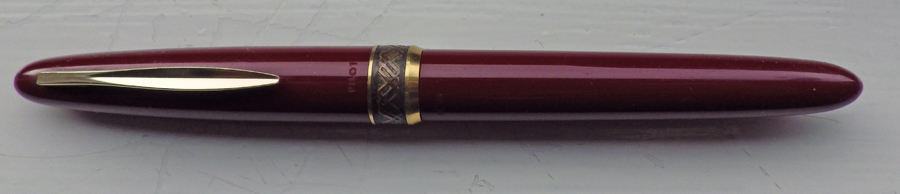
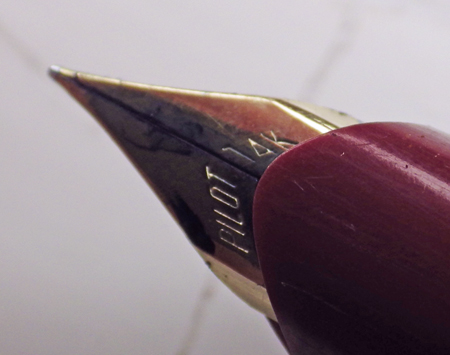
This is the latest in an increasingly long line of ageing Pilots I’ve acquired. Not quite vintage by my standards though I can’t tell the date of manufacturing of this one with any certainty. Probably 1960s but online searches have failed to find another. For once I am completely stumped in finding a model name or number. The patterned cap band is very distinctive but various image searches have failed to discover anything similar. There is only “Pilot” on the cap and the tiny characters HL06 lightly etched into the barrel. They do not seem to be a model number.

The nib, like many Pilot nibs of the period, is semi-hooded and 14 carat gold. I have several EFs but this one is needlepoint. The pen accepts modern Pilot cartridges. Very streamlined, it is reminiscent of Sheaffer Balances. The deep burgundy is pleasing.

Any suggestions about the pen’s age or model would be most welcome.

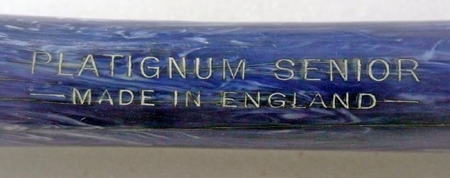
A Lapis Lazuli Platignum Senior

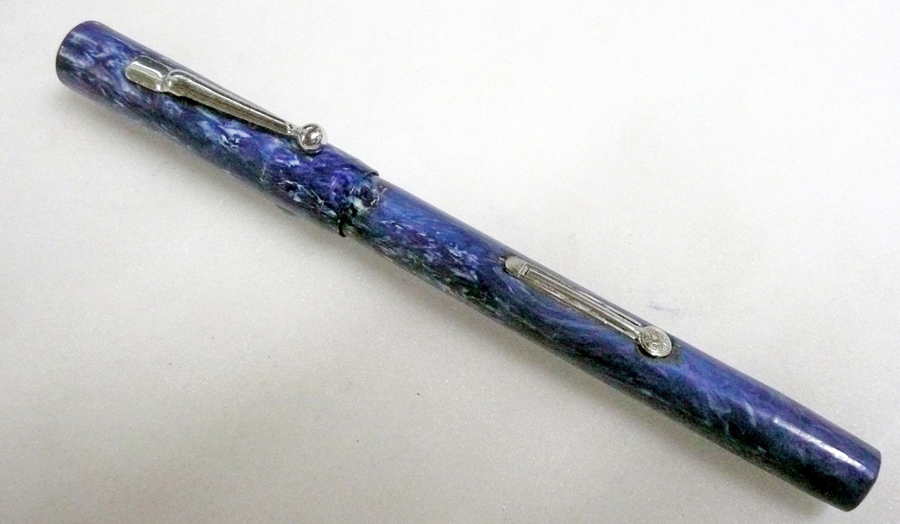
During the 1920s and 30s Platignum produced a wide range of models. By the end of that period they were turning out pens and sets in very colourful – even gaudy – plastics. Many of these pens were beautiful and probably pleasant to use but often they suffered from quality issues that affected their durability. In particular the steel or plated nibs were subject to corrosion.

I would place this blue pen in the 1920s, with its flat top and straight sides. I think we are entitled to call this pattern Lapis Lazuli. It’s certainly quite close to the appearance of the mineral.

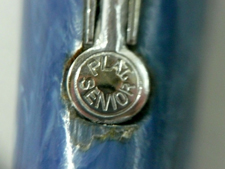
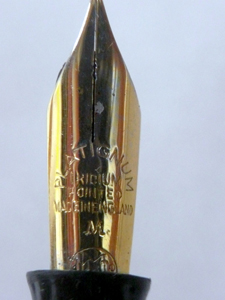
These “Seniors” appear to have been better made than some other Platignum models of the time as quite a few have survived in good condition. The plated nib is interesting. Imprinted on it are “Platignum” followed by a plain “M” that might mean medium, then another “M”, this time larger and in a circle, doubtless referring to Mentmore, the parent company. This is quite a noticeable nib and it would be useful if a date could be assigned to it. Is this the original nib (unlikely) or a later, but appropriate, replacement?

A few years ago I would have taken little or no notice of an old Platignum. I certainly wouldn’t have bought one and when one turned up in a batch I’m afraid that it went into the trash-bucket. I was wrong. These pens are just as much part of the history of the fountain pen as the finest Onoto or Swan.

It appears that, like other manufacturers, Platignum re-used names for different models. There is a later, streamlined Platignum Senior in the post-war period.

Thanks to Paul S for photos and information.

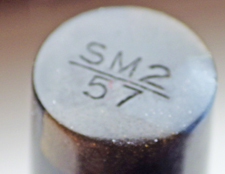
Mabie Todd Swan SM2/57

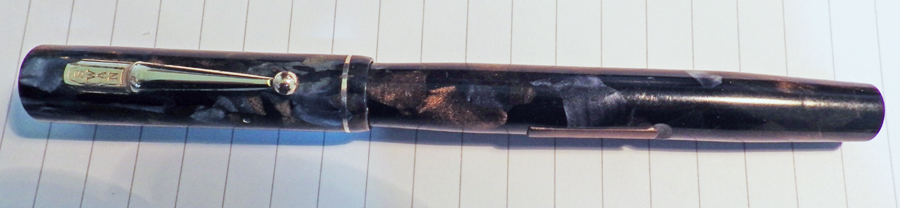
To my mind the absolute apex of the Mabie Todd production is the Minor of the 1930s. The flat-topped gently tapered shape is elegant and the celluloid patterns in which they come are some of the best produced by any company. The name “Minor” is a little misleading; these are big pens at 13.6 cm capped.

I saw an SM2/57 in eBay a few days ago and I was determined to have it. I last had one in that blue-bronze pattern in March 2011. It cost £48 then and I probably thought at the time that it came close to breaking the bank! The one I bought this week was well more than twice as much, but that’s what these pens cost now, in unrestored condition.

It arrived this morning and it lives up to my expectations. The colours are wonderful and the pattern gives the impression of great depth. One would not have thought that blue, bronze and black would go together well, but they do, to delightful effect.

Everything about the Minor comes close to absolute perfection. The inserted clip is a good design and the hard rubber lever blends in with the barrel much better than metal would do. The nib has a tilted tip, a specialty of Swans at this period which always makes a good writer. This one has some flexibility, perhaps semi-flex.

I have said before, about the SM range, that no better pen has ever been made. I reiterate that here. More than eighty years have passed since this pen was made and I do not believe it has ever been surpassed.


Sorry about the quality of the photos.  I was unable to capture the colours of this beautiful pen as well as I would have wished

Tools

The more tools you have, the more relaxing pen repair and restoration becomes. Having been at this for a long time, I think I have all the tools I need though every now and again I’ll see something that I suddenly must have. And I get it. There’s no point in not acquiring something that will allow you to do the job better.

My most commonly used tools are contained in a large wine box. Less frequently used but still essential tools are distributed in various drawers and on shelves. They are all easily accessible and I more or less know where everything is. Some things like glues, shellac, abrasives and polishes might be regarded by some as materials or consumables. To me they’re all tools.

My most commonly used tools are shellac and a sac spreader of my own devising, two pairs of section pliers, needle nose, parallel and round nose pliers, forceps, a couple of suitably-shaped dental picks, nitrile gloves, a dowel for pushing sacs into Leverless pens, a short section of bicycle inner tube to provide grip, a pocket knife, a tiny container of silicone grease, cotton thread and probably a few other things that escape my mind for the moment (I am not writing this at home.)

Other essentials are too many to list but here are a few: knockout block, polishing materials, various adhesives, small steel and brass wire brushes, cotton buds, various abrasives, camera – a tool like any other, needle files, a magnifying headset, loupes, an ultrasonic cleaner which I don’t really use that often, ear bulbs, nib straightening tools and a selection of small hammers. There are many, many other things, useless until they become vital.

I’ve probably forgotten some essentials, but things like sacs, pure talc, new spares such as pressure bars and old spares sorted by brand make the process easier. I have a small jar of mixed gold nibs which I rarely have to call upon if I handle purchasing of pens for restoration well.

There are a dozen drawers to hold pens for sale, lists to keep track of everything, a huge spreadsheet and other essential software to ensure that the correct pens go to the correct customer. And a couple of websites.

I could go on and make this the longest post ever but my hand is getting tired so that will do.

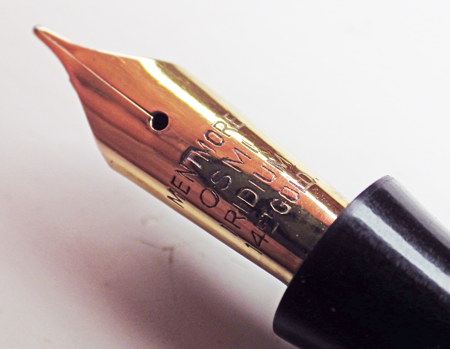
Mentmore Autoflow Button Filler

The Mentmore Autoflow button filler is a high quality pen. It doesn’t have the charisma of the Swan nor the variety of the Conway Stewart but it is a well-made, reliable pen.

Mentmore nibs often have a large blob of tipping material, like some modern pens in that respect. Some are flexible; most are firm. They resemble the Newhaven Duofolds in the type of nib they have.

Being not as highly regarded as the Mabie Todd, Conway Stewart and De La Rue pens, they tend not to be quite as expensive. This one is in splendid condition and has its box and papers. Unfortunately someone has written on the box. The fact that the box, papers and pen are still together reflects the care with which this pen has been treated. The gold plating is exceptionally good.

A Coral Jackdaw

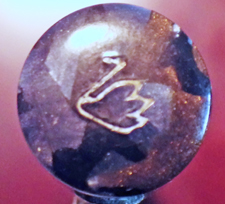
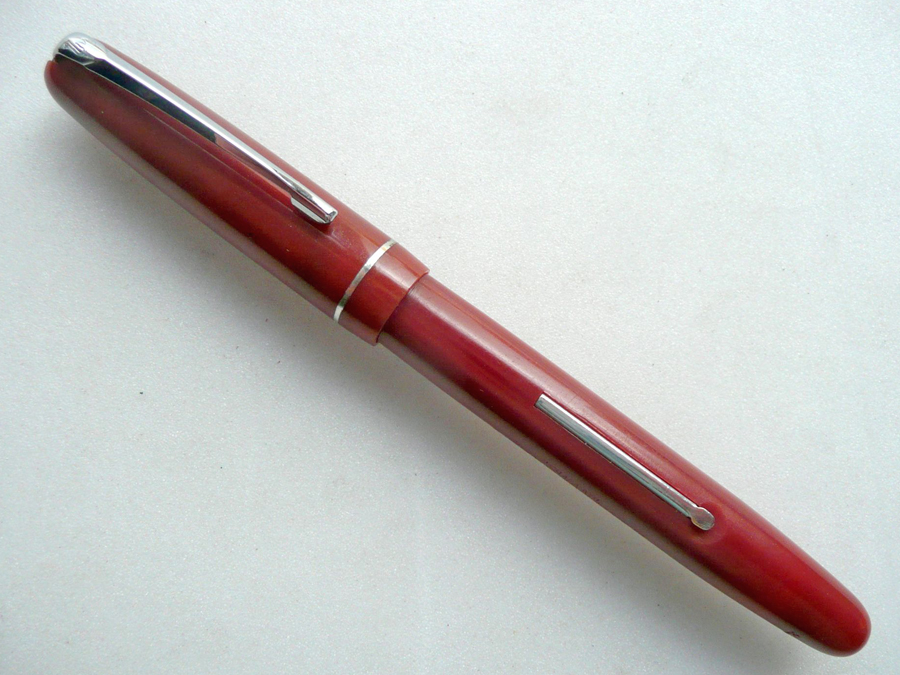
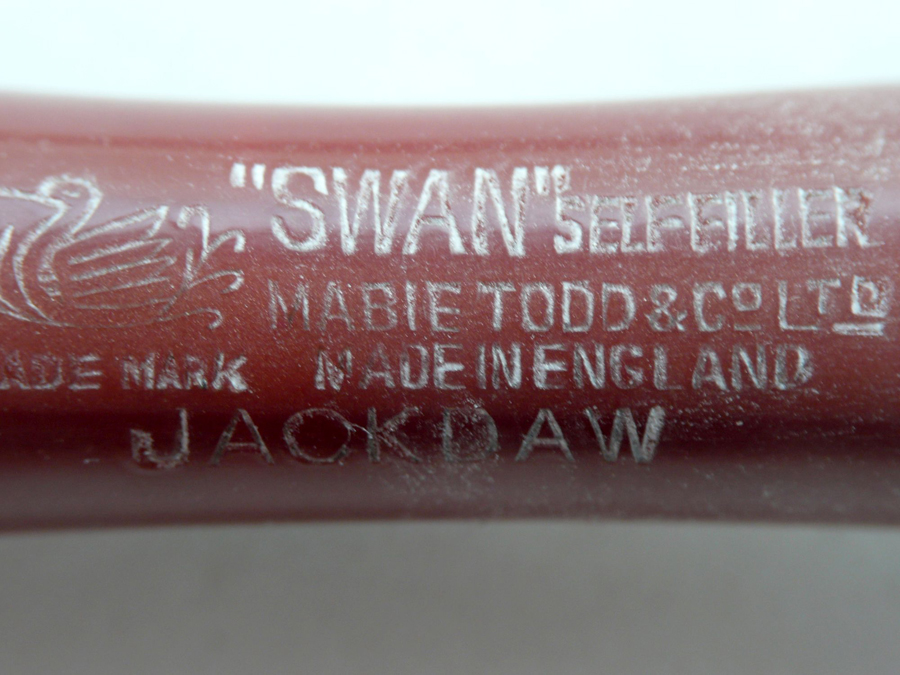
Paul Stirling kindly sent me photos of another coral pen (3173). This one is a self filler Jackdaw, evidently quite late. You can be sure it’s a late pen when you see that duck-like swan. A few years earlier Mabie Todd would not have used a swan image on a Jackdaw or Blackbird. The pen is in very good condition but sadly the nib has been replaced with a folded-tip plated Unique. Not the nib for such a fine pen but Jackdaw nibs are thin and fragile.

I think it is no more than coincidence that a few of these pens have turned up recently. I don’t believe that the colour is common.

This pen was undoubtedly made under the ownership of Biro. I read recently in a Biro website that Miles Martin invested heavily in the Biro ballpoint when it was being tested by the RAF. After the war, when the pen was being developed commercially, manufacture of the caps and barrels was contracted out. To whom? Mabie Todd, who would be swallowed up by Biro in a few years.