The Pocket Swan Safety Screw Cap

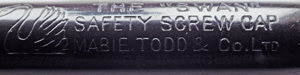
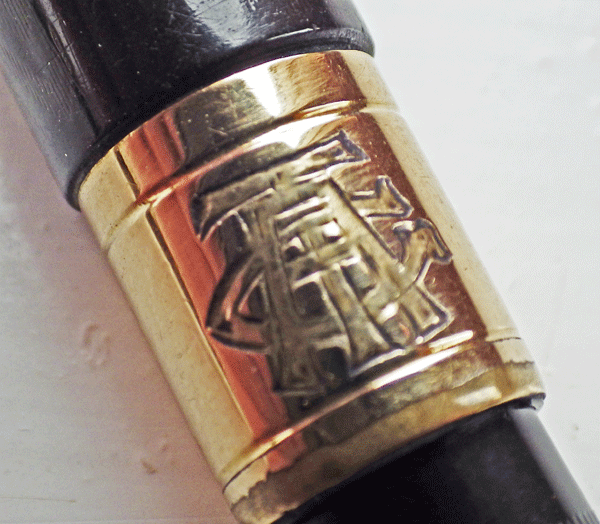
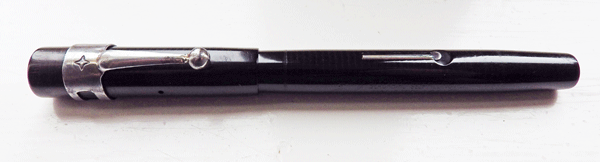
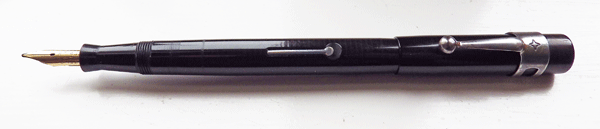
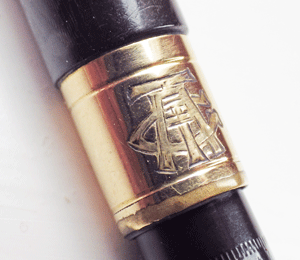
You don’t often see a pocket size Swan Safety Screw Cap. It sports a No 2 nib and is more practical than it might at first seem. It is 10.9 cm capped but a more practical 14 cm posted. The little pen is in good order. The barrel imprint shows up well as does the chasing but there is some wear on the gold plated broad band. The band has a very artistic superimposed collection of initials which I am struggling to make out: clearly there is a T with an A and what looks like a G but there is something else there that I can’t puzzle out! Very attractive, anyway.

The Safety Screw Cap was about the last of the eyedropper fillers, going into production in 1915 and proving popular, judging by the numbers that survive. This little pen qualifies as an antique, then, being fully a century old. It is of its time, both in that it is an original eyedropper filler and in that it was designed to be kept in the pocket of a waistcoat which very few wear nowadays.

It remains a quite practical writer. Both sets of threads, those which enclose the ink in the barrel and those which close the pen, are in excellent condition. The nib is smooth and has some flexibility.

Edit: It has been pointed out to me that this monogram is AT together with the Christian fish symbol. That does seem likely. Many thanks, Jens!

The Red Hand!

I was rather taken with Noodlers Black Swan in Australian Roses and I bought a sample bottle. His sample bottles are pretty large! His normal bottles must be enormous. I tried it in a throwaway Chinese pen and it seemed very pleasant and quite innocuous but I needed to try it with flex to give the shading an opportunity to show. I put it in my Swan 1060. The ink was beautiful with flex. Then catastrophe struck! I set down the pen and noticed that my hand was covered in red ink. That ink is described as 16% bullet-proof which basically means that it was very hard to wash off! I examined the pen and it was leaking at the turn button. When I pulled the section off the ink poured out. The sac had parted company with the nipple.

I restored that pen perhaps six or seven years ago and on previous experience I wouldn’t have expected it to fail. A re-sacing usually lasts 10 years or more. Does Noodlers Black Swans in Australian Roses eat shellac? I think it’s worth saying, though, that flushing Leverless pens thoroughly requires working the turn button pretty hard for a large number of times. I’d never really flushed that pen before because I always filled it with blue-black. There is always a temptation to blame Tardiff’s ink because of its reputation and, in all fairness, because he is an obnoxious critter. The No 22 sac fits the nipple quite snugly but when I re-sac it I think I shall wrap it with thread, just to be sure.

Mabie Todd Swan Leverless Dark Blue and Black

There are times when the eye is better than the camera. I can see the pattern on this Leverless perfectly well but the camera can’t. I don’t set up the lightbox for the individual pens I write about and I’m not sure that if I did it would show up this subtle pattern well. Those are my excuses about the photos, now let’s talk about the pen.

The pen has no number on the barrel but if it did it would be L205/52, dark blue and black. Mabie Todd’s patterns are often subtle; this one is, I think, the most subtle. These mid 30s pens were expensive and rightly so. They are absolutely outstanding examples of fountain pen design and execution. The stepped clip is beautiful and very strong. I don’t often come across one of those clips damaged or broken out. The absence of a lever gives a smooth, unbroken barrel. The black hard rubber cap top and barrel turn button make a balanced design. The straight lines of the cap and the gentle tapering of the barrel make a most satisfying and instantly recognisable shape.

It’s not only beautiful but comfortable in the hand. It is well balanced uncapped which is how I write. The nib, a No 2, is flexible and smooth. When properly restored the pen holds a good volume of ink. I have used a straight No 20 sac. The turn button – and hence the paddle – rotates well, compressing the sac fully and creating sufficient vacuum to fully charge the sac in ten seconds.

It is my belief that these Leverlesses have never been bettered and like the Parker Duofold or the Onoto, will stand as examples of excellence for all time.

FPR Darjeeling Update

You may remember that I gave away the FPR Darjeeling some time ago. The recipient has kindly written a report on his experience with the pen. Many thanks, Kev.

I thought you might like an update on the Darjeeling. I tried it when it arrived and it was exactly as you said, wrote well for a page or so then gave up.  I cleaned it and fiddled a bit but to no avail and then went on holiday for a couple of weeks.  


I would like to say that, as a result of my thorough investigation on my return, and my expertise, the pen is now working as it should.  In fact the pen is now working beautifully but it has nothing whatsoever to do with expertise, more ‘persistent tinkering’.
I noticed that the feed was slightly off centre with respect to the nib and that the feed was not tightly screwed into the section, both of which may well have been as a result of my earlier ‘fiddling’, so i put that right.  S.B.R.Brown, on his Darjeeling review suggested that the nib may work better with some inks than others so I filled it with Diamine Saphire rather than the Parker Quink I had been using.  I then smoothed the nib a little and tried it again, more in hope than expectation.  It wrote beautifully.


I thought it wise to use it a few times for extended periods before I claimed victory and it has continued to behave, the odd ‘tramlining’ at full flex but nothing more.


The nib deserves a good deal of credit as I am left handed and naturally push the nib along making more demands on it than a right handed angle of attack. Over the years I have managed to minimise this by angling the pen so the top is pointing to the right and sloping the letters forward.  My writing is still horrible but nowhere near as diabolical as it used to be.  Surprisingly the ultra flex nib responds quite well to my contortions and I am enjoying it immensely.  I am in the process of finding a calligraphy style to settle on and practice, I anticipate it may take some time but that is a commodity that is in plentiful supply at the moment.

Flexible Nibs

There is considerable demand for vintage flexible nibs these days and I think that mostly applies to Swan, Onoto and Waterman. Indeed, demand for flex seems much greater now than it was in the heyday of the fountain pen. I do get flexible and semi-flex nibs, probably at the ratio of one to every three firm nibs. Not every flexible nib is fine, of course, the size most required, and not every one has the snapback needed to make flex really usable.

A common request is for a fine or extra-fine “wet noodle”. “Wet noodle” is a problem as a description. Everyone knows what they mean by “wet noodle” but no one knows what anyone else means! I take it to mean a nib with line variation at the outer edge of what is possible, easily achieved with very little pressure and with instant, elastic snapback. It needs to have consistent flow that will keep up with the line variation. I can pass whole years together without seeing such a pen. Those pens do appear in Swans but are more common, I think, in Watermans. The only way to tell if a pen has those characteristics is to write with it. Nib shape is no guide.

Historically, writing that made use of strong line variation predated the fountain pen and indeed, had gone out of fashion in the latter days of the dip pen, replaced by an easier, more rapid business style that paid only slight attention to light upstrokes and heavy downstrokes. It has been revived by calligraphers and those ambitious to be calligraphers in recent times. The demand for modern flexible nibs has never really been met though it seems closer now than ever before. It is constantly said in the fountain pen discussion boards that for true flex you must go vintage. That’s correct, of course, but it is sad that vintage pens are sometimes only appreciated for their nibs and vintage nibs are sometimes transferred into modern pens. In truth, no fountain pen will ever equal the line variation of a dip pen or even a quill, both much cheaper methods of achieving impressive flexibility.

I’m not trying to discourage those in the quest for their ideal flex fountain pen but I do wish to impart a realistic view of the difficulty. Some eBay sellers of unrestored vintage pens make much of how flexible the nibs are. Those pens tend to fetch a high price, often a price beyond what my customers would be happy to pay. I have to take pot luck among the rest and sometimes I get lucky. That is part of the service I provide. I don’t charge extra for flex. I apply the same margin to all my pens. Thankfully many of my customers either prefer firm nibs or have other interests in fountain pens beyond flex. There is a home for every old pen.

Gold Filled Swan Set

It isn’t often that you get a 1930s gold filled pen set in pristine condition. Even the case still has its original shine!

Clearly this was a presentation set, reverently stored and never used. Both pen and pencil bear the inscription J Arnold Fleming, who was famous enough to have his own Wikipedia entry. John Arnold Fleming used the abbreviated form of his name for his journalism. He was also an industrial chemist, author and philanthropist. He died in 1966.

The quality of this set shows in the detail. It is always here, at the junction of the metal and hard rubber that ink eats away at the plating. It’s immaculate on this pen. The chased pattern is very fine.

Value

High quality new pens were – and are – always expensive. So much so, I suppose, that many people in times gone by didn’t own a fountain pen. Pencils served the purpose more cheaply and schoolchildren used slates and slate pencils. Someone whose occupation or leisure made a fountain pen a necessity would generally own just one. When that pen wore out or broke it would be replaced but most people didn’t own several pens at a time, as most of us today do not own several computers or cell phones at a time.

Though prices varied, high quality pens, then, were valuable and remained so until they were replaced by the ballpoint. They went quite quickly from valuable to valueless and were forgotten in drawers. In the 60s, 70s and 80s when old pens fell into the hands of house clearers or otherwise came on the market, they were stripped of gold nibs and scrapped because there was no other way to obtain value from them. Yes, even then there were some people who wanted old fountain pens as writing instruments or collectables but that only accounted for a few of the masses of no longer appreciated old pens.

Gradually the view that old fountain pens had value began to save more of them, though there are still some cretins who scrap pens for their 14 carat nibs. Even quite ordinary old pens are now re-used. One might say that they have now gone from valueless to valued again, though probably not yet at their full, real value. Prices have risen in the last 20 years and continue to rise but they may have some way to go.

I’m writing this with a 1930s Swan. It has a springy, fine nib and it writes very much like my Platinum 3776. Looking at it, it would be hard to decide which pen had written a paragraph. I paid less than £40 for the Swan and £140 for the 3776. Which is the more truly valuable pen? That’s an opinion, of course, a matter of subjectivity. It’s precisely that subjectivity which has been driving up the prices paid for old pens. I can certainly envisage a time when high quality, good condition ordinary old pens will cost as much or more than modern equivalents.

This didn’t happen on its own of course. eBay, more than any other factor, gave value to old, rejected items. It isn’t too wide of the mark to say that most old pens would have gone into landfill without eBay. In the early days of collection and acquisition of old pens it was the very rare and exquisitely overlaid items that collectors wanted. The saving of the mass of ordinary old pens came with eBay.

Through years of using them, I, of course, would say that good old Swan pens merit a higher value than most modern pens.

A Blackbird Fountpen

I don’t write about Blackbirds often enough. I have three at the moment and should be uploading them to the sales site shortly.

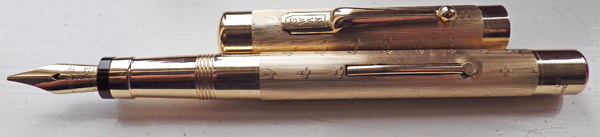
This is a rather plain one and it has seen quite a bit of use judging by the wear on the chasing. It’s none the worse for that, a true veteran and a splendid writer.

I’m not quite sure of the date of these Blackbirds. They seem to have been in production in this form for quite a long time.It’s referred to as a “fountpen” and that suggests the twenties to me.

The nib is semi-flexible. Blackbird nibs are thinner than Swan ones and are therefore more easily damaged. Spare Blackbird nibs are very hard to come by.

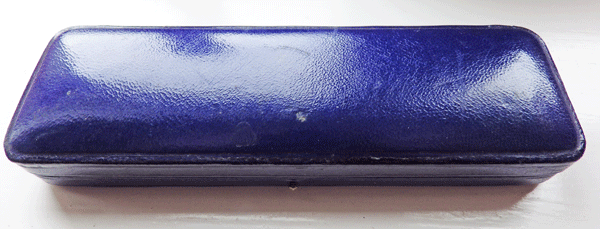
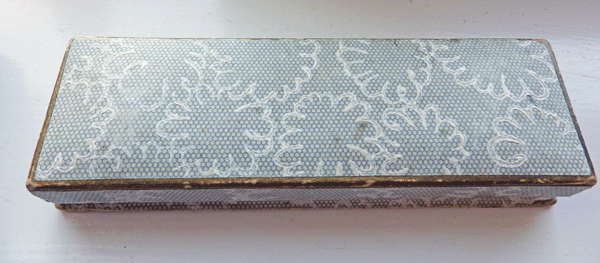
The pen came to me in this splendid box which is as fresh and clean as if it was new. Considering how well-used the pen is, I’m not sure that pen and box began together. I suppose it’s possible if the box was stored carefully for the years that the pen was kept busy.

I don’t recognise the four-pointed star on the accommodation clip.

These clips are often so stiff and unbending that it must have been difficult enough to attach them to a shirt, never mind a jacket. This one isn’t too bad, requiring only superhuman strength to apply it.

Swan SM205/63

I bought this pen as damaged goods – a broken clip – and on arrival I found that it was even more damaged than had been indicated. There is a 4 mm lateral crack on the side of the cap away from the clip and another the same size on the cap lip. It had also been used as a punch at some time as there are dents on the base of the barrel and the top of the cap. I tried to evaluate whether this pen could be saved or whether it was a collection of parts.

I decided that if I could remove the clip stub I would restore the pen as best I can. I have to leave the cracks as they are as I don’t use MEK for health reasons. Short pieces of clip are always difficult. Failing all else, I will drill a small hole in what still protrudes, pass a wire through it and pull it out that way. To my surprise, however, this piece came out moderately easily with heat and pliers.

I salvaged another goldplated clip from a broken cap and fitted it. I cleaned the pen internally and externally and fitted a new sac. The nib needed a tiny bit of tine alignment. It is distinctly flexible, as is usually the case with these pens.

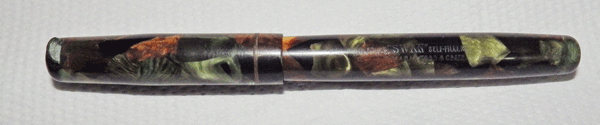
Had this been a black pen, or indeed anything less striking than this Russet and Jade pattern the pen would undoubtedly have been parts, but look at these glowing colours! Doesn’t this deserve a second chance?

Black Swan Set

This set dates to 1949. The pen is a Leverless filler and the pencil has lead and works well. They are excellent instruments but what interests me most is the box! I have never come across a Swan box like this before, textured and patterned cardboard with gold piping, it looks rather more like a Conway Stewart box. Definitely a Swan box though as it says so on the inner lid.

The part of the box that the pen and pencil sit in was lined in imitation velvet and like other similar boxes of this age the material has started to come apart leaving the pen and pencil covered in a fine velvet dust. Never mind, the pen and pencil are like they were made yesterday.