Stephens Leverfil 270

This handsome Stephens 270 has yet to be restored, always a finicky job with a pen that still has its price label, so you see it with the grime of decades still in place. Quite a few decades actually, because the 270 was issued in 1946 and as I will go on to show, it probably didn’t remain in production for long.
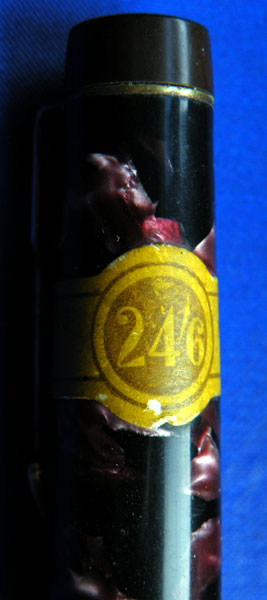
At first, like Sheaffer, Stephens had numbered their pens by their price, so that the 76 cost 7/6d, the 106 cost 10/6d and so on. If the company had not already abandoned that naming policy it did so now as the 270 was first priced at 20/- (£1.00) and later it rose to 24/6d as this price tag indicates.

 

This is essentially the same Leverfil pen as Stephens had been selling with varying degrees of trim since 1940, the main difference being the introduction of an arrow clip instead of the previous ball-ended clip. By 1951, it seems, Stephens had ceased selling gold-nibbed pens and had begun to concentrate on plated-nib fountain pens and ballpoints*.

Who made these pens? Stephens does not appear to have had a pen production facility of their own and must therefore have bought in parts for assembly or whole pens made by some other manufacturer. I assume that it was Langs of Liverpool who made all the Stephens pens until this post-war period, though, so far as I know, there is no direct evidence that this is so. The indirect evidence is strong, though. Stephens first pen, the excellent stud-filler range of 1935 used a mechanism developed by William Livesey, a Langs employee. Given that and the resemblance of the stud-fillers to Lang’s known production, it seems reasonable to assume that Langs did indeed make them. The later Leverfils resemble the stud-fillers quite closely so again, by inference, one may, not unreasonably, take it that they were made by the same firm.

The early fifties plated-nib Leverfil pens I have seen are essentially the same model too. Did the reduced contract from Stephens hasten Langs’ end? It is certainly the case that by 1954 they had withdrawn from pen manufacture.

*Stephen Hull: The English Fountain Pen Industry 1875 – 1975  p51.

An Oversize Salz Jade

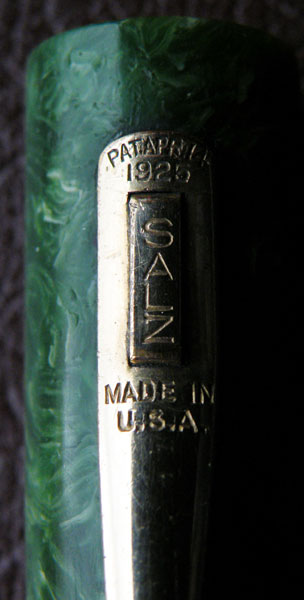
It’s an American pen today, and one that isn’t often seen in Britain: a Salz. We’re not talking about those little Dinkie-sized Salz Peter Pan pens either. This is a Great Big Salz – 13.8cm capped and 16.6cm posted.


I would guess that this pen dates from the mid to late twenties. Salz is usually thought of as one of the lesser brands but this is a high quality pen.

The gold plating has lasted well on the cap rings, lever and the unusual two-part clip. The nib is a warranted 14k gold No 8, which is a sizeable lump of bullion. Sadly, there’s no tipping material left on this nib, so the long search for a warranted replacement of the right size begins, before I can restore this big beast to working condition.


Perhaps the best thing about this pen is the colour. It’s that all-too-uncommon thing, a perfect jade with no discolouration. Quite the dream pen, or it will be when I finally get it fixed up.

An Undated Swan Ad

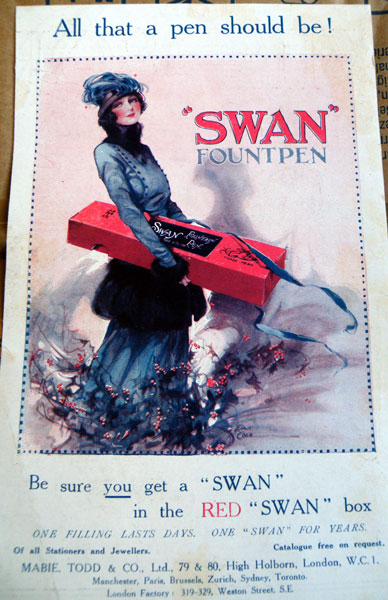
That’s a big pen in that box!

Not all the advertisements that come my way have a date on them. In this case, because there’s no actual pen in the advert., dating matters a little less. All the same, I would like to know, but I’m hopeless on dating fashions. However, overleaf there’s a picture of a woman in a cloche hat. Wikipedia, that refuge of the lazy and the none too critical, tells me the cloche hat was invented in 1908, became especially popular in the 1920s and continued to be worn until about 1933. Doesn’t exactly pinpoint it, does it?

A little bit of googling around tells me that though the 1920s was the period of the flappers and their short dresses, that was evening wear. Day time dresses were much longer – the hem at ankle level. Because of the swirl of holly around her feet, the Swan girl’s hemline isn’t really visible. Early 1920s, then?

It’s possible that it’s Edwardian, though. There’s no mention either of the Great War or of the period of recovery after it, as there is in Swan adverts of those times, so it’s fair to assume that if it’s not as late as the early twenties, it’s before the war.

I dunno. Maybe you do. I just wish the people I buy these things from would take note of the date of the magazines they cut them out of.

The Army & Navy Stores Stationery Catalogue 1907

I picked up this Army & Navy Stores Stationery Department catalogue from 1907 recently, mostly because I knew there would be pens in it – and there were.


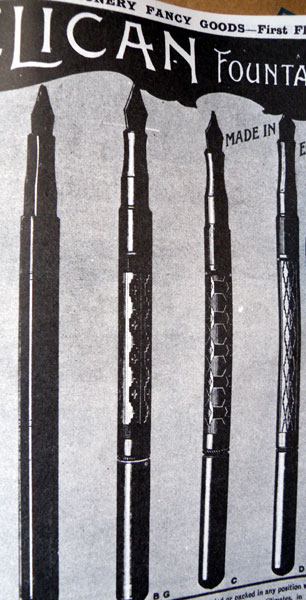
Here are some of De La Rue’s “Pelican” eyedropper pens. Always ahead of the field, these pens had a cut-off valve which enabled them to be carried without risk of leaking.


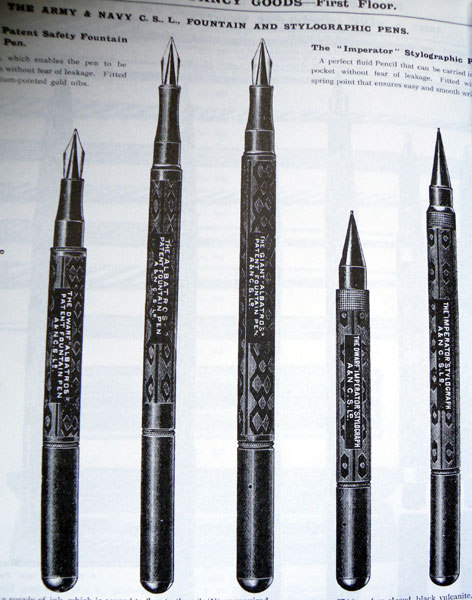
These are the Army & Navy Stores’ own-brand pen, some of which also had cut-off valves. Did De La Rue make these pens for the Army & Navy Stores? Pelicans are rare and expensive now but they do appear from time to time. The Army & Navy Stores pens seem to have disappeared without trace. I don’t remember ever seeing one for sale.

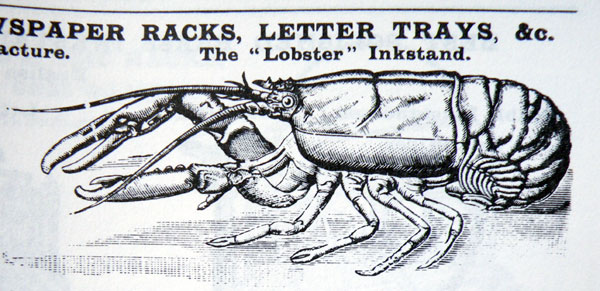
However, if you didn’t trust these new-fangled fountain pens and decided to stick with your dip pen, you could buy a nice polished brass lobster ink-stand:


What? You wouldn’t be seen dead with a lobster ink-stand? You think it’s a creepy horror from a sick mind? I concur, people. Indeed I do.

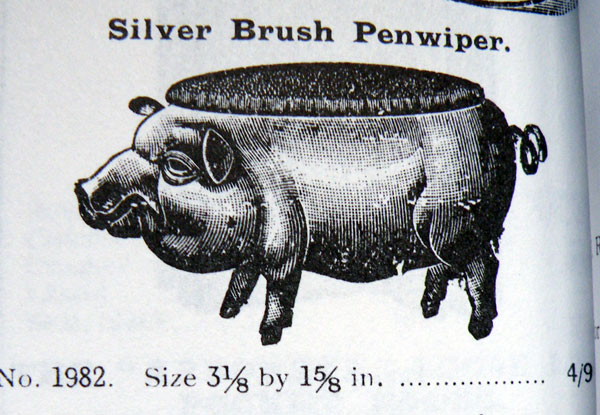
But if the lobster ink-stand made you shiver with revulsion, how about this cute piggy pen-wiper for only four shillings and ninepence?


The Boots Chatsworth – De La Rue Version

Not all high quality pens leap out at you and announce their presence with fanfares and 21-gun salutes; there are hidden gems out there. The Boots Chatsworth is one of these, though you have to be sure of which Chatsworth you’re buying. There’s one made by Burnham for Boots. Though quite an attractive pen, it’s of the quality of the middle-of-the-range post-war Burnhams, i.e. not especially high. The real jewel is the one made by Thomas De La Rue & Co.


It’s easily identified. It’s the one with the sunburst logo on the clip and a warranted nib that has “TDLR & Co Ltd” near the section. (As an aside, a sunburst logo on the clip always identifies De La Rue, but not on the lever. Their ubiquity suggests that these sunburst levers were mass-produced parts available to anyone who wanted to buy them.) This Chatsworth pen is a re-badged and slightly cut down version of the De La Rue pen and the quality is very good despite the slightly smaller size and the smaller nib.


For those who don’t know Boots The Chemist was and is a pharmacy with elements of a chain-store. Back in the day they had a stationery department where they sold their own-branded pens among other items. “Chatsworth” is one of those aggrandising names sometimes chosen by pen sellers for their products. It refers to Chatsworth House in Derbyshire, the seat of the Dukes of Devonshire. It’s all a bit of an excessive embellishment for a modest if worthy pen. Of course the born-again Conway Stewart company has now taken the name for one of their productions – possibly more suitably as like Chatsworth House it’s an overblown lump of pomposity designed for those with more money than taste.

Be that as it may, it’s well worth looking out for the Boots Chatsworth which appears in eBay not infrequently, usually at a good price. I snap ’em up myself whenever I can.

The Bulow X450

I do stupid things sometimes. So do you, I expect, but you don’t then sit down and write about them in your blog.


A few weeks back I read somewhere about these good deals that were to be had at Xfountainpens. I went and had a look. Sure enough, the pens cost half nothing and for very little more you could have a supposedly improved nib fitted. Even broad and double-broad obliques were available. I selected a couple of X450s, paid the paltry sum and forgot about it.

A week later the postman delivered a package. By the weight I thought it must be at least a part for the car or maybe somebody had bought me a new bench vice. But no, it was the two cheap pens I bought. Each weighs an astounding 39.7g! A proper pen like, for instance, a Waterman 52, weighs about a third of that at 13g. Now I understand that some people – for whatever foolish reason – equate weight with quality, but brass pipe ain’t quality.

Once I got over the shock of the weight I tried filling one. A messy business. The converters the pens came with don’t exactly fit securely. However, once I got some ink into the things, they wrote. Quite adequately well, too, though their manufacturers’ idea of an oblique and mine don’t quite match. What this is is the normal round bead of tipping material with one side ground down a bit and rounded off!

I have bought the odd cheap Chinese pen before (recurring fits of madness) and it has been my experience that they write quite well for a fortnight and then bits fall off. These, I believe are made by Jinhao and re-badged as Bulow. The “improved” nibs are marked “Knox, Germany” but which bits of that are true – if any – I know not, though I have my suspicions.

The pens are solid if uninspired. The castings of the clips are somewhat vague, quite unlike the precision castings we’re used to in the west. The clutch on one pen is fine, on the other it takes such a grip that a mighty effort is required to pull the cap off, which is only accomplished to accompaniment of a fine spray of ink being jetted from the nib.

They make good paperweights, though.

National Security Lapis Lazuli Ring-Top

The sheer variety of their designs alone would make British Carbon Papers’ National Security one of the most interesting British companies. Behind that variety, of course, lie the various manufacturers who made pens for them, including Langs, Valentine, Conway Stewart and Stark, Son & Hamilton.

There was a period during which National Security’s pens were audacious copies of the Parker Duofold range and this pen, which has no model number, is an example. It’s tempting to date the pen by the Duofold model it most closely resembles. Not streamlined? 3 cap rings? That’ll be 1927, then. That may be too simplistic and it could well be the case that these imitations trail well behind the originals. Be that as it may, this beautiful Lapis Lazuli pen could easily be mistaken at first glance, and the second one too, for a prestigious Lady Duofold, which doubtless was the company’s intention. Imitation may be the finest form of flattery but it also sells pens.

The build quality is superb and this tough celluloid shows little wear from its 80-odd years. Though it’s a ring-top the pen isn’t tiny, being 11.5cm capped (without the ring) and a respectable 14.9cm posted. Who made this pen? The short answer is that I don’t know. The longer answer is that Valentine were making pens for Parker during this period, and they seemed to have carte blanche to make near-copies of Parkers under their own name. It’s likely that this was extended to their work for companies requiring “own brand” pens like British Carbon Papers. It’s not certain, but the evidence points at Valentine.

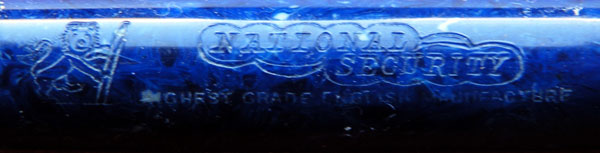
The barrel imprint is suitably vague: “Highest Grade English Manufacture”. Stephen Hull has done great work in trying to clarify the relationship between the shadowy British Carbon Papers, Henry Stark, Son & Hamilton, National Security and the other manufacturers. The picture remains a little confused. One can hope that future research will make these relationships clearer but there’s no certainty. Some things just remain mysterious.

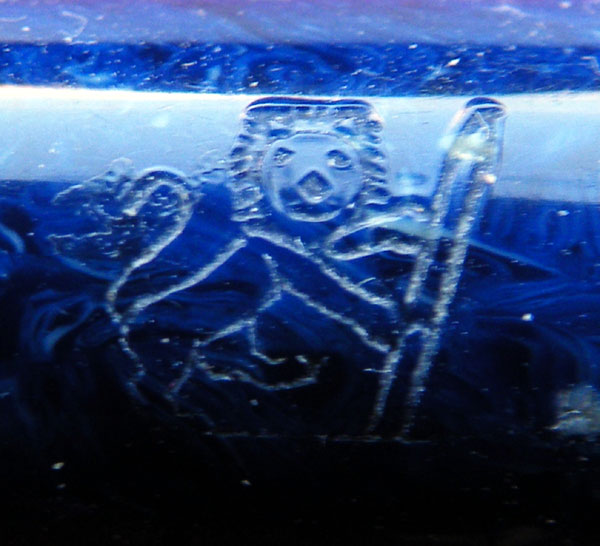
What’s happened to the NatSec lion? He has a snout like a pig! It’s quite hard trying to be a ferocious and dignified King of The Jungle when you have a nose like a grunter.

Tools: Rubber Gloves


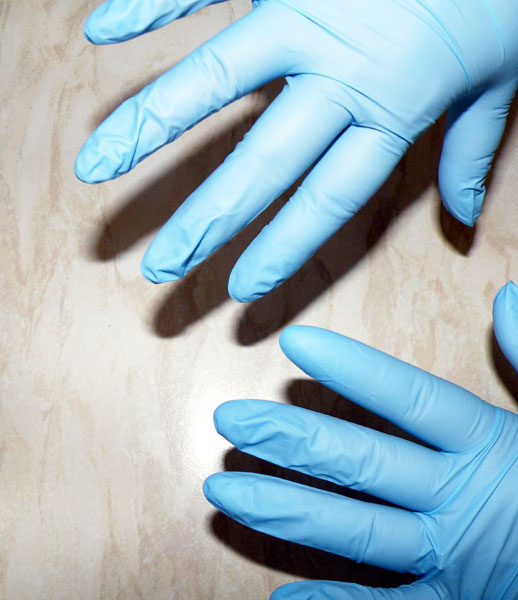
Until recently if you had asked me if I was allergic to anything I would have said, ‘bullets, sharp knives and roving gangs of disaffected youth’, but now I have another thing to add, unfortunately: latex gloves. After many years of using latex gloves in pen repair (the cool, black-coloured tattooists’ gloves), my skin said “that’s enough!” and revolted. So now if you were trying to identify me in a crowd, I’d be the one scratching my wrists.

Thankfully there are alternatives, and nitrile-skin is the one I have settled on. Nothing is as good as latex, it has to be said, but nitrile-skin comes second. Not a close second, but an adequate one.

This isn’t just a girly concern about keeping the nasty ink off the well-manicured fingers, it’s much more than that, and in fact I would say that rubber gloves are the most important tool in the toolbox. More important than the knock-out block, the inner-cap puller or the section pliers, gloves enable you to apply all the force that your fingers are capable of, and believe it or not, that’s just about all the force you’ll need to repair pens. With an appropriate application of dry heat, patience and determination you have no need to apply such things as section pliers. Gloved fingers will do the job.

Not all the time, of course. There are instances where pens are so deliberately and perversely awkward that you have to have a little leverage. But for the most part, the extra grip that gloves give you is enough to do the job while protecting the fragile pen.

The final consideration with gloves, and it’s a small one for me but it may be greater for others, is that we deal with a lot of strange and mostly-unknown chemicals in the various cleaning and polishing agents we apply. Skin tends to be something of a two-way street and stuff goes in that’s probably better kept out. Frankly, I must admit that health and safety is an unintended bonus so far as I’m concerned. For many years before I took to rubber gloves, I suppose I must have absorbed all sorts of noxious substances through my pinkies. Which may go some way to explaining the additional head that is beginning to grow out of my shoulder.


The Phillpson & Golder Cestrian

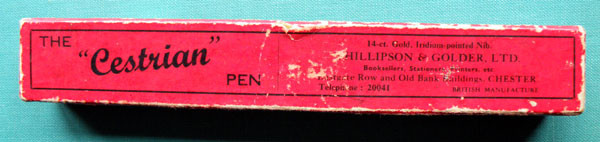
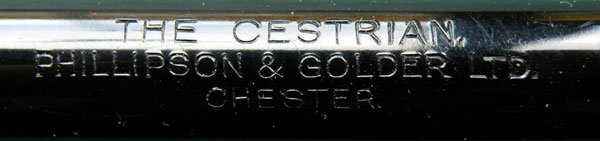
A Cestrian, in case you didn’t know (I didn’t) is an occupant of the city of Chester. Phillipson & Golder were (and may still be, for all I know) a large and successful printing and publishing business in Chester, turning out books, many related to the area, directories, maps, prints and an almost endless list of other things.


They also sold – or maybe gave away as a promotion – the Cestrian pen.


We don’t have to hunt for clues as to who actually made it; Thomas De La Rue’s logo is on the clip.


It’s a well-made pen in a plain way. Its only notable features are the quite short filling lever and the peaked clip screw.


I have nothing to date it by, but going on the style alone I would suggest that it’s a post-war pen.

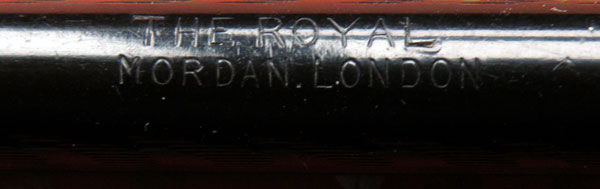
The Mordan Royal

The firm of Sampson Mordan is best known for the wonderful silver mechanical pencils they produced throughout the nineteenth century and into the first half of the twentieth century, until the company’s premises were bombed in the Blitz in 1941. They did also occasionally make pens, but not many, with the result that Mordan pens are very rare today.

The Royal is an eyedropper filler. It’s a little hard to date. It has a slip cap which suggests it’s early, as does the large, plain 14ct nib. It doesn’t have an over-and-under feed but a slightly more modern type and the tapered section suggests later rather than earlier. If I was forced to guess I’d opt for the mid-teens, possibly just on the eve of the First World War.

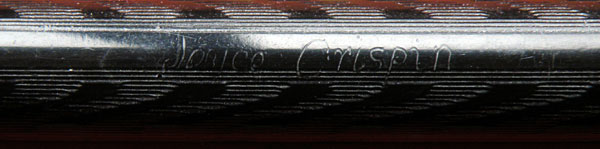
It has a discreet little personalisation. It’s as if Joyce Crispin wanted the world to know this was her pen, but only in a whisper. I thought that was quite an unusual name and went searching to see if I could discover the pen’s owner. There are many Joyce Crispins, though, several of them on Facebook. I suspect that they’re not our Joyce who has probably been kicking up the daisies for a few decades now.

Though the rest of the pen is in remarkably good condition, the nib has lost the tipping material from one tine. It would be my guess that that won’t matter much, as this pen will never be used again, given its rarity, and it is destined for a collector’s cabinet.