Whew! Finally! Some fresh uploads to my website! It’s been a while, so please come on over and have a look. Something new in each category today!
Mabie Todd Swan 100/60

Life can be such a nuisance at times, you know? You just can’t get a thing done for life getting in the way, tripping you up and blocking you at every turn. Hence the lack of posts recently. I hope life is going to back off and behave itself and let me get on with some work.
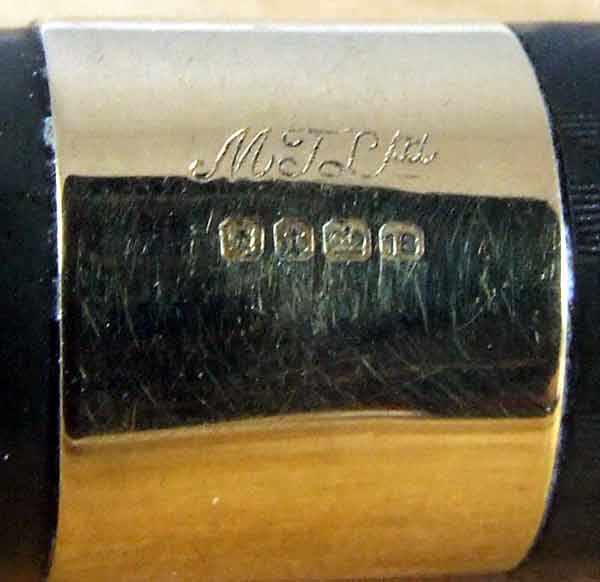
This is a Swan 100/60. No SM or SF, just 100/60. It’s a plain pen, essentially just two BCHR tubes with a little bit of taper at the end of the barrel. It reminds one of its immediate predecessor, the SF1 and points further back to the eyedropper fillers of a few years previously. However it has the handsome fixed clip that became a Swan icon, and it is embellished with a broad cap band. The hallmark tells us the band was made in London in 1924 – 1925 and it is 18 carat. That fits with the date I would put the pen at, so it’s not a later addition.
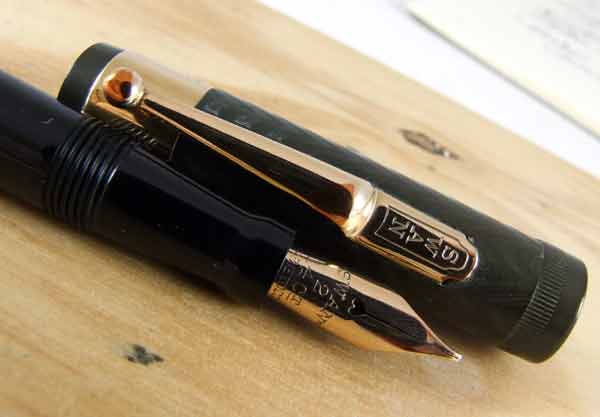
The nib is, though, because this pen should have a No 1 nib, rather than this No 2. I’m going to leave it there, though, because it fits well and has clearly been there for a long time. It’s a lively and characterful semi-flex.
Something Is Rotten In The State Of Denmark
There have been some pretty disturbing things going on in Fountain Pen Network over the last few days. Sweeping rule changes have been introduced which, of themselves, will affect most members little if at all. It’s the implication and consequences of these rule changes that are at the heart of the unpleasantness.
Which is the worst thing that’s been happening?
The admins asked for feedback. In the thread that followed some members made measured and polite criticisms. Wim replied with what appears to me to be an explosion of arrogance. We’ve seen this before in the “private” communications to individuals who were being rebuked or expelled, but up to now it has been kept out of the forum. He then withdrew posting privileges from those involved. Is that the worst thing?
Unsurprisingly, the new rules gave rise to a number of threads where members questioned the rules (some of which were not very clear) or made suggestions for better ways of raising money. Several of these threads have been deleted. Is this censorship (which, truth be told, we should be used to by now) the worst thing?
The rule changes are about making money. To conduct trading at anything less than the lowest level, a premium account costing $90, $180 or $360 must be purchased. This is serious money. It has been asserted (no evidence was forthcoming) that FPN costs $25,000 p.a. to run. David Isaacson has said that FPB costs around $200 to run. Admittedly, FPN is huge in comparison with FPB but the comparison does make the figure of $25,000 look suspect. It has been suggested that they’re doing it wrong but they can hardly be doing it that wrong. I don’t believe that figure. I think we’re seeing a community being turned into a meal ticket, perhaps with a sale looming on the horizon. Is that the worst thing?
FPN has always treated members with contempt, even the most knowledgeable. Long a bone of contention, the Conway Stewart forum has been the most evident example of this. It has always seemed strange that there should be a Conway Stewart forum rather than a British Pens forum. The appointment of an employee of the resuscitated Conway Stewart company as a moderator clarified what was going on there. It has been shamelessly used as a marketing tool for the company ever since. Those who complained were unceremoniously booted out, with the result that FPN lacks expertise on British pens now. Is that the worst thing?
I don’t know. It all leaves a bad taste in the mouth.
For myself, I was never particularly fond of FPN. Too much Montblanc and ink for my taste, and the bulk of the discussion rarely rose above the “What ink should I use in my purple Monteverde?” level. Whereas groups like Lion & Pen and the Fountain Pen Board gradually move forward as shared information is absorbed by the membership, FPN’s huge size and very poor search facility ensures that it remains static and the same questions are asked over and over again. I took part because I could help a little with repair and history questions, and because it enabled me to push awareness of the excellent qualities of British pens, which is my primary purpose in all of my involvement in the world of fountain pens.
It all reminds me of nothing so much as England’s (things were a little different in Scotland) long and bloody struggle towards democracy against monarchs who believed in their divine right to rule. I don’t say the outcome will be the same, sadly. In fact, I suspect that the tyrant will triumph, in this Lilliputian rerun of history. Still, the LiveJournal example suggests that even tyrants may need to move with caution if they don’t want to see their investment drop like a stone. In the end, for all forms of internet social networking it holds true that their only value is the members’ input. Lose that, or lose the best of that, and you’re finished.
The Thin Blackbird Fount Pen
 This is the Thin Blackbird Fountpen and it certainly is thin when compared with the BB2/60, but it’s not as thin as the original Fountpen, an eyedropper filler of 1911.
The first lever filler Blackbird was introduced in 1922. I suspect that was the Blackbird Self-Filling Pen with no assigned model number and a spoon feed. Sometime soon after that (I assume) it was replaced with the BB2/60 which had a ladder feed. As the Thin Fountpen resembles the BB2/60 so closely and also has a ladder feed, it would be my guess that its dates are roughly the same.

Why did Mabie Todd produce the Thin Fountpen? It’s unlikely we’ll ever get an explanation, so we’re free to speculate. Fountain pens started thin because they copied the style of dip pens. Around 1920 they started getting noticeably thicker, as their dip pen ancestry drifted into the past and people wanted a pen that held plenty of ink in a sac inside the barrel, necessitating a thicker pen. That might not have suited everybody, and there may have been customers who asked for a traditional, thin pen. Perhaps the Blackbird Thin Fountpen was the result. They’re not common, perhaps because the demand for them turned out to be less than expected and they were dropped after a short production run.
Latest Uploads
New uploads to the website tonight – a sort of Parker Extravaganza! 51s, 61s, AFs, and Aerometrics! Some choice new items in the other categories as well.
An Exceptional Parker 61
As many of you will know, I’m not usually a fan of hooded nib pens with the exception of the glorious Mentmore 46. I like to see and enjoy a polished gold nib and I find them easier to write with because I’m not constantly checking to see that I’m approaching the paper at the correct angle. However, I know that others like them, so I keep adding a few Parker 51s and 61s to the sales site.
Of the two pens I prefer the 61. It has a better shape than the 51 to my mind and the arrow on the hood is both stylish and helpful (remember that thing about approaching the paper with the pen at the correct angle?). The capillary filling system is, I think, the last major advance in fountain pen technology and like many great inventions, it’s wonderful in its simplicity. Inverting the pen over the ink bottle must have seemed very unintuitive to the pen’s first buyers.
Of course flushing a capillary 61 is a bit of a chore, so it isn’t for the writer who is constantly changing inks. However, if you just use it with one favourite ink and keep it in use there’s no need to flush it.

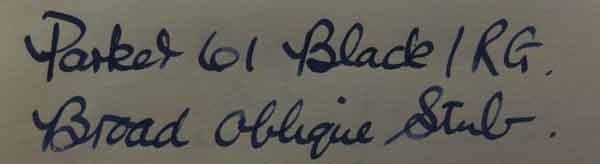
This 61 looks like nothing special at first glance, just a black pen with a rolled-gold cap, but look at this nib:
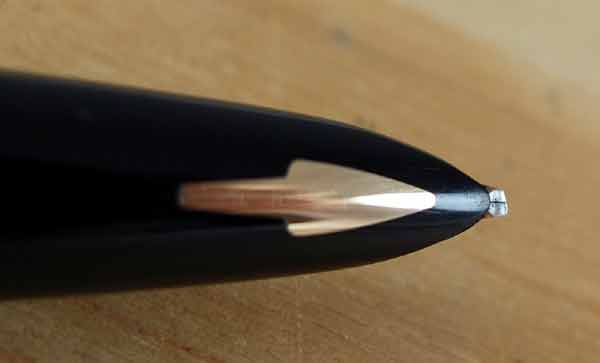
Isn’t that a beauty?
Mabie Todd Swan 3160
The post-war 31– range of Swans is often deprecated because of the small size of the nib. Quite strange really, because the Swan No 1 is no smaller than many nibs that meet with approval, such as the bulk of the medium to lower-cost Conway Stewarts but I have seen people say that they avoid them because of their quality. In truth, the build quality of the pen is same as that of its bigger siblings and the fact that so many of them have survived in very good condition supports that.
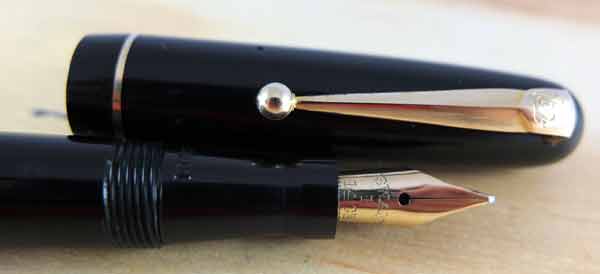
Judging by the very good condition of the gold plating, this 3160 hasn’t seen much use. The plastic, too, has much less in the way of marks of everyday use than you would expect to see in a pen of this age.
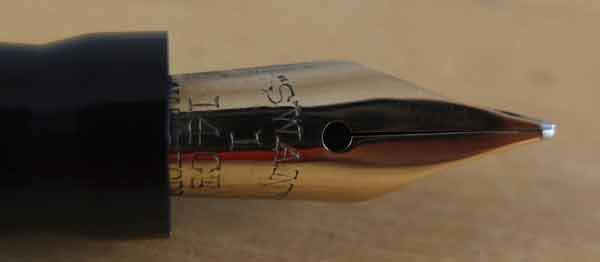
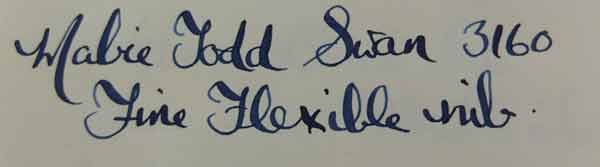
Like so many in the 31– range, this pen has an absolutely outstanding nib. Its appearance gives no clue that this is one of the best flexible nibs to come my way in a long time. It expands easily from fine to triple broad and the snap-back to its usual shape is instant. The ladder feed supplies enough ink to meet the demands the nib makes. I had some fun testing this pen after re-saccing. Here’s a writing sample to give an idea of its capabilities:
Repairing A Lever Fill Pen
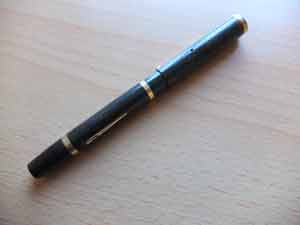
I keep being asked questions about fitting a new sac in a lever fill pen, so here goes: this is a Swan SF230 in need of repair.
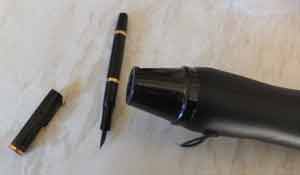
For a start, the section has to come out. This is a black hard rubber pen so don’t soak it. Personally, I never soak any pen to take the section out. Dry heat is the way to go, and I’d say always use heat. It expands things and softens them a little, and makes a cracked barrel much less likely. These Swans are friction fit. I just pull the section out with my fingers. Latex or nitrile gloves help by giving you a better grip. Some people use section pliers.
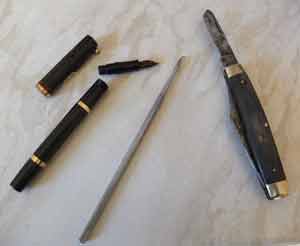
The section’s out and you’ll need some tools to remove the remains of the old sac. I use a dental pick to get into the barrel and a pocket knife to chip the old sac off the peg. Mostly, sacs are desiccated and crumble at a touch but sometimes they can assume the consistency of part-dried glue or very stiff chewing gum. Clearing the barrel takes longer with a sac like that.
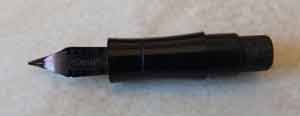
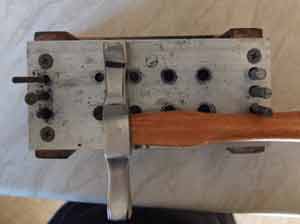
Once you have the barrel and peg cleaned up, the next move depends on the state of the nib and section. If the nib is badly offset or damaged, you will have to drift it out. That’s where the knock-out block comes in. Most of those you get to buy are fiddly little things that tend to be unstable. It’s best to make one yourself if you can.
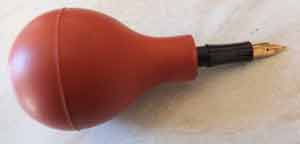
In this case there’s no need to remove the nib, and it’s best not to take it out unless you have to, as re-setting a nib isn’t a trivial task. It needs a good flush to remove old ink, and that’s where this bulb is so useful.
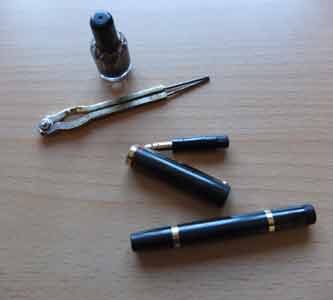
When that’s done and you’ve dried the exterior of the section, you’ll need an appropriate size of sac – 18 in this case – and some shellac. A sac spreader is optional. I like this pair of old dividers with the points cut off and ground smooth.
Measure the sac and cut it to the correct length.
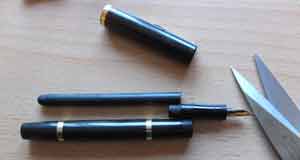
Get a good coating of shellac on the peg and fit the sac. Then apply some pure talc. I see a lot of “repaired” pens where this step has been missed out. Don’t. It’s significant. Without a covering of talc the latex sac will stick to the pressure bar and it will shorten the sac’s life considerably.
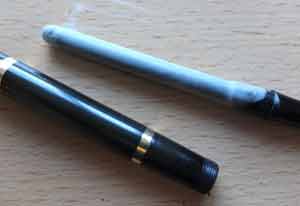
Let it dry. Half an hour will do it. Then reassemble and give the pen a good clean up.

You’re done!
Mystery Pens!
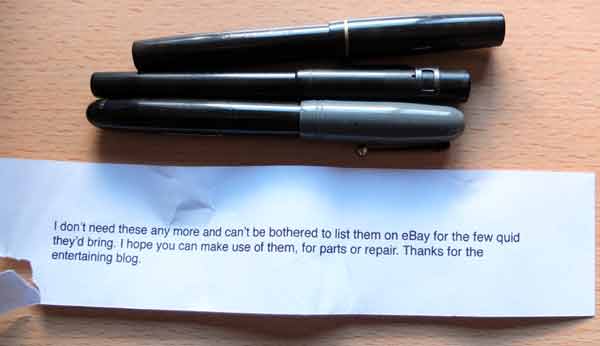
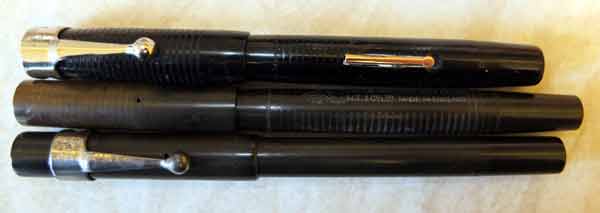
An anonymous benefactor sent me these pens which arrived yesterday. I can’t even guess at who it was who gave me these pens. One will provide useful parts and the other two can be restored to working condition.
Thank you very much, unknown donor!
English Duofolds

English Parkers remain among the most underrated pens around. Not so much the the 51s and 61s, at least partly because our American cousins recognise them, but the whole English Duofold range remains a mystery to overseas buyers. Maximas and Seniors do somewhat better because they cater to the modern taste for large pens, but the more usual standard Duofolds, Demis, Slimfolds and Juniors sell poorly in comparison with other pens, many of them of considerably less quality. Though the market has picked up a little recently, I still see Slimfolds, Juniors and the similar Victory Mark V passing through ebay without a bid.
My own favourite is the Duofold AF. It has a lot going for it. The splendid Duofold nib – usually firm but not quite as rigid as the American counterpart – remains consistent throughout the Newhaven production. The aluminium filler looks a lot better than the traditional button. It’s finely machined and has a very modern look about it, as though it might be a part for a moon rocket or at the very least a snazzy sports car. It’s an easy fix when it needs a sac and it holds a decent quantity of ink. Externally, the Aerometric Duofold is the same pen with the same writing characteristics and many people like it but I think of it as Parker’s first step back from ingenious filling solutions. Having to take the barrel off to fill the pen is not an advance in convenience. Having done so, you’re faced with a bulb filler with a protective metal surround – nineteen thirties technology in a nineteen fifties pen. Thereafter came the descent to Parker pens being mere holders for cartridges, which ensured that the buyer handed the company large profits in perpetuity.
That doesn’t mean that the Aerometric was worse than other pens that were being produced at the time. The reverse is true. Despite the dated technology the quality was so high that the pen sold in huge numbers, even at a time when the ballpoint was beginning to dominate the industry. Though a little subject to cap lip cracks, Aerometrics otherwise just don’t fail. They’ve kept on going until today with no servicing and indications are that they’ll see all of us off. Though the plastic they’re made from is soft enough that barrel imprints can wear off, it’s thick and robust. The sac is so durable that today hardly one in fifty needs replacing. The sac protector may dull and discolour with age but it remains completely sound, unlike, for instance, many of Conway Stewart’s Pressac protectors. The nib has a good lump of tipping material, and the pens continue to write as they did when new.
That quality extends throughout the range. The Junior was cheaper only because it was smaller and had less gold in the nib, not because the quality was less. That’s shown by the vast numbers of Juniors and Slimfolds that continue to appear in ebay, just in need of a flush and a wipe with the polishing cloth to look as good as new.
Try one, from the first Newhaven Duofolds, through the New Style, Aluminium Filler and Aerometric. There’s plenty to choose from.
 Goodwriterspens's Blog