Please see the very informative update to the Ingersoll post.
Christmas Over
I think that’s Christmas over at last. There has been a succession of visitors, some from very far away. Good times – and huge meals, some cooked by me, others in restaurants. I need to get back to normal meals. And to pens, which I have been missing badly. So I’m gathering my energies for the New Year and a new burst of pen repair, pen sales and pen blogging. Watch this space!
Ingersoll No 30S
I wrote about English-made Ingersoll pens once before, back here: http://wp.me/p17T6K-3T. That post gives some of the background to these mysterious pens.

This pen appears to have been made later, perhaps the nineteen-fifties, or maybe it’s just the superb condition that makes it appear later than it is. It has the curious mid-cap fitting for the clip, but that gives no clue as it appears from time to time from the nineteen-twenties on. The chunky section with a decided step harks back to that earlier model.
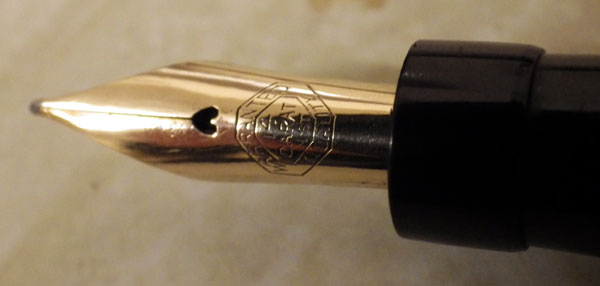
The rather splendid warranted nib is unusual. I read somewhere (can’t remember where) that some later Ingersolls were made by Wyvern. Wyvern had their own nib-making capability and may have made such a nib.

In any case, it’s an attractive and very unusual pen.
Edit: With thanks to Simon (Waudok)

This picture shows why I think Ingersoll’s were made by Wyvern. The 3 on the left are Ingersolls, the other 5 are all Wyverns. I have quite a few of this model Wyvern in these 5 colours but with different cap band configurations, and also shorter pens. I also have this model as a Kenbar (store pen for Barkers of Kensington), The City Pen from Spooners of Plymouth and some other advertising pens such as Earle’s Cement. I think I also saw one called a Regent pen on the Melbourne Pens site a few years ago.
The model names change over the years, I think the earliest is the Wyvern No 60, Clutch Selfil-Safety, Pat151753, WP Co, London (e.g. the Orange one); the Jade one is a Wyvern No 7N; and the Lapis one is a Wyvern Perfect Pen, No 81. There is also a shorter No 5, and shorter pens with an S instead of the N suffix.
The patent was applied for in 1919 (http://worldwide.espacenet.com/publicationDetails/biblio?DB=EPODOC&II=17&ND=3&adjacent=true&locale=en_EP&FT=D&date=19201007&CC=GB&NR=151753A&KC=A) and judging from the shape, I would have thought this pen dates to late 20s or 30s.
By the way, the section of your other Ingersoll looks like a Wyvern section to me as well.
Happy new year
Simon
Progress
Yesterday I fixed up five pens. Today it was eight. These are not large numbers, at least not in comparison with what I was doing before I became ill. The limitation is my legs which get a bit shaky all too soon. Not surprising, I suppose, as between hospital and gradual recovery at home I wasn’t very active, probably for long enough to lose quite a bit of muscle tone and it will take some time and gradual increase in effort to get that back. Nothing particularly spectacular among the pens I’ve been fixing – the usual Swans, Conway Stewarts, Watermans, Parkers and the like that people expect from me. Nice ones among them are a Swan eyedropper (either a 200 or a 1500, memory fails me at the moment) with a flexible broad stub. There’s a lapis lazuli Parker Junior too, and a splendid rose-marbled Kingswood.
Let’s see what tomorrow will bring.
The Chatelaine
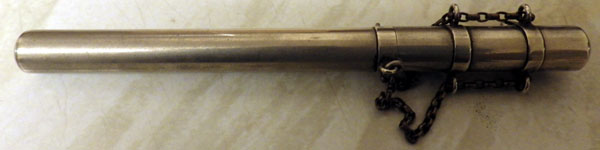
This is a chatelaine. No, not a chatelaine pen; it’s a receptacle that you put your pen in. Does that seem a little redundant to you? It did for me, at first, then I had a bit of a think about it. The later ringtops, the ones with a screw on cap, they were more or less all right, though I believe it was not entirely unknown for them to unscrew themselves in a treacherous way, allowing the delicate pen to fall to the flagstone floor. Like cats which always land on their paws, pens dropped on a hard surface mostly manage to twist themselves into the nib-down position. If they were liable to self-destruction, so much more so must the cone-cap pens of an earlier time have been. I’d be amazed if any of them lasted the week. Swan turned out a few with a bayonet-type cap fitting, but they didn’t seem to catch on to any great degree. All this does make the chatelaine look more practical, if a bit tiring. Pull the cap off the chatelaine, take the pen out. Pull the cap off the pen, post it on the back of the pen. Write note. Take cap off back of pen, slide it back onto the front. Put pen in chatelaine. Put cap back on chatelaine. Do that a couple of times and I’d be done for the day. Makes the pencil behind the ear seem more of a practical solution…
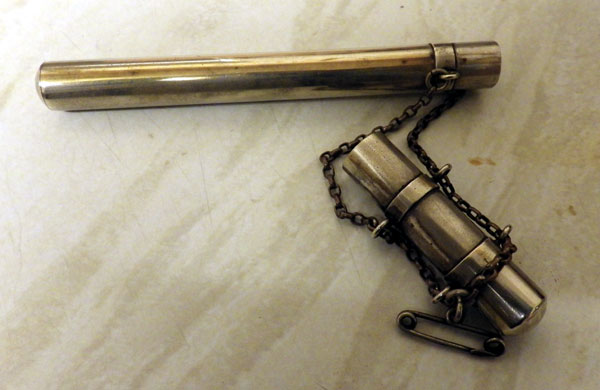
Though it’s made from some base metal it’s quite a stylish and well made thing. Quite plain, though the equally spaced bands with the attachments for the chain give it dignity. I confess to being quite taken with it. If you have to hang something off your clothing for writing purposes, this might as well be it. It could be quite versatile, too. You could stir your tea with it or if any person in the company was becoming irritating you could use it poke them in the eye.
I’m sure they had great fun with all their accoutrements back in those Edwardian times.
A Match-Box Cover with Swan Advertising
I write-tested and tweaked 25 pens this morning and that’s enough for today. They have still to be photographed and described, but that’s for another day.

Here’s an unusual bit of Swaniana – a match-box cover. I don’t know why you’d need a cover for your match-box but it leaves us an interesting bit of ephemera. Looking at the pen and box illustrated I’d guess at the nineteen-twenties or earlier. As ever, Mabie Todd graphics are striking. The Swan reaches out of a circle which breaks the surface of the match-box cover to seize the pen. One wing is partly concealed by the surface of the cover, the other lies over it – an impossibility that is made to appear quite believable. The cover advertises Swan Fountpens. So far as I can remember I’ve only seen the term “Fountpen” used to refer to Blackbirds, so that’s something new for me.
I can find no business information for R Johnston and Son, but they made (or had made) and sold picture postcards of the north-east of England, many of which survive and are collector’s items in their own right.
Unidentified Eversharp
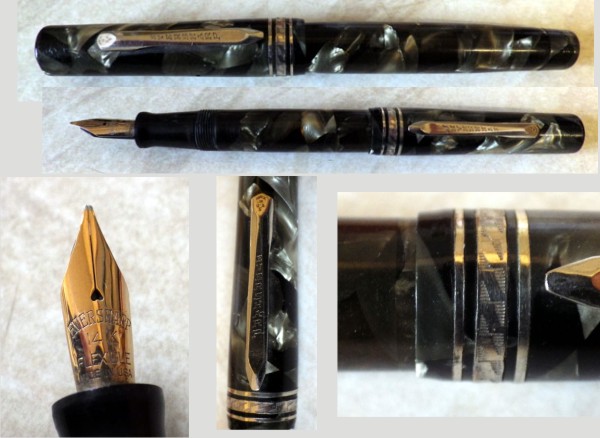
Can someone who is knowledgeable about Eversharps tell me what this is, please. It appears to be a plunger filler.
Turning The Corner
At long last we have the all clear – of sorts, in that neither of us is in hospital nor making regular visits to hospital any more. It has been an exceptionally tough time and it’s not quite over, in that we’re both still recuperating but becoming better and more able by the day.
I’ve been buying, so there will be some odds and ends to write about. Next task is to write-test some pens that have been sitting repaired on the shelf for weeks. Then photography, editing, descriptions and new uploads!
Thank you all for your prayers, good wishes, kind words and support.
Bringing this up to date.
As some of you will already know, it wasn’t enough that I should be ill; it was necessary, it seems, that my husband be hospitalized as well.
It has been a thoroughly miserable few weeks and it isn’t over yet, though I think the prognosis is good for both of us in the longer term. For the moment, we’re limping along. We can handle sales OK – a little behind in shipments but I’ll rectify that this coming week – but new uploads to the sales site will have to wait a while. It’s annoying. I have around twenty restored pens ready to go but I don’t have the strength to get the testing, photography and so on done. It will come in time.
Many thanks for all your kind messages. I hope to get back to blogging before too long.
A National Security Stud-Filler
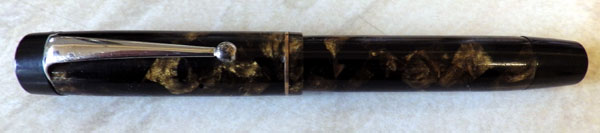
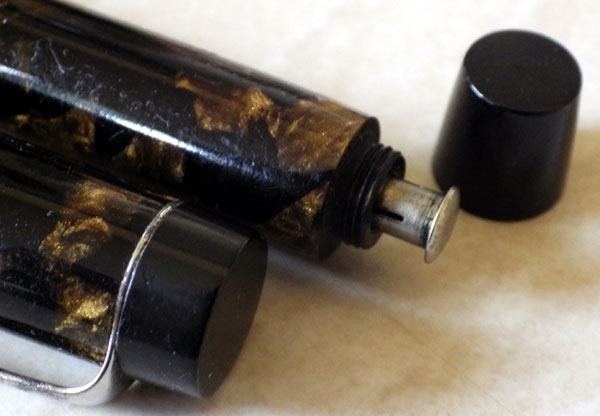
I’ve told the story of National Security (so far as I can) in several previous entries. This pretty stud filler probably dates to the thirties and has the look of a Langs pen. I picked up this one because of the brown/black marbled pattern. More than any of the other colours, this modest pattern evokes those years for me. Every manufacturer had a brown/black pen and they seem to have been unfailingly popular.

National Security were a maverick company, probably thoroughly unpopular with the other manufacturers. Those were days when protectionism was gospel with rigidly imposed price fixing making for an unnaturally level playing field for all brands. That only really works if everyone joins in, and doubtless much pressure was brought to bear on National Security, but they persisted in offering discounted deals to retailers. No doubt such sanctions as could be applied were used against National Security – it’s notable that no advertisements from them appeared in the trade press* – but they carried on in their own independent way and appear to have thrived.
Nowadays, of course, National Security would be behaving in conformity with the present economic orthodoxy and the attempts of the rest of the pen industry would be declared illegal. Who was right and who was wrong? From today’s perspective Conway Stewart, De La Rue, Mabie Todd and the rest were restricting trade, an unforgivable sin. However, if you have an empire that you wish to milk to the last drop and economic stability is your top priority, protectionism might appear to be the answer to your prayers. It’s also worth remembering that laissez-faire liberalisation of the financial markets left the developed world tottering on the brink a few short years ago.
*Stephen Hull: The English Fountain Pen Industry 1875 – 1975 p161.
 Goodwriterspens's Blog