The Perry Duragold

IMGP7453

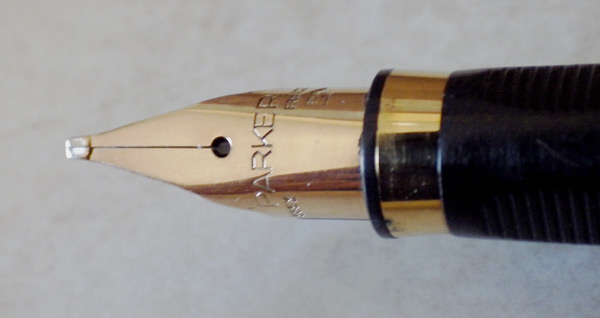
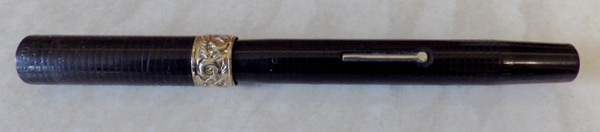
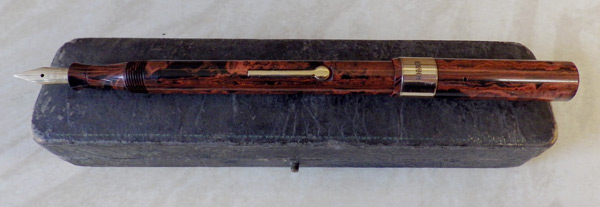
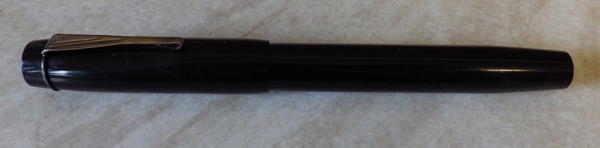
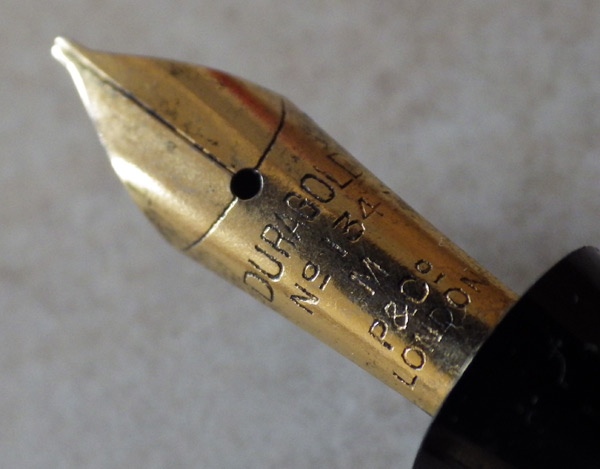
Now that, I dare say, is as plain a pen as you could wish to see.  No inessentials, no furbelows and fol-de-rols there!  It has a simple straight lever and a pressed metal clip because these things are essential and not from any wish to show off!  Perhaps the only concession to appearance is the thin coating of gold but that’s it.  Thus far and no further.  The nib is a plated one.
IMGP7457
Why am I writing about this clearly inexpensive and visually dull pen?  Well, for a start, it’s a pen you probably haven’t seen before as these are far from common.  Beyond that it’s a Perry’s Duragold, and thereby hangs a tale.

IMGP7455
Without the work of James Perry we wouldn’t have any of the dip pens or even fountain pens that are so familiar.  A teacher, Perry was frustrated by the amount of time wasted in re-pointing students’ quills.  This was around 1819 and though steel nibs did exist they were not popular because they were so rigid.  Perry developed a way of slitting the nib to encourage ink flow and allow flexibility.  He later developed a nib with the central hole  at the top of the slit. That was really the basis of everything that followed in the pen industry.  By the 1830s, Perry’s nibs were being mass produced and supplied to schools and industry.  By the mid-1870s Perry’s was the largest manufacturer of steel nibs in the world.
IMGP7459
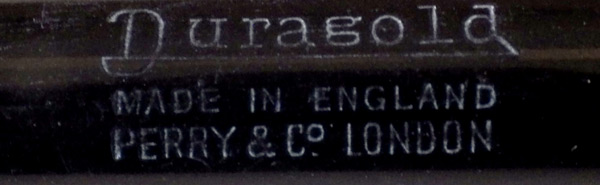
In 1918, Edmund, the second son of James Perry, set up his own factory in London, producing a variety of office supplies and other items including even a motor car.  It was this company, ES Perry, that eventually produced the famous Osmiroid fountain pen.  I suspect, though I can’t say with certainty, that they also produced the Duragold.
IMGP7461
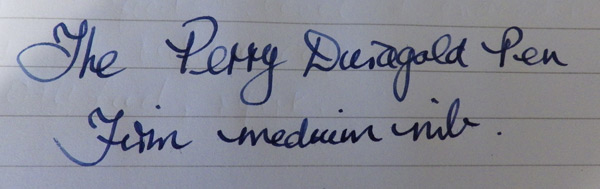
If you think that the similarity of sounds between Duragold and Duofold can hardly be an accident, you’re probably right!  I have no doubt that the name was intended to cash in on the popularity of the more expensive American pen.  I believe that the Duragold was produced at several different prices; I used to have a Duragold with a gold nib and a single cap ring.  The present example is a sturdy, well-made pen and despite the plated nib being of the cheap, folded tip kind, it writes very well.  I confess to a fondness for it in its unpretentious utility.  I might hang onto it for a while.

An Exceptional Blackbird

I love a pen with a good story and very often the story attaches to a personalisation so I’m certainly not one of those who dislikes engraved names and initials on old pens.
IMGP7438
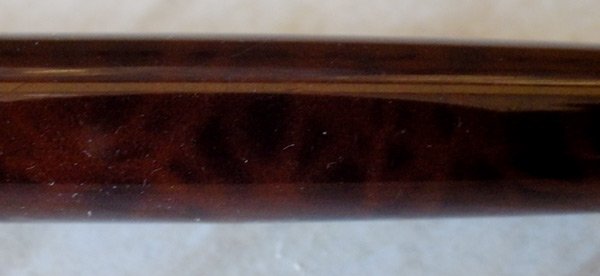
Under other circumstances this would be a very ordinary Blackbird.  However, it was owned by L W Hyde who was a medical doctor practising at different times in South Africa and South America.  The pen is discoloured to dark brown, perhaps by the subtropical sun.  It seems likely that Dr Hyde had no issue, as his effects ended up in a box in a friend’s attic.  Recently, the friend’s grandson found the box and among other treasures of a bygone era was this Blackbird in a handmade oak box.
IMGP7439
Having our knowledge of the item enhanced in this way elevates the pen from being yet another anonymous example of that model to a valued link with the past.  We don’t know all that much about the long-deceased doctor but his practice in these far-off places makes him, and hence the pen, quite exceptional.  It’s impossible to feel the same way about Dr Hyde’s pen as one would feel about a pen that turned up with no provenance attached.
IMGP7441
For a moment I thought he might be the eponymous hero of RL Stevenson’s “Dr Jekyll and Mr Hyde” but of course he’s Doctor not Mr Hyde and he would have had to be very long-lived to be that entirely fictional character.
IMGP1557
I would have liked to have had some assistance from my assistant with this article but she was otherwise occupied: sleeping.  She was out carousing until 4:30 AM.  Would that I had her social life!

Mabie Todd Swan Minor SM1/58

IMGP7432

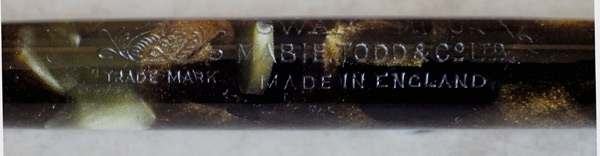
I have a list of Mabie Todd information which includes the various colour patterns that they used pre- and post-war.  Unfortunately, there are gaps and number 58 which is what this pen is, is one of those gaps so I will have to title it myself.  It looks like sage, bronze and black to me, so that’s what it’s called.
IMGP7431
These colourful Swan Minors never cease to surprise me.  There is always another one coming along that I haven’t seen before.  This one is subtler than, say, the Italian marble pattern.  If there is something occurring in nature that it resembles, I can’t think what it might be, though I suppose there might be all sorts of patterns to copy from geology.
IMGP7434
People seem to have prized these pens as many of them, like this one, are in excellent condition.  Though it has clearly been used, as I had to flush ink out of the section, it is unmarked and has obviously been handled with care.  Not many pens of this age that have been used show so few signs of it.
IMGP7435
As is so often the case with Swan Minors, it is a charm to write with.  The number one nib is smooth and has considerable flexibility allowing for pleasing line variation.


Edit to add:  Eric Wilson tells me it is called “Marine Bronze”.

Empire Pens

I don’t usually go in for lesser-known American pens but this pair caught my eye.
IMGP7428
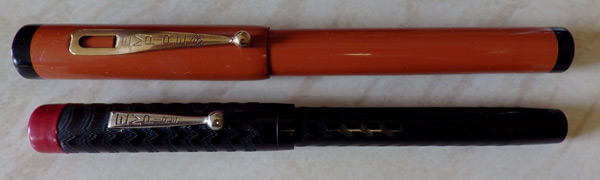
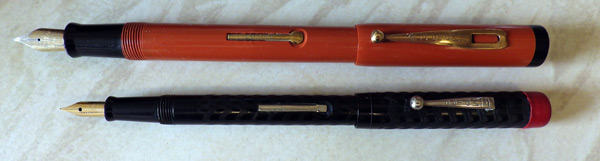
The fountain pen industry has had a long affair with the name “Empire”.  Parker, Sheaffer, Conway Stewart and DuPont have all used it at one time or another and there are modern examples too, like the Piper and the Conklin.  Perhaps the concept of empire reflects their corporate ambitions.  Be that as it may, this particular Empire is a sub brand of Eclipse.  I don’t think it was around very long but some handsome flat tops were made.

The orange, oversized pen has a Sengbusch nib, probably a replacement for the original.  These nibs were made by the Sengbusch Self-Closing Inkstand Company of Milwaukee, Wisconsin.  Now there’s a name to conjure with!

The black pen with the red top may be black hard rubber but I think it’s more likely that it’s celluloid.  It has a beautifully crisp engined chased pattern.
IMGP7430
Both of these pens are in superb condition and appear to have been used little if at all.  It’s unusual to see pens that some would call “third tier” in such pristine condition.  Though they may not be the equal of the Parkers and Sheaffers of the day, they are not all that far behind and they are extremely attractive and useful pens.

Edit To Add:  Doubt has been cast on the idea that Empire is an Eclipse product.  No indication has been offered as to what else they might be.

Parker 75 Thuya

IMGP7416

I’ve always wanted to get my hands on a Parker 75 but up to now I have never succeeded, mostly because the prices they fetched were a bit too steep for my pocket.  When I saw this beautiful lacquered example I was determined to have it and luckily it sold at not too wild a price.
IMGP7418
It has always seemed to me to be the most beautiful of all the Parkers, whether it was in the cisele pattern or this beautiful Thuya.  This one is French made and is part of the lacquer series which dates the pen to the period from 1981 until it went out of production in 1994.
IMGP7422
The lacquer on this pen gives the impression of great depth and in a sense that’s right because these lacquer finishes were worked up layer upon layer.  The metalwork fits right in with the finish and the gold trim has lasted well as it remains perfect.
IMGP7420
The cap and barrel are made of metal – probably brass – but the pen isn’t really heavy.  The cap slides over the section smoothly and closes the pen with a satisfying click.  It’s completely firm and requires a noticeable effort to remove the cap again.  The pen is a cartridge/converter filler, of course, and it takes several turns to remove the barrel.  This one has a squeeze-type converter fitted and it takes a good fill of ink.  It posts securely and, for me, feels absolutely right in the hand.  The sculpted section indicates where your fingers should go and provides a secure, non-slippery grip.  The very handsome gold nib – in this case a broad one – is as smooth as silk.
IMGP7424
This was an expensive pen when it was new and 75s continue to fetch a high price when they appear.  I would say that unlike many another high-priced pen, this one has always been extremely good value for money.  It’s a pinnacle of pen-making.

Sacs

IMGP7122

Have you seen a sac like that before?  It came from a Waterman 52 that clearly hadn’t been used for a long time.  I’m not sure why it should be ridged in that way.  Perhaps it helped to ensure that the sac did not stick to the pressure bar or the inside of the barrel.  Strange that I shouldn’t have come across one of these before but I don’t remember doing so.

Sacs are quite confusing these days.  There is the basic latex sac that we’ve used for most repairs for a long time.  Then there are the sacs that we thought were silicone but turned out not to be, and there are David Nishimura’s true silicone sacs.

For me, the latex sac remains the default.  Unless the pen is one of those colours that are greatly at risk of deterioration when latex sacs begin to decompose, I see no reason to use anything other than a latex sac.  Latex sacs are by far the most flexible and therefore cause least stress on the filling system.  Those sacs that we once believed to be silicone but have proved not to be don’t seem to have a place in pen repair any more, so far as I can see.  Their place has been taken by Nishimura’s silicone sacs.

We are very fortunate that today’s sac manufacturers were able to resuscitate the process.  Without sacs – and for a time their production had ceased worldwide – pen repair becomes very limited.  Lever fillers, button fillers, Vacumatics, Touchdowns, Bulb fillers, Crescent fillers and a host more – most pens, in fact, would be unrepairable.  Competition would be quite stiff for Onotos, Fords, Sheaffer plunger fillers and the like.  Many of us might be limited to (shudder) the cartridge/converter!

Some Pens I’ll Be Uploading To The Sales Site Soon.

Here are some of the pens I’ll be uploading to the sales site in the next few days (Deo volente).  I would like to write about all of them in much greater detail but I just don’t have the time.  There are a number of others that I have written about already.
IMGP7077
This one’s a sturdy Valentine which bears some resemblance to the 1947 Parker Victory Mark III so it’s doubtless of a similar date.  I’m not usually fond of Valentines; most of those I come across are flimsy, fragile things but this one is the opposite.
IMGP7079
The De La Rue pen is a close relative of the Onoto and this one sports a number 22 nib which is fitted to some of the Onotos as well.  The handsome mottled hard rubber section is correct; it’s a feature of these pens.
IMGP7080
The jade cap lip on this American Swan ringtop is very distinctive; a very rare pen.
IMGP7082
Another of those splendid Italian marble Swans.  I’ve been very lucky in picking up several this past year.  This one’s an SM 100/59.
IMGP7084
A fine old Swan safety screw cap.  A little faded, but sound and bearing an accommodation clip.
IMGP7087
A superb Conway Stewart 479M, the Universal pen.  This is the earliest version, dating to around 1931, identified by the inserted clip, flange lever and domed top.  The colours of the mottled hard rubber are very rich.
IMGP7090
A very fresh Cross in matte black with a broad stub nib.
IMGP7093
This is a Blackbird Self-Filling Pen of the earliest type with the spoon feed, soon to be abandoned in favour of the ladder feed.  The embossed gold-plated broad band is very attractive.
IMGP7097
This Mabie Todd “The Swan Pen” is around 100 years old and still working splendidly with its over-and-under feed, New York nib and slip cap.
IMGP7100
This one is an oddity: a Pilot with a “fude” nib, intended for writing Chinese characters.  The more you angle the pen the wider the line becomes.
IMGP7104
“Rosemary – that’s for remembrance”, a beautiful lever filler made for National Security to commemorate those lost in the Great War.  In excellent condition, bearing a hallmarked broad cap ring.
IMGP7107
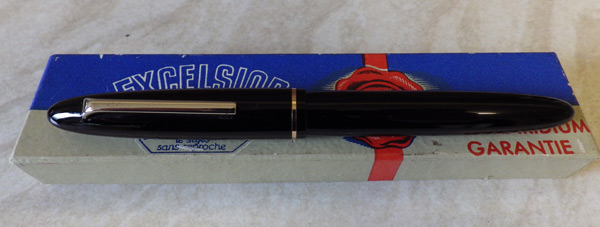
This boxed Excelsior is New Old Stock.  Interestingly, it’s an accordion filler.  A most uncommon pen here in Britain.
IMGP7108
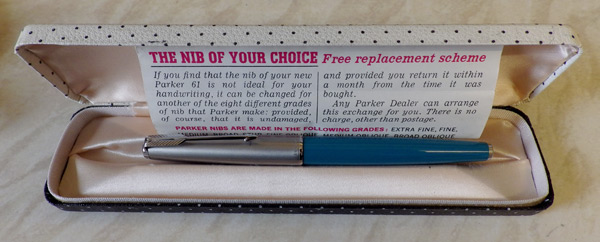
An excellent Parker 61 of the capillary type.  It has been thoroughly flushed out and is ready to write.  The box is in first class condition and filling instructions are included.
IMGP7111
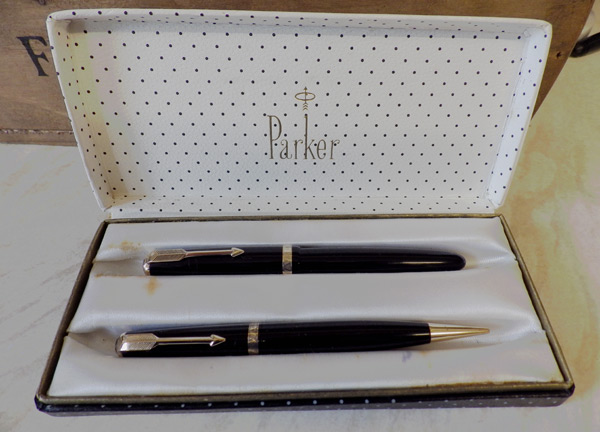
A Parker Aerometric pen and pencil set.  There is some staining on the interior of the box but it’s otherwise sound.

A Carved Wood Dip-Pen Handle


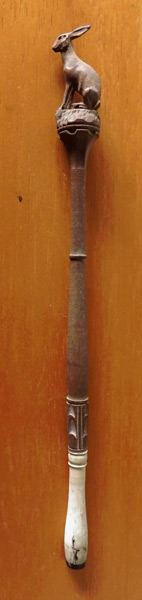
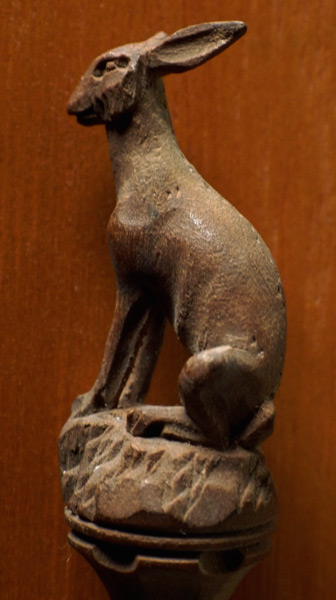
IMGP7072I couldn’t resist this little fellow.  I don’t know how old he is or where he came from, with absolute certainty, though the seller suggested that he had come from the Black Forest.  That seems quite likely given the quality of the work and the fact that it appears to be made from lime wood, which was much used in Germany.  I’ve checked my various reference works and I see nothing else with a carved wood animal finial.
IMGP7071
There is not a lot I can say about this object.  It’s not perfect – much of the ear away from the camera has been lost.  That’s a pity but it doesn’t affect the function and it barely affects the aesthetics.  It’s my guess that the part that the nib goes in is bone rather than ivory.  So far as I can, given that I can’t write with a dip pen, I’ve tried it and it seems perfectly practical.