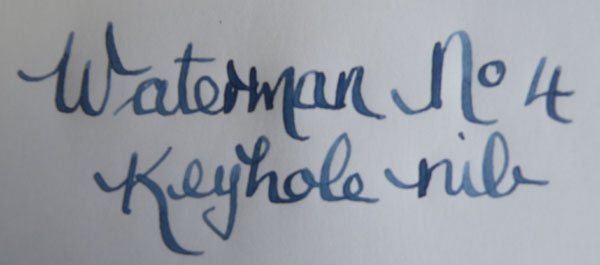
Canadian Waterman 52V

In the bad old protectionist days (as opposed to the bad new global days) Britain used tariffs to favour its own national production, as did every other country. As Commonwealth countries were exempt from these taxes, Parker and Waterman were quick to establish manufacturing plants in Canada to exploit the British market, hence the large numbers of Canadian pens we find today, some of them interestingly different from their American equivalents.

 

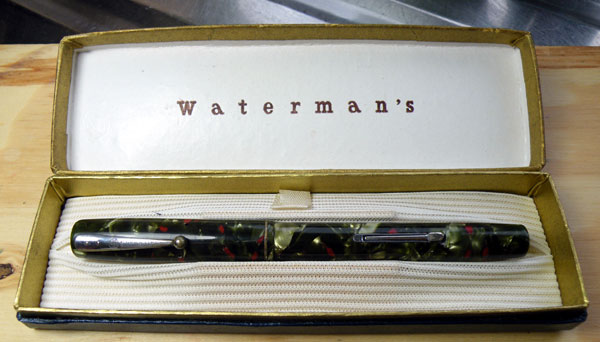
This 52V is, I think, identical to the American version except for the imprints. At 10.7cm capped, it’s a short pen, but not so short as to be uncomfortable to write with when it’s posted, for me at least.
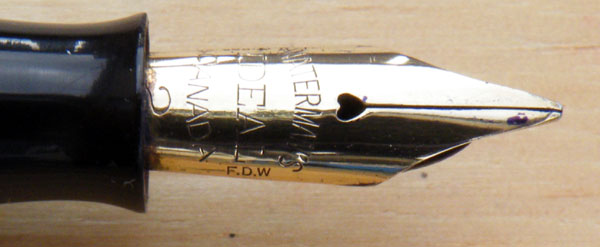
 

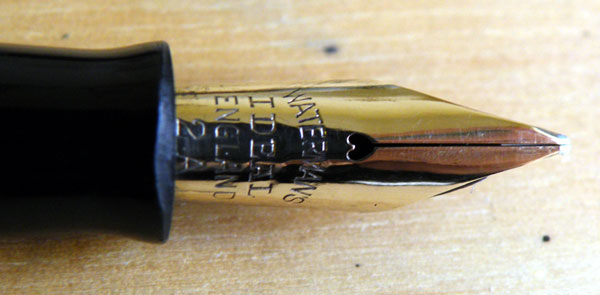
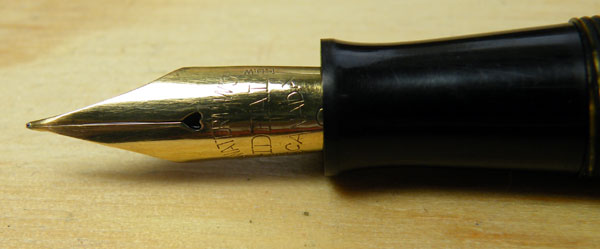
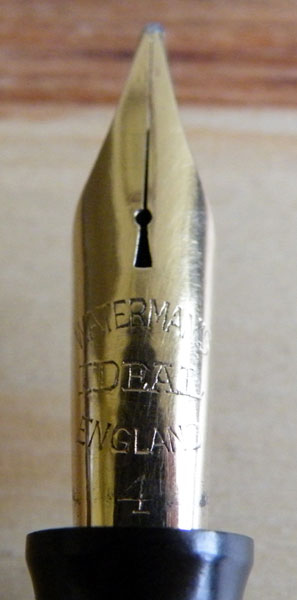
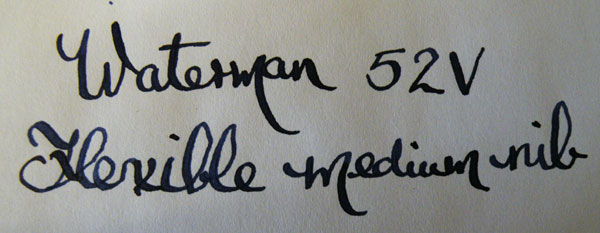
And that’s a very good thing, because this is a writer’s pen par excellence. The beautiful Canadian Ideal No 2 is a generous medium and flexes at a touch. It snaps back instantly to its default width and the spoon feed keeps up effortlessly with a supply of ink. It’s a joy to write with.


Waterman may have been a little late in the day in getting into celluloid, due to its commitment to patterned and plain hard rubber, but by the nineteen thirties it was using some of the loveliest patterns ever seen. This grey and russet pattern has great clarity and almost seems to shine from within.


Flat-topped and with the metal of the clip at the top of the cap, it has a slight resemblance to the contemporaneous Parker Moderne in that respect. The pierced clip is instantly recognisable.

These pens are not uncommon and they’re almost invariably fitted with a flexible nib. As half-sized pens, they tend to sell quite a bit cheaper than their full-sized brethren. If you want flex and you don’t find a short pen uncomfortable to write with, the 52V is a pen to look out for.
 

Watermans

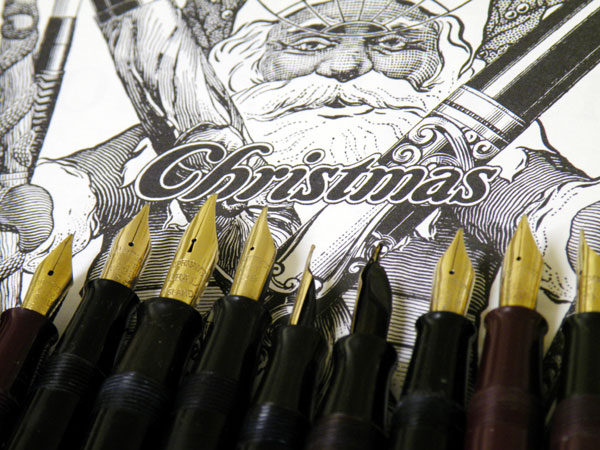
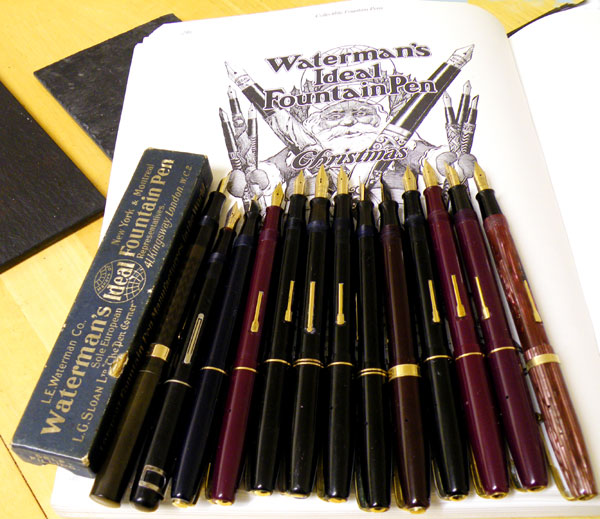
I buy a lot of Watermans. Mostly, they’re English and made in the late forties and early fifties. In this lot, the current accumulation of Watermans in my “restored” box, there’s a thirties Canadian Junior and a twenties American 52. All the rest are English and post-war.

Unrestored English Watermans, especially the less expensive models, don’t fetch much of a price. That’s understandable in a way. They’re quite undistinguished pens at first glance and the plating, especially on the clips, is often poor. Many people are reluctant to tackle repairing them as they have a deserved reputation for being difficult to disassemble. The part of the section that meets the barrel is usually ridged to provide extra grip and if that’s not enough, they’re also not infrequently glued with some mighty substance known only to Waterman. On the upside, it’s worth saying that dry heat and patience will eventually loosen them all and once that’s done they’re an extremely straightforward repair and they smarten up pretty well – plating loss aside. Waterman’s spoon feed was a great, efficient and much copied invention, which delivered ink in all but the most extreme circumstances, so even the older ones write very well. In the forties, with perhaps a sideways look at Sheaffer’s multi-finned feeds, Waterman developed much more complex feeds that do an immaculate job of ink delivery. If you have a Waterman from this period, provided it hasn’t been stamped on repeatedly, it won’t be too hard to get it to lay ink on the page.

The other part intimately involved in laying the ink down is the nib, and the nibs are why I keep buying so many Watermans. Many have some degree of flexibility, quite a few are impressively flexible, and all write well, even the rock-hard ones. Even through the company’s worst times, Waterman always made superb nibs.

It’s certainly the case that the W5s and 515s have some pretensions to being prestige pens, but in truth these pens aren’t collector’s items, or not to any great degree. They’re pens for people who like to write, and as such they’re exactly the kind of pens I love to send back out into the world to be used again. Going on the number available today, they were hugely popular here in their time, and rightly so. They’re great pens.

An English Waterman

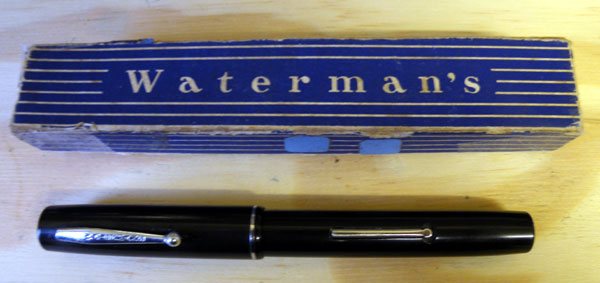
These rather plain Waterman pens turn up quite often. They have no name or number, and resemble the last, celluloid version of the Waterman 52, cut down, without the lever box and a little more streamlined. They’re not fancy but they’re good, and I buy them whenever I can. Guessing that they’re 1930s pens, they’re more robust than Waterman’s output would be ten years later, they’re well-balanced and comfortable in the hand, and they often have exceptional nibs.

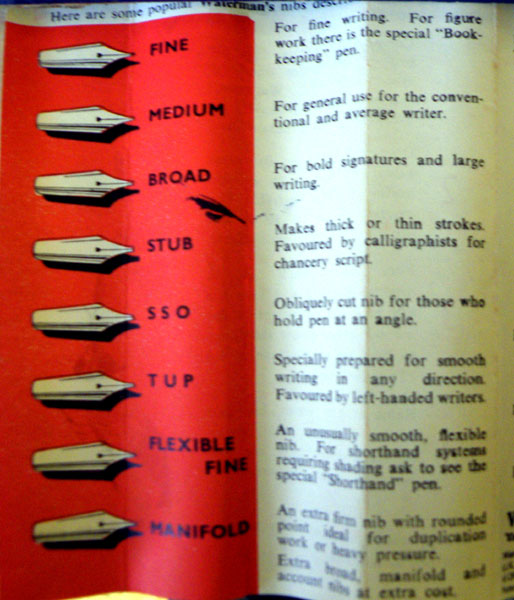
Talking of which, this is from the guarantee/instruction leaflet in the box. Quite a range of nibs were available for this humble pen. First time I’ve heard an oblique called an “SSO” and I’m still not quite sure what distinguished a “TUP” from other nibs.

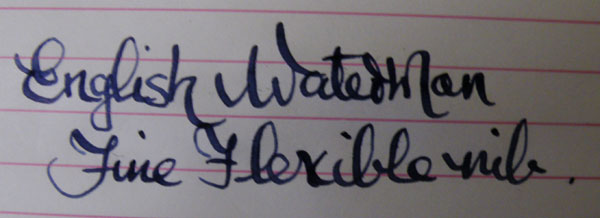
It would be my guess that the “Flexible Fine” was fitted to this pen!

Grey Striated Waterman

When I bought this pen I assumed that it was an English W3. It’s the same style and size but it’s actually an American pen. Not being well up on the lesser US Watermans, I don’t know what it is, and the barrel imprint is worn, so that doesn’t help. To complicate matters further it has an English 2A nib, probably a replacement.

In Britain, Waterman was using the combination of that clip type with the striated plastic in the mid to late forties, and I’m assuming that this pen also will date from that time. It was an unfortunate period for Waterman. Quality was not what it had been and it shows in this example. The nickel plating is worn on the clip, showing the brass beneath. There are a few scratches and some wear on the plastic, which is quite soft.

Actually, though, none of that matters at all. The pen’s sound and it’s fitted with a nib to die for. I’ve had much fun practicing my curlicues with it this morning.

The Waterman 3

Waterman have had their ups and downs over the decades, but their moderately-priced flat-tops were very popular in Britain in the 1930s. They can be a bit confusing, because similar-at-a-glance pens appear from the USA, Canada, England and from Jif Waterman in France.

This one is a Waterman 3 made in Canada, and is typical of the Canadian output with its box lever and riveted clip. The colours are outstanding and the beautiful fine No3 nib has great flexibility.

Many of these pens have flexible nibs, and though they weren’t expensive when new, they have proved durable and they restore well.