Conway Stewart Scribes

There are three sorts of Conway Stewart Scribe. All are the same shape and dimensions but there the similarity ends. The 330 and the 333 are black hard rubber pens, mass produced doubtless in the thousands. They appear to have been bought by companies for their clerks to use. Though they were built to a price, they are not bad pens. They have some nice engine chasing and they are good writers, like all Conway Stewarts. They remain low-priced because they are so common.

The other Scribe is the 336. These are casein pens in delightful colour patterns, some bright, others more subtle. They are not so common and some patterns are quite rare and therefore more valuable. As a writer, it’s no different from its poorer relations but as a collector’s item it’s much more desirable.

If you want to see photographs of these pens, go to http://jonathandonahaye.conwaystewart.info/index.html, Jonathan Donahaye’s site. Though Jonathan is sadly no longer with us, his site is still maintained though not updated. Research has moved on in the years since Jonathan passed away so not all the information is completely accurate but the photographs and basic dimensions remain a splendid resource.

The Burnham Chatsworth

I’ve written about the Boots Chatsworth before. The search facility will find it if you’re interested. Though this pen has the same name it’s completely different from the one I wrote about before.

Boots is a pharmacist that sells lots of other things. At one time it had pens made bearing their own name under the Chatsworth label. I’m pretty sure it no longer does. The pen I wrote about previously was a rebadged De La Rue, and therefore an extremely high quality pen. At some point in the 50s, the manufacturing contract was awarded to Burnham, possibly in a cost-cutting exercise.

Burnhams are very pretty pens, mostly because they used patterned casein which allows for greater colour depth and subtlety than even celluloid can provide. Unfortunately, the casein Burnham used appears to have been less robust and durable than that employed by – for instance – Conway Stewart. You will often find Burnham pens with the disfiguring craquelure that can spoil casein pens and, even worse, some of these pens begin to disintegrate. Years ago, I bought a large box of varied 1950s Burnhams. Many were good but others had fragmented, leaving small jewel-like pieces of patterned casein at the bottom of the box.

Perhaps Burnham bought a lower grade of casein or maybe it wasn’t seasoned long enough. Anyway, that’s the reason you see so little about Burnhams in my blog. I rarely buy them. However, when they’re good they’re good. This Burnham-made Boots Chatsworth is a fine example. Burnham had their own way of doing things. When they have gold nibs, like this one, they tend to be small to keep the cost down. Their sections screw in which makes their removal for servicing easier. Small though they may be, Burnham nibs are good. Size doesn’t really matter except aesthetically. After all, you only write with the last millimetre.

Though the Burnham was undoubtedly cheaper to produce than the De La Rue had been, it is still a great little pen of vastly higher quality than the very cheap items offered by the few stores – WH Smith comes to mind – that still stock own brand fountain pens.

Burnham casein may be an extreme example of fountain pen deterioration but it is a straw in the wind. Eventually, however long it takes, all our old fountain pens are likely to fail irrecoverably. Casein is especially subject to failure. Celluloid is tougher – or at least most celluloids are – but it ages too. Red and mottled hard rubber are brittle and subject to damage. Black hard rubber, as we know, oxidises. We can, of course, improve its appearance by removing a layer but it will oxidise again.

The general point I am making is that our pens, unlike some other antiques, will not endure forever. That makes them all the more precious. We are their custodians and we should give them the best care possible, especially avoiding unsafe polishes, cleaning materials and waxes.

The Abbey Pen

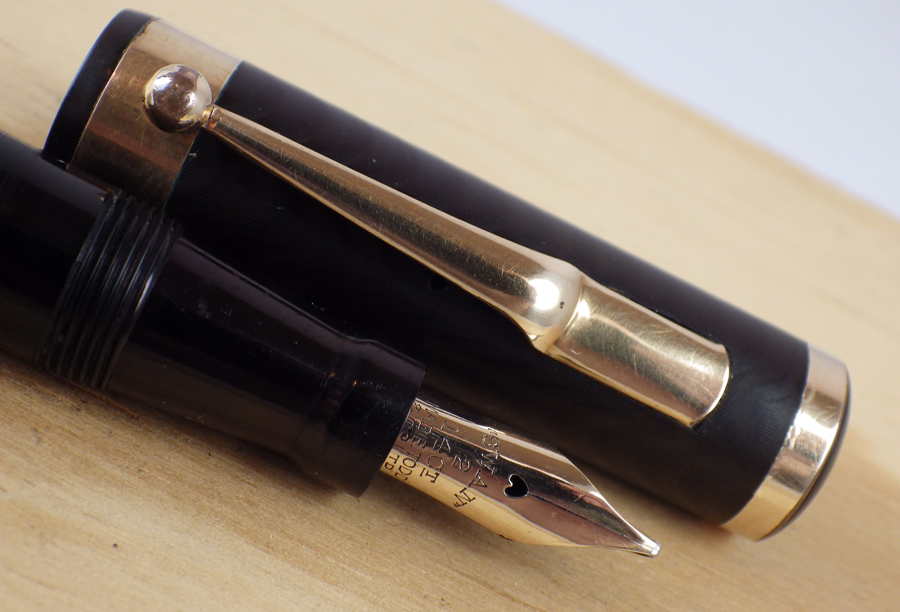
This rather handsome Mabie Todd pen is neither a Swan nor a Blackbird, nor yet a Jackdaw. It’s just “The Abbey Pen”. I’ve been unable to find any explanation for it and this is the only one I’ve ever seen.

Wyvern made an Abbey pen in the 30s but I think that’s just a coincidence of names. The Wyvern pen was at the lower-cost end of their production, and this Mabie Todd Abbey Pen would have been expensive, going by the quality of construction and the amount of gold-plated trim.

It measures 12.6 cm capped, but it is a useful size posted at 15.6 cm. When it came to me it had no nib but I have fitted a Swan number two flexible medium stub. It writes like a dream.

FPR Himalaya Update

Just a follow-on to my comments of 1st May on the FPR Himalaya; I’ve been using it for a fortnight now and I’ve had no problems at all, neither drying out between uses nor skipping. It’s a brilliant pen.

My Workshop

My workshop was rebuilt at the back of the house yesterday. I have a shelf to put up and I’ll put in a light and some electrical sockets and we’re good to go!

In discussion with another restorer, he admitted that he had to work in his kitchen. To be frank, I’ve worked like that too. In some of the houses and flats I’ve lived in it was impossible to have a shed and at one stage I had a two-shelf trolley which contained all my sacs, polishes, chemicals of one kind or another, glues, large tools and so on. It lived in a store-room and was wheeled into the kitchen when restoration work began. The small tools, the ones most used, were in a hinged wooden box that once contained several bottles of schnapps.

That worked well enough but there is no substitute to having everything to hand in permanent positions. Also – and I think this is psychologically important – having a separate workplace is conducive to the right frame of mind. I leave the house, unlock the workshop, snap on the lights and I’m at work. When I’m finished I lock up and go home like any other worker.

I love my shed!

Osmia 60 C

IMGP3247

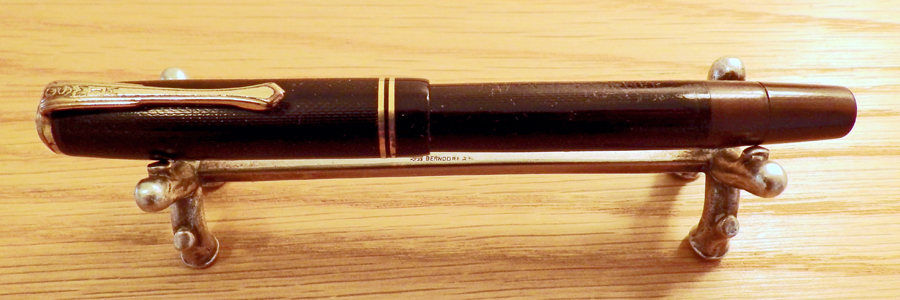
This is an Osmia 60C. Osmia’s model numbers are a mystery but those in the 60s seem to have been issued in the mid-thirties, which would be in line with the black hard rubber blind cap.

I’m not much good on piston fillers so my friend Paul L. kindly fixed this one for me. Major kudos and gratitude for the excellent job he did.

IMGP3248
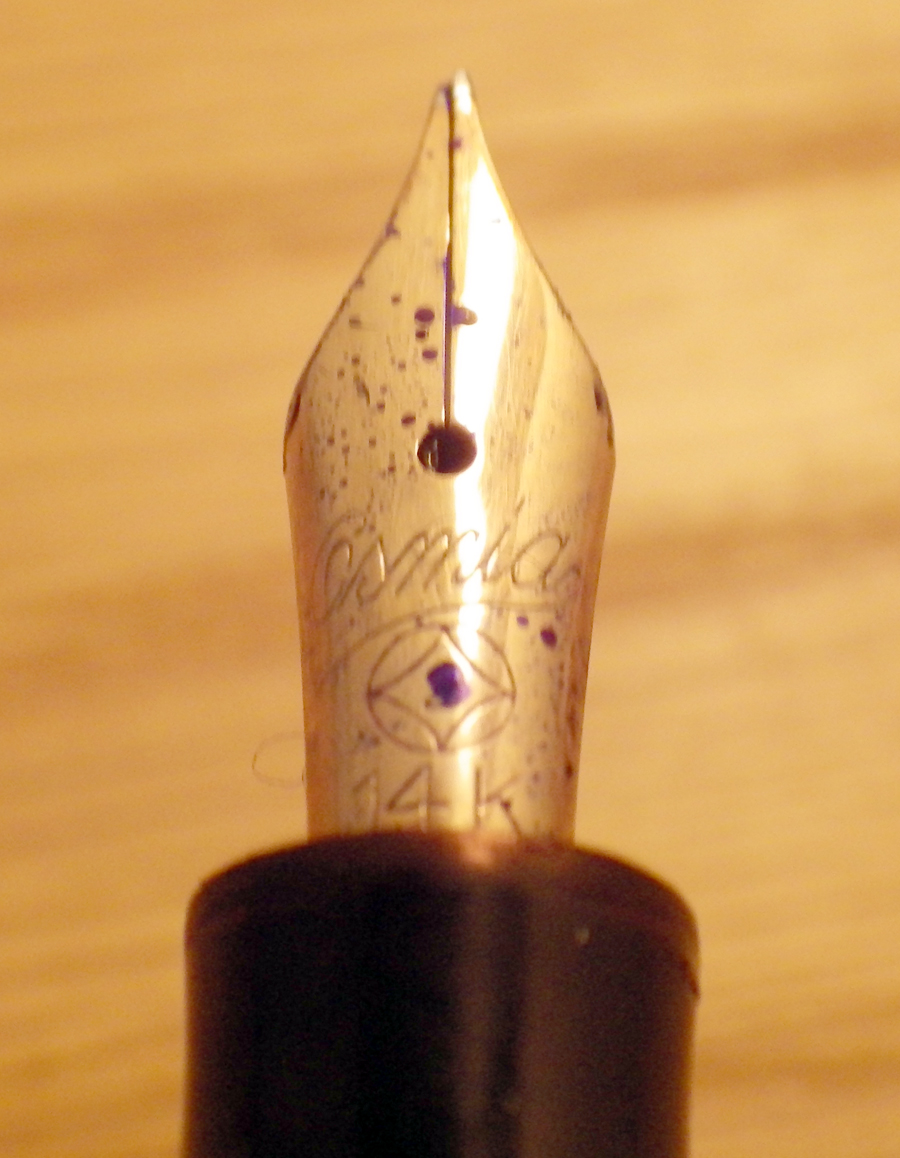
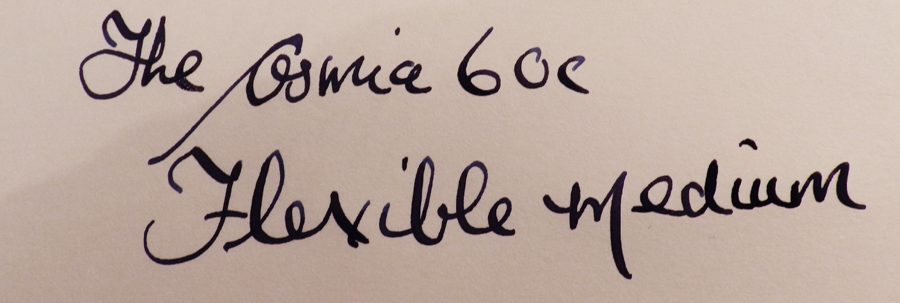
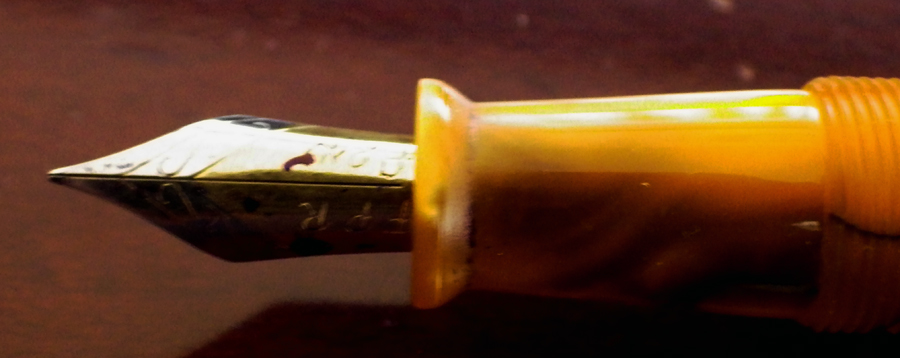
The nib is semiflexible, heading for fully flexible and the ink flow is generous, which makes the pen a joy to write with. The Germans know how to make a fountain pen – or perhaps I should say they did. I’ve had modern Pelikans and Montblancs, neither of which I found all that impressive, especially when you consider how much they cost. Nice looking pens but they don’t have the writing quality of this 80-year-old sweetheart!

IMGP3250

The 60C is rather a rarity. I’ve been able to track down only one other example online. It’s a small pen by today’s standards at 12.5 cm capped. Personally, I find it quite a convenient size. The faded blind cap may be seen by some as a flaw but I feel that it speaks to the age of the pen. I’m not one of those who re-black pens.

IMGP3252

I suppose I’m going to have to sell this pen but it will be with great reluctance. It’s what I’m in business to do, after all, and I really shouldn’t add to the boxful I already have. In fact I think I shall deal with temptation by listing the pen on the sales website today.

Re-blacking Again

The debate about re-blacking hard rubber pens has died away of late, largely because no effective method has been publicly available. However, a new re-blacking material has appeared on the market and you can find out about it here:

http://www.lbepen.com/deoxidizer-instructions

I have seen the results of using this method of re-blacking and I confess that I am impressed. A very thin layer of oxidised rubber is removed from the surface of the pen, exposing the black material underneath. Imprints and chasing appear to be unaffected.

I continue to have reservations. In the short term, the pens appear undamaged and it is even suggested that the process well make them less likely to oxidise in future. What of the longer term, though? Will bad effects appear somewhere down the road?

My advice to those who wish to use it would be to avoid employing it on rare or expensive pens for the time being. It would be prudent and fair for restorers to make buyers aware that pens have been re-blacked using this method.

FPR Himalaya

IMGP3241This is my first pen review in quite a while. Sorry to start with a modern pen but it was what I had to hand. This is a Himalaya from Fountain Pen Revolution. Capped, it measures 13.4 cm, so it’s average sized for a modern pen. The acrylic is quite spectacular. The cap fits with a turn and a half but the section/barrel thread is much longer, allowing for the pen to be used as an eyedropper filler, I assume.
IMGP3244

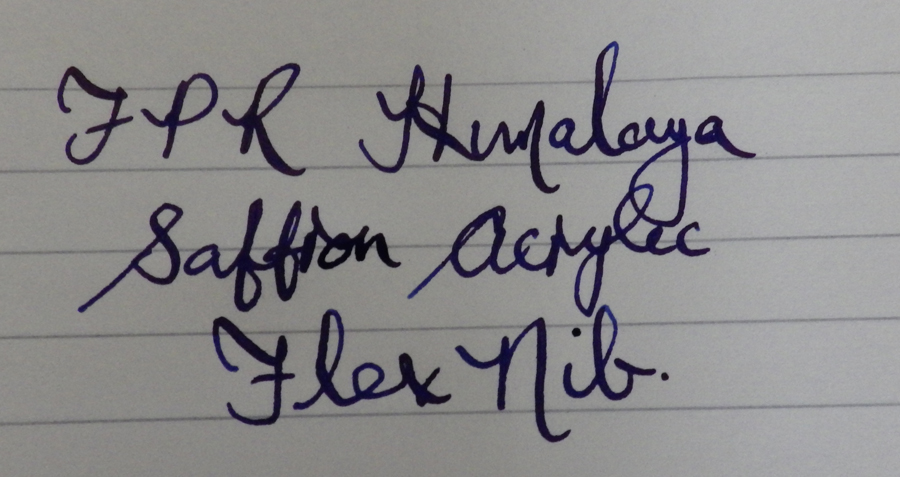
It is an inexpensive pen. Allowing for the extra $3 for the “flex” nib, it cost $32 or about £24.75. I put flex in quotes because I wouldn’t really regard it as very flexible. It’s semi-flex at best and that requires a noticeable amount of pressure. That said, some line variation can be induced and it is a very pleasant writer. The nib is very smooth and writes very well on the medium-rough paper I have used here.

IMGP3246

It comes with a plunger-type converter which works well enough, though it is impossible to get a complete fill. It holds about as much as a short international cartridge, or maybe a little less. I would have preferred a better converter but for the money I can hardly complain. All in all, this is a really excellent pen, comparable with models that cost five times as much. It doesn’t skip and starts immediately after not being used for a day. Time will tell how robust it is but I can’t see much to go wrong.

IMGP3245

I don’t know for certain where these pens are made but I assume China. The Fountain Pen Revolution website states “Each FPR pen has been manufactured to our specifications and fitted with high quality German-tipped nibs.” Yup. That sounds Chinese to me. How times have changed! 10 years ago Chinese pens were almost a joke. Most didn’t work well and many didn’t work at all. Even those that worked tended to fall apart after a few weeks of use. Now, many of the pens that are coming our way from China are very good indeed. Though the nibs are not up to European or Japanese standards, they are not bad at all.

IMGP3242

Getting There!

One good thing about moving is the forced ‘opportunity’ to clear out, organize, and re-assess. The pen workshop is slowly taking shape – as a result, many items have resurfaced after spending almost a year in hibernation.

It’s been a joy getting back to some pen repair, some pen photography, and the odd upload here and there to the website.  It’s all a bit overwhelming, but we’ll get there!

Back Again!

I’m back in business if only in a small way. I’ve added a couple of choice items to the Odds & Ends section of my sales website. I’ve already managed to get a few pens ready for upload and they will be appearing in the next few days. This is without benefit of my workshop, which I’m still waiting to get together.

I’ve been in eBay buying a few pens. It’s a long while since I did that and my goodness how the prices have risen! There are less high-quality old pens around too, which is sad but I suppose it had to happen sooner or later. There isn’t a bottomless well of old pens out there. There are still plenty of excellent post-war Parkers, and very fine pens they are too but, for the moment, the demand for them is poor. I generally try to keep a few in stock and they do move, but slowly.

The days when there were hordes of Swans of all dates have gone, I’m afraid. Those that do appear sell for serious money now. Still, not to worry. EBay isn’t the only game in town and I’m sure I can find some pens that my customers will want.