Whining, Excuses And A Promise To Do Better

The pen restoration and sales seem to have swallowed my life whole recently. Some time ago I found that the most I could reasonably do was twenty pens a week and that somehow became a target which I’ve aimed at – not always successfully – ever since. Each pen takes a minimum of two hours, which may seem a lot, but there’s much to be factored in: purchasing, paperwork, assessment, repair and restoration, testing, research and description, photography, listing and despatch. That’s fairly demanding for a decrepit restorer no longer in the first flush of youth nor the peak of good health. Something has had to suffer and it has been this blog. Neither lack of interest nor a shortage of things to write about caused the falling-off in blog entries recently. I just couldn’t find the time.

This wasn’t the way it was meant to be. Switching to restoring pens rather than collecting them was to be a way to see and handle all the wild, weird and wonderful pens that would never have come my way otherwise. The other side of that was to write about them here, and get more information about (mostly) British pens out here on the Web where it’s freely available to all. For a long time the only good information on British pens was Jonathan Donahaye’s admirable Conway Stewart site. All the major American manufacturers like Waterman, Parker and Sheaffer were comparatively well-represented on the net, but I remember how I used to despair over the absence of useful data on almost any British pen. The situation has improved with the arrival of the excellent websites on Burnham and Summit, but there is a long way to go. So for the foreseeable future, and until the plenitude of British brand websites makes me redundant, I’ll carry on adding what I find to this blog. It may be – sometimes at least – short on hard information and long on speculation, but it may provide a starting point for someone in their quest for knowledge about that odd pen that they found.

I think the method must be to firmly scrap the target. If I fix twenty pens that’s wonderful. If I only fix five, that’s equally wonderful. At least I’ll have time to do more in this blog.

Trapped Emails

Merely by chance I happened to discover that British Telecom in their wisdom (if you detect the sharp flavour of sarcasm there, your taste buds are not wrong) have applied a spam trap to my email accounts. I could never have guessed that they had done so, as a goodly measure of blatant spam gets through on a daily basis. Having been alerted to the presence of this spam trap I examined its contents. None of the more than one hundred emails in there was spam. Some of it was important. Worse, I found out that they delete everything when it reaches thirty days old.

The spam trap has now been turned off. I’m working through replies to unanswered mails, but if you have written to me and not received an answer please accept my apologies and write to me again. I always reply to emails (except when BT hides them from me).

I am left to wonder why my ISP would take it upon himself to block a sizeable proportion of my email. I wonder even more why it wouldn’t occur to him (her, them, it) to give me a hint that he was doing so. I am beyond wondering how it came to pass that the emails that were trapped were genuine while all the V14GRA ones got through…

I’m not off to a good start with my new ISP.

Even my assistant is displeased.

The Overwrappers And The Underwrappers.

I get pens in the mail just about every day. Despite the fact that it works out about twenty a week, each pen is still as exciting to unwrap as the first one I ever bought. There often is a fly in the ointment, though, and it centres around that word “unwrap”.

There are, it seems to me, three kinds of packers. There are those who use good materials to wrap a pen securely and still leave it easy to unwrap at the other end. They are very, very rare. Then there are the ones who throw the precious pen that I spent £50 on in an ordinary envelope and let it take its chances. Not even a padded bag – an ordinary envelope! They are all too common. Last, there’s the third kind. He knows you have to protect the pen but he doesn’t have any postal tubes or cardboard boxes, so he takes whatever may be to hand, in the knowledge that an abundance of bubble wrap and parcel tape will make up for any other shortcomings. I hate this one SO BAAAAD!!

This morning I got a splendid Macniven & Cameron Waverley (of which more another day). First, it had been wrapped in six layers of bubble wrap, secured by half a pound of parcel tape. This mess was placed in a small plastic tupperware-style box, and that was wrapped with many layers of that white-and-red “Fragile” tape which is made of the toughest substance in the known universe.

I broke a nail on it. I repair twenty pens a week and I never break a nail. Never.

No fate is too horrible for people who pack a pen in this way.

This Week’s Work – Or A Part Of It

This lot arrived this morning: 28 pens in need of restoration. So you know what I’ll be doing for the next few days. If I were the webmaster of a certain fountain pen group which shall remain nameless (but whose initials are FPB) I would make it a competition to Name Those Pens and then drag it out for about a week. However, as I find that sort of thing thoroughly tedious and I expect you do too, I won’t bother. That picture’s probably too small anyway. So I’ll tell you that there’s a Swan there and a Blackbird too. There are several Mentmores of various dates and some Parkers including a Vac and a 51 Vac, along with a brace of Stephenses, a Relief and a wee Waterman chatelaine. And a few other things including a green herringbone Valentine. Doubtless some of them will be featured here soon.

Oh, and the tray’s an example of Scottish early twentieth century chip carving, if anyone noticed it.

Price

I see the search terms that people use which lead them to this blog, and sometimes they become the subject of what I write that day. One thing that comes up time and again is a source of frustration to me because I can do nothing useful with it, and that’s the question of value for individual pens. Today there’s a search for the value of a Conway Stewart 55 and a Conway Stewart 27. Both of these are highly esteemed pens which sell quite well, whether in eBay or on retail sites. However, there are so many variables that affect value that it’s impossible to put a price on a pen without handling it. Even if I had the pen in my hand to examine, I could in all honesty only give a range of prices because it’s sadly true that so much depends on who is in the market on a given day.

Condition is of considerable importance. A pen that is in pristine condition is likely to be worth well more than twice the price that would be paid for a well-worn example. Black pens sell for less than patterned ones and some patterns will sell for many multiples of the price of others.

It might be, of course, that those entering the search terms merely want to know whether their CS27 and 55 are worth anything at all. The short answer to that is yes they are, they are both very good pens and in almost any condition short of broken, they will have a value. Of course we’re not talking in the large sums that are paid for the rare and opulent. More like £20-£30 unrestored and around three times that much in good working condition, bearing in mind all of the above provisos. Both of these were everyday working pens when they were made, but they were at the higher end of the quality that the company produced.

I realise how unsatisfactory a response this is to those daily queries, but unfortunately that’s about as good as I can do. There are, dare I say, restorers and repairers who will evaluate your pens for a fee. Try ten of them and you’ll get ten different answers, and I expect there will be a pretty wide spread between the lowest and highest estimates.

There are few things more slippery and harder to grasp than the price of an old pen.

Buying Pens In Ebay

I constantly search for pens to buy and restore. I source them wherever I can but nowadays they mostly come from eBay. In truth, without eBay, far fewer old pens would be available to us. Before that market existed, most old pens were stripped of their gold nibs and scrapped. Though that still goes on, sadly, it happens much less as people have become aware that pens are worth more complete.

Buying pens in eBay is easy enough but buying well requires a little more thought. There’s a general body of knowledge that you bring to it, and then there are some differences between buying restored and unrestored pens.

Starting with restored pens, the first requirement is to know about the pen you want to buy. Research it in books and online. Consult other pen fanciers if you’re in a position to do so. It’s going to help you immensely if you know the pen’s strengths and weaknesses, any changes in the model during its period of production and what sort of price range the pen falls into for a given condition.

Check out the seller. The eBay feedback system is imperfect, but it’s a whole lot better than nothing at all. Have a look at the actual feedback comments: are they just routine or is there a genuine enthusiasm for this seller? Does he or she mainly sell pens? Pen descriptions are important: are they clear and comprehensive and do they show a knowledge of fountain pens? Are the photographs good enough to let you see what you’re considering buying? The informed and dedicated pen seller is much less likely to try to sell you a pup, I suggest. Their reputation as a seller is as much their stock-in-trade as the pens themselves. It may well be that in time you will develop a list of trustworthy sellers who present pens that interest you.

Buying unrestored pens is similar but there’s a shift in emphasis. You need to know your pens at least as well as you do buying restored pens. Descriptions are unlikely to be anywhere near as good but they should at least cover any faults the pen may have. The quality of photographs is often poor. Sellers vary a lot. Many are house clearance people for whom pens are only one of the many items they deal with. Some – though sadly they’re a vanishing breed – are pen pickers who obtain pens from a variety of sources and are generally quite knowledgeable. I find that the list I develop for buying unrestored is rather different. It’s a list of sellers I will avoid buying from again, usually because they have been less than honest in describing the pens they sell. You undoubtedly have to take more of a gamble buying unrestored, but all sellers have a basic level of responsibility to their buyers. More of that anon.

Some rather more general hints: don’t impulse buy! That’s sure to lead to tears. There’s no magic trick to “winning” on eBay. Without exception, whether you bid early or late, use sniper software or sit with your finger poised on the mouse until the last second, the highest bid wins and that’s all there is to it. In reality, you don’t “win” in eBay. You buy. It isn’t a game, it’s a purchase like any other. Determine before you begin what the pen is worth to you and stick to that. Bid only once. Bidding wars are a mug’s game. Bid late. If you bid early, you indicate to others that there’s interest in the pen, and they may jump on the bandwagon.

If the pen you buy is not as described, you don’t have to accept it. Sellers may say that they won’t accept returns, but that counts for nothing if they have failed to notify buyers of a clear deficiency. Use the channels that eBay provides to return the pen and, in my experience, eBay will back you. I’ve returned many pens that had undisclosed cap-lip cracks or cracked nibs. The vast majority of sellers are honest and the faults were not disclosed because they weren’t pen people and didn’t know what to look for. They accept the return and refund the price with good grace. I always ask for – and almost invariably get – repayment of my postage in both directions. There’s no reason why the buyer should be out of pocket because a pen was not as described. It’s worth adding that these comments apply to eBay UK. The law isn’t the same everywhere and I’m aware that getting your money back doesn’t work the same in some other countries.

A good eBay seller puts the customer first. That sounds like an unlikely ideal, but in reality it’s what every pen seller who makes eBay their business or part of their business must do. Otherwise the bad feedback will accumulate and they can’t sell their pens. Speaking for myself, as a seller of restored pens, good customer service including after-sales service is part of what I do. Not only do I have to, to protect my business, but as a pen enthusiast myself, I want my customers to be happy with the pens they buy from me. Most of the pen sellers who last the pace in eBay are the same, I would suggest.

Compared with the online retailers, eBay appears a little wild and woolly. Prices are generally considerably lower than retail prices, though, and there are often tremendous bargains to be had for the discerning buyer. The variety is immense, too. Often criticised in the online pen discussion groups, I find that most criticism arises from those who blunder into eBay without preparation. Be prepared, as the Boy Scout motto has it, and you’ll have a lot of fun in eBay.

They’re At It Again!

Once again, someone is referencing this blog to help them sell something without having asked my permission (not that they would get it, anyway!).

http://www.tradera.com/Pennset-fran-50-talet-Dinkie-Conway-Stewart–auktion_302522_142130552

It’s a Swedish auction site, and doubtless quite respectable, but they do make it very difficult to contact them without first logging in to their site, which I have no wish to do.  In the end, I had to go to their Facebook page to ask them to remove the offending link.

As the site is Swedish, I can’t really tell what it is that they hope to achieve by linking to my post but I assume that it’s an attempt to validate their item by comparing it with mine, which is completely inexcusable.  The photo, apart from anything else, is so poor that you could be bidding on anything, but even if it was perfectly depicted and described, my blog does not exist to validate other people’s sales.

In a sense this doesn’t matter to me because I don’t think that I have any realistic legal exposure, here.  However, I don’t want anyone who knows this blog to make a purchase that they would regret because they believe that in some way I am standing behind it.

I’m not.  No reference you will ever see to my blog in any sale that doesn’t bear my eBay name (redripple52) has anything to do with me.

Preparation

I photographed the pens for sale yesterday. Whenever possible, I use natural light, and yesterday was bright, but with a high haze that diffused the light. Perfect conditions, so the photographs are quite good. Clear, anyway, which is what I need. Today, I described the pens. I enjoy doing the descriptions. It’s technical and exact – dimensions, condition, performance of nib. When I began doing this, I used to write descriptions so detailed that you would be able to envisage the pen without a photo. It can be done, but it’s unnecessary and now I just use the description to add the detail that the photos cannot give.

It’s interesting, because you’re addressing a wide audience in eBay. Most of my potential buyers will know what a Conway Stewart 475 is, for instance, but the questions that are sometimes asked make it clear that not everyone does. You’d expect that; there are people new to the hobby coming along all the time. They’re the future. Descriptions, then, need to be comprehensive but not overkill. My descriptions generally run to 100 – 150 words which I believe is enough to give a good idea of the pen without sending the buyer into an impenetrable jungle of information. After all, the photographs are the important thing, and if I’ve left anything out, someone is sure to ask.

Tomorrow I’ll list the pens in eBay, and we’ll see how they will fare. These will be the first I’ve listed since April.

The Future of Old Pens

The pens that I’m restoring this week are all over sixty years old. The SF2 is at least 90 years old, the Lapis No-Name is a little younger and the Conway Stewart and the other Swan are 1940s pens. The BHR pens are a little faded and the Lapis one has a tiny bit of discolouration. That’s their past, but what of their future?

Nothing lasts forever. Even the Pyramids are crumbling, but in practical terms I see no reason why these pens and others like them should not be around and available to write with indefinitely. Yes, you hear the odd horror story of disintegrating celluloid but it’s actually a pretty stable substance, when it has been cured properly, as was mostly the case. Black Hard Rubber may discolour but it’s durable. Sacs are easily obtained once again, so when one wears out it can be replaced. The nibs have plenty of tipping material, the threads are good and the levers are sound.

Fountain pens aren’t used the way they once were – all day every day. None except the most eccentric among us does that now, so these old pens will accrue wear much more slowly than they did when in the hands of their first owners. Also, new owners, whether collectors or users, have a different attitude to these pens. First time around they were working tools. The first purchaser might well appreciate the quality and beauty of the pen, but it was there to get a job done, first, last and always. Nowadays buyers respect these pens for their age as well as their beauty and quality of construction. They reflect the virtues and values of an earlier age. They have become objects of desire and are well looked after.

You will, occasionally, read those harbingers of doom who would have you believe the we are drinking in the Last Chance Saloon, and that our collections will turn to dust before our very eyes any day now. I don’t believe them. The evidence just isn’t there to support their thesis. Yes, some casein pens are crumbling, though by no means all. There’s evidence that those that show the worst cracking were exposed to moisture early on. Pens that have been kept in boxes in drawers are fine. Some forties Watermans are subject to celluloid rot, but the material was not cured properly. Most celluloid is as good as the day it was machined.

They will outlive us, these pens, and probably our children too. It will be a long time in the future before a Swan SF1 or a Conway Stewart 475 only exists as a picture in a book.

Restoring Again

I picked four pens at random to be my first restoration projects now that I’ve begun to recover. Normally I would aim to restore around twenty pens a week, but I’m starting small, as I still tire easily.

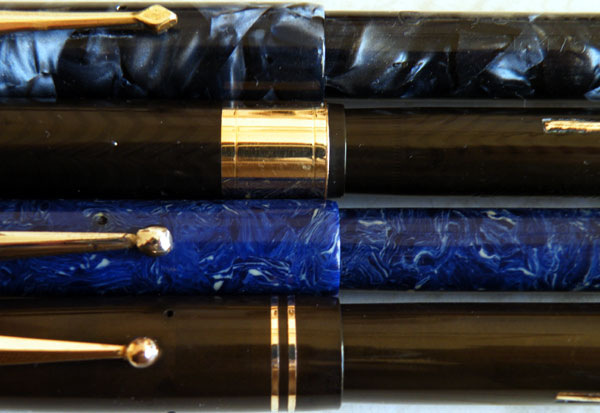
These are a black hard rubber Swan 3261 from the nineteen-forties, with a medium oblique stub nib, a blue marbled Conway Stewart 475, a No-Name Lapis Lazuli pen, and another Swan, a rather special SF2 with a broad gold cap band and cap end. So far, I’ve re-sacced them and given them a good clean-up. Next will come extensive write-testing, then photographing, followed by writing descriptions and listing. I hope to put them up for sale on Sunday.

It’s good to have a challenge again, to be using tools and returning pens to as close to their original condition as possible, both as writers and cosmetically.