The Swan Ladder Feed

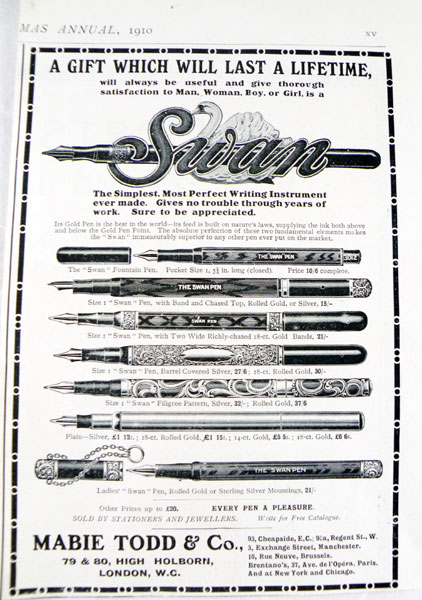
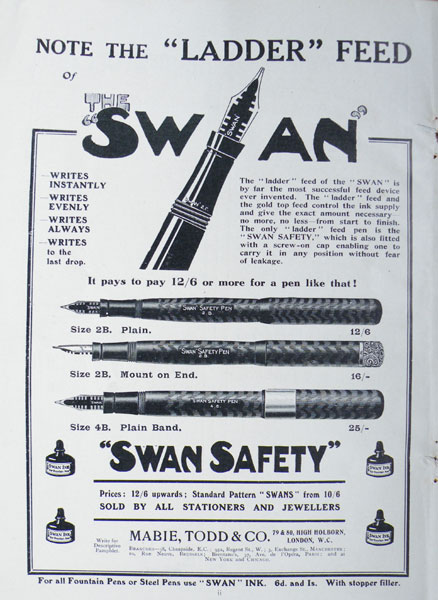
Advertisements are wonderful things. This one nails the introduction of the ladder feed for Swan pens at 1912. I have a suspicion that Mabie Todd continued to experiment with other feeds in Blackbirds for a time, but this was the date that Swans adopted the ladder feed which they retained right to the end.

It was only the year before, 1911, that Swan had brought out the Safety Screw Cap so it’s new enough to also be made a feature in this full page spread. Would you pay 12/6d (62 ½ pence) for a pen like that? I would, and indeed I’ve paid a great deal more on many occasions. Safety Screw Caps are wonderful pens, fully modern in every respect except the filling system – and who can say the eyedropper filler is outdated, with so many on the market today?

On the middle pen illustrated, you’ll see what Swan call the top-feed. Discussion still goes on around this short-lived feature which Swan and a few other manufacturers installed on their pens in those years. It isn’t a feed, exactly, because it doesn’t extend far enough through the section to reach the reservoir of ink in the barrel. Only the ladder feed does that. However, it may redirect some of the flow of ink once it reaches the nib. Another possibility is that it shields the gap between the tines from the air and delays drying out. It’s quite likely that the gold top-feed did these things, to some degree at least, but it was entirely unnecessary. Later models dispensed with it and performed just as well. The ladder feed itself delivered the ink to the nib beautifully without assistance.

Provided the appropriate feed was matched to the nib, Swan’s ladder feed was (and remains, of course) superior to the other types of feed around at the time and it continued to hold that lead for many years. Properly adjusted, broad, stub and even flexible Swan nibs don’t suffer from ink starvation as so many of their contemporaries do. Even into the forties and fifties when Sheaffer and Waterman developed deeply-cut multi-finned feeds to control ink flow, Swan stuck with their tried and tested ladder feed which remained the equal of of these innovations.


Swan Mystery Material

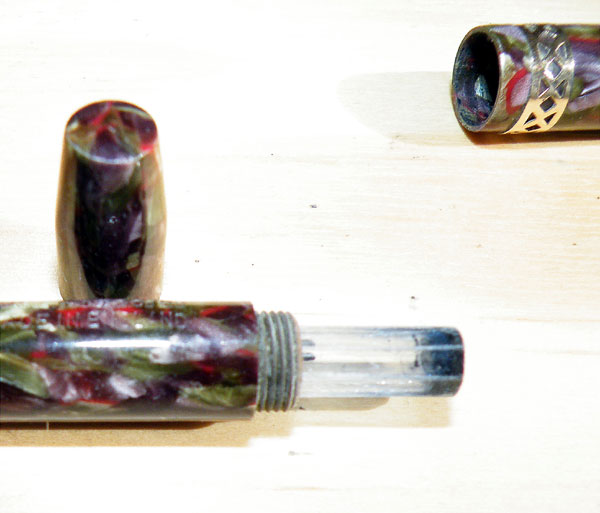
I had always assumed that all the colourful pre-war Swans were celluloid but it seems it is not so. I sent this pocket-size jade lever filler to Eric Wilson to have a crack in the cap lip celluloid welded. Eric gave it a try but, to his surprise, couldn’t because it’s not celluloid!

So what is it? At that date the most likely alternative would be casein. It may be casein but I’m by no means sure that it is. With the application of a little heat, casein gives off an unmistakable cheesy smell that indicates its origins. I hope none of the neighbours were looking in my kitchen window as I alternatively heated and sniffed the pen – they might have got the wrong idea! (Watch out for that Deb! She’s a pen sniffer, y’know…) Despite my best efforts, I could detect no dairy smells from the pen. It smelled of nothing, in fact.

The other test for casein is its reaction to water. I’m not going to dump this pen in a glass of water – that’s a test too far – but I’ve never seen a Swan pen with the craquelure that afflicts casein pens that have been exposed to a mixture of humid and dry conditions. Admittedly, some caseins are more resistant to this failure than others – Burnhams show it more than Conway Stewarts, for instance – but given the right – or wrong – conditions, all will show it to some degree.

If it’s not casein, and though I can’t be absolutely positive the indications are strong that it’s not, then what is it?

Mabie Todd Swan Leverless 4461

Here’s another big one, the Leverless 4661, pretty much the replacement for the Levereless 2060 which I wrote about here: http://wp.me/p17T6K-jZ .


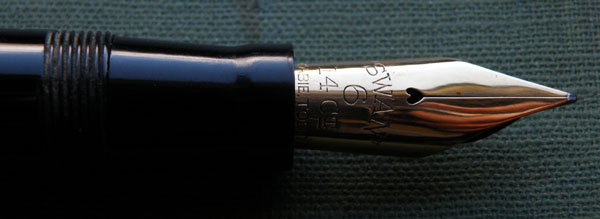
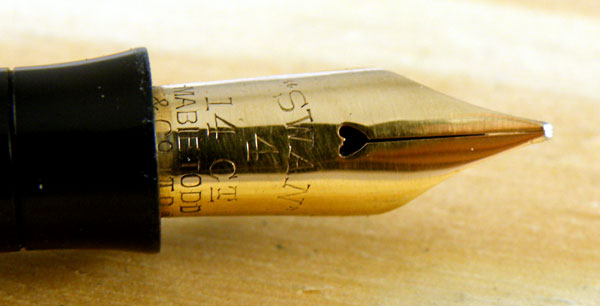
It doesn’t have the brass barrel threads, so I’m guessing that this one’s from 1950 or 1951. It’s a handsome black hard rubber pen. Though it’s substantial, it’s not exceptionally large at 14cm capped, so the huge No 6 nib is something of a surprise when you take the cap off. It’s a hunk of gold and makes a beautiful nib with its heart-shaped breather and deeply-incised engraving. Surprisingly, for such a big nib, it has an appreciable degree of flexibility.


These were interesting years for Swan. The company had gone public a couple of years before and in 1949 they’d finally managed to unveil their much-delayed new range of torpedo-shaped pens. Despite the depressed state of the post-war economy, these pens were selling like hot cakes. Who would have guessed that within another couple of years they would have been taken over by Biro Pens Ltd, a company which did not have the best interests of Mabie Todd’s fine heritage at heart, and who would initiate the rapid decline from this high point to the dissolution of Swan in a few short years.

Mabie Todd Swan SF300B

Mabie Todd introduced the Swan SF300B in 1929. It was one of only two pens the company brought out that year, the other being a mottled hard rubber Blackbird, so it seems to have been an attempt to plug a hole in the market.


At 12.7cm capped it’s a short pen, especially by the standards of the day, but it’s longer than you would expect a vest pocket pen or a ring-top to be and, indeed, it’s fitted with one of Swan’s classic gold-filled stepped clips. It isn’t a chopped-off version of one of the larger pens either; its parts are all in proportion. Though it has a No 3 nib, being a short pen with no cap band, it was doubtless aimed at a spot a little lower down the price range than some of their more prestigious pens.

It appears not to have caught on, though. The following year the Swan Minor range was brought out, aimed squarely at the same section of buyers. Though not quite rare, the SF300B isn’t commonly found nowadays. Doubtless it had a short run.


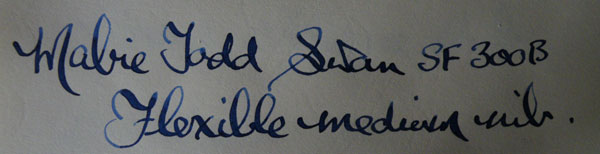
The SF300B may not have appealed to the pen-buying public of 1929 but it appeals to me. This example I have is without fault except for a very slight fading of the hard rubber. The gold plating shows only a little wear at the ball end of the clip and the chased pattern is crisp. The No 3 nib is fully flexible and slightly stubbish – perfect for my writing style. I’ve had a couple of these pens before and both were flexible, so the chances are good that they all are. They don’t appear all that often but if one does, grab it. The SF300B is a real writer’s delight.


An Undated Swan Ad

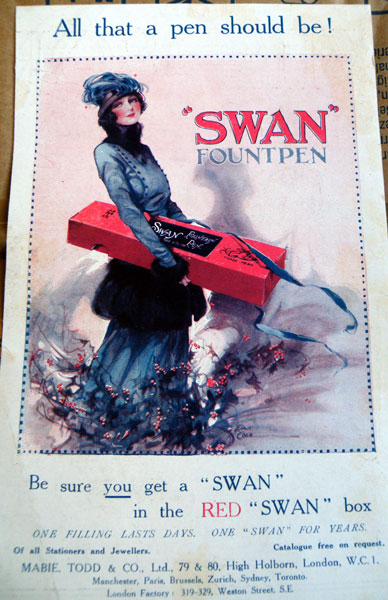
That’s a big pen in that box!

Not all the advertisements that come my way have a date on them. In this case, because there’s no actual pen in the advert., dating matters a little less. All the same, I would like to know, but I’m hopeless on dating fashions. However, overleaf there’s a picture of a woman in a cloche hat. Wikipedia, that refuge of the lazy and the none too critical, tells me the cloche hat was invented in 1908, became especially popular in the 1920s and continued to be worn until about 1933. Doesn’t exactly pinpoint it, does it?

A little bit of googling around tells me that though the 1920s was the period of the flappers and their short dresses, that was evening wear. Day time dresses were much longer – the hem at ankle level. Because of the swirl of holly around her feet, the Swan girl’s hemline isn’t really visible. Early 1920s, then?

It’s possible that it’s Edwardian, though. There’s no mention either of the Great War or of the period of recovery after it, as there is in Swan adverts of those times, so it’s fair to assume that if it’s not as late as the early twenties, it’s before the war.

I dunno. Maybe you do. I just wish the people I buy these things from would take note of the date of the magazines they cut them out of.

1910 Mabie Todd Ladies’ Swan

It was the proud boast of Mabie Todd & Co. in 1910 that a Swan pen was “a gift which will last a lifetime.”

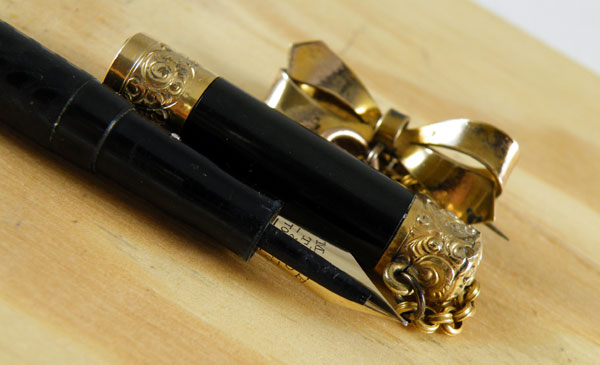
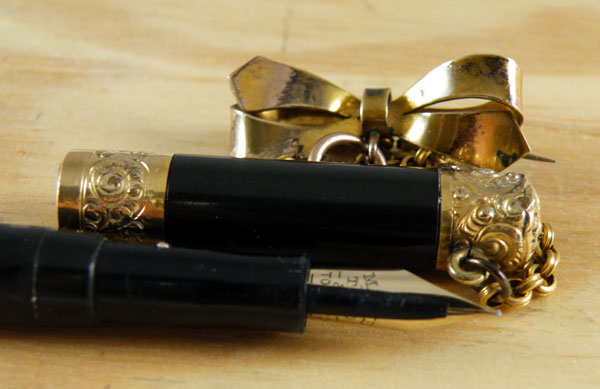
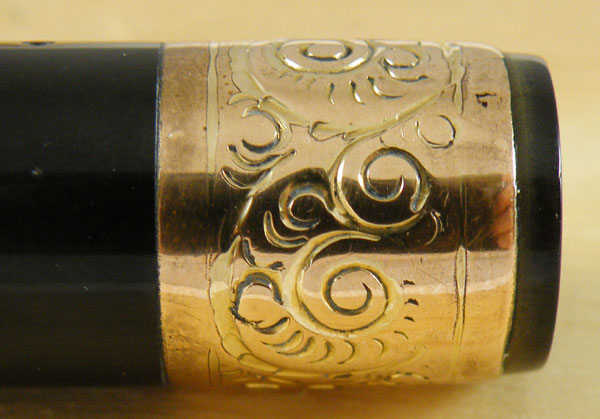
It has certainly proved to be the case with this Ladies’ “Swan” pen. The black hard rubber is still black and there’s little wear on the rolled gold. The chased pattern is crisp and fresh and the cap fits as firmly as when it was new. At 102 years old this pen is good for another century at least.


The design on the trim is called the Snail Pattern, I believe, and it was popular for overlays on pens. This is, of course, an eyedropper filler with an over-and-under feed. The bow-shaped brooch by which the pen would be pinned to its owner’s blouse is an after-market add-on which didn’t have quite as good plating.


There are various ready reckoners that you can use to compare prices of earlier years with today. It doesn’t do to place too much trust in them. Not everything rises in price at the same rate and these tables are by necessity a compromise. Nonetheless, they can give us some guidance in comparing the cost in 1910 and today. According to one, a 1910 pound is worth £67.99 today, and a shilling then is worth £3.40 now, so you could buy our 1910 guinea pen for £71.39 today. That’s hogwash, of course. A pen of this quality and trim would cost a lot more today, but that’s partly because we no longer have the economies of scale that existed when fountain pens were the primary writing instrument.


I’m going to pin this fine pen to my blouse, attach a bunch of keys to my waist and be La Chatelaine – for tonight, at least.

Mabie Todd Swan Leverless L470/60

Perhaps you may have come across a Swan Leverless like this before, but it’s new to me. It’s an L470/60, and a strange beast it is in a variety of ways. First, it should be said that this is not a clipless pen. It should have a washer clip but it came to me without one and I don’t have one of this size. It’s quite short at 12.7cm capped but it’s stout: the cap diameter is 1.1cm. The cap band is hallmarked and signed MT Ltd. Reading the hallmark as best I can (I’m not very good at it!) I take the date to be 1935, which would go with the style of the pen.


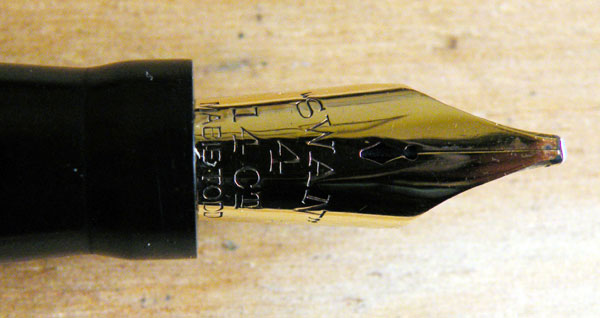
The most surprising thing is the No 4 nib, which has a keyhole breather. I’ve never seen one of those on a Swan.


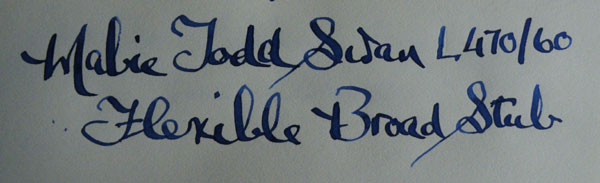
The nib is a flexible broad stub with a touch of oblique – in real life it looks less oblique than in the photo. The line variation that can be achieved by a combination of the stub shape of the nib and making use of the flex is outstanding. I used very little pressure in making this writing sample. The variation is best seen on the ‘b’ of Mabie or the ‘S’ of Stub.


Altogether a quite remarkable pen!

Mabie Todd Swan Visofil V111/59

The Swan Visofil was introduced in a fanfare of publicity in 1937 and it was clearly seen by the company as a major part of their future but it was not to be. Visofil production was a casualty of the Blitz, so far as I can tell, but it is instructive that whereas the company moved heaven and earth to reintroduce the Leverless and Self Fillers, the Visofil never reappeared. That may have been the government’s decision. They took control of wartime production and, across the industry, the emphasis was on fewer and more simple models. It may also be, though, that Mabie Todd were not entirely grief-stricken at the necessity to drop a model that was expensive to produce, fairly fragile, and had not reached sales expectations.

Comparatively uncommon now, the Visofil is eagerly sought after by collectors, and small wonder. When restored, it’s an excellent filling system, the pen comes in some of Mabie Todd’s most beautiful colours and the trim is decorative.


This is the smaller purse or vest pocket version in Italian Marble, a V111/59, I believe. It’s a wonderful colour mixture and unique to Mabie Todd, so far as I know. As well as in their prestige Visofil models, they used this colour, and some of the other Visofil patterns, in their low-cost Jackdaw school pens. The No1 nib is an oblique stub with some flexibility.


My thanks to Eric Wilson for restoring this pen.

Mabie Todd Swan Safety Screw Cap No 5

Pen companies are happy to announce their new models, but they neglect to tell us when they stopped making a particular model, darn them! So it is with some confidence that I say that Mabie Todd brought in the Swan Safety Cap range in 1911, but it’s a more shaky guess that they ceased production in 1920. That was the year they introduced lever fillers, making the Swan SSC obsolete. However, I expect they remained on sale in shops for a time after that.   When the Safety Screw Cap was launched, Mabie Todd made much of the the screw-on cap which was intended to stop the pen leaking into your pocket. Advertisements also drew attention to the ladder feed, an innovation which the company kept until the end, and to the gold bar over the centre-line of the nib which delayed drying out.    This pen, I believe, is one of the later ones, made after they stopped installing the gold bar over the nib. It’s a No 5, and while it retains all the features of the smaller Safety Screw Caps, it’s an altogether more chunky pen. While still quite long posted, it doesn’t share the long slender proportions of, say, the Safety Screw Cap No 2. Indeed its length both posted and capped is much more like a modern pen. Quite worn by long use, the pen now shows little sign of chasing and the barrel imprint has almost gone. The decorated cap band still looks good despite obvious signs of plating loss. The large nib is a No 4. One might expect a No 5 pen to have a No 5 nib, though I can’t be certain that this was the case. The No 4 nib may well be a replacement, but it’s in proportion with the rest of the pen and it looks good there. It’s a semi-flexible medium. 

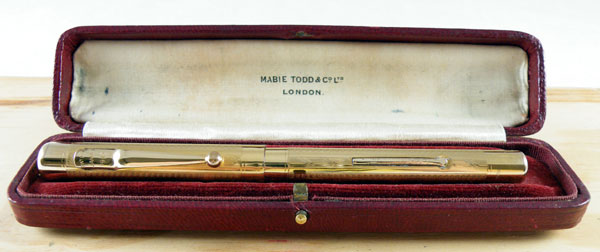
A Boxed Mabie Todd Swan Overlay

The one thing that the UK arm of Mabie Todd shied away from for a very long time was making overlay pens. So far as I’m aware, no overlays were made in Britain before World War II. Overlays were always a small part of pen production and it probably made economic sense to share one facility for their production.

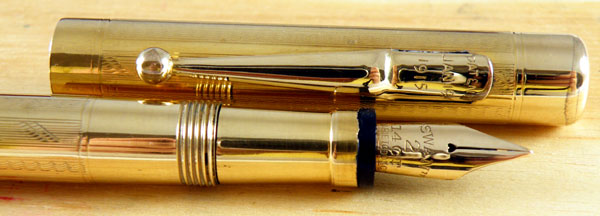
I don’t know whether this was a pen produced in America purely for the British market, or whether it was also on sale in the USA. These pens are not rare, though they’re moderately uncommon, and they turn up not all that infrequently in either clipped or clipless versions. Here’s a similar one with no clip and a different engine-turned pattern: http://wp.me/p17T6K-b5


Without a little more information, dating these pens with any exactitude is impossible. Any time between 1920 and 1930 will do, and even a year or two after 1930 doesn’t seem to me to be impossible.

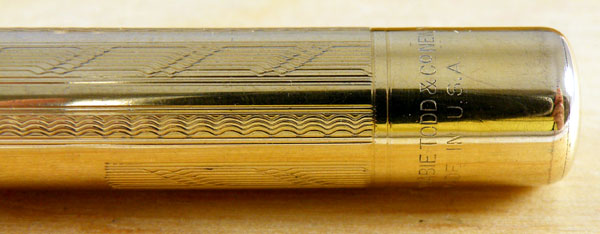
Is there a pattern-book for engine-turning somewhere? It would be nice to put a name to this pattern but it’s beyond me. The pen’s not quite perfect; there’s slight plating loss at top and bottom and on the ball of the clip. There’s also a tiny area of loss where the exposed edge of the section meets the plating, a common area for attack by the harsher inks of long ago. That said, in its red leather (or probably leatherette) box it’s a real stunner.

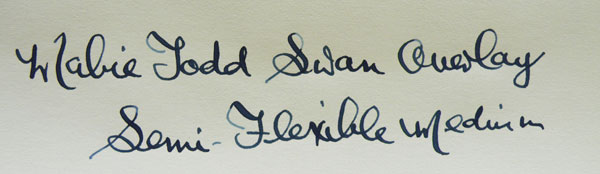
My guess would be that under the gold lies a Swan Minor No2, one of the most deservedly popular pens of its day. As always, it writes beautifully.