The John Bull Eyedropper Pen

IMGP0425

The John Bull Pen Company had premises at 77 Long Acre, Covent Garden, London.  It seems impossible now to tell what was done there, though I have heard it said that the pens were assembled there, from parts made by other manufacturers.  Which manufacturers remain a mystery.    John Bull pens have been associated at different times with Conway Stewart and De La Rue; it’s likely that most of the major manufacturers had the contract at one time or another.  Though never a major manufacturer themselves, John Bull was well known from its lively advertising, both for John Bull pens and Bulldog pens.  The latter image, of a bulldog wearing a top hat and a monocle, with a pen in its mouth, has been often reproduced.

IMGP0427

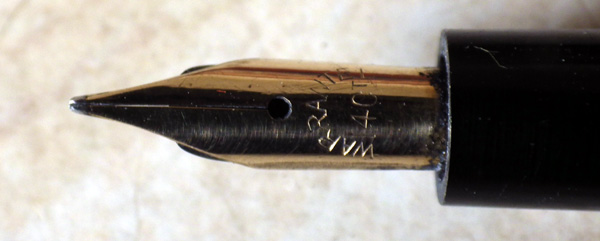
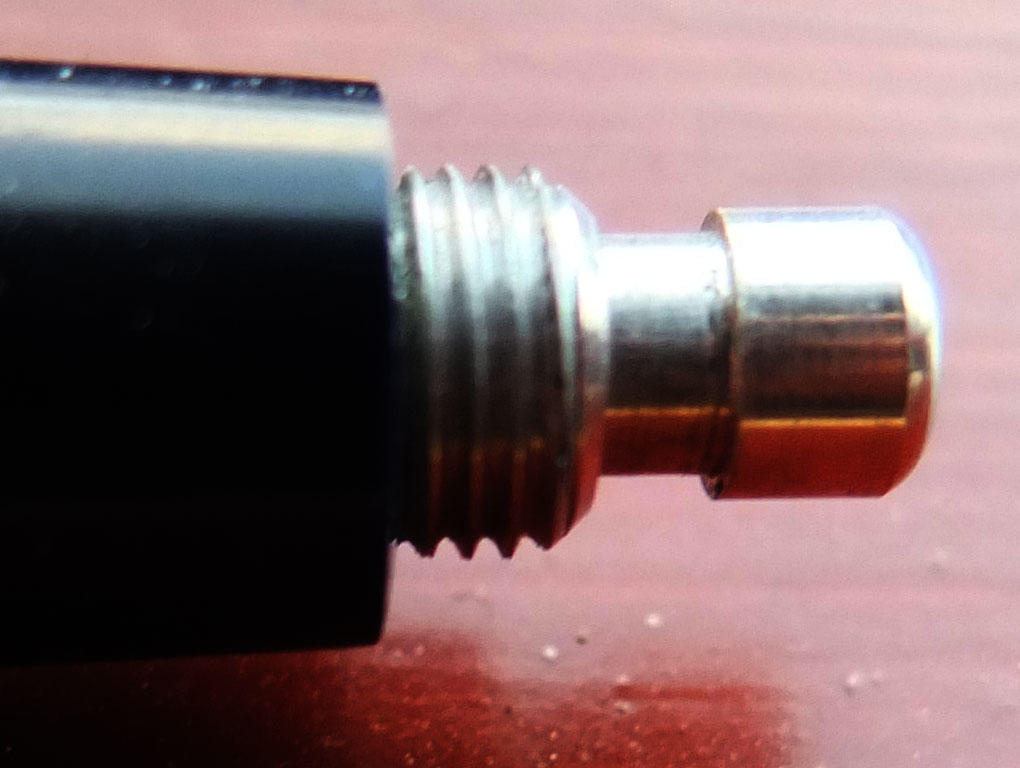
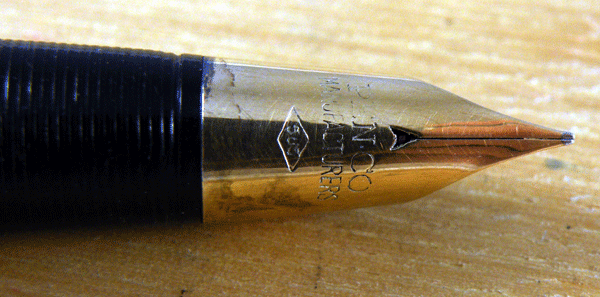
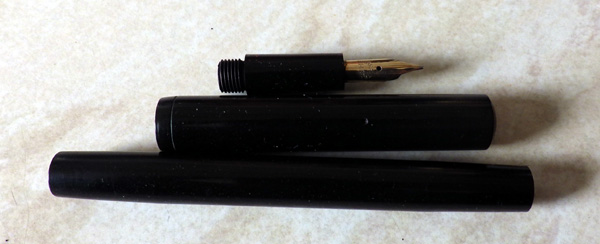
This is an early example of the company’s output, a cone-cap eyedropper filler.  Cone caps require some precision in machining to work properly, and this is a very well made pen of a simple design.  It’s probably pre-World War I.  The smooth hard rubber has retained its original blackness.  Though quite small, the nib has some flexibility, as was usually the case at that date.  The barrel and section threads are excellent and the pen holds ink without leaking.
IMGP0428

IMGP0430

John Bull pens were very variable in quality.  Some, like this one, are excellent pens, others leave something to be desired.  Nevertheless, the company survived at least until the Second World War, perhaps longer.  Why, when other middling quality producers fell by the wayside did this company survive?  Part of the answer may lie in the name and image they chose for themselves.  John Bull is the personification of England and a patriotic symbol, as is the subsidiary brand, the Bulldog pen.

IMGP0432

Had the company maintained the high quality of this pen, they would have had good sales on the basis of customer satisfaction.  Some, at least, of their later production was rather more shoddy and traded on the patriotic appeal.

Kaweco Sport

DSCF2025

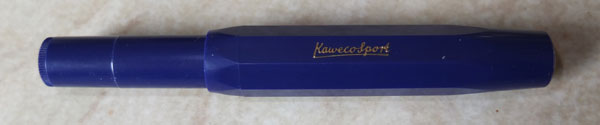
As you may have noticed I seldom buy modern pens.  Not my thing, really, but I had a bundle of small international cartridges that came in a lot I bought some time ago and I wanted an inexpensive pen to use them up.  I didn’t really consider any of the Chinese pens.  They haven’t worked out for me – metal sections and brass barrels make no sense to someone whose usual pens are Swans and Conway Stewarts.  I’ve had earlier piston fill versions of the Kaweco Sport with gold nibs and I knew that the current classic Sport isn’t as well featured as they were, but I like the idea of the long-short pen.

DSCF2027

I bought mine from Amazon and it came directly from Germany.  Postage included, it was around £20.00.  I opted for the broad and that’s what I got but it isn’t all that broad.  More of a generous medium, I feel.  That’s not a complaint, really.  The nib width is good.  I’m pleased with it.  The pen weighs practically nothing, which is how I like them and it does what it’s meant to do.  The threads, both cap and section, are good.  There’s no clip but I wasn’t going to be carrying it anyway and the octagonal cap keeps it from rolling off the desk.  The plated nib has a few curlicues on it as they all do nowadays, but it also reminds us that Kaweco has been around since 1883.  There’s a little gilded disc with “Kaweco” on it on the top of the cap, and “Made In Germany” is on the bottom of the barrel.

DSCF2029

In use it’s long enough posted, the ink flow’s great out of the box and I’m very pleased with it.  Great little pen.  Everybody should have one.

DSCF2014

My assistant doesn’t work on Saturdays.

DSCF2018

She’s not very keen on having her photograph taken either.

The Dickinson Croxley Button Filler

Dickinson Croxley had a short life (1947 – 1949) but, judging by the number of their pens out there, a very successful one.  I’ve heard it said that because of their outdated styling and the absence of an alternative filling system (Croxleys are generally lever fillers) there was no future for the brand and Dickinson wound it up.

This has never struck me as being a satisfactory explanation of the demise of the company.  After all, Conway Stewart got another couple of decades out of the lever filling system.  Moreover, in 1948 Croxley made a streamlined pen that broke away from the admittedly staid line of their previous production.
DSCF1972
As if that wasn’t enough, here’s a Croxley button-filler with a metal cap, in a very modern style for 1948.  It seems that Croxley’s designers had a good look at what was happening in the rest of the market before they came out with this pen.  The clip’s fitting is similar to what Conway Stewart were doing, but simpler and better.  The shallow-cowled washer clip is held by a plastic stud that has a slot for a normal screwdriver on the inside end. No aluminium nut or spanning screwdriver! DSCF1985

The beautifully machined button and its housing bear a debt of gratitude to the Parker Duofold AF which was introduced in the same year.  The pen caps with a Parker-like clutch.  Taken all in all, this remarkable pen is evidence that whatever other reason there was for Dickinson to bring an end to the Croxley range of pens, lack of new ideas wasn’t the cause.

The one failing that mars this otherwise pristine pen are plier marks on the section, evidence of the drooling cretin at work once more.  Thankfully they are shallow and relatively unobtrusive, as I am prevented from minimising them further by the ribbing on the section.
DSCF1974
This example was produced, probably as a giveaway for members, for the Manchester Unity Of Odd Fellows.  You will know, of course, that the Odd Fellows were a benevolent society whose origins are lost in the depths of time, and also that the Manchester Unity broke away from the parent body in 1810 to become a most effective and innovative Friendly Society, providing such benefits for its members as health care provision in pre-National Health Service times.  I think they’re still around but they’re not getting their pen back!

DSCF1976

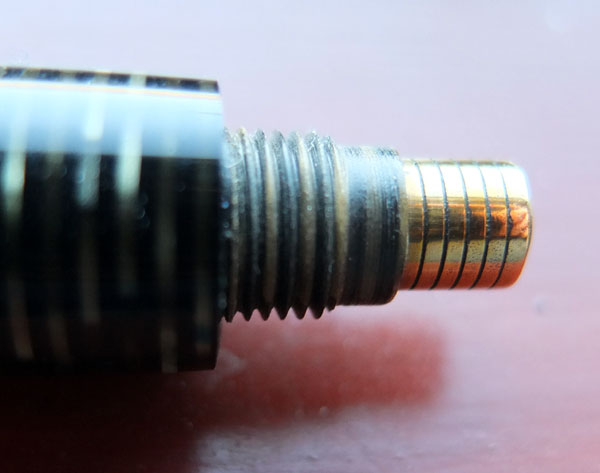
The Stabil Junior Button Filler

DSCF0931

This very beautiful pen is the Stabil Junior.  For comparison, it’s the same size as an English Parker Duofold Aerometric, so the “Junior” title doesn’t imply small size, except in comparison with the senior-sized Stabil, which is a distinctly over-sized pen.

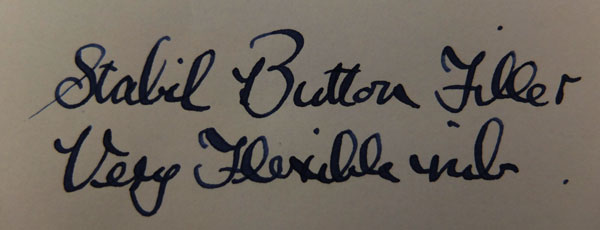
The plastic appears to share an origin – or at least a concept – with the Parker Vacumatic.  It’s fairly generally Parkerish, even to the button which is reminiscent of the Duofold AF.  The major difference is the nib which is supremely flexible.  The feed, too, is unlike anything else I’ve seen and is capable of keeping up with demands of the flex nib.  It’s a very high quality pen with a solid feel in the hand.  The threads are deeply and well cut and the gold plating remains very good.

DSCF0933

DSCF0932

If you try to research Stabil, you’ll find that it isn’t an especially well-known company.  Some say it’s German, others that it’s Hungarian but I prefer the explanation that it’s a Belgian company, established by Chaim Jukubowicz in 1938 and remaining in business until 1974.  The company appears to have made much of its income as an importer of Sheaffer pens while manufacturing quite small quantities of its own pens.  The nib fitted to this pen, with its bison imprint, is a German Nichroma – a sub-brand of Penol.  I don’t know if it’s original but it seems quite likely that it is.

DSCF0937

DSCF0928

This interesting pen may have been the product of a small company, but in terms of quality it’s the equal of anything else that was on the market at the time.

DSCF0939

The Majestic Pen

It’s not easy to research “The Majestic pen” on Google or any of its lesser brethren. The first hundred or so responses relate to a modern Majestic kit pen which is no way helpful. Eventually, after enough digging that you’re hearing Australian accents, you find that there was a late twenties Majestic pen, a sub-brand of Wyvern. That’s what I thought this was when I bought it due to an attack of the stoopids .
DSCF0618
That’s not what it is, of course, it’s an entirely unrelated American Majestic pen. By the late twenties, J. Harris & Son, manufacturer of black hard rubber pens, had become the The Majestic Pen Company, which turned out a multitude of colourful and inexpensive pens. Most have plated nibs; the best, like this one, have warranted 14K nibs. They made combos too.

So, it’s essentially a low-quality pen, what Americans tend to think of as third tier. By time I’d removed a few decades-worth of grunge, the plating on the trim was pretty well gone, but on the other hand, that astonishingly bright and lovely striated red shone out. What is that? Crimson? Ruby? I don’t know but whatever it is it will catch your eye across the room.

DSCF0620

The celluloid has survived about 80 years without distortion and the pen has an ink-view section that came clean and transparent. It may not be a Parker or a Sheaffer, but I think stylish, durable, low-cost pens like this one are well worthy of our attention too.

The Jewel Oma

DSCF0086


I’ve written in more general terms about that old-established firm, The Jewel Pen Company, back here http://wp.me/p17T6K-lE. In 1913 Jewel bought the Alliance Pen Company which may have provided them with manufacturing facilities that they did not have before. In the following year they increased their production capability further by acquiring George Shand Ltd. New Jewel models followed: safety retractables, new stylos and in 1921 their first lever filler.

DSCF0095

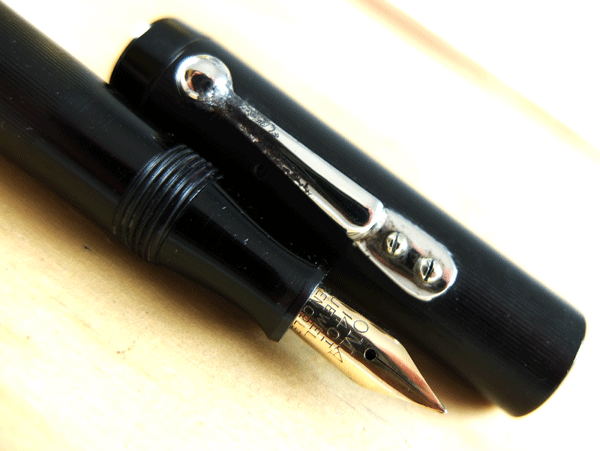
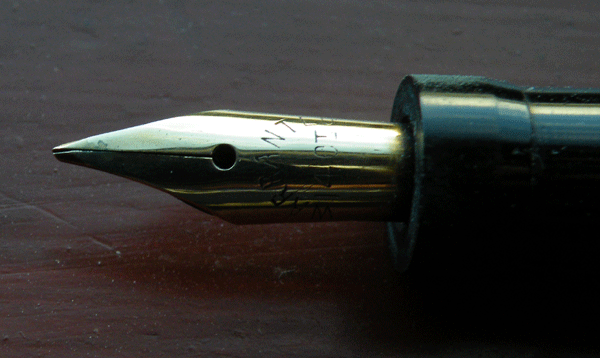
The Oma appeared in 1922, described both as a lever-filler and a safety screw cap. Though this example now shows some corrosion on the lever and clip, it’s a sound and appealing pen. The flat-top style with a slight taper at the barrel end is very much of its period, but the chased pattern of very fine lines is less often seen. Unusually, the clip is fixed with tiny screws. The pen has the original 14ct Oma nib.

DSCF0096

I’ve puzzled over the name “Oma” without coming to any conclusion. To those of German or Dutch ancestry, “Oma” is “grandmother” but in this context it seems unlikely that this was meaning intended. Perhaps, like “Onoto”, it’s a meaningless but easily remembered word that Jewel hoped would catch on. It appears not to have done so, because despite its durability, the Oma is a great rarity today.

The Forward 45 Lever Filler

DSCF9468

Spicer Bros. Ltd. of London was a pen manufacturer which existed from 1917 to 1926*. They made stylos, the Tudor pen, the Kingscote pen and this one, the Forward Pen. Made from black chased hard rubber, the Forward 45 is a large pen at 13.8cm capped. It reminds me of the the Mabie Todd Blackbird BB2/60 in its size, shape and long filler lever.

DSCF9473

The warranted nib is about the size of a Swan No 1 but it’s dwarfed by the pen. A clipless pen, it has been fitted with a rather unusual accommodation clip. It’s a decent pen, and it would be interesting to see the other pens this company made, especially the Kingscote which carried a 6 months supply of ink tablets in the cap*. All are unfortunately rare now.

DSCF9470

Excuse the quality of the pictures which were taken quickly with flash rather than with a full light-box setup.

With the exception of a very few, all the pictures in this blog were taken with my trusty old Fujifilm S8100fd. It took thousands of fountain pen pictures for the blog, eBay, my sales site and the pen discussion boards, as well as the use it got on our travels. It was the perfect camera for close work and it never gave me a single problem until yesterday. After taking these Forward photos it failed in a very final way. I’m sorry to lose it but it certainly didn’t owe me anything!

Fujis have, over the years, served me better than Canons or Nikons and I plan to stick with them. After looking into the best macro cameras around at the moment, I settled on a Fujifilm X 10 and that should arrive in a day or two.

*Stephen Hull, The English Fountain Pen Industry 1875 – 1975.

The Pento “Truda”

DSCF9439

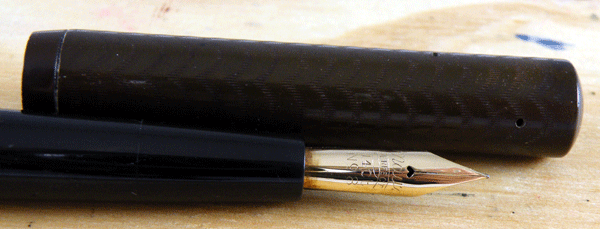
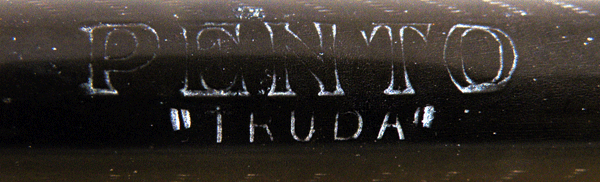
This one is quite a rarity – a Pento “Truda” eyedropper, made by W.J. May & Co Ltd of May pen Works, East Twickenham, London. The company had a short life, from 1923 to 1928 when it failed. It’s probably most famous for the Pento Capless but it made more conventional eyedroppers and lever fillers as well.

DSCF9440

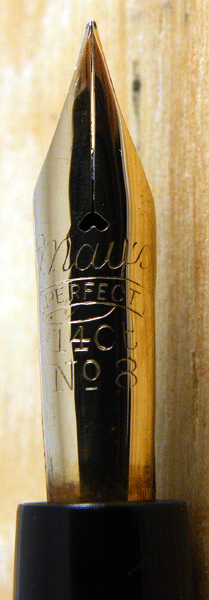
This example, probably one of their earliest pens, is a straightforward eyedropper filler in black chased hard rubber with a slip cap. Perhaps its most eye-catching feature is the splendid May’sPerfect No 8 nib. If quality were all that it takes for a company to survive, Pento would be with us yet, because this is a very well-made pen. A combination of low investment and development costs of a new and complex pen seem to have been the cause of the company’s demise. DSCF9443

The “Truda” (I wonder what that meant, if anything) is a memento of a briefly-lived early pen company, but it is more than that. It’s an excellent pen that suggests what we may have lost in future models through the company’s untimely end.

DSCF9436

A Candy-Striped Kingswood

DSCF8995

Most fountain pen manufacturers had the candy stripe pattern in their range at one time or another, and looking at this Eversharp Kingswood you can see why. It’s just such a beautiful pattern. In some cases, like the Onoto, candy stripe can be translucent but even when it’s not you’d almost swear the light shines through it. This one has a little discolouration, whether darkening of the cap or yellowing of the barrel I cannot say with certainty. It can go either way. A decaying sac in the barrel can change the colour but so can outgassing of the BHR inner cap. Even ink trapped behind the inner cap can do it. It’s not too bad in this case. It’s still a very attractive pen.

At first glance I thought that the clip was a replacement. It looks big and clunky and doesn’t seem to suit the pen all that well. I checked it against Simon’s collection (http://wp.me/p17T6K-uG) and, sure enough, his candy stripes had the same over-large-looking clip, so it’s original.

These are the Kingswoods I have always assumed were made by Valentine. I’ve seen Valentines – and Parkers too – made from this material, and if you discount such details as the clip and nib, the pens are very alike.

Penco No 53B

It’s not often I get my hands on a high-quality Italian pen and I think I only got this one because no-one else knew what it was when it was listed on eBay. I watched it for several days, expecting the price to take off but it never did and mine was the first and only bid.

The Penco name was adopted by the Rossi Brothers in 1952 after a couple of decades as FRV. It was a period in which English or English sounding names went down well in Europe. This pen was their much-advertised No 53. The resemblance to a Triumph-nibbed Sheaffer is obvious and clearly no accident. It’s a copy but it’s also something more; the Rossi brothers admired the Sheaffer Balance and had the confidence to believe that they could produce something even better. The 53 is the result. The filling system with which this pen was fitted when first issued was quite complicated and bore some resemblance to Parker’s Vacumatic. Between 1953 and 1954 the first version was replaced by the 35B which had a version of the Touchdown filler. That’s the pen I have here. All in all, this was beginning to look very like an infringement of Sheaffer’s patents and legal action was threatened. In response, the pen was fitted with a piston filling system, but this was not enough for Sheaffer and in the face of expensive legal proceedings the Rossi Brothers withdrew the pen and, indeed, the company didn’t survive much longer.

So how do you classify this pen? Given the build quality it’s far from being a cheap knock-off. There was no suggestion that this pen was a Sheaffer, so it isn’t a forgery. It is, in a sense, an homage and there can be no doubt that it’s a copy, too. So what’s the difference between this pen and all the – for instance – Duofold copies that appeared under a variety of names in the twenties and thirties? Not much, one might say, except that perhaps the concept of the Duofold was less unique and identifiable than that of the Sheaffer Balance 1000. Also, Sheaffer was renowned for being hair-trigger litigious.

It’s a curiosity for the use of three filling systems in the short period of its production. It’s also notable as the height of cheek, but it’s also a superbly well-made pen.


Thanks to Abrate G. (2004) Article 416, Pentrace.